
Introduction : Le rôle critique de l'usinage de précision dans les articulations robotiques
Le mouvement fluide et sans à-coups d'un bras robotisé effectuant un assemblage complexe ou d'un robot chirurgical réalisant une procédure délicate est une merveille de l'ingénierie moderne. Cette capacité repose sur un élément unique et critique : la précision de ses articulations. Les articulations robotiques sont les pivots mécaniques dont dépendent toute la fonctionnalité, la précision et la fiabilité d'un robot. Toute imperfection dans ces composants — un micron de désalignement, une fraction de degré d'erreur — peut se répercuter en défaillances de performance importantes, allant d'une précision de positionnement réduite à une usure mécanique catastrophique. C'est ici que l'usinage des articulations robotiques passe d'une étape de fabrication à une discipline fondamentale. C'est le processus spécialisé de création de géométries complexes à haute tolérance qui permettent aux systèmes robotiques de se déplacer avec l'exactitude exigée par les applications autonomes actuelles. Alors que le marché de la robotique connaît une forte croissance, avec un TCAC projeté de 15,2%, la demande pour une telle précision n'a jamais été aussi élevée, faisant de l'usinage avancé non seulement un avantage mais une nécessité absolue pour l'innovation et la fiabilité.
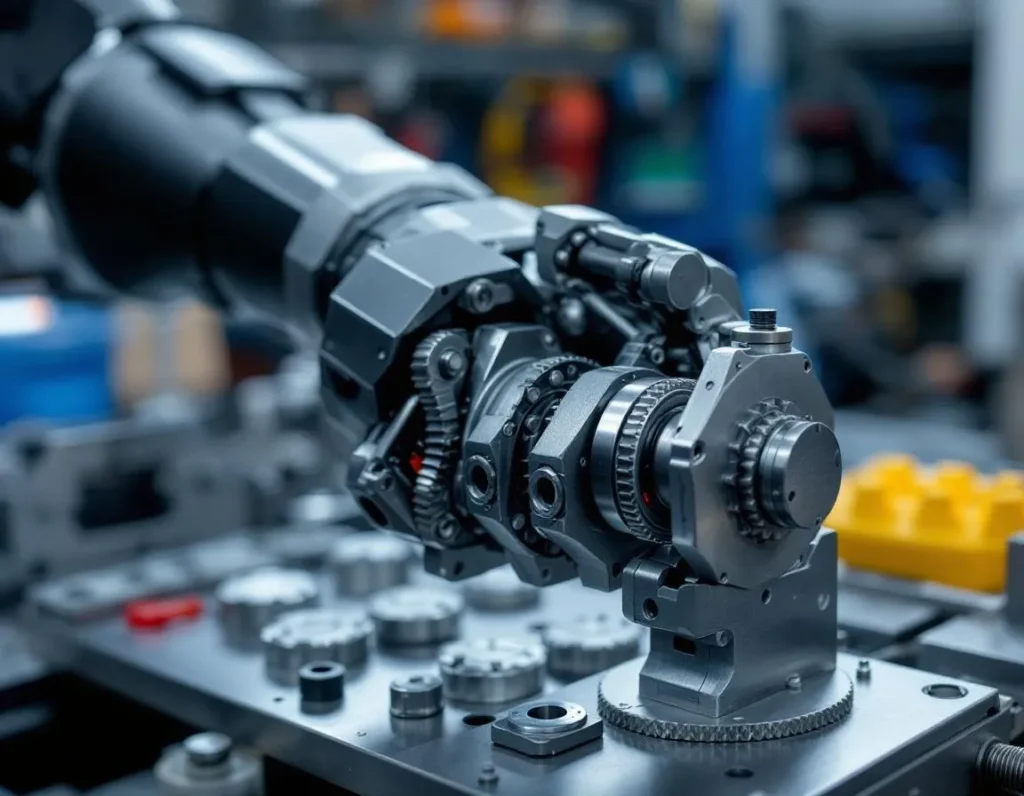
Qu'est-ce que l'usinage des articulations robotiques ? Définition du processus et de son importance
L'usinage des articulations robotiques est un sous-ensemble de la fabrication de précision axé exclusivement sur la fabrication des composants interconnectés qui constituent les points d'articulation d'un robot. Il s'agit bien plus que de simplement couper du métal ; c'est un processus d'ingénierie intégré qui combine une technologie avancée de commande numérique par ordinateur (CNC) avec une science approfondie des matériaux et un contrôle qualité rigoureux pour produire des pièces répondant à des spécifications extrêmes. Le processus commence par un modèle 3D numérique du composant d'articulation, qui est traduit en instructions machine (code G) guidant des outils de coupe multi-axes. Ces outils sculptent la matière première — des blocs d'aluminium, de titane ou d'alliages spécialisés — en pièces finies avec des géométries qui incluent souvent des canaux complexes pour le câblage, des trous de montage précisément positionnés pour les capteurs et les actionneurs, et des surfaces de roulement finies à une douceur semblable à un miroir.
L'importance de cet usinage spécialisé ne saurait être surestimée. Dans un système robotique, les articulations sont responsables de la conversion de la force de rotation d'un moteur en un mouvement contrôlé et multidirectionnel. Le processus d'usinage détermine directement l'intégrité structurelle de l'articulation, ses caractéristiques de frottement, son poids et sa capacité à maintenir l'alignement sous charge. Un engrenage mal usiné dans une articulation introduira un jeu, provoquant le tremblement ou la dérive de l'effecteur terminal du robot. Un logement de roulement alésé de manière imprécise entraînera une usure prématurée et un grippage éventuel. Par conséquent, l'usinage des articulations robotiques est le pont critique entre la conception numérique d'un robot et sa capacité physique. Il garantit que la plage de mouvement théorique et la capacité de charge utile conçues sur un ordinateur sont pleinement réalisées dans un composant mécanique durable et fiable, permettant aux robots d'effectuer des tâches répétitives et à enjeux élevés avec une constance inébranlable.
L'anatomie d'une articulation robotique : composants clés et leurs fonctions
Pour comprendre les défis d'usinage, il faut d'abord comprendre l'anatomie mécanique d'une articulation robotique typique. C'est un assemblage sophistiqué où des pièces usinées avec précision fonctionnent de concert.
Boîtier/Corps
C'est l'enveloppe structurelle qui contient et protège les mécanismes internes. Usiné à partir d'une seule pièce de métal pour une rigidité maximale, il comporte des alésages et des faces précisément positionnés sur lesquels sont montés les roulements, les joints et les segments de bras adjacents. Sa géométrie doit garantir un alignement parfait de tous les composants internes.
Engrenages et éléments de transmission
Ce sont le cœur de la transmission du mouvement. Des engrenages de haute précision — tels que les types planétaires, harmoniques ou cycloïdaux — réduisent la vitesse élevée du moteur en un couple élevé à la sortie de l'articulation. Chaque profil de dent d'engrenage doit être usiné selon des normes rigoureuses afin de minimiser le frottement, le bruit et la perte d'énergie. Les cannelures, les arbres et les accouplements sont également des éléments usinés critiques au sein de la transmission.
Roulements et bagues
Ces composants facilitent une rotation ou un mouvement linéaire fluide tout en supportant des charges radiales et axiales. Leurs surfaces de montage sur les carters et les arbres doivent être usinées avec des tolérances extrêmement serrées et des états de surface supérieurs afin d'éviter tout désalignement, qui réduirait considérablement la durée de vie des roulements et introduirait du jeu.
Supports de capteurs et points d'intégration
Les articulations modernes sont équipées de nombreux dispositifs de retour d'information tels que des encodeurs, des résolveurs et des capteurs de couple. Les caractéristiques usinées comprennent des supports de montage délicats, des trous précisément indexés pour l'alignement des capteurs et des passages internes pour les faisceaux de câblage. La précision de ces caractéristiques usinées influe directement sur la qualité des données de retour qui contrôlent l'articulation.
Chacun de ces composants est interdépendant. Le plafond de performance de l'ensemble de l'articulation est défini par la précision de sa pièce usinée la moins précise, ce qui rend un usinage global à haute tolérance de tous les composants non négociable.
Types d'articulations robotiques et leurs exigences d'usinage
Les robots utilisent différents types d'articulations pour obtenir diverses amplitudes de mouvement, chacune présentant des exigences d'usinage uniques. Les deux catégories principales sont les articulations rotatives et linéaires, avec plusieurs variantes spécialisées.
Articulations rotoïdes (rotatives)
Il s'agit de l'articulation la plus courante dans les bras robotisés articulés, fonctionnant comme un coude ou un genou humain, permettant un mouvement de rotation autour d'un seul axe. L'attention en usinage porte ici sur les composants qui permettent une rotation pure et sans vacillement. Le carter doit présenter des alésages coaxiaux de diamètre identique et une circularité parfaite pour recevoir les roulements. L'arbre de sortie ou le flasque doit être usiné avec un haut degré de concentricité par rapport à son axe de rotation. Les engrenages à l'intérieur d'une articulation rotoïde exigent une constance exceptionnelle dent à dent pour garantir un transfert de puissance fluide sans erreur périodique ni vibration.
Articulations prismatiques (linéaires)
Ces articulations assurent un mouvement de glissement linéaire, semblable à un télescope ou à une glissière de tiroir, et sont courantes dans les robots portiques et les pinces robotisées. Les principaux composants usinés comprennent de longs rails ou arbres de guidage droits et des patins de roulement correspondants (douilles linéaires ou écrous à billes). Le principal défi d'usinage consiste à obtenir une rectitude et un état de surface exceptionnels sur toute la longueur du rail. Toute déviation ou rugosité provoquera un mouvement saccadé (stick-slip), réduisant la précision de positionnement et la répétabilité. Le parallélisme entre plusieurs rails sur le même axe est également critique.
Articulations sphériques et à cardan
Les articulations sphériques permettent une rotation autour de plusieurs axes (comme une hanche humaine), tandis que les joints de cardan (joints universels) transmettent la rotation entre des arbres désalignés. Ils impliquent des surfaces d'appui complexes à angles multiples et des géométries de chapes ou d'emboîtements complexes. Leur usinage nécessite des capacités CNC 5 axes avancées pour usiner les courbes composées et les alésages sécants sous plusieurs angles en une seule prise, garantissant que toutes les surfaces mobiles sont parfaitement appariées.
Articulations cylindriques et planes
Une articulation cylindrique combine rotation et glissement linéaire le long du même axe. Cela exige d'usiner à la fois des surfaces de roulement rotatives et des surfaces de guidage linéaire sur le même composant, ce qui nécessite un séquençage soigneux des opérations. Les articulations planes permettent un mouvement selon deux axes linéaires perpendiculaires (comme une table XY). Ici, l'exigence d'usinage redouble d'importance en matière de planéité, de parallélisme et de perpendicularité sur de grandes plaques de surface et les composants correspondants qui glissent dessus.
Each joint type dictates a specific machining strategy. A revolute joint prioritizes concentricity and gear quality. A prismatic joint demands supreme straightness. A spherical joint necessitates multi-axis contouring. The common thread across all types is the uncompromising need for dimensional accuracy, geometric perfection, and surface integrity—requirements that are met through the capabilities of modern CNC machining centers, which we will explore in the next section.
CNC Machining: The Core Technology for Precision Robotic Components
As the specific requirements of each joint type make clear, the manufacturing process must be capable of translating intricate digital designs into flawless physical parts. This is where Computer Numerical Control (CNC) machining establishes itself as the indispensable core technology. CNC machining is a subtractive manufacturing process where pre-programmed computer software dictates the movement of factory tools and machinery. This digital control enables the production of three-dimensional parts from solid blocks of material with a level of precision, repeatability, and complexity that is unattainable with manual machining.
For robotic joints, this precision is non-negotiable. The interplay between a gear and a pinion, the smooth travel of a linear slide, and the seamless articulation of a spherical socket all depend on geometries held to tolerances often measured in microns (thousandths of a millimeter). CNC machines achieve this by operating with exceptional rigidity and using cutting tools whose paths are calculated to accuracies beyond human capability. The process begins with a 3D CAD model of the component, which is converted into a set of coordinates and instructions (G-code) for the machine. From there, the CNC mill or lathe executes a sequence of operations—drilling, turning, milling—with unwavering consistency, part after part.
The role of CNC machining extends beyond just shaping metal. It is integral to creating the very features that define a joint’s function. This includes machining the precise races for bearings, cutting the tooth profiles for gears, finishing the guide rails for linear motion, and creating the threaded holes for assembly and adjustment. Every surface finish, every chamfer, and every dimensional tolerance is directly controlled by the CNC program. This end-to-end control ensures that the final machined component will integrate perfectly with its mating parts, resulting in a joint assembly with minimal backlash, low friction, and predictable, reliable motion—the foundational qualities for any high-performance robot.
Material Selection for Robotic Joints: Balancing Strength, Weight, and Durability
The performance and longevity of a machined joint are inextricably linked to the material from which it is made. Selecting the right material is a critical engineering decision that balances often-competing demands: strength to withstand operational forces, low weight to maximize payload and efficiency, and durability to endure millions of cycles without failure. The optimal choice varies significantly based on the robot’s application, size, and environment.
For many industrial robotic arms, aluminum alloys like 6061 and 7075 are the workhorses. They offer an excellent strength-to-weight ratio, are highly machinable (which reduces production time and cost), and provide good corrosion resistance. 7075, in particular, is known for its high tensile strength, approaching that of some steels, making it suitable for highly stressed structural joint components. For applications where weight is a premium, such as in collaborative robots (cobots) or drones, magnesium alloys can be considered for even greater weight savings, though they come with higher material cost and different machining considerations.
When extreme strength, stiffness, or wear resistance is required, steel alloys are employed. Stainless steels, such as 304 or 316, provide excellent corrosion resistance for robots in harsh environments like food processing or marine applications. Alloy steels like 4140 or 4340 are heat-treatable to achieve very high strength and hardness for critical components like high-load gear shafts or bearing housings. The trade-off is significantly increased weight, which must be accounted for in the robot’s overall design and motor sizing.
At the pinnacle of performance for aerospace, medical, or high-end robotics applications are titanium alloys, notably Ti-6Al-4V. Titanium boasts a strength-to-weight ratio superior to both aluminum and steel, exceptional corrosion resistance, and excellent biocompatibility. However, it is expensive, challenging to machine due to its low thermal conductivity and tendency to work-harden, and thus reserved for applications where its unique properties justify the cost. Finally, engineered plastics and composites like PEEK or carbon-fiber reinforced polymers are increasingly used for specific non-structural or lightly loaded joint components where extreme weight reduction, self-lubrication, or electrical insulation is needed.
Advanced CNC Capabilities for Complex Joint Geometries (5-Axis, High-Speed)
Standard 3-axis CNC machining is sufficient for many prismatic parts, but the complex, organic geometries of modern robotic joints—especially spherical joints, multi-axis housings, and integrated structural components—demand more advanced capabilities. This is where 5-axis CNC machining and high-speed machining (HSM) become game-changers, pushing the boundaries of what is possible in a single setup.
5-axis CNC machining refers to the ability of a machine to move a cutting tool or a part along five different axes simultaneously. In addition to the traditional linear movements (X, Y, Z), it adds two rotational axes (typically A and B). This allows the tool to approach the workpiece from virtually any angle. For l'usinage des articulations robotiques, this capability is transformative. It enables the complete machining of complex contours, undercuts, and angled features—like the socket of a spherical joint or the mounting lugs on an articulated arm housing—without requiring multiple re-fixturings. This not only saves significant time but, more importantly, eliminates the cumulative error that can occur when moving a part between setups, guaranteeing higher overall accuracy and perfect alignment of interrelated features.
High-Speed Machining complements this by using specialized toolpaths, spindle speeds, and feed rates to remove material rapidly while maintaining precision and achieving superior surface finishes. HSM is particularly valuable for machining the delicate thin walls often found in lightweight robotic structures and for finishing complex curved surfaces without leaving visible tool marks. The combination of 5-axis and HSM allows for the production of monolithic, highly integrated joint components that consolidate what would have been an assembly of multiple parts into one. This consolidation reduces potential points of failure, improves stiffness, and simplifies the overall assembly process, leading to a more robust and reliable robotic joint.
Overcoming Challenges in Robotic Joint Machining: Tolerances, Integration, and Cost
Despite the power of advanced CNC technology, producing perfect robotic joints is fraught with significant engineering and manufacturing challenges. Successfully navigating these hurdles is what separates a functional prototype from a production-ready, reliable component.
Pushing the Limits of Tolerances and Surface Finish
The quest for zero backlash and minimal friction drives tolerance requirements to extreme levels. Holding concentricity within 0.005 mm on a revolute joint’s bearing seats or achieving surface flatness of 0.01 mm across a linear guide rail is commonplace. These tolerances are at the limit of standard machining capabilities and are influenced by a myriad of factors: thermal expansion of the machine and material, tool wear, and even ambient temperature fluctuations in the workshop. Overcoming this requires a holistic approach: using climate-controlled environments, implementing in-process probing and tool wear compensation, and employing post-process inspection with Coordinate Measuring Machines (CMM) to verify every critical dimension. The surface finish, measured in Ra (roughness average), is equally critical for sealing surfaces, bearing fits, and gear teeth, requiring precise control over cutting parameters and often secondary finishing processes like grinding or honing.
System Integration and IoT Readiness
A machined joint is rarely an island; it is a mechanical node that must seamlessly integrate with actuators, sensors, and wiring. Modern smart factories demand joints that are “IoT-ready.” This means the machining process must now accommodate integrated features for sensors, such as precisely machined cavities and bores for embedding encoders or force/torque sensors. Cable management becomes a design and machining consideration, requiring smooth internal conduits and strain relief features to prevent wear. Furthermore, components may need to be machined from materials compatible with embedded sensor systems or have specific electromagnetic properties. This adds a layer of design-for-manufacturability (DFM) complexity where the machinist must work closely with the robotics engineer from the earliest design stages.
Balancing Performance with Cost-Effectiveness
The high-performance materials and ultra-tight tolerances required for robotics naturally drive up cost. Titanium is expensive, and machining it is slow and hard on tools. Holding micron-level tolerances requires more machine time, advanced equipment, and rigorous quality control—all of which add cost. The challenge is to optimize the design and manufacturing strategy to control cost without sacrificing the performance essential for the joint’s function. This can be achieved through several strategies: intelligent material selection (using high-strength aluminum where possible instead of titanium), design simplification to reduce machining complexity, and the use of near-net-shape processes like forging or casting before final precision machining. Perhaps most importantly, partnering with a manufacturer experienced in high-precision robotics work can prevent costly redesigns and production errors, ensuring the most efficient path from design to a reliable, cost-effective component.
Quality Control and Testing: Ensuring Reliability in Machined Joints
The precision achieved during l'usinage des articulations robotiques is only as valuable as the quality control that verifies it. For a robotic joint, reliability is non-negotiable; a single component failure can halt an entire automated line or, in critical applications like surgery, have severe consequences. Therefore, a multi-layered QC regimen is integral to the manufacturing process, moving beyond simple pass/fail checks to a philosophy of continuous verification and traceability.
The foundation of this regimen is metrology. Coordinate Measuring Machines (CMMs) are indispensable for validating the complex 3D geometries of housings, gear profiles, and bearing seats. By comparing the machined part against its digital CAD model, CMMs can confirm that tolerances—often within microns—are held across the entire component. For surface finish, which is critical for minimizing friction and wear in moving joints, profilometers provide quantitative data on roughness (Ra values). This is especially important for gear teeth and sliding contact surfaces where improper finish can lead to premature failure and increased noise.
Non-destructive testing (NDT) methods play a crucial role in uncovering hidden flaws that could become failure points under stress. Dye penetrant inspection is used to detect surface cracks in materials like aluminum or steel, while eddy current testing can find sub-surface defects. For critical, high-integrity joints, particularly in aerospace or medical robotics, X-ray or CT scanning provides a complete internal view, revealing porosity in castings, voids, or internal stress fractures without damaging the part. This level of inspection ensures the structural soundness of the component before it ever sees a load.
Finally, functional and performance testing brings it all together. This involves assembling the machined joint components with their bearings, seals, and drives to test the actual articulation. Tests measure parameters like rotational stiffness, backlash, runout, and smoothness of motion across the entire range. Dynamic load testing simulates real-world operating conditions, cycling the joint thousands of times to validate its durability and identify any potential for fretting, loosening, or fatigue. This holistic approach to quality control—from dimensional verification to functional validation—is what transforms a precisely machined part into a reliable, high-performance robotic joint ready for integration.