
Choisir un partenaire de fabrication pour l'usinage CNC de PEEK est une décision à enjeux élevés. Le matériau lui-même est coûteux—coûtant souvent entre $80 et $150 par kilogramme pour les qualités standard, les qualités certifiées médicales ou aérospatiales atteignant $300 à $600 ou plus par kilogramme. Le processus est techniquement exigeant, et le mauvais choix peut entraîner des pièces déformées, des tolérances non respectées et des composants mis au rebut qui représentent des coûts de matériaux importants. Ce guide est conçu pour vous aider à naviguer dans le processus de sélection. Nous comparerons les facteurs critiques qui distinguent un partenaire fiable d'usinage de PEEK d'un atelier généraliste, examinerons comment différents fournisseurs abordent les défis uniques de ce polymère haute performance, et vous montrerons pourquoi Jucheng est devenu un nom de confiance pour les ingénieurs et les professionnels des achats dans le monde entier.
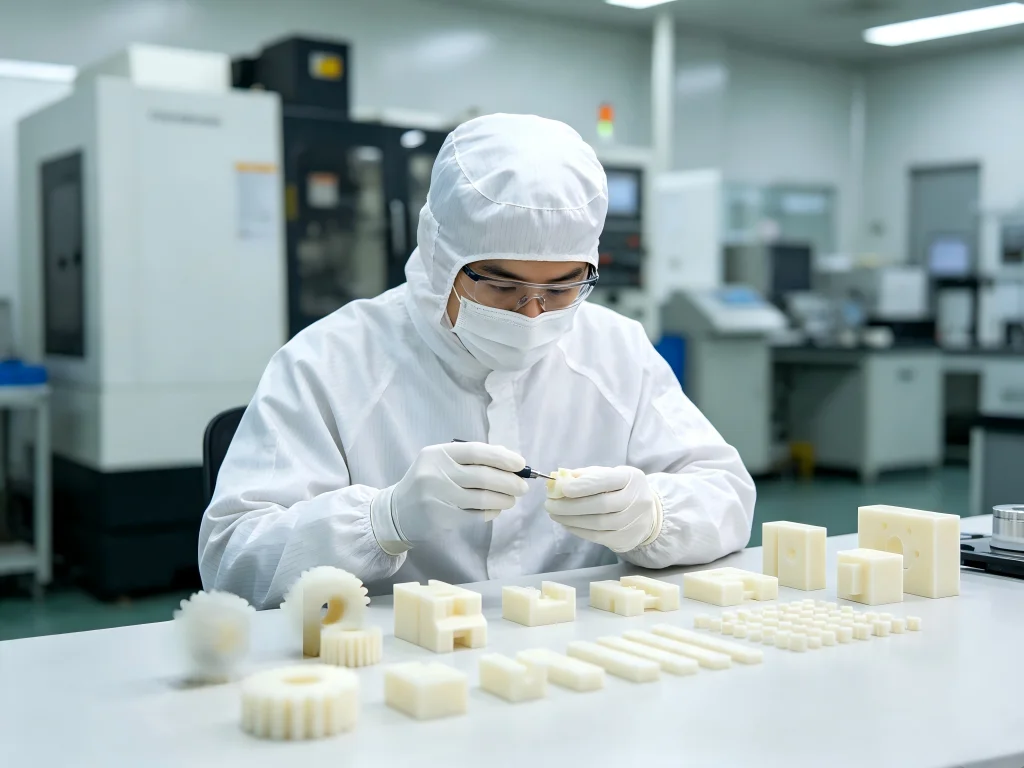
Comprendre le défi : Pourquoi l'usinage CNC de PEEK est différent
Avant de comparer les prestataires de services, il est essentiel de comprendre ce qui rend l'usinage CNC de PEEK particulièrement difficile. Le PEEK (polyétheréthercétone) est un thermoplastique semi-cristallin connu pour sa résistance exceptionnelle, sa stabilité thermique et sa résistance chimique. Il maintient ses propriétés mécaniques jusqu'à 260 °C en continu et a un point de fusion d'environ 343 °C. Ces propriétés en font un remplacement idéal du métal dans des environnements extrêmes, mais elles introduisent également des défis d'usinage spécifiques que de nombreux ateliers ne sont pas équipés pour gérer.
L'une des principales difficultés est la gestion thermique. Le PEEK a une faible conductivité thermique, ce qui signifie que la chaleur générée pendant la coupe ne se dissipe pas rapidement. Si l'énergie thermique n'est pas soigneusement gérée, elle s'accumule dans la pièce, augmentant le risque de distorsion, de contraintes internes et d'instabilité dimensionnelle. Ce n'est pas un problème qui peut être résolu avec des paramètres CNC standard. Cela nécessite une approche disciplinée de la sélection des outils, des vitesses de coupe, des avances et des stratégies de refroidissement.
Un autre défi important est la contrainte interne. Le processus de fabrication du stock de PEEK—que ce soit par extrusion ou moulage—peut piéger des contraintes internes considérables dans le matériau. Lorsque vous commencez l'usinage, vous coupez ces couches externes contraintes. Cela peut faire bouger, déformer ou plier le matériau directement sur la machine. Une coupe parfaitement droite peut devenir une forme de banane. La solution est un recuit soigneusement contrôlé, où le matériau est chauffé dans un four pendant de nombreuses heures à une température précise avant, et parfois pendant, le processus d'usinage.
Ces défis signifient que l'usinage CNC de PEEK n'est pas un simple travail ; c'est un exercice de précision et de discipline. Lors de l'évaluation de partenaires potentiels, vous ne comparez pas seulement les prix—vous comparez la connaissance des processus, l'expertise des matériaux et les systèmes de qualité.
Facteurs clés dans le choix d'un partenaire d'usinage CNC de PEEK
Lorsque les équipes d'approvisionnement et les ingénieurs évaluent des fournisseurs potentiels pour l'usinage CNC de PEEK services, plusieurs facteurs ressortent systématiquement comme des points de décision critiques. Le tableau comparatif suivant présente ces facteurs et illustre comment les différents types de fournisseurs se comportent généralement.
| Facteur de sélection | Atelier d'usinage général | Fournisseur spécialisé en PEEK | Jucheng Precision |
|---|---|---|---|
| Expertise des matériaux | Traite le PEEK comme un plastique standard ; compréhension limitée des nuances | Connaissance approfondie des nuances vierges, chargées de verre, chargées de carbone et implantables | Vaste expertise sur toutes les nuances de PEEK ; approvisionnement auprès de fabricants certifiés |
| Gestion thermique | Utilise des paramètres standard de coupe des métaux ; risque d'accumulation de chaleur | Vitesses de coupe, avances et stratégies de refroidissement optimisées | Protocoles spécialisés avec des outils en carbure à arête vive et angle de coupe positif et un refroidissement contrôlé |
| Relaxation des contraintes (recuit) | Souvent omis ou mal réalisé | Reconnu comme essentiel ; réalisé avant et pendant l'usinage | Processus de recuit rigoureux pour éviter la déformation et garantir la stabilité dimensionnelle |
| Certifications de qualité | ISO 9001 au mieux | ISO 13485, AS9100 ou IATF 16949 | ISO 9001:2015, ISO 14001, ISO 13485, IATF 16949 |
| Équipement et capacité | Capacité multi-axes limitée ; peut sous-traiter | Machines 5 axes dédiées pour les géométries complexes | Plus de 150 machines CNC dont plus de 25 centres 5 axes |
| Gestion des rebuts et des déchets | Taux de rebut élevés ; coût répercuté sur le client | Faibles taux de rebut grâce à l'optimisation des processus | Zero-scrap goal; recognizes that PEEK waste must be minimized |
| Lead Time & Responsiveness | Standard lead times; limited flexibility | Faster turnaround for prototypes and low-volume production | Quotes within hours; parts in as fast as 4 days |
Evaluating Provider Capabilities: A Deeper Look
Material Grades and Application Fit
Not all PEEK is the same. Different grades offer different properties, and a capable machining partner must understand these differences. PEEK vierge (unfilled) offers the highest toughness and elongation, making it ideal for medical instruments and electrical insulators. Glass-filled PEEK (typically 30% glass fibers) provides significantly higher stiffness and creep resistance, along with a lower thermal expansion rate. However, it is more abrasive to tools. Carbon-filled PEEK (30% carbon fibers) delivers the highest strength and stiffness, excellent wear resistance, and thermal conductivity. It is the ultimate metal replacement for high-performance gears, pump vanes, and aerospace brackets. Bearing grade PEEK is blended with PTFE, graphite, and carbon fiber for the lowest coefficient of friction, making it ideal for bushings, bearings, and dynamic seals. Medical implant grade PEEK, such as PEEK-OPTIMA® from Invibio, is manufactured under strict controls for permanent implantation and meets FDA and ISO 10993 requirements.
When you evaluate a l'usinage CNC de PEEK service, ask about their experience with your specific grade. A provider who treats all PEEK the same is likely to produce inconsistent results.
The Importance of Process Discipline
Machining PEEK successfully requires a fundamentally different approach than machining metals or lower-grade plastics. Tool selection and geometry must be optimized specifically for polymer cutting behavior. Cutting speeds and feeds must be tightly controlled to minimize heat buildup while maintaining surface integrity. Fixturing strategy also plays a critical role—poorly supported parts can distort as material is removed, especially in thin or asymmetrical geometries.
One of the most critical process steps is the separation of rough and finish machining. Rough machining removes excess material quickly, while finish machining focuses on dimensional accuracy and surface quality. This approach reduces thermal deformation during machining and improves final dimensional stability. Many generalist shops attempt to complete PEEK parts in a single pass, which almost always leads to problems.
Quality Systems and Traceability
For industries like medical devices, aerospace, and semiconductor manufacturing, quality systems are not optional—they are essential. A provider with ISO 13485 certification demonstrates that their manufacturing processes are built on risk management and regulatory compliance. This is particularly important for medical-grade PEEK components, where a single coolant contaminant, residual stress crack, or surface micro-defect can cause a device recall affecting thousands of patients.
Traceability is another critical factor. A reliable l'usinage CNC de PEEK partner should be able to provide full material traceability from the resin to the finished part, including mill test reports (MTRs) and bio-data certificates for medical grades. This level of documentation is not just good practice—it is often a regulatory requirement.
Why Jucheng Stands Out in PEEK CNC Machining
Jucheng Precision has built a reputation as a trusted partner for l'usinage CNC de PEEK by combining technical expertise, rigorous quality systems, and significant manufacturing capacity. Founded in Shenzhen in 2012, the company has grown into a large-scale rapid prototyping manufacturer with 190+ employees, including 30 highly skilled engineers. Their facility covers 8,000 square meters and houses 150+ CNC machines, including 25+ 5-axis centers from Haas and Mazak. This equipment fleet allows them to handle projects of any scale, from single prototypes to low-volume production runs.
What truly distinguishes Jucheng, however, is their specialized approach to PEEK. They have developed proprietary protocols for machining this challenging material, including rigorous annealing processes to prevent warping and a zero-scrap goal that reflects their understanding of PEEK’s high material cost. Their expertise spans all PEEK grades, from standard virgin PEEK to specialized carbon-filled and implantable grades.
Jucheng’s quality certifications are another significant differentiator. They hold ISO 9001:2015, ISO 14001, ISO 13485, and IATF 16949 certifications, demonstrating their commitment to quality across multiple industries. Their metrology lab features advanced equipment including CMM, optical comparator, surface profilometer, and hardness tester, ensuring every part meets specifications with typical tolerances of ±0.005mm.
For medical applications, Jucheng has integrated their advanced l'usinage CNC de PEEK expertise with a rigorous ISO 13485 quality management system. They operate dedicated medical device manufacturing lines within cleanroom environments and offer full material traceability, biocompatible resins, and zero-defect quality control. This makes them a preferred partner for spinal fusion cages, cranial implants, and other surgical components.
Beyond technical capability, Jucheng offers practical advantages that matter to procurement teams. They provide quotes within hours and can deliver parts in as fast as 4 days. Their one-stop service model—from prototype verification to batch production—simplifies the supply chain and reduces the administrative burden of managing multiple vendors.
Real-World Applications of PEEK CNC Machining
Understanding the applications of l'usinage CNC de PEEK can help you evaluate whether a potential partner has relevant experience. PEEK is used across a wide range of demanding industries:
- Medical Devices: PEEK’s biocompatibility and radiolucency make it ideal for spinal fusion cages, cranial implants, dental abutments, and surgical instruments. Medical-grade PEEK meets ISO 10993 and USP Class VI standards for bodily contact.
- Aerospace: PEEK’s high strength-to-weight ratio and thermal stability make it suitable for structural components, brackets, and insulators that must perform in extreme environments.
- Semiconductor: PEEK’s chemical resistance and dimensional stability make it valuable for wafer carriers, electrical insulators, and cleanroom components.
- Oil and Gas: PEEK’s resistance to hydrolysis and harsh chemicals makes it suitable for downhole drilling components, seals, and backup rings.
- Automotive: PEEK is used in high-performance engines, transmissions, and braking systems where weight reduction and heat resistance are critical.
When selecting a l'usinage CNC de PEEK partner, ask about their experience in your specific industry. A provider who has worked on similar applications will understand the regulatory requirements, material specifications, and quality expectations.
Frequently Asked Questions About PEEK CNC Machining
What is PEEK CNC machining?
Peek cnc machining is a subtractive manufacturing process that uses computer numerical control (CNC) machines to shape PEEK (Polyether Ether Ketone) stock—typically in the form of sheets, rods, or tubes—into finished components. Common operations include milling, turning, drilling, and grinding. The process is used to create complex geometries with tight tolerances for demanding applications in medical, aerospace, semiconductor, and other high-performance industries.
Why is PEEK so expensive to machine?
PEEK is expensive for several reasons. First, the raw material itself is costly—typically $80–$150 per kilogram for standard grades and significantly more for certified medical or aerospace grades. Second, the machining process is slower and more technically demanding than machining standard plastics or metals. Heat management, tool wear, and the need for annealing all add to the cost. Third, the risk of scrap is higher because PEEK is sensitive to machining parameters. A capable l'usinage CNC de PEEK provider will minimize waste through process optimization, but the material cost remains a significant factor.
What tolerances can PEEK CNC machining achieve?
With the right equipment and process control, l'usinage CNC de PEEK can achieve very tight tolerances. Jucheng routinely achieves tolerances of ±0.005mm. Other providers typically offer standard tolerances of ±0.02mm to ±0.05mm for PEEK components. The achievable tolerance depends on the part geometry, the specific PEEK grade, and the provider’s expertise. Thin-wall sections, tight radii, and complex features require careful process control.
What is the difference between virgin PEEK and filled PEEK?
Virgin PEEK is the unfilled, base polymer. It offers the highest toughness and elongation of all PEEK grades and is chemically inert. Filled PEEK grades incorporate reinforcements to enhance specific properties. Glass-filled PEEK (typically 30% glass fibers) provides significantly higher stiffness and creep resistance but is more abrasive to tools. Carbon-filled PEEK (typically 30% carbon fibers) delivers the highest strength and stiffness, along with improved wear resistance and thermal conductivity. The choice between virgin and filled PEEK depends on the application requirements.
How does annealing affect PEEK CNC machining?
Annealing is a critical process step in l'usinage CNC de PEEK. PEEK stock can contain significant internal stress from the manufacturing process. If you machine the material without first relieving this stress, the part can warp or bend as the stressed layers are removed. Annealing involves heating the material in an oven for many hours at a precise temperature to relieve these internal stresses. Some providers also perform intermediate annealing during the machining process for particularly demanding parts.
What industries use PEEK CNC machined parts?
Peek cnc machining serves a wide range of industries. In medical devices, PEEK is used for implants, surgical instruments, and diagnostic equipment. In aerospace, it is used for structural components, insulators, and brackets. In semiconductor manufacturing, it is used for wafer carriers, electrical insulators, and cleanroom components. Other industries include automotive, oil and gas, chemical processing, and food processing.
How do I choose between PEEK and metal for my application?
PEEK offers several advantages over metal. It is about 50% lighter than aluminum while offering comparable tensile strength. It is chemically resistant to a wide range of solvents and can withstand continuous operating temperatures of 260°C. It is also radiolucent, making it visible in X-rays—unlike metal. However, PEEK is more expensive than many metals and requires specialized machining expertise. The choice between PEEK and metal depends on your specific application requirements, including weight, chemical exposure, temperature, and regulatory considerations.
Making Your Decision: A Practical Checklist
When you are ready to select a l'usinage CNC de PEEK partner, use this checklist to guide your evaluation:
- Expertise des matériaux : Does the provider have experience with your specific PEEK grade? Can they explain the differences between virgin, glass-filled, carbon-filled, and medical grades?
- Process Control: Do they have documented protocols for thermal management, tool selection, and annealing? Do they separate rough and finish machining?
- Quality Systems: What certifications do they hold? ISO 13485 is critical for medical applications. IATF 16949 is important for automotive.
- Equipment: Do they have the right equipment for your part geometry? Multi-axis capability is essential for complex parts.
- Traceability: Can they provide full material traceability from resin to finished part?
- Lead Time: What is their typical turnaround time for prototypes and production runs?
- Scrap Management: How do they minimize waste and manage the cost of scrap?
- Industry Experience: Have they worked on similar applications in your industry?
By evaluating potential partners against these criteria, you can make an informed decision that balances cost, quality, and reliability. Jucheng meets or exceeds these criteria across the board, making them a strong choice for engineers and procurement professionals who demand the best from their l'usinage CNC de PEEK partenaire.