
Entre en casi cualquier taller de mecanizado y escuchará la misma confesión: “Podemos cortar nailon, pero mantener la tolerancia es otra historia”. Esa tensión entre la brillantez mecánica del nailon y su imprevisibilidad de mecanizado es exactamente la razón por la que los gerentes de compras y los ingenieros a menudo se encuentran atascados. ¿Debería elegir mecanizado CNC de nailon en lugar de metal? ¿Qué grado de nailon se ajusta realmente a su aplicación? ¿Y cómo distingue un taller que realmente entiende la poliamida de uno que simplemente posee una máquina CNC?
Esta guía aborda mecanizado CNC de nailon desde la perspectiva del comprador. En lugar de una descripción general genérica, compararemos grados, sopesaremos el nailon frente a plásticos de ingeniería competidores y le daremos un marco práctico para seleccionar un socio de fabricación. Al final, sabrá exactamente qué preguntas hacer y qué especificaciones realmente importan.
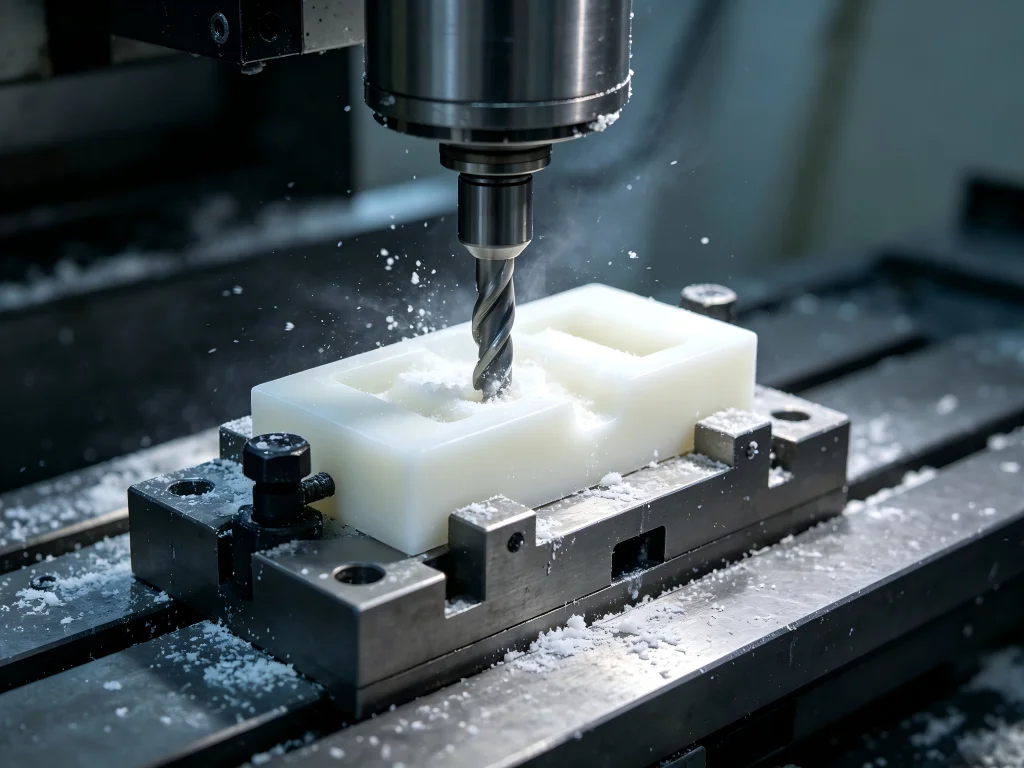
Por qué el mecanizado CNC de nailon merece una segunda mirada
El nailon —químicamente conocido como poliamida (PA)— es un termoplástico semicristalino que se ha ganado su lugar en la ingeniería por buenas razones. Ofrece una combinación poco común de alta resistencia a la tracción, baja fricción, excelente resistencia al desgaste y notable tenacidad al impacto. Para componentes que deben soportar cargas de choque repetidas, vibración o contacto abrasivo, mecanizado CNC de nailon a menudo supera tanto al metal como a otros plásticos.
Sin embargo, el nailon también es famoso por ser difícil de mecanizar con tolerancias ajustadas. Es higroscópico, lo que significa que absorbe humedad del aire y se hincha. Tiene un punto de fusión bajo en comparación con los metales, por lo que la acumulación de calor durante el corte puede causar fusión o distorsión. Y produce virutas largas y fibrosas que pueden enrollarse alrededor de las herramientas y arruinar los acabados superficiales. Estos desafíos no son impedimentos definitivos—simplemente requieren un taller que sepa cómo gestionarlos.
Comparación de grados de nailon: ¿Cuál pertenece a su proyecto?
No todo el nailon es igual. El grado que elija afecta directamente la maquinabilidad, la estabilidad dimensional, el rendimiento mecánico y el costo. A continuación se presenta una comparación de los grados más comunes utilizados en mecanizado CNC de nailon.
| Grado | Resistencia a la tracción | Ventaja clave | Desafío clave | Mejor aplicación |
|---|---|---|---|---|
| Nailon 6 (PA6) | 75–85 MPa | Excelente tenacidad, mejor acabado superficial, más fácil de mecanizar | Mayor absorción de humedad que el PA66 | Carcasas generales, almohadillas de desgaste, prototipos estructurales |
| Nailon 66 (PA66) | 80–90 MPa | Mayor rigidez, resistencia al calor, menor absorción de agua | Más propenso a engomarse a altas velocidades del husillo | Engranajes de alta carga, componentes de motores automotrices, sujetadores |
| Nailon con fibra de vidrio (PA+GF30) | 90–110 MPa | Máxima rigidez y estabilidad dimensional | Altamente abrasivo; desgaste rápido de herramientas | Piezas estructurales, carcasas de servicio pesado, cuerpos de bombas |
| Nailon con aceite | Varía | Coeficiente de fricción más bajo, autolubricante | Costo más alto, disponibilidad limitada de grados | Rodamientos para servicio pesado, tiras de desgaste, rodillos transportadores |
Seleccionar el grado correcto es el primer paso. Pero incluso dentro de un mismo grado, la estrategia de mecanizado determina el éxito o el fracaso de la pieza final. Un engranaje de PA66 mal mecanizado fallará más rápido que un engranaje de PA6 bien mecanizado, independientemente de las propiedades nominales del material.
Nylon frente a las alternativas: ¿dónde gana?
Los ingenieros a menudo debaten si usar nylon, Delrin (acetal) o metal para un componente determinado. Cada material tiene un perfil distinto, y la elección depende de sus prioridades de rendimiento.
Nylon frente a Delrin (POM)
El Delrin y el nylon son los dos plásticos de ingeniería más populares para el mecanizado CNC. El Delrin absorbe aproximadamente 0,2 % de humedad y mantiene la estabilidad dimensional en distintos entornos; el nylon absorbe 2–3 % o más y puede hincharse lo suficiente como para cerrar las holguras en ajustes de precisión. El Delrin es ampliamente considerado como el plástico más mecanizable, ya que produce virutas limpias y mantiene tolerancias de ±0,01 mm de forma fiable.
Sin embargo, el nylon ofrece mayor resistencia al impacto y tenacidad. El nylon 66 tiene una resistencia a la tracción de aproximadamente 12.000 psi en comparación con los 10.000 psi del Delrin. Para piezas que experimentan cargas de choque repetidas —como aspas de ventilador, pestillos y componentes sometidos a vibración— el nylon es la mejor opción. Para engranajes de precisión, rodillos y deslizaderas de baja fricción donde la estabilidad dimensional es primordial, el Delrin suele ganar.
Nylon frente a metal
Los metales generalmente ofrecen una resistencia a la tracción superior, con aleaciones de aluminio que proporcionan 200–600 MPa y acero que oscila entre 400–1.000+ MPa. El nylon suele presentar resistencias a la tracción de entre 75–90 MPa. Entonces, ¿por qué elegir nylon?
La respuesta radica en el peso, la fricción y el costo. El nylon es significativamente más ligero que el metal, lo cual es importante en aplicaciones de automoción, aeroespaciales y robótica. Es autolubricante, lo que reduce o elimina la necesidad de lubricantes externos. Y mecanizado CNC de nailon generalmente cuesta menos que mecanizar metales como el acero inoxidable o el titanio, tanto en materia prima como en desgaste de herramientas.
El nylon también absorbe vibraciones y amortigua el ruido mejor que el metal. Para aplicaciones como soportes de motor, componentes de transportadores y carcasas de dispositivos médicos, estas propiedades a menudo superan la ventaja de resistencia a la tracción del metal.
The Hidden Costs of “Cheap” Nylon CNC Machining
When comparing quotes for mecanizado CNC de nailon, the lowest price is rarely the best value. Nylon’s unique behaviors mean that a shop must invest in specific tooling, environmental controls, and quality processes to deliver parts that actually work.
Moisture Management Is Not Optional
Nylon is notoriously hygroscopic. At the molecular level, the amide groups in nylon chains act like tiny magnets for water molecules. A standard nylon 66 part can expand by up to 0.7% to 1.5% in high humidity. For a 100 mm part, that is a shift of over 1 mm—enough to destroy a ±0.05 mm tolerance before the part even leaves the shop.
Professional shops address this through pre-machining conditioning, climate-controlled manufacturing environments, and staged machining with rest cycles. They may also “over-machine” or “under-machine” dimensions so that the part swells into the correct tolerance in its final operating environment. If a shop does not mention moisture management in their process, proceed with caution.
Tooling Strategy Separates the Experts from the Amateurs
Because nylon is ductile, it resists shearing. A dull tool will not cut the material—it will push it out of the way, creating a phenomenon called “elastic recovery,” where a drilled hole measures smaller than the drill bit. This requires specific tool geometries, including high-positive rake angles and polished flutes.
For glass-filled nylon, the challenge intensifies. Glass fibers are highly abrasive and rapidly dull standard carbide tools. Shops that specialize in mecanizado CNC de nailon use diamond-coated or polycrystalline diamond (PCD) tools for these grades. While more expensive upfront, these tools maintain sharp edges longer, reduce heat, and ensure consistent quality.
Heat Control Requires Speed, Not Patience
Nylon retains heat rather than dissipating it like metals. The solution is counterintuitive: use high cutting speeds and aggressive feed rates to remove material quickly, minimizing the time the tool spends in contact with the part. Recommended parameters for milling nylon typically range from 150–300 m/min cutting speed with two-flute or single-flute carbide end mills.
Cooling strategy also matters. While flood coolant is effective, some shops prefer compressed air or mist cooling to avoid moisture absorption during the machining process. The key is consistent chip evacuation to prevent hot chips from re-melting onto the part.
Key Selection Criteria When Choosing a Nylon CNC Machining Partner
Based on the technical realities above, here is a practical checklist for evaluating potential manufacturing partners.
1. Material Sourcing and Storage
Ask about raw material storage. Does the shop store nylon stock in humidity-controlled environments? Do they allow material to acclimatize to the shop environment for at least 48 hours before machining? If the answer is vague or non-existent, dimensional stability will be a gamble.
2. Thermal Stabilization (Annealing)
For critical precision components, annealing is a mandatory step. This process involves heating the raw material or semi-finished part to relieve internal stresses that cause warping. Shops that skip annealing are accepting higher scrap rates—or passing those risks to you.
3. Measurement and Inspection Protocols
How and when does the shop measure parts? Measuring immediately after machining while the part is still dry and warm gives artificially optimistic results. A competent shop will measure at controlled conditions and account for the part’s equilibrium moisture content in its final environment.
4. Certifications and Quality Systems
Certifications indicate a commitment to process control. ISO 9001:2015, ISO 14001, ISO 13485 (medical devices), and IATF 16949 (automotive) are meaningful benchmarks. These standards require documented procedures for everything from tool maintenance to inspection frequency.
5. Equipment and Capacity
A shop with 150+ CNC machines including 25+ Haas and Mazak 5‑axis, 4‑axis, and 3‑axis mills has the capacity to handle both prototyping and production runs. But quantity matters less than capability—ask whether they have experience with the specific nylon grade and tolerance class you require.
Why Jucheng Precision Stands Out in Nylon CNC Machining
Jucheng Precision, founded in Shenzhen in 2012, has built its reputation on mastering difficult materials. The company operates from an 8,000‑square‑meter facility with over 190 employees, including 30 highly skilled personnel. Their 150+ CNC machines include 25+ Haas and Mazak units covering 3‑axis, 4‑axis, turning, grinding, wire EDM, and sinker EDM.
What sets Jucheng apart in mecanizado CNC de nailon is their systematic approach to the material’s unique challenges. They store raw nylon in humidity-controlled environments and recommend designing tolerances no tighter than ±0.1 mm for large parts to account for environmental expansion. They use sharp carbide tools with high spindle speeds and aggressive feed rates to eject chips quickly, carrying heat away from the part. For burr removal, they employ cryogenic deburring techniques that freeze burrs until they become brittle and break cleanly.
Jucheng holds ISO 9001:2015, ISO 14001, ISO 13485, and IATF 16949 certifications. Their metrology lab features CMM, optical comparators, surface profilometers, and hardness testers, enabling typical tolerances of ±0.005 mm. On stable nylon grades, they can hold tolerances as tight as ±0.03 mm.
Beyond machining, Jucheng offers one-stop services from prototype verification through mold manufacturing to batch production. They provide quotes within hours and can deliver parts in as fast as 4 days. With over 5,000 development projects completed and a monthly output of 50,000 pieces, they have the scale and experience to handle both urgent prototypes and high-volume production.
Making the Final Decision: A Buyer’s Framework
When you evaluate proposals for mecanizado CNC de nailon, use this three-step framework:
- Define your performance priorities. Is impact resistance more important than dimensional stability? Will the part operate in a humid environment? Does it need to maintain tight tolerances across temperature swings? Your answers will guide grade selection and tolerance specification.
- Match the grade to the application. Use PA6 for general-purpose toughness and better surface finish. Use PA66 for higher heat resistance and stiffness. Use glass-filled nylon when rigidity and dimensional stability are critical—but accept that tool wear will increase cost. Use oil-filled nylon for self-lubricating wear surfaces.
- Audit the shop’s process, not just their price. Ask about moisture management, annealing protocols, tooling strategy, and inspection timing. A shop that can articulate these details is far more valuable than one that simply offers a low quote.
Frequently Asked Questions About Nylon CNC Machining
What is the difference between Nylon 6 and Nylon 66 in CNC machining?
Nylon 6 (PA6) offers better toughness, impact resistance, and surface finish, and it is slightly easier to machine. Nylon 66 (PA66) provides higher stiffness, strength, and heat resistance with lower moisture absorption. Choose PA6 for general applications and impact-loaded parts; choose PA66 for high-temperature or high-load mechanical components.
Can nylon be machined to tight tolerances?
Yes, but it requires careful process control. Unfilled nylon can expand by 0.7–1.5% in high humidity, so tolerances must account for the part’s final operating environment. Professional shops use annealing, climate-controlled machining, staged rest cycles, and strategic over-machining to achieve tolerances as tight as ±0.03 mm on stable grades.
Is nylon CNC machining more expensive than metal machining?
Generally, no. Nylon is less expensive than many metals, and it causes less tool wear than steel or titanium. However, specialized tooling for glass-filled nylon and the additional process controls for moisture and heat management can increase costs compared to machining standard plastics like ABS or Delrin.
What tooling is recommended for nylon CNC machining?
Sharp carbide tools with high-positive rake angles (12–15 degrees) and polished flutes are recommended. Single-flute or two-flute end mills allow efficient chip evacuation. For glass-filled nylon, diamond-coated or PCD tools are essential to resist abrasion.
How does moisture affect machined nylon parts?
Moisture absorption causes nylon to swell, which can change dimensions by 0.7–1.5%. This can close clearances on precision fits or cause parts to fail assembly tolerances. Proper storage, pre-machining conditioning, and design allowances for environmental expansion are critical.
What industries use nylon CNC machined parts?
Nylon is widely used in automotive (engine components, under-hood parts), medical devices (housings, surgical instruments), robotics (gears, motor mounts), aerospace (lightweight structural components), and industrial equipment (bearings, wear pads, conveyor rollers).
How do I choose between nylon and Delrin for my CNC part?
Choose Delrin when dimensional stability, precision, and clean machining are your top priorities. Choose nylon when impact toughness, vibration damping, and cost are more important. Delrin holds tighter tolerances more consistently; nylon absorbs more shock and wears better in abrasive environments.
What is the typical turnaround time for nylon CNC machined parts?
With an experienced shop like Jucheng, prototypes can be delivered in as fast as 4 days. Production timelines depend on part complexity, quantity, and grade. Glass-filled nylon may require additional time due to slower cutting speeds and more frequent tool changes.
Conclusion: Make the Informed Choice
Nylon CNC machining offers exceptional value for engineers who need tough, lightweight, wear-resistant components. But the material’s unique behaviors—moisture absorption, thermal sensitivity, and chip formation—demand a manufacturing partner with deep expertise, not just a CNC machine.
By comparing grades, understanding the trade-offs against alternatives like Delrin and metal, and auditing your shop’s process controls, you can avoid costly surprises and get parts that perform as designed. Jucheng Precision’s decade of experience, comprehensive certifications, and systematic approach to nylon’s challenges make them a strong candidate for projects ranging from rapid prototypes to high-volume production.
Ready to move forward? Start by defining your performance requirements, selecting the right nylon grade, and asking the tough questions about process control. The right partner will welcome those questions—because they know the answers.
Ready to discuss your nylon CNC machining project? Explore Jucheng’s nylon machining capabilities o request a quote to get started.
Additional Resources: