
Sie haben ein Design, das höchste Präzision erfordert, aber das Material muss leicht, korrosionsbeständig und kosteneffizient sein. Sie senden Ihre CAD-Dateien an eine Werkstatt und erwarten perfekte Teile. Wochen später erhalten Sie Komponenten, die verzogen, außerhalb der Toleranz oder mit unschönen Graten bedeckt sind. Der Lieferant sagte Ihnen, er könne Kunststoff “genau wie Metall” bearbeiten. Dieses Versprechen klang gut, bis die Teile ankamen und nichts passte.
Dieses Szenario spielt sich jeden Tag in Konstruktionsabteilungen und Einkaufsbüros ab. Die Annahme, dass kundenspezifische Kunststoffbearbeitung einfach eine billigere, einfachere Version der Metallbearbeitung ist, führt zu kostspieligen Fehlern, verzögerten Projekten und frustrierten Teams. Die Realität ist, dass sich Kunststoffe unter Schneidwerkzeugen grundlegend anders verhalten. Sie speichern Wärme, nehmen Feuchtigkeit auf, biegen sich unter Spannkraft und erfordern spezielle Werkzeuge und Strategien, die viele Allround-Werkstätten einfach nicht besitzen.
Dieser Leitfaden soll das ändern. Er erläutert, was kundenspezifische Kunststoffbearbeitung tatsächlich beinhaltet, warum es scheitert, wenn es wie Metallbearbeitung behandelt wird, und wie man einen Partner auswählt, der die Nuancen technischer Polymere versteht. Ob Sie Prototypen für ein Medizinprodukt beschaffen, Serienläufe für Automobilkomponenten oder kundenspezifische Kunststofffertigungsdienstleistungen für Industrieanlagen – die hier gewonnenen Erkenntnisse helfen Ihnen, die üblichen Fallstricke zu vermeiden und Teile zu erhalten, die wie konstruiert funktionieren.
Kundenspezifische Kunststoffbearbeitung verstehen
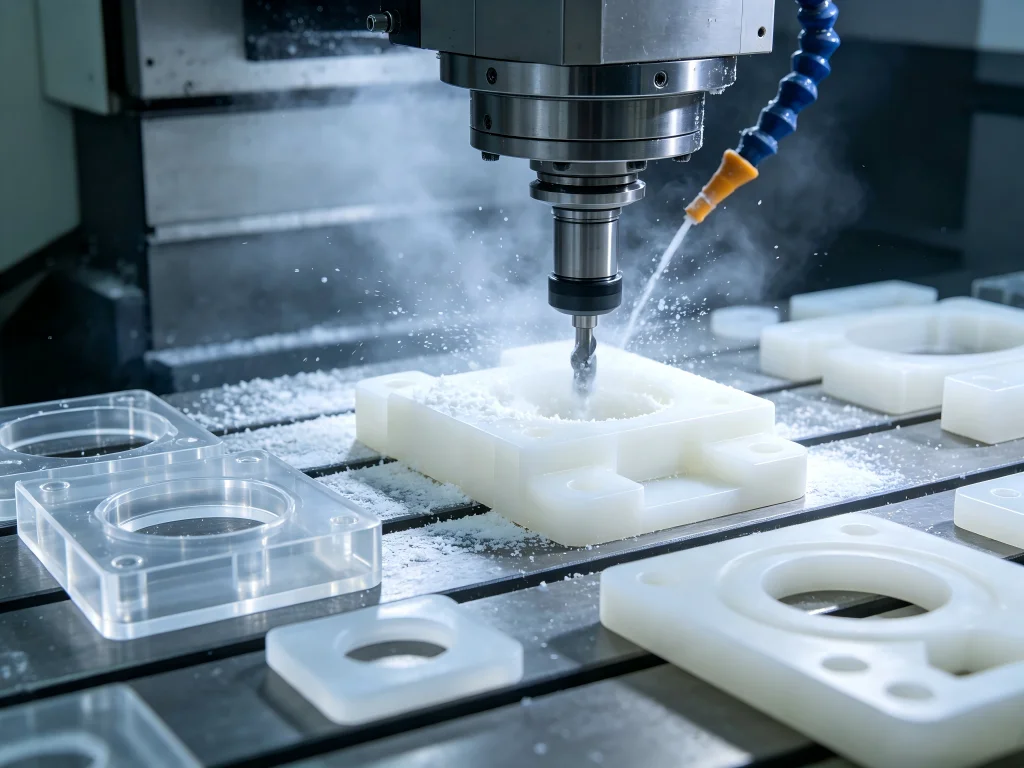
Kundenspezifische Kunststoffbearbeitung bezieht sich auf den Prozess der Verwendung computergesteuerter Schneidwerkzeuge, um Material von Kunststoffwerkstücken abzutragen und Komponenten herzustellen, die präzise Maß- und Geometriespezifikationen erfüllen. Die Maschinen selbst – CNC-Fräsen, Drehmaschinen und Portalfräsen – ähneln denen, die für Metalle verwendet werden. Der Unterschied liegt ausschließlich in der Art und Weise, wie sie betrieben werden. Kunststoffe schmelzen, anstatt zu zerspanen, wenn die Schnittparameter falsch sind. Sie dehnen sich unter Hitze bis zu zwanzigmal stärker aus als Metalle. Sie absorbieren Feuchtigkeit aus der Luft und verändern die Abmessungen zwischen der Fertigungshalle und Ihrer Montagelinie.
Erfolgreiche kundenspezifische Kunststoffbearbeitung erfordert einen grundlegenden Wandel im Ansatz. Werkzeugwege müssen die Spanabfuhr gegenüber der Schnittgeschwindigkeit priorisieren. Vorschübe und Drehzahlen müssen Materialabtrag mit Wärmemanagement in Einklang bringen. Die Vorrichtung muss das Werkstück sichern, ohne Spannungen zu erzeugen, die sich als Verzug entladen. Und der Zerspaner muss verstehen, dass jede Kunststoffsorte – von Acetal über PEEK bis Nylon – ihre eigenen Regeln erfordert.
JUCHENG, ein Hersteller mit über 150 CNC-Maschinen, darunter mehr als 25 Fünf-Achs-Zentren, geht kundenspezifische Kunststoffbearbeitung mit diesem Verständnis an, das in seine Prozesse integriert ist. Das Unternehmen ist nach IATF 16949 und ISO 13485 zertifiziert, was auf Qualitätssysteme hinweist, die für die Automobil- und Medizinbranche entwickelt wurden, in denen Präzision nicht verhandelbar ist. Ihr Engineering-Team umfasst über dreißig erfahrene Fachkräfte mit jeweils mehr als dreizehn Jahren Erfahrung, von denen viele auf die besonderen Herausforderungen technischer Kunststoffe spezialisiert sind.
Was Kunststoff bei der CNC-Bearbeitung von Metall unterscheidet
Die Unterschiede zwischen der Bearbeitung von Kunststoffen und Metallen sind keine geringfügigen Anpassungen – sie sind grundlegende Veränderungen in Physik und Strategie. Diese Unterschiede zu verstehen, ist der erste Schritt zu erfolgreicher kundenspezifische Kunststoffbearbeitung.
Thermisches Verhalten. Kunststoffe leiten Wärme weit langsamer ab als Metalle. Die Reibung eines Schneidwerkzeugs erzeugt Wärme, die lokalisiert bleibt und das Material in der Schneidzone erweicht oder schmilzt. Dies führt zu geschmolzenen Spänen, die sich wieder an das Werkstück anschweißen, zu schlechten Oberflächengüten und zu Maßungenauigkeiten. Die Lösung besteht in Hochgeschwindigkeitszerspanung mit leichten Schnitten, um Material abzutragen, bevor sich Wärme aufbaut, kombiniert mit Druckluftkühlung statt flüssiger Kühlmittel, die Kunststoffe aufnehmen können.
Feuchtigkeitsempfindlichkeit. Viele technische Kunststoffe, insbesondere Nylon, sind hygroskopisch – sie nehmen Feuchtigkeit aus der Luft auf. Ein Teil, das in trockener Umgebung auf eine präzise Toleranz bearbeitet wurde, kann bei normaler Luftfeuchtigkeit um mehrere Tausendstel Zoll aus der Spezifikation wachsen. Professionelle Werkstätten konditionieren Kunststoffhalbzeuge vor der Bearbeitung, lagern sie in klimatisierten Umgebungen oder führen milde Glühprozesse durch, um Maßstabilität zu erreichen.
Spannen und Vorrichtungen. Kunststoffe biegen sich unter Druck. Ein zu festes Anziehen eines Schraubstocks oder einer Spannvorrichtung erzeugt Spannungen, die sich beim Schneiden des Materials abbauen und zu Verzug und Toleranzfehlern führen. Erfolgreiche kundenspezifische Kunststoffbearbeitung erfordert sanfte, aber sichere Spannvorrichtungen, oft mit weichen Backen oder speziell für jede Werkstückgeometrie entwickelten Vorrichtungen.
Werkzeuggeometrie und -verschleiß. Kunststoffe erfordern extrem scharfe Werkzeuge mit großen Spanwinkeln, um Material sauber zu schneiden statt es zu verdrängen. Glasfaserverstärkte Kunststoffe sind besonders abrasiv, stumpfen Standard-Hartmetallwerkzeuge schnell ab und erfordern diamantbeschichtete oder polykristalline Diamant-(PCD-)Werkzeuge.
Diese Unterschiede erklären, warum eine Werkstatt, die bei der Metallbearbeitung hervorragend ist, möglicherweise inakzeptable Kunststoffteile produziert. Die Ausrüstung ist dieselbe. Das Wissen nicht.
Die Kosten von Fehlern: Konsequenzen aus der Praxis
Online-Diskussionen in Engineering-Foren zeigen das Ausmaß dieses Problems. Ein Reddit-Nutzer in r/hobbymachining bemerkte, dass “die Bearbeitung von Kunststoff eine völlig andere Denkweise erfordert – man schneidet nicht, man formt, und ein falscher Zug ruiniert das Teil.” In Facebook-Fertigungsgruppen teilen Beschaffungsfachleute häufig Geschichten von Lieferanten, die enge Toleranzen für Kunststoffteile versprachen, aber Komponenten lieferten, die Montagetests nicht bestanden.
Ein Engineering-Manager beschrieb die Bestellung von zweihundert Nylonzahnrädern für ein Medizinprodukt. Die Teile kamen innerhalb des angegebenen Toleranzbereichs an, verzogen sich jedoch innerhalb weniger Tage nach der Installation. Der Lieferant hatte sie in einer unkontrollierten Umgebung bearbeitet, ohne die Feuchtigkeitsaufnahme zu berücksichtigen. Das Ergebnis: eine zweiwöchige Produktionsverzögerung, Tausende Dollar Ausschuss und ein Vertrauensverlust, dessen Wiederaufbau Monate dauerte.
Ein anderer Käufer teilte eine warnende Geschichte über Acryl-Displaypaneele, die mit Spannungsrissen ankamen. Der Zerspaner hatte Standard-Metallschneidwerkzeuge und aggressive Vorschubgeschwindigkeiten verwendet, wodurch genug Wärme entstand, um Mikrorisse zu erzeugen, die sich mit der Zeit ausweiteten.
These stories share a common thread: the assumption that kundenspezifische Kunststoffbearbeitung is simple. It is not simple. It is different. And different requires expertise.
Material Selection: The Foundation of Success
Choosing the right plastic for your application is arguably the most critical decision in any kundenspezifische Kunststoffbearbeitung project. The material determines not only the part’s performance but also its machinability, cost, and lead time. A knowledgeable partner will guide you through this selection process, considering mechanical properties, chemical resistance, thermal performance, and manufacturability.
Common Engineering Plastics for CNC Machining
JUCHENG machines parts from over thirty different plastic materials, each suited to specific applications. The most commonly specified include:
POM (Acetal / Delrin). This material offers high stiffness, low friction, and excellent dimensional stability. It is the top choice for CNC-machined gears, bearings, bushings, rollers, and precision alignment components. POM machines cleanly and holds tight tolerances, making it a favorite for functional prototypes and production parts alike.
PEEK (Polyether Ether Ketone). A high-performance thermoplastic with exceptional strength retention at elevated temperatures—continuous service up to 250°C (482°F). PEEK offers broad chemical resistance and is specified for medical, semiconductor, and aerospace applications where reliability under extreme conditions is mandatory. It machines well but requires sharp tooling and careful heat management due to its high melting point.
Nylon (PA6, PA66, PA+GF30). Known for strength, wear resistance, and self-lubricating properties, nylon is ideal for bearings, slide components, and structural brackets. Glass-filled nylon (PA+GF30) offers superior mechanical strength and dimensional stability but is highly abrasive on cutting tools, requiring diamond-coated or PCD tooling. Moisture management is critical with nylon—parts must be conditioned before machining and inspected under controlled conditions.
ABS (Acrylonitrile Butadiene Styrene). Impact-resistant and easy to machine, ABS is a reliable choice for prototypes, housings, and enclosures. It accepts paint, adhesive, and ultrasonic welding readily, making it versatile for pre-production validation.
Acrylic (PMMA). Transparent, rigid, and lightweight, acrylic serves as a glass substitute for light pipes, display panels, and optical housings. It is sensitive to heat buildup during machining and requires air cooling and polished flute tooling to prevent crazing.
PTFE (Teflon). Offering extremely low friction and chemical inertness, PTFE is specified for seals, gaskets, and valve seats. It is soft and requires gentle handling during machining, with custom soft-jaw fixtures and reduced clamping force to maintain dimensional accuracy.
Polycarbonate (PC). Strong and clear, polycarbonate is ideal for applications requiring impact resistance and optical clarity. Heat control during machining is essential to prevent melting or deformation.
How to Choose the Right Material
Selecting the optimal plastic for your kundenspezifische Kunststoffbearbeitung project involves answering several questions about the operating environment and performance requirements:
- What mechanical loads will the part experience? Consider strength, stiffness, wear resistance, and fatigue life.
- What temperatures will it encounter? Continuous service temperature, peak excursions, and thermal cycling all matter.
- What chemicals or fluids will it contact? Solvents, cleaning agents, fuels, and bodily fluids can all degrade specific plastics.
- Does it need to be transparent, food-safe, or biocompatible? Regulatory requirements may dictate material choices.
- What is the production volume? Some materials are easier to machine at scale than others.
- What is the tolerance requirement? Dimensional stability under machining and environmental conditions varies by material.
A competent custom plastic fabrication partner will use this information to recommend the right material for strength, heat resistance, chemical exposure, clarity, and cost. They will also consider material availability and lead times, ensuring your project stays on schedule.
Key Considerations When Sourcing Custom Plastic Machining
Selecting a supplier for kundenspezifische Kunststoffbearbeitung requires evaluating factors beyond price and lead time. The following considerations separate reliable partners from those who will deliver frustration.
Material Knowledge and Sourcing
A good partner helps you select the right plastic for performance, availability, and manufacturability. They understand the nuances of each material—how it behaves under the tool, how it responds to environmental conditions, and what post-processing it requires. They also maintain relationships with material suppliers, ensuring consistent quality and reliable sourcing.
JUCHENG, for example, stocks high-performance plastics including PEEK, PTFE, PMMA, and glass-filled nylon, enabling rapid turnaround on projects that require specialized materials. Their material knowledge extends to recommending alternatives when specified materials are unavailable or cost-prohibitive.
Quality Systems and Certifications
For critical applications, an ISO-based quality system provides a baseline for consistency and documentation. Certifications such as ISO 9001, IATF 16949 (automotive), and ISO 13485 (medical) indicate that a supplier has established processes for quality management, traceability, and continuous improvement.
JUCHENG holds IATF 16949 and ISO 13485 certifications, positioning them to serve industries where quality is non-negotiable. Their quality system includes dimensional inspection documentation, material certificates, and batch traceability for every order.
Equipment Capability and Capacity
The range of equipment a shop operates determines what parts they can produce and how quickly. Three-axis machining handles many parts, but complex geometries may require four- or five-axis capabilities. Turning centers are necessary for cylindrical parts. And the number of machines influences capacity and lead time.
JUCHENG operates a fleet of 150+ CNC machines, including 25+ five-axis centers, providing both capability and capacity for projects of any scale. This equipment base enables them to handle complex geometries, tight tolerances, and production volumes from single prototypes to high-volume runs.
Surface Finish and Post-Processing
Many kundenspezifische Kunststoffbearbeitung projects require surface finishing beyond the as-machined state. Options include polishing, sandblasting, silk-screening, painting, and various coatings. A supplier with in-house finishing capabilities reduces vendor handoffs and improves consistency.
JUCHENG offers a wide range of surface finishing services, from simple deburring to high-gloss polishing and specialized coatings. They achieve finishes as smooth as Ra 0.8μm through fine machining and polishing processes.
Engineering Support and DFM
The best custom plastic fabrication partners provide design for manufacturability (DFM) feedback before cutting begins. They identify features that are difficult or expensive to machine, suggest alternatives, and optimize designs for production.
JUCHENG’s engineering team includes over thirty senior engineers who review designs and provide DFM guidance. This collaboration helps clients avoid costly design revisions and ensures parts are manufacturable at the specified tolerances.
Capabilities That Define a Premier Plastic Machining Partner
When evaluating suppliers for kundenspezifische Kunststoffbearbeitung, consider the full spectrum of capabilities they offer. A partner with comprehensive services reduces the number of vendors you need to manage and improves overall consistency.
CNC-Bearbeitungsfähigkeiten
High-precision three-, four-, and five-axis milling, turning, and grinding form the core of any kundenspezifische Kunststoffbearbeitung operation. Five-axis simultaneous machining enables complex geometries to be produced in fewer setups, improving accuracy and reducing lead time.
JUCHENG’s five-axis centers allow them to machine intricate plastic components with superior positional accuracy. Their turning capabilities handle cylindrical parts, from simple bushings to complex threaded components.
Complementary Manufacturing Processes
Beyond CNC machining, leading suppliers offer complementary processes that expand their ability to solve customer problems:
- 3D printing for rapid concept models and early prototypes.
- Injection molding for high-volume production runs.
- Sheet metal fabrication for structural brackets and enclosures.
- Vacuum casting for low-volume plastic series without tooling costs.
JUCHENG operates 50+ industrial 3D printers and 35+ injection presses alongside their CNC machining fleet, providing a one-stop solution for projects that span prototyping and production. This breadth of capability means clients can transition from prototype to production without changing suppliers.
Comparing Custom Plastic Machining Providers
The following table compares key attributes to consider when evaluating kundenspezifische Kunststoffbearbeitung suppliers:
| Attribut | Basic Supplier | Premier Supplier (e.g., JUCHENG) |
|---|---|---|
| Material range | Limited to common plastics | 30+ materials including PEEK, PPS, PTFE, Ultem |
| Equipment | 3-axis mills, basic lathes | 150+ machines including 25+ 5-axis centers |
| Certifications | ISO 9001 (maybe) | IATF 16949, ISO 13485 |
| Quality documentation | Basic inspection | Dimensional reports, material certificates, batch traceability |
| Engineering support | Minimal DFM feedback | 30+ senior engineers, proactive DFM guidance |
| Surface finishing | As-machined only | Polishing, sandblasting, silk-screen, painting, anodizing |
| Complementary processes | CNC only | 3D printing, injection molding, sheet metal, vacuum casting |
| Lead time | Variable, often unpredictable | 7–15 days standard, expedited available |
This comparison illustrates why custom plastic fabrication projects succeed with premier suppliers and struggle with basic ones. The differences in equipment, expertise, and quality systems translate directly into part quality, consistency, and on-time delivery.
Frequently Asked Questions About Custom Plastic Machining
1. What tolerances can custom plastic machining achieve?
Kundenspezifische Kunststoffbearbeitung can achieve tolerances as tight as ±0.01mm (0.0004 inches) with the right equipment and expertise. However, achievable tolerances depend on the material, part geometry, and environmental conditions. Plastics with high moisture absorption or thermal expansion may require looser tolerances or special handling. A knowledgeable supplier will advise on what is achievable for your specific application.
2. Is custom plastic machining cheaper than metal machining?
In most cases, kundenspezifische Kunststoffbearbeitung is more cost-effective than metal machining for prototyping and low-volume production. Plastics are cheaper to source, faster to cut, and cause less tool wear. However, the cost advantage diminishes for high-volume production, where injection molding may be more economical. The optimal manufacturing method depends on quantity, complexity, and material requirements.
3. How do I choose between CNC machining and 3D printing for plastic parts?
CNC machining is best for functional parts that require tight tolerances, strong mechanical properties, and production-grade materials. 3D printing is faster and more cost-effective for concept models and early prototypes. For parts that will eventually be injection molded, CNC-machined prototypes using the production material provide the most accurate validation.
4. What causes warpage in machined plastic parts?
Warpage in kundenspezifische Kunststoffbearbeitung typically results from three factors: heat buildup during cutting, stress induced by clamping, or moisture absorption. Proper toolpath strategies, gentle fixturing, and material conditioning prevent these issues. A supplier who understands plastic behavior will address all three factors in their machining process.
5. Can all plastics be CNC machined?
Most engineering thermoplastics can be CNC machined, but machinability varies widely. Soft materials like PTFE require gentle handling. Abrasive materials like glass-filled nylon require specialized tooling. Heat-sensitive materials like acrylic require careful cooling. A competent custom plastic fabrication partner will know which materials are suitable for your application and how to machine them successfully.
6. What documentation should I expect with a custom plastic machining order?
For quality-critical applications, expect dimensional inspection reports, material certificates, and batch traceability documentation. These documents provide evidence that parts meet specifications and enable traceability in regulated industries. Premier suppliers like JUCHENG provide this documentation as standard practice.
7. How long does custom plastic machining typically take?
Standard lead times for kundenspezifische Kunststoffbearbeitung range from seven to fifteen days for stocked materials. Expedited options are often available for urgent projects. Lead times may extend for specialized materials, complex geometries, or high volumes. A supplier with extensive material stock and equipment capacity can typically offer shorter lead times.
8. What is the minimum order quantity for custom plastic machining?
Many kundenspezifische Kunststoffbearbeitung suppliers have no minimum order quantity (MOQ). This makes CNC machining ideal for prototypes and low-volume production runs where injection molding would be cost-prohibitive. Some suppliers may have minimum charges for setup and programming, but these are typically modest for straightforward parts.
Why JUCHENG for Custom Plastic Machining
JUCHENG has built its reputation on solving the challenges that kundenspezifische Kunststoffbearbeitung presents. Their approach combines extensive equipment capability, deep material knowledge, and rigorous quality systems to deliver parts that meet specifications consistently.
Industry-certified quality. JUCHENG holds IATF 16949 and ISO 13485 certifications, demonstrating quality systems designed for automotive and medical applications where precision is critical. Their quality documentation includes dimensional inspection reports, material certificates, and full batch traceability.
Massive manufacturing capacity. With 150+ CNC machines including 25+ five-axis centers, 50+ industrial 3D printers, and 35+ injection presses, JUCHENG handles projects from single prototypes to high-volume production runs. This capacity translates into reliable lead times and the ability to scale production as demand grows.
Deep material expertise. JUCHENG machines parts from over thirty plastic materials, including PEEK, PPS, PTFE, Ultem, POM, nylon, ABS, and polycarbonate. Their engineering team provides DFM guidance and material recommendations, helping clients select the right plastic for their application.
Comprehensive surface finishing. In-house finishing capabilities including polishing, sandblasting, silk-screening, and painting reduce vendor handoffs and ensure consistent quality. Finishes as smooth as Ra 0.8μm are achievable through fine machining and polishing.
One-stop manufacturing. Beyond kundenspezifische Kunststoffbearbeitung, JUCHENG offers complementary processes including 3D printing, sheet metal fabrication, injection molding, and vacuum casting. This breadth of capability allows clients to consolidate suppliers and streamline their supply chain.
Proven track record. JUCHENG has served clients across automotive, medical, aerospace, and industrial sectors, delivering precision components that meet demanding specifications. Their engineering team’s experience with high-performance plastics ensures that even challenging materials are machined successfully.
When your project demands precision, reliability, and expertise in kundenspezifische Kunststoffbearbeitung, JUCHENG provides the capabilities and quality systems to deliver. Their combination of equipment, expertise, and certifications positions them as a partner who can handle the complexities that plastics present.
Request a quote for your next kundenspezifische Kunststoffbearbeitung project and experience the difference that specialized expertise makes. With no minimum order quantity and rapid lead times on stocked materials, JUCHENG makes it easy to get precision plastic parts when you need them.
Get a custom plastic machining quote from JUCHENG and see how the right partner transforms your design into reality.
Explore JUCHENG’s CNC machining capabilities and discover how their equipment and expertise support your project.