
You have a design that demands high precision, but the material needs to be lightweight, corrosion-resistant, and cost-effective. You send your CAD files to a machine shop, expecting perfect parts. Weeks later, you receive components that are warped, out of tolerance, or covered in unsightly burrs. The supplier told you they could machine plastic “just like metal.” That promise sounded good until the parts arrived and nothing fit.
This scenario plays out in engineering departments and procurement offices every day. The assumption that custom plastic machining is simply a cheaper, easier version of metal cutting leads to costly mistakes, delayed projects, and frustrated teams. The reality is that plastics behave fundamentally differently under cutting tools. They retain heat, absorb moisture, flex under clamping pressure, and require specialized tooling and strategies that many generalist machine shops simply do not possess.
This guide exists to change that. It walks through what custom plastic machining actually entails, why it fails when treated like metalwork, and how to select a partner who understands the nuances of engineering polymers. Whether you are sourcing prototypes for a medical device, production runs for automotive components, or custom plastic fabrication services for industrial equipment, the insights here will help you avoid the common traps and get parts that perform as designed.
Understanding Custom Plastic Machining
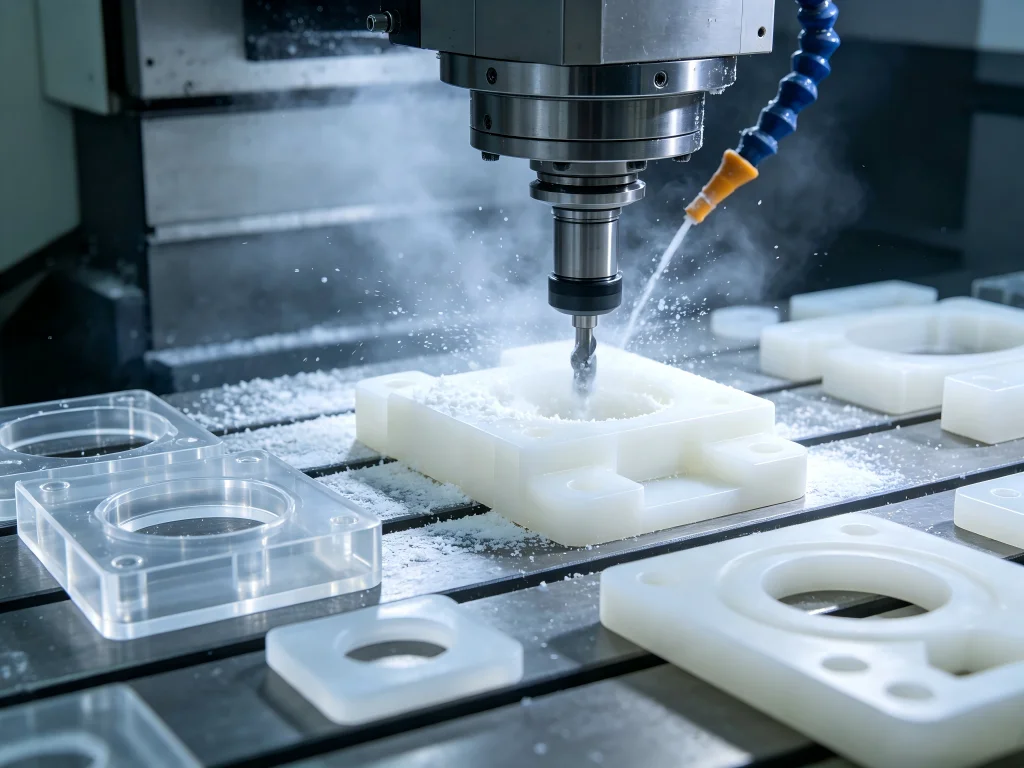
Custom plastic machining refers to the process of using computer-controlled cutting tools to remove material from plastic workpieces, producing components that meet precise dimensional and geometric specifications. The machines themselves—CNC mills, lathes, and routers—are similar to those used for metals. The difference lies entirely in how they are operated. Plastics melt rather than chip when cutting parameters are wrong. They expand up to twenty times more than metals under heat. They absorb moisture from the air, changing dimensions between the machining floor and your assembly line.
Successful custom plastic machining requires a fundamental shift in approach. Tool paths must prioritize chip evacuation over cutting speed. Feeds and speeds must balance material removal with heat management. Fixturing must secure the workpiece without inducing stress that will release as warpage. And the machinist must understand that each plastic grade—from acetal to PEEK to nylon—demands its own set of rules.
JUCHENG, a manufacturer with over 150 CNC machines including 25+ five-axis centers, approaches custom plastic machining with this understanding baked into its processes. The company holds IATF 16949 and ISO 13485 certifications, indicating quality systems designed for the automotive and medical sectors where precision is non-negotiable. Their engineering team includes over thirty senior professionals with thirteen-plus years of experience each, many of whom specialize in the unique challenges of engineering plastics.
What Makes Plastic Different from Metal in CNC Machining
The differences between machining plastics and metals are not minor adjustments—they are fundamental shifts in physics and strategy. Understanding these differences is the first step toward successful custom plastic machining.
Thermal behavior. Plastics dissipate heat far more slowly than metals. The friction from a cutting tool generates heat that stays localized, softening or melting the material at the cutting zone. This leads to melted chips that weld back onto the part, poor surface finishes, and dimensional inaccuracies. The solution involves high-speed cutting with light passes to remove material before heat builds up, combined with compressed air cooling rather than liquid coolants that plastics may absorb.
Moisture sensitivity. Many engineering plastics, particularly nylon, are hygroscopic—they absorb moisture from the air. A part machined to a precise tolerance in a dry environment can grow out of specification by several thousandths of an inch when exposed to normal humidity. Professional shops condition plastic stock before machining, storing it in climate-controlled environments or performing mild annealing processes to achieve dimensional stability.
Clamping and fixturing. Plastics flex under pressure. Over-tightening a vise or clamp induces stress that releases as the material is cut, causing warpage and tolerance failure. Successful custom plastic machining requires gentle but secure fixturing, often using soft jaws or custom fixtures designed specifically for each part geometry.
Tool geometry and wear. Plastics require extremely sharp tools with high rake angles to slice material cleanly rather than push it. Glass-filled plastics are particularly abrasive, rapidly dulling standard carbide tools and requiring diamond-coated or polycrystalline diamond (PCD) tooling.
These differences explain why a shop that excels at metal machining may produce unacceptable plastic parts. The equipment is the same. The knowledge is not.
The Cost of Getting It Wrong: Real-World Consequences
Online discussions across engineering forums reveal the scale of this problem. A Reddit user in r/hobbymachining noted that “machining plastic requires a completely different mindset—you’re not cutting, you’re sculpting, and one wrong move ruins the part.” On Facebook manufacturing groups, procurement professionals frequently share stories of suppliers who promised tight tolerances on plastic parts but delivered components that failed assembly tests.
One engineering manager described ordering two hundred nylon gears for a medical device. The parts arrived within the specified tolerance range but warped within days of installation. The supplier had machined them in an uncontrolled environment without accounting for moisture absorption. The result: a two-week production delay, thousands of dollars in scrap, and a loss of confidence that took months to rebuild.
Another buyer shared a cautionary tale about acrylic display panels that arrived with stress cracks. The machinist had used standard metal-cutting tools and aggressive feed rates, generating enough heat to create micro-fractures that expanded over time.
These stories share a common thread: the assumption that custom plastic machining is simple. It is not simple. It is different. And different requires expertise.
Material Selection: The Foundation of Success
Choosing the right plastic for your application is arguably the most critical decision in any custom plastic machining project. The material determines not only the part’s performance but also its machinability, cost, and lead time. A knowledgeable partner will guide you through this selection process, considering mechanical properties, chemical resistance, thermal performance, and manufacturability.
Common Engineering Plastics for CNC Machining
JUCHENG machines parts from over thirty different plastic materials, each suited to specific applications. The most commonly specified include:
POM (Acetal / Delrin). This material offers high stiffness, low friction, and excellent dimensional stability. It is the top choice for CNC-machined gears, bearings, bushings, rollers, and precision alignment components. POM machines cleanly and holds tight tolerances, making it a favorite for functional prototypes and production parts alike.
PEEK (Polyether Ether Ketone). A high-performance thermoplastic with exceptional strength retention at elevated temperatures—continuous service up to 250°C (482°F). PEEK offers broad chemical resistance and is specified for medical, semiconductor, and aerospace applications where reliability under extreme conditions is mandatory. It machines well but requires sharp tooling and careful heat management due to its high melting point.
Nylon (PA6, PA66, PA+GF30). Known for strength, wear resistance, and self-lubricating properties, nylon is ideal for bearings, slide components, and structural brackets. Glass-filled nylon (PA+GF30) offers superior mechanical strength and dimensional stability but is highly abrasive on cutting tools, requiring diamond-coated or PCD tooling. Moisture management is critical with nylon—parts must be conditioned before machining and inspected under controlled conditions.
ABS (Acrylonitrile Butadiene Styrene). Impact-resistant and easy to machine, ABS is a reliable choice for prototypes, housings, and enclosures. It accepts paint, adhesive, and ultrasonic welding readily, making it versatile for pre-production validation.
Acrylic (PMMA). Transparent, rigid, and lightweight, acrylic serves as a glass substitute for light pipes, display panels, and optical housings. It is sensitive to heat buildup during machining and requires air cooling and polished flute tooling to prevent crazing.
PTFE (Teflon). Offering extremely low friction and chemical inertness, PTFE is specified for seals, gaskets, and valve seats. It is soft and requires gentle handling during machining, with custom soft-jaw fixtures and reduced clamping force to maintain dimensional accuracy.
Polycarbonate (PC). Strong and clear, polycarbonate is ideal for applications requiring impact resistance and optical clarity. Heat control during machining is essential to prevent melting or deformation.
How to Choose the Right Material
Selecting the optimal plastic for your custom plastic machining project involves answering several questions about the operating environment and performance requirements:
- What mechanical loads will the part experience? Consider strength, stiffness, wear resistance, and fatigue life.
- What temperatures will it encounter? Continuous service temperature, peak excursions, and thermal cycling all matter.
- What chemicals or fluids will it contact? Solvents, cleaning agents, fuels, and bodily fluids can all degrade specific plastics.
- Does it need to be transparent, food-safe, or biocompatible? Regulatory requirements may dictate material choices.
- What is the production volume? Some materials are easier to machine at scale than others.
- What is the tolerance requirement? Dimensional stability under machining and environmental conditions varies by material.
A competent custom plastic fabrication partner will use this information to recommend the right material for strength, heat resistance, chemical exposure, clarity, and cost. They will also consider material availability and lead times, ensuring your project stays on schedule.
Key Considerations When Sourcing Custom Plastic Machining
Selecting a supplier for custom plastic machining requires evaluating factors beyond price and lead time. The following considerations separate reliable partners from those who will deliver frustration.
Material Knowledge and Sourcing
A good partner helps you select the right plastic for performance, availability, and manufacturability. They understand the nuances of each material—how it behaves under the tool, how it responds to environmental conditions, and what post-processing it requires. They also maintain relationships with material suppliers, ensuring consistent quality and reliable sourcing.
JUCHENG, for example, stocks high-performance plastics including PEEK, PTFE, PMMA, and glass-filled nylon, enabling rapid turnaround on projects that require specialized materials. Their material knowledge extends to recommending alternatives when specified materials are unavailable or cost-prohibitive.
Quality Systems and Certifications
For critical applications, an ISO-based quality system provides a baseline for consistency and documentation. Certifications such as ISO 9001, IATF 16949 (automotive), and ISO 13485 (medical) indicate that a supplier has established processes for quality management, traceability, and continuous improvement.
JUCHENG holds IATF 16949 and ISO 13485 certifications, positioning them to serve industries where quality is non-negotiable. Their quality system includes dimensional inspection documentation, material certificates, and batch traceability for every order.
Equipment Capability and Capacity
The range of equipment a shop operates determines what parts they can produce and how quickly. Three-axis machining handles many parts, but complex geometries may require four- or five-axis capabilities. Turning centers are necessary for cylindrical parts. And the number of machines influences capacity and lead time.
JUCHENG operates a fleet of 150+ CNC machines, including 25+ five-axis centers, providing both capability and capacity for projects of any scale. This equipment base enables them to handle complex geometries, tight tolerances, and production volumes from single prototypes to high-volume runs.
Surface Finish and Post-Processing
Many custom plastic machining projects require surface finishing beyond the as-machined state. Options include polishing, sandblasting, silk-screening, painting, and various coatings. A supplier with in-house finishing capabilities reduces vendor handoffs and improves consistency.
JUCHENG offers a wide range of surface finishing services, from simple deburring to high-gloss polishing and specialized coatings. They achieve finishes as smooth as Ra 0.8μm through fine machining and polishing processes.
Engineering Support and DFM
The best custom plastic fabrication partners provide design for manufacturability (DFM) feedback before cutting begins. They identify features that are difficult or expensive to machine, suggest alternatives, and optimize designs for production.
JUCHENG’s engineering team includes over thirty senior engineers who review designs and provide DFM guidance. This collaboration helps clients avoid costly design revisions and ensures parts are manufacturable at the specified tolerances.
Capabilities That Define a Premier Plastic Machining Partner
When evaluating suppliers for custom plastic machining, consider the full spectrum of capabilities they offer. A partner with comprehensive services reduces the number of vendors you need to manage and improves overall consistency.
CNC Machining Capabilities
High-precision three-, four-, and five-axis milling, turning, and grinding form the core of any custom plastic machining operation. Five-axis simultaneous machining enables complex geometries to be produced in fewer setups, improving accuracy and reducing lead time.
JUCHENG’s five-axis centers allow them to machine intricate plastic components with superior positional accuracy. Their turning capabilities handle cylindrical parts, from simple bushings to complex threaded components.
Complementary Manufacturing Processes
Beyond CNC machining, leading suppliers offer complementary processes that expand their ability to solve customer problems:
- 3D printing for rapid concept models and early prototypes.
- Injection molding for high-volume production runs.
- Sheet metal fabrication for structural brackets and enclosures.
- Vacuum casting for low-volume plastic series without tooling costs.
JUCHENG operates 50+ industrial 3D printers and 35+ injection presses alongside their CNC machining fleet, providing a one-stop solution for projects that span prototyping and production. This breadth of capability means clients can transition from prototype to production without changing suppliers.
Comparing Custom Plastic Machining Providers
The following table compares key attributes to consider when evaluating custom plastic machining suppliers:
| Attribute | Basic Supplier | Premier Supplier (e.g., JUCHENG) |
|---|---|---|
| Material range | Limited to common plastics | 30+ materials including PEEK, PPS, PTFE, Ultem |
| Equipment | 3-axis mills, basic lathes | 150+ machines including 25+ 5-axis centers |
| Certifications | ISO 9001 (maybe) | IATF 16949, ISO 13485 |
| Quality documentation | Basic inspection | Dimensional reports, material certificates, batch traceability |
| Engineering support | Minimal DFM feedback | 30+ senior engineers, proactive DFM guidance |
| Surface finishing | As-machined only | Polishing, sandblasting, silk-screen, painting, anodizing |
| Complementary processes | CNC only | 3D printing, injection molding, sheet metal, vacuum casting |
| Lead time | Variable, often unpredictable | 7–15 days standard, expedited available |
This comparison illustrates why custom plastic fabrication projects succeed with premier suppliers and struggle with basic ones. The differences in equipment, expertise, and quality systems translate directly into part quality, consistency, and on-time delivery.
Frequently Asked Questions About Custom Plastic Machining
1. What tolerances can custom plastic machining achieve?
Custom plastic machining can achieve tolerances as tight as ±0.01mm (0.0004 inches) with the right equipment and expertise. However, achievable tolerances depend on the material, part geometry, and environmental conditions. Plastics with high moisture absorption or thermal expansion may require looser tolerances or special handling. A knowledgeable supplier will advise on what is achievable for your specific application.
2. Is custom plastic machining cheaper than metal machining?
In most cases, custom plastic machining is more cost-effective than metal machining for prototyping and low-volume production. Plastics are cheaper to source, faster to cut, and cause less tool wear. However, the cost advantage diminishes for high-volume production, where injection molding may be more economical. The optimal manufacturing method depends on quantity, complexity, and material requirements.
3. How do I choose between CNC machining and 3D printing for plastic parts?
CNC machining is best for functional parts that require tight tolerances, strong mechanical properties, and production-grade materials. 3D printing is faster and more cost-effective for concept models and early prototypes. For parts that will eventually be injection molded, CNC-machined prototypes using the production material provide the most accurate validation.
4. What causes warpage in machined plastic parts?
Warpage in custom plastic machining typically results from three factors: heat buildup during cutting, stress induced by clamping, or moisture absorption. Proper toolpath strategies, gentle fixturing, and material conditioning prevent these issues. A supplier who understands plastic behavior will address all three factors in their machining process.
5. Can all plastics be CNC machined?
Most engineering thermoplastics can be CNC machined, but machinability varies widely. Soft materials like PTFE require gentle handling. Abrasive materials like glass-filled nylon require specialized tooling. Heat-sensitive materials like acrylic require careful cooling. A competent custom plastic fabrication partner will know which materials are suitable for your application and how to machine them successfully.
6. What documentation should I expect with a custom plastic machining order?
For quality-critical applications, expect dimensional inspection reports, material certificates, and batch traceability documentation. These documents provide evidence that parts meet specifications and enable traceability in regulated industries. Premier suppliers like JUCHENG provide this documentation as standard practice.
7. How long does custom plastic machining typically take?
Standard lead times for custom plastic machining range from seven to fifteen days for stocked materials. Expedited options are often available for urgent projects. Lead times may extend for specialized materials, complex geometries, or high volumes. A supplier with extensive material stock and equipment capacity can typically offer shorter lead times.
8. What is the minimum order quantity for custom plastic machining?
Many custom plastic machining suppliers have no minimum order quantity (MOQ). This makes CNC machining ideal for prototypes and low-volume production runs where injection molding would be cost-prohibitive. Some suppliers may have minimum charges for setup and programming, but these are typically modest for straightforward parts.
Why JUCHENG for Custom Plastic Machining
JUCHENG has built its reputation on solving the challenges that custom plastic machining presents. Their approach combines extensive equipment capability, deep material knowledge, and rigorous quality systems to deliver parts that meet specifications consistently.
Industry-certified quality. JUCHENG holds IATF 16949 and ISO 13485 certifications, demonstrating quality systems designed for automotive and medical applications where precision is critical. Their quality documentation includes dimensional inspection reports, material certificates, and full batch traceability.
Massive manufacturing capacity. With 150+ CNC machines including 25+ five-axis centers, 50+ industrial 3D printers, and 35+ injection presses, JUCHENG handles projects from single prototypes to high-volume production runs. This capacity translates into reliable lead times and the ability to scale production as demand grows.
Deep material expertise. JUCHENG machines parts from over thirty plastic materials, including PEEK, PPS, PTFE, Ultem, POM, nylon, ABS, and polycarbonate. Their engineering team provides DFM guidance and material recommendations, helping clients select the right plastic for their application.
Comprehensive surface finishing. In-house finishing capabilities including polishing, sandblasting, silk-screening, and painting reduce vendor handoffs and ensure consistent quality. Finishes as smooth as Ra 0.8μm are achievable through fine machining and polishing.
One-stop manufacturing. Beyond custom plastic machining, JUCHENG offers complementary processes including 3D printing, sheet metal fabrication, injection molding, and vacuum casting. This breadth of capability allows clients to consolidate suppliers and streamline their supply chain.
Proven track record. JUCHENG has served clients across automotive, medical, aerospace, and industrial sectors, delivering precision components that meet demanding specifications. Their engineering team’s experience with high-performance plastics ensures that even challenging materials are machined successfully.
When your project demands precision, reliability, and expertise in custom plastic machining, JUCHENG provides the capabilities and quality systems to deliver. Their combination of equipment, expertise, and certifications positions them as a partner who can handle the complexities that plastics present.
Request a quote for your next custom plastic machining project and experience the difference that specialized expertise makes. With no minimum order quantity and rapid lead times on stocked materials, JUCHENG makes it easy to get precision plastic parts when you need them.
Get a custom plastic machining quote from JUCHENG and see how the right partner transforms your design into reality.
Explore JUCHENG’s CNC machining capabilities and discover how their equipment and expertise support your project.