
Einleitung: Die Präzisionskraft von Drahterodier-Services
In der Welt der fortschrittlichen Fertigung, in der Komplexität auf kompromisslose Genauigkeit trifft, hebt sich ein spezialisiertes Verfahren besonders ab. Drahterodier-Services repräsentieren den Höhepunkt der Präzisionsbearbeitung und ermöglichen die Herstellung von Teilen, die einst als unmöglich oder unerschwinglich teuer galten. Dieses berührungslose thermische Bearbeitungsverfahren nutzt kontrollierte elektrische Funken, um selbst härteste Metalle mit erstaunlicher Genauigkeit zu durchtrennen und dabei eine überlegene Oberfläche und perfekte Geometrie zu hinterlassen. Für Branchen, in denen Fehler keine Option sind – Luft- und Raumfahrt, Medizintechnik, Verteidigung und darüber hinaus – ist Drahterodieren nicht nur eine Dienstleistung; es ist ein entscheidender Wegbereiter für Innovation. Es verwandelt anspruchsvolle Designs in Realität, von komplexen Prototypen bis hin zu Serienfertigungsläufen, und hält dabei Toleranzen ein, die mit der Breite eines menschlichen Haares konkurrieren. Dieser Artikel befasst sich mit der Leistungsfähigkeit dieser Technologie und untersucht ihre Prinzipien, Vorteile und die umfangreichen Möglichkeiten, die sie dem modernen Ingenieurwesen bietet.
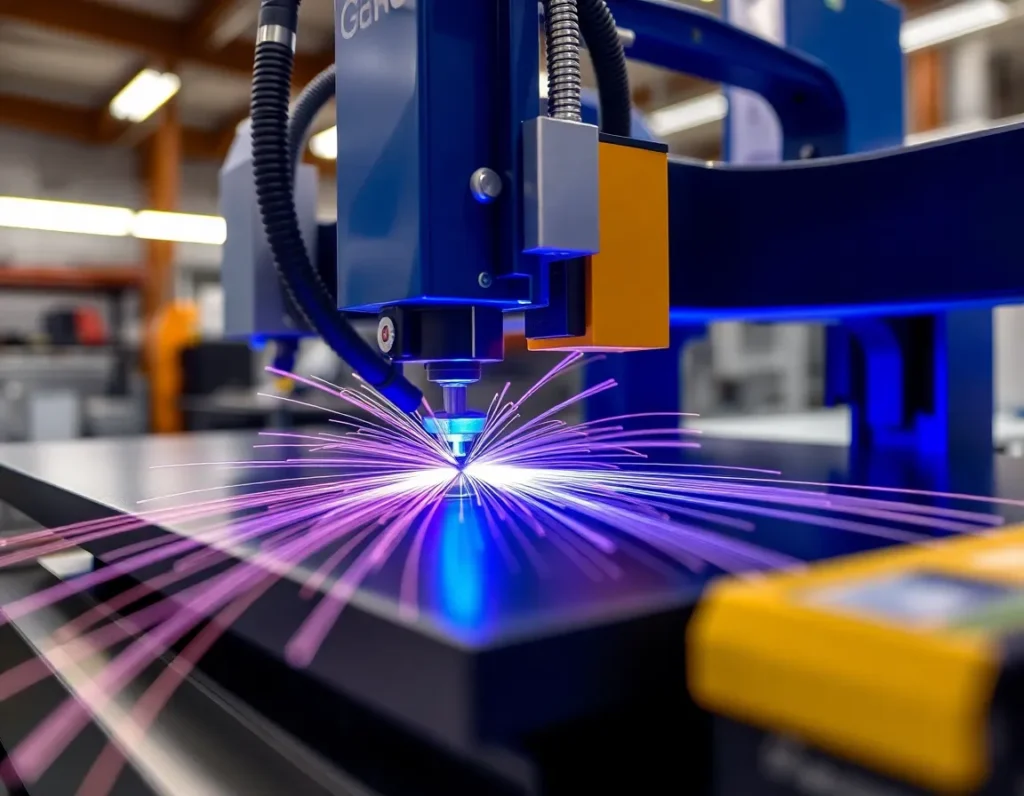
Was ist Drahterodieren? Ein tiefer Einblick in die elektroerosive Bearbeitung
Die drahtelektroerosive Bearbeitung (Wire EDM) ist ein Präzisionsverfahren zur Metallabtragung, bei dem ein dünner, elektrisch geladener Draht als Elektrode verwendet wird, um eine programmierte Kontur in ein Werkstück zu schneiden. Das Grundprinzip beruht auf kontrollierter Erosion durch eine Reihe schneller, wiederkehrender elektrischer Entladungen (Funken) zwischen dem Draht und dem leitfähigen Material, das in ein dielektrisches Fluid, typischerweise deionisiertes Wasser, eingetaucht ist.
Der Kernmechanismus: Funkenerosion
Der Prozess beginnt mit dem CNC-gesteuerten Draht, der kontinuierlich von einer Spule zugeführt wird und nahe am Werkstück positioniert ist, aber niemals physischen Kontakt herstellt. Zwischen dem Draht (negative Elektrode) und dem Werkstück (positive Elektrode) wird ein starkes elektrisches Potenzial erzeugt. Wenn der Spalt klein genug ist, bricht die Isoliereigenschaft des dielektrischen Fluids zusammen und ein Funke springt über. Dieser Funke erzeugt eine intensive, lokalisierte Hitze – über 10.000 Grad Celsius – die sofort einen mikroskopisch kleinen Teil des Werkstücks schmilzt und verdampft. Das fließende dielektrische Fluid spült dann die winzigen Ablagerungen weg und kühlt den Bereich, wodurch thermische Verformung verhindert wird. Dieser Zyklus wiederholt sich Hunderttausende Male pro Sekunde und erodiert stetig und präzise einen Pfad durch das Material.
Hauptkomponenten des Drahterodiersystems
- Die Drahtelektrode: Typischerweise aus Messing oder geschichtetem Kupfer gefertigt, kann der Drahtdurchmesser von 0,004 Zoll für Mikropräzisionsarbeiten bis über 0,012 Zoll für schwerere Schnitte reichen. Er ist ein Verbrauchsmaterial und läuft mit konstanter Geschwindigkeit von einer Vorratsspule zu einer Aufwickelspule.
- Das dielektrische Fluid (deionisiertes Wasser): Erfüllt drei kritische Funktionen: Es wirkt als Isolator, bis die Funkenspaltspannung erreicht ist, es spült erodierte Partikel weg (die “Späne” des Prozesses) und es kühlt das Werkstück und den Draht.
- Das CNC-Steuerungssystem: Das Gehirn der Operation. Es steuert präzise die Bewegung des Drahtes entlang der X- und Y-Achse (und oft auch U und V für Schrägschnitte) basierend auf einem digitalen Programm und kontrolliert den Spalt, die Drahtvorschubgeschwindigkeit und die Leistungseinstellungen, um die gewünschte Schnittqualität, Geschwindigkeit und Oberflächenbeschaffenheit zu erreichen.
- Der Arbeitstisch & die Stromversorgung: Das Werkstück wird sicher auf einem servogesteuerten Arbeitstisch gespannt. Die Stromversorgung erzeugt den gepulsten Gleichstrom, der die Funken erzeugt, wobei die Parameter fein auf das spezifische Material und die Oberflächenanforderungen abgestimmt werden.
Diese “berührungslose” Natur verleiht der Drahterosion ihren einzigartigen Vorteil: Da keine mechanische Kraft auf das Teil ausgeübt wird, gibt es keinen Werkzeugdruck, keine Gratbildung und kein Risiko der Verformung empfindlicher oder dünnwandiger Merkmale. Der Prozess kann gehärteten Stahl genauso einfach bearbeiten wie Aluminium, was ihn zu einer einzigartig vielseitigen Lösung im Arsenal der Präzisionsfertigung macht.
Drahterosion vs. konventionelle Bearbeitung: Wann und warum EDM wählen
Die Wahl des richtigen Fertigungsprozesses ist eine kritische technische Entscheidung. Während konventionelle Bearbeitung (Fräsen, Drehen) für viele Anwendungen hervorragend geeignet ist, bietet die Drahterosion eine Reihe von Vorteilen für spezifische Herausforderungen. Die Wahl hängt oft von Materialeigenschaften, Bauteilgeometrie, erforderlicher Präzision und Kosteneffizienz ab.
Wann Drahterosion die überlegene Wahl ist
- Gehärtete Materialien: Konventionelle Schneidwerkzeuge haben Schwierigkeiten mit oder können gehärtete Werkzeugstähle, Hartmetalle und exotische Legierungen nicht bearbeiten. Der Funkenerosionsprozess der Drahterosion wird von der Materialhärte nicht beeinflusst, sodass Teile zuerst wärmebehandelt (für optimale Festigkeit und Stabilität) und dann ohne Verformung auf Endmaße bearbeitet werden können.
- Extreme geometrische Komplexität: Komplizierte Profile, scharfe Innenkanten und empfindliche Merkmale sind die Domäne der Drahterosion. Der dünne Draht kann komplexe 2D- und 3D-Konturen schneiden, die für einen Schaftfräser unmöglich zu erreichen wären oder prohibitiv teure kundenspezifische Formwerkzeuge erfordern würden.
- Anspruchsvolle Toleranzen und Oberflächen: Für Anwendungen, die Toleranzen innerhalb von ±0,0001” und ultrafeine Oberflächen erfordern, ist die Drahterosion oft die zuverlässigste und wiederholbarste Methode. Der Prozess eliminiert Rattern und Werkzeugablenkung und gewährleistet gleichbleibende Genauigkeit von Teil zu Teil.
- Kein Grat, geringe Spannung: Da kein physischer Kontakt besteht, erzeugt der Prozess praktisch gratfreie Kanten. Die wärmebeeinflusste Zone ist minimal, und das Fehlen von Schnittkräften bedeutet, dass keine mechanische Spannung in das Werkstück eingebracht wird, wodurch seine metallurgische Integrität erhalten bleibt.
- Prototyping and Low-Volume Production: No custom tooling is required. A simple digital program is all that’s needed to cut a part, making wire EDM exceptionally fast and cost-effective for prototypes, one-off parts, and short runs compared to designing and fabricating hard tooling.
Limitations and Conventional Machining Advantages
Conventional machining typically holds the advantage in speed for large volumes of simple parts, bulk material removal, and machining non-conductive materials (like plastics or composites). It is also generally more economical for producing simple holes and pockets in soft materials. Wire EDM is a slower, more precise cutting process best suited for conductive materials where its unique benefits are required. The most effective manufacturing strategy often involves using both: conventional machining for roughing and basic shaping, followed by wire EDM for finishing critical features on a hardened part.
Core Wire EDM Services and Capabilities: From Prototyping to Production
Modern wire cut EDM services have evolved far beyond simple shape cutting. They encompass a sophisticated suite of capabilities designed to support every stage of the product lifecycle, from initial concept to full-scale manufacturing.
Prototyping and Rapid Turnaround
For engineers and designers, wire EDM is an invaluable prototyping tool. The ability to go directly from a CAD model to a finished, precision metal part without tooling enables rapid iteration and design validation. Service providers specializing in quick-turn EDM can often produce sample parts within days, allowing for functional testing of complex gears, medical implant prototypes, or aerospace components under real-world conditions. This agility accelerates development cycles and reduces time-to-market.
High-Volume Production and Palletized Systems
Contrary to common perception, wire EDM is not solely for prototypes. For high-volume production of intricate components, advanced EDM shops utilize palletized systems and automated wire threading. Multiple parts can be stacked or “nested” on a single fixture, and machines can run unattended for hours, cutting dozens of parts from a single thick block of material. This method ensures absolute accuracy and repeatability across thousands of parts, making it ideal for critical production runs in the medical device and automotive industries.
Advanced Technical Capabilities
- 4-Axis and Taper Cutting: Beyond simple vertical cuts, advanced wire EDMs can tilt the wire to create parts with drafted sides or complex 3D contours. Tapers up to 30 degrees or more allow for the creation of molds, dies, and aerospace components with clearance angles.
- Fine Wire and Micro-EDM: Using wire as small as 0.004” in diameter, this capability is essential for micro-miniature parts in medical, semiconductor, and electronics applications. It allows for incredibly small corner radii, narrow slots, and the machining of extremely delicate features.
- Submerged Cutting: Performing cuts fully submerged in dielectric fluid provides superior thermal stability, crucial for holding tight tolerances on tall or thick workpieces. It also results in a finer surface finish and more efficient flushing during interrupted cuts.
- Large-Part Capacity: Industrial wire EDM machines can handle massive workpieces, with travel capabilities exceeding 30” in X and Y axes and the ability to cut material thicknesses of 16” or more, accommodating large stamping dies, aerospace structural components, and industrial tooling.
- Anti-Electrolysis Power Supplies: For sensitive materials like medical-grade titanium or certain tool steels, this technology prevents the electrochemical pitting or corrosion that can sometimes occur with standard EDM, ensuring pristine surface integrity.
Integrated Manufacturing Support
Leading EDM service providers operate as full-service contract manufacturers. This means they offer complete machine shop support, including CNC milling and turning, quality inspection (with CMMs and optical comparators), and secondary operations like abrasive flow machining (AFM) to polish and remove the thin recast layer from EDM surfaces. This integrated approach provides a single source for the entire component, streamlining logistics and ensuring seamless quality control from raw material to finished part.
Key Industries Served: Aerospace, Medical, Defense, and Commercial Applications
The unique capabilities of wire EDM make it indispensable across sectors where precision, material integrity, and complex geometries are non-negotiable. Specialized wire cut edm services are not a one-size-fits-all solution; they are tailored to meet the stringent and often unique demands of each field.
Aerospace & Satellite Machining
In aerospace and satellite manufacturing, components must perform flawlessly under extreme stress, temperature fluctuations, and in vacuum conditions. Wire EDM is used to produce critical parts such as turbine engine components, fuel system elements, structural brackets, and satellite guidance mechanisms. The process’s ability to machine hardened, high-strength alloys and exotic materials like Inconel and titanium after heat treatment—without inducing stress or distortion—is paramount. Tolerances within .0002” and superior surface finishes ensure parts meet rigorous AS9100 and NADCAP standards for flight-worthiness and long-term reliability.
Medical & Surgical Device Manufacturing
The medical industry relies on wire EDM for life-saving and life-enhancing devices. This includes the production of intricate components for surgical tools, implants (such as knees, hips, and spinal devices), biopsy needles, and micro-scale parts for minimally invasive robotics. Medical-grade materials like stainless steels, titanium, and cobalt-chrome are machined to exceptional finishes to prevent bacterial adhesion and ensure biocompatibility. The process’s precision in creating sharp, burr-free edges and complex internal features in hardened materials is critical for device performance and patient safety, adhering to ISO 13485 and FDA guidelines.
Defense & Military Applications
Defense projects demand uncompromising accuracy, durability, and secrecy. Wire EDM services are employed to manufacture components for firearms, optical systems, armored vehicle systems, and communication devices. The technology excels at producing hardened tooling for ammunition production, intricate gears for guidance systems, and robust parts from tungsten alloys. The ability to handle classified ITAR-controlled projects and work with difficult-to-machine armor plate materials makes a capable EDM partner a strategic asset for defense contractors.
Commercial & Industrial Tooling
Beyond these high-stakes fields, wire EDM is the backbone of advanced commercial manufacturing. It is essential for producing precision tool and die sets for stamping, molding, and extrusion processes. This includes punches, dies, ejector pins, and mold inserts for plastic injection molding. The semiconductor industry uses EDM for wafer handling components and fixtures. Automotive manufacturers leverage it for prototype parts and production tooling. The commercial benefit lies in the technology’s ability to extend tool life by machining after hardening and to create complex geometries that improve end-product quality and manufacturing efficiency.
The Wire EDM Process: Technology, Techniques, and Tolerances
Understanding the mechanics behind wire EDM demystifies its precision. At its core, it is a thermoelectric process where material is removed by a series of controlled electrical sparks (discharges) between a traveling wire electrode and the conductive workpiece.
Core Technology and Setup
The workpiece is securely mounted on the machine table, submerged in a tank of deionized water, which acts as a dielectric fluid to cool the cut and flush away eroded particles. A thin, precisely spooled wire (typically brass or coated varieties) is fed from a supply spool through the workpiece and onto a take-up spool. The wire is constantly moving to present a fresh, erosive surface. A power supply generates a pulsed DC current, creating rapid sparks in the gap between the wire and the workpiece. These sparks, which can number in the tens of thousands per second, generate intense heat (around 10,000°C) that melts and vaporizes microscopic portions of the material.
Key Techniques for Enhanced Capability
- CNC Path Control: The wire’s path is dictated by sophisticated CNC programming, allowing for the cutting of intricate 2D profiles or complex 3D shapes with tapered sides.
- Submerged Cutting: Operating fully submerged stabilizes the wire thermally and mechanically, enabling higher accuracy and finer finishes, especially in tall or interrupted cuts.
- Automatic Wire Threading (AWT): This feature allows the machine to automatically re-thread the wire through a starter hole, enabling the unattended machining of multiple parts or complex internal features without operator intervention.
- Multiple Passes (Roughing & Skimming): A part is often cut using a series of passes. A first, faster pass removes the bulk of material, leaving a rough surface. Subsequent, slower “skim” passes with a reduced power setting use a slight wire offset to achieve the final dimension, a superior surface finish, and tight tolerances.
- Fine Wire EDM: Utilizing wire as small as 0.004” in diameter, this technique is for micro-machining, producing extremely small radii, slots, and delicate parts with exceptional precision.
Achievable Tolerances and Finishes
The precision of modern wire EDM is extraordinary. Standard tolerances for production work are routinely within ±0.0002” (0.005mm), with some applications holding tolerances as tight as ±0.0001”. Surface finishes of 8-10 microinches Ra (0.2-0.25 µm Ra) are achievable with multi-pass skimming, often eliminating the need for secondary polishing. The process can produce sharp inside corners with very small radii, limited only by the wire diameter and spark gap. This combination of dimensional accuracy and fine finish is what sets high-end wire cut EDM services apart from conventional machining for complex, hardened components.
Materials Mastery: Machining Hardened Steels, Exotics, and Conductive Materials
One of the most compelling advantages of wire EDM is its material agnosticism. Since the process cuts via electrical discharge rather than mechanical force, the hardness, toughness, or wear resistance of the material presents no barrier. This opens a world of possibilities for engineers designing with advanced materials.
Hardened Tool Steels and Alloys
Wire EDM is the preferred method for machining tool steels (like D2, A2, M2, H13) and high-speed steels after they have been fully hardened, often to 60 HRC or higher. Machining post-heat-treatment avoids the dimensional distortions that can occur during the quenching process, saving time and cost associated with secondary machining and correction. This capability is fundamental to the tool and die industry, ensuring cutting dies and mold inserts retain their precise geometry and durability.
Exotic and Difficult-to-Machine Alloys
Industries such as aerospace and medical regularly employ superalloys and exotic materials known for their strength and resistance to heat and corrosion. These materials, which are notoriously challenging for conventional machining, are readily processed by wire EDM. This includes:
- Nickel-Based Superalloys: Inconel, Monel, Hastelloy.
- Titanium Alloys: Ti-6Al-4V, CP Titanium.
- Carbides: Tungsten carbide, used for extreme wear applications.
- Other Exotics: Kovar, Molybdenum, and various beryllium-copper alloys.
Conductive Composites and Specialty Materials
The only strict requirement for wire EDM is that the material must be electrically conductive. This extends its use to advanced composites like metal matrix composites (MMCs) and certain graphite grades used in EDM electrodes. Even conductive ceramics and polycrystalline diamond (PCD) can be cut using specialized wire EDM techniques. This mastery over such a diverse material portfolio allows designers to select the ideal material for a component’s function without being constrained by manufacturability concerns.
Complementary EDM Services: Sinker EDM, Hole Drilling, and Abrasive Flow Machining
A full-service EDM provider offers more than just wire cutting. A suite of complementary processes addresses a wider range of geometric challenges and ensures complete part readiness, often within a single facility.
Sinker EDM (Ram EDM)
Also known as conventional or cavity-type EDM, sinker EDM uses a pre-shaped electrode (typically graphite or copper) that is lowered into the workpiece to create a negative impression. This is ideal for producing complex 3D cavities, blind features, sharp internal corners, and textured surfaces that are impossible for a wire to create. Common applications include intricate mold cavities for plastic injection or die casting, forging dies, and machining internal splines or gears. It is the perfect partner to wire EDM for complex tooling.
EDM Hole Drilling (Fast Hole EDM / Hole Popping)
This specialized process uses a rotating tubular electrode to rapidly drill small, deep, and accurate holes in conductive materials—regardless of hardness. It is indispensable for creating starter holes for wire EDM threading, cooling channels in mold tools, fuel injection nozzles, and turbine blade cooling holes. Capabilities include drilling holes as small as 0.010” in diameter with high depth-to-diameter ratios and at shallow angles to surfaces, a task extremely difficult for conventional drilling, especially in hardened materials.
Abrasive Flow Machining (AFM)
While EDM produces excellent finishes, it leaves behind a thin, recast layer or “white layer” on the surface, which can be microscopically fractured. For applications requiring ultimate fatigue resistance, corrosion resistance, or a polished surface (like medical implants or fluid flow paths), AFM is the ideal finishing step. AFM extrudes a viscous, abrasive-laden media through or across the part’s surfaces. It uniformly deburrs, polishes, and removes the EDM recast layer, producing radii and improving surface finishes without altering the part’s critical dimensions. This process is key to achieving the highest quality standards in finished EDM components.
Ensuring Quality: Certifications, Standards, and Quality Assurance in EDM
For industries where component failure is not an option, the quality assurance framework behind wire cut EDM services is as critical as the machining itself. The process’s precision is only as reliable as the system that governs it. Leading providers embed quality at every stage, from initial programming to final inspection, supported by a foundation of rigorous certifications and standardized procedures.
Certifications are the cornerstone of trust. The AS9100 standard, built upon ISO 9001, is the aerospace benchmark, mandating stringent controls for design, traceability, and risk management. For medical device manufacturing, ISO 13485 certification is essential, ensuring processes meet regulatory requirements for safety and efficacy. Specialized accreditations like NADCAP for EDM represent an even higher audit level, where technical processes are scrutinized by industry experts. A shop holding these credentials demonstrates a proven, audited commitment to systematic quality management.
This systemic approach translates into concrete shop-floor practices. First-article inspection reports (FAIR) meticulously validate that initial production parts meet all print specifications. In-process verification, using tools like optical comparators and coordinate measuring machines (CMM), ensures consistency throughout a production run. Advanced shops employ vision systems and laser scanners for non-contact inspection of delicate or complex geometries. Crucially, all inspection equipment is regularly calibrated against NIST-traceable standards to guarantee measurement integrity.
Material certification and traceability are non-negotiable, especially in aerospace and medical applications. Providers must be able to document a component’s material pedigree from mill to finished part. Process documentation, including detailed traveler packets that follow each job, ensures every step—from EDM cut parameters to post-process treatments like abrasive flow machining—is recorded and repeatable. This level of documentation not only assures quality but also provides vital data for continuous improvement and root-cause analysis should any deviation occur.
Ultimately, a true quality culture extends beyond certificates on the wall. It is reflected in a team of highly skilled personnel dedicated to perfection, a pledge to complete customer satisfaction, and a drive for continuous technical development. This holistic approach to quality assurance is what transforms a precision cutting service into a reliable manufacturing partner for mission-critical components.