
+86-188-7042-1176
project@jcproto.com
Mon-Fri: 8am-6pm (GMT+8)
EN
ISO 9001:2015 Certified
Wire EDM
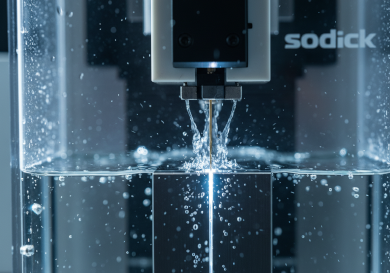
Wire Electrical Discharge Machining (Wire EDM) is a non-contact subtraction process that uses a thin, electrically charged wire (usually brass) to erode conductive materials. Unlike traditional milling, Wire EDM exerts zero mechanical force on the part, making it ideal for machining extremely fragile parts or hardened materials (up to 70 HRC) without distortion.
At Jucheng Precision, we operate advanced Sodick and Fanuc Wire EDM machines. We specialize in producing intricate contours, tight-tolerance extrusion dies, and complex medical components that require accuracy as fine as +/- 0.002mm. Our 4-axis capabilities also allow us to cut tapers for mold draft angles or variable geometry parts.
Key Specifications
| Specification | Technical Range | Note |
|---|---|---|
| Max Part Size | 600 mm x 400 mm x 300 mm | Depends on tank travel |
| Machining Tolerance | +/- 0.002 mm (2 microns) | Ultra-precision capability |
| Surface Roughness (Ra) | Down to 0.4 µm (Mirror EDM) | Eliminates polishing needs |
| Wire Diameter | 0.10 mm – 0.30 mm | 0.25mm is standard |
| Min. Corner Radius | 0.06 mm | Limited by wire diameter |
| Compatible Materials | Conductive Materials Only | Steel, Titanium, Carbide, Copper |
| Taper Angle | Up to +/- 30 degrees | For 4-axis cutting |
Cutting Strategies
| Strategy | Description | Key Benefits & Applications |
|---|---|---|
| 2-Axis Contouring | The wire remains vertical (90°) to cut straight walls, holes, or profiles through a block. | Benefit: Perfect verticality and straightness. App: Gears, splines, punch dies, through-holes. |
| 4-Axis Taper Cutting | The top and bottom wire guides move independently to cut angled walls or different shapes on top/bottom. | Benefit: Creates complex geometries like cones or mold drafts. App: Injection mold cores, extrusion dies, nozzles. |
| Skim Cutting | Multiple passes (rough cut followed by light finishing passes) to improve accuracy and surface finish. | Benefit: Achieves “mirror” finishes and micron-level tolerances. App: High-precision gauges, aerospace instrumentation. |
| Stacked Cutting | Stacking multiple thin sheets of metal and cutting them simultaneously. | Benefit: Extremely efficient for high-volume sheet metal parts. App: Laminations for motors, shims, brackets. |
Design Guidelines for Wire EDM
Conductive Materials Only:
Wire EDM requires the workpiece to conduct electricity. We can cut Hardened Steel, Titanium, Tungsten Carbide, and Brass. We cannot cut plastics, ceramics (unless conductive), or wood.
Internal Corner Radii:
The wire has a diameter (usually 0.25mm), so sharp internal corners are impossible. The minimum radius is Wire Radius + Spark Gap (approx 0.135mm). Tip: Design internal corners with a specific radius rather than “sharp.”
Start Holes:
To cut an internal feature (like a hole inside a block), we must first drill a “start hole” to thread the wire through. Tip: If machining hardened steel, pre-drill start holes before heat treatment, or we can use our “Hole Popper” (EDM Drill).
Relieving Stress:
EDM cuts by heat. Although the heat affected zone is small, cutting a large chunk out of a stressed material block can cause it to warp and “pinch” the wire. Tip: Heat treat and double-temper materials before EDM to stabilize them.
Industry Applications
Tool & Die Making
The primary use of Wire EDM. Fabricating carbide punch dies, extrusion dies, and blanking tools with zero clearance for stamping industries.
Aerospace
Cutting exotic superalloys (Inconel, Hastelloy) for turbine fir-tree root slots and fuel system components where milling tools would fail.
Medical Devices
Manufacturing intricate surgical instruments and implants from Titanium and Stainless Steel where burr-free edges are mandatory.
Automotive
Prototyping complex gears and splines from hardened steel for transmission testing without needing expensive hobbing tooling.