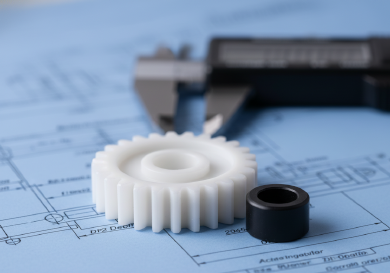
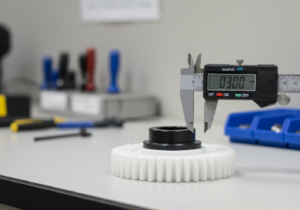
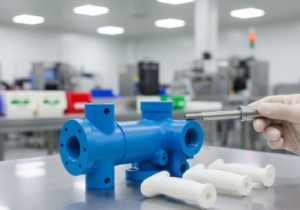
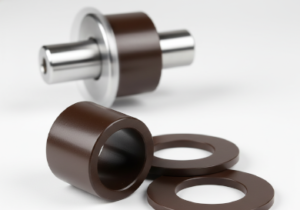
Available POM (Delrin) Grades
| Grau |
Nome Comum |
Características Principais |
Aplicações Típicas |
| POM-H (Homopolímero) |
Delrin® 150 |
Higher mechanical strength, stiffness, and hardness than copolymer. Slight centerline porosity possible. |
Precision gears, bearings, stiff mechanical parts, check valves. |
| POM-C (Copolymer) |
Acetal / Celcon® |
Better chemical resistance (especially to high pH) and free of centerline porosity. Easier to machine without voids. |
Plumbing fittings, medical instrument handles, food processing parts. |
| POM com PTFE |
Delrin® AF |
Blended with Teflon (PTFE) fibers. Extremely low coefficient of friction and high wear resistance. |
High-speed sliding bearings, bushings, conveyor wear strips. |
| Glass-Filled POM |
POM-GF |
Reinforced with glass fibers for increased stiffness and dimensional stability. Abrasive to tools. |
Structural parts requiring high rigidity and low creep. |
POM Machining Capabilities
| Capacidade |
Descrição Técnica |
Vantagem Jucheng |
| Precision Gear Machining |
Milling or hobbing high-precision plastic gears (spur, helical) directly from POM stock. |
We achieve high gear quality (AGMA standards) with low noise and excellent wear properties. |
| Torneamento de Alta Velocidade |
Rapid production of bushings and rollers using bar-fed CNC lathes. |
Optimized for high-volume orders (50k+ pcs/month) with extremely low unit costs. |
| Complex Milling |
3/4/5-axis milling of intricate housings and clips with snap-fit features. |
POM’s stiffness allows for machining precise snap-fits that function reliably without breaking. |
| Burr-Free Machining |
Using sharp tooling and optimized paths to minimize burr formation, which can be an issue with plastics. |
Eliminates manual deburring for many parts, ensuring consistent edge quality and fit. |
Fabrication Guidelines for POM
Sensibilidade à Fixação:
While stiffer than most plastics, POM can still deform. We use collets or soft jaws with controlled pressure. For flat parts, vacuum workholding is ideal to maintain flatness.
Uso de Refrigerante:
POM machines very freely, but coolant is recommended to flush chips and keep the part cool to maintain tight tolerances. Air blast is also effective for simple cuts.
Ferramentas:
Standard sharp HSS or Carbide tools work best. High rake angles help slice the material cleanly. Dull tools will cause heat buildup, which can lead to POM outgassing (smelling like formaldehyde).
Estabilidade Dimensional:
POM-C (Copolymer) is preferred for parts where centerline porosity (common in thick Delrin sections) could be an issue, such as parts requiring sealing or aesthetic perfection.
Principais Indústrias de Aplicação
Automotivo
Peças-Chave: Fuel system components, window lift gears, door lock actuators.
Why POM: Resistance to fuels/solvents and excellent fatigue endurance for moving parts.
Eletrônicos de Consumo
Peças-Chave: Zippers, clips, mechanical keyboard switches, rollers.
Why POM: Low friction (“slipperiness”) and high stiffness provide a premium tactile feel and durability.
Máquinas Industriais
Peças-Chave: Conveyor links, bearings, wear strips, guide rails.
Why POM: Self-lubricating properties reduce the need for external grease and maintenance.
Dispositivos Médicos
Peças-Chave: Inhaler components, insulin pens, surgical instrument handles.
Why POM: Easy to sterilize (some grades), dimensionally stable, and resistant to cleaning agents.