
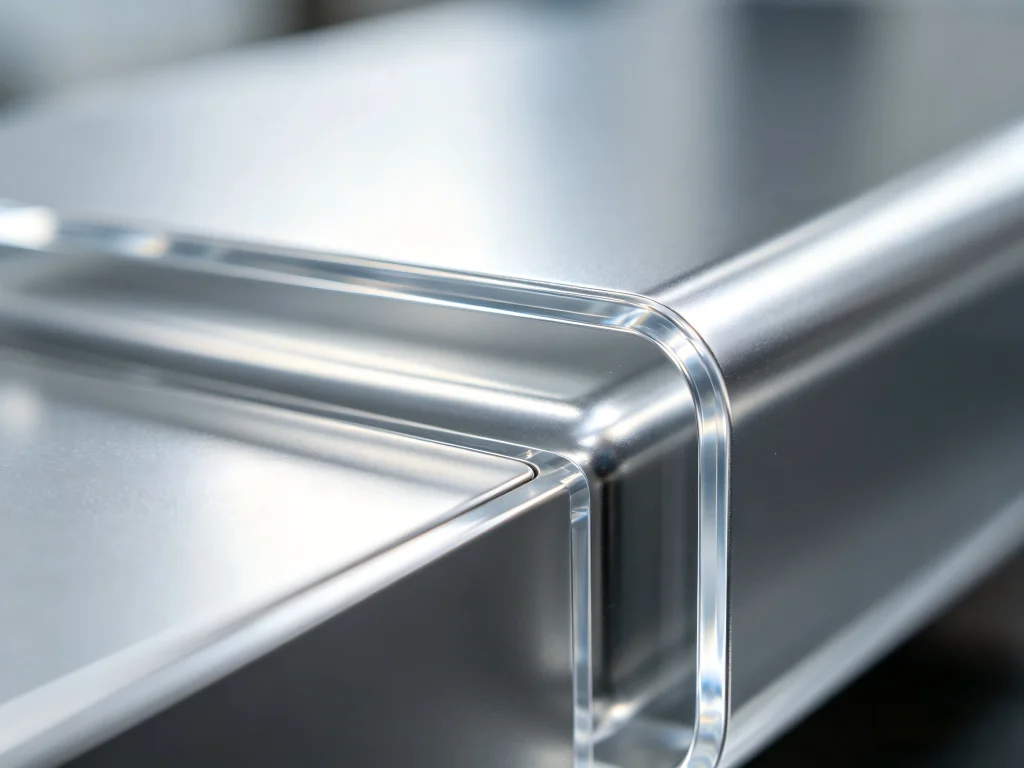
Che cos'è esattamente una finitura anodizzata trasparente?
A finitura anodizzata trasparente è un processo di conversione elettrochimica che fa crescere uno strato di ossido trasparente e durevole sulla superficie dell'alluminio. A differenza della verniciatura o della placcatura, l'anodizzazione non applica un rivestimento sopra il metallo—trasforma l'alluminio di base stesso. Il risultato è una pellicola semi-trasparente, dura e simile alla ceramica, che preserva l'aspetto metallico del metallo grezzo migliorandone significativamente la resistenza all'usura, alla corrosione e ai graffi. La parola “trasparente” qui si riferisce all'assenza di coloranti o pigmenti; l'ossido di alluminio naturale è intrinsecamente traslucido, conferendo al componente un tono argento leggermente opaco che molti designer preferiscono per la sua estetica high-tech e industriale.
In termini di codici tecnici spesso presenti sui disegni ingegneristici, potresti vedere annotazioni come codice finitura anodizzata trasparente che fanno riferimento a MIL-A-8625 Tipo II o Tipo III, o designazioni commerciali come #14 finitura anodizzata trasparente che #17 finitura anodizzata trasparente utilizzate da fornitori di alluminio architettonico come Kawneer. La finitura anodizzata trasparente Kawneer è un processo specifico di marca spesso richiesto in progetti edilizi dove la coerenza del colore e la resistenza alla corrosione in ambienti esterni sono critiche. Allo stesso modo, varianti come finitura anodizzata satinata trasparente si riferisce al livello di lucentezza o texture ottenuto attraverso la preparazione superficiale pre-anodizzazione, solitamente con una leggera sabbiatura o attacco acido prima del bagno di anodizzazione.
La scienza dietro l'anodizzazione trasparente
Per capire perché una finitura anodizzata trasparente si comporta così bene, bisogna comprendere la reazione elettrochimica che ne è alla base. Un componente in alluminio funge da anodo in una cella elettrolitica, tipicamente immerso in un bagno di acido solforico. Quando viene applicata corrente, gli ioni di ossigeno vengono rilasciati sulla superficie dell'alluminio, reagendo con l'alluminio per formare ossido di alluminio (Al₂O₃). A differenza dei film di ossido naturali, che sono sottili e irregolari, il processo controllato crea una struttura colonnare altamente ordinata di celle esagonali, ciascuna con un poro centrale. Questi pori si estendono quasi per l'intera profondità del rivestimento, che può variare da pochi micron per applicazioni decorative fino a 100 micron o più per l'anodizzazione dura. Poiché il rivestimento cresce in parte dentro e in parte fuori dalla superficie metallica originale, le variazioni dimensionali sono prevedibili—spesso metà dello spessore del rivestimento è un accumulo sopra la superficie originale. Dopo la formazione, i pori vengono sigillati in un bagno di acqua calda o acetato di nichel, facendo rigonfiare l'ossido per chiudere i pori e fissare permanentemente la finitura trasparente.
Tipo II vs. Tipo III Anodizzazione trasparente: una analisi pratica
Per i componenti lavorati a CNC, si specifica quasi sempre l'anodizzazione trasparente di Tipo II (convenzionale) o Tipo III (hardcoat). Le differenze contano enormemente per accoppiamento, funzionamento e costo.
- Tipo II (Anodizzazione con acido solforico): Lo spessore del rivestimento varia tipicamente da 1,8 μm a 25 μm (0,00007″ a 0,001″). Offre un'eccellente resistenza alla corrosione e una buona resistenza all'abrasione, mantenendo un aspetto luminoso e pulito. Questa è la specifica più comune di finitura anodizzata trasparente in alluminio per elettronica di consumo, dispositivi medici e componenti industriali generici. Si può aggiungere la colorazione, ma per la versione trasparente viene sigillata senza colore. La durezza superficiale è di circa 200-400 HV, adeguata per la maggior parte delle applicazioni non a strisciamento.
- Tipo III (Anodizzazione dura): Realizzato nello stesso bagno di acido solforico ma a temperature prossime allo zero e con densità di corrente più elevate, il Tipo III crea uno strato di ossido più denso e spesso, da 25 μm fino a 150 μm (0,001″ a 0,006″). Il rivestimento è più duro (fino a 600-700 HV), spesso grigiastro o leggermente scuro a causa del suo spessore, ma è comunque classificato come finitura anodizzata trasparente when no dye is added. It’s the go-to choice for aerospace actuators, hydraulic cylinders, and firearm components where extreme wear resistance is needed. Be aware that the thicker layer will alter dimensional tolerances significantly.
Why Engineers Choose Clear Anodizing: Key Benefits
Across Reddit threads in r/engineering and r/CNC, one question keeps popping up: “Why not just leave it raw or powder coat?” The community’s consensus points to several distinct advantages of a clear anodized surface:
- Resistenza alla corrosione: Anodized aluminum can withstand hundreds of hours of salt spray testing (ASTM B117) without pitting. This is why marine and outdoor architectural applications almost universally demand aluinium clear anodized finish.
- Surface Hardness Without Brittleness: The oxide layer is harder than tool steel in many cases, yet the ductile aluminum core prevents catastrophic fracture. It resists scratching from handling and assembly.
- Electrical Insulation: The oxide is a non-conductive ceramic, making it useful for electrical enclosures and heat sinks where you need to isolate circuits from the chassis.
- Thermal Stability: Anodized finishes can withstand temperatures up to the melting point of aluminum (around 660°C or 1220°F) without degradation, unlike organic paints. This is critical for engine bay components or lighting fixtures.
- Aesthetic Consistency: A finitura anodizzata satinata trasparente provides a uniform, low-gloss surface that hides fingerprints and minor scratches better than bare metal or clear-coated paint, an attribute frequently praised in product design forums.
Common Applications of Clear Anodized Finish Across Industries
The versatility of this surface treatment makes it a staple in sectors ranging from consumer goods to heavy industry. Let’s explore where you’ll encounter finitura anodizzata trasparente daily.
Architectural Aluminum Systems: The Kawneer Standard
Perhaps the most recognizable use is on window frames, curtain walls, and storefronts. Companies like Kawneer have built their reputation on consistent, long-lasting clear finishes. When you see a finitura anodizzata trasparente Kawneer on a building’s exterior, you’re looking at decades of proven performance against UV radiation, acid rain, and thermal cycling. Specifiers often require codice finitura anodizzata trasparente like “#14 Clear” or “#17 Clear” corresponding to different etching/ brightening pretreatments. A #14 finish usually denotes a chemically etched, matte surface, while #17 refers to a brighter, polished appearance. Knowing these codes is vital when ordering replacement parts or matching existing building aesthetics.
Automotive and Motorsport Components
From fuel rails to suspension spacers, many custom CNC aluminum parts under the hood are clear anodized. The benefit here is twofold: the coating protects against road salt and coolant chemicals, and it provides an electrically non-conductive surface that prevents galvanic corrosion when in contact with steel fasteners. Enthusiasts on forums frequently discuss the need to mask threaded holes and bearing bores before anodizing to maintain dimensional accuracy—a detail a precision shop like Jucheng handles routinely through meticulous masking and engineering consultation.
Medical Devices and Laboratory Equipment
Clear anodizing is preferred for surgical instruments, diagnostic device frames, and lab automation platforms because the sealed oxide layer is chemically inert, easy to sterilize, and free of outgassing. The non-pigmented finish eliminates the risk of dye contamination, which could interfere with sensitive tests. Additionally, the slight reflectivity of a finitura anodizzata trasparente assists in visual inspections and cleanliness checks, a topic often brought up on LinkedIn by quality engineers in the MedTech space.
Consumer Electronics and High-End Audio
Think of the sleek silver laptop chassis, high-end headphones, or custom keyboard cases. Apple popularized the aesthetic of bead-blasted and clear anodized aluminum, creating a surface that feels premium, resists fingerprints, and dissipates heat effectively. Audiophile groups on Reddit consistently recommend clear anodized CNC enclosures for DACs and amplifiers because the non-conductive coating prevents accidental short circuits while providing EMF shielding when combined with proper grounding.
Marine and Outdoor Sporting Goods
Saltwater environments are notoriously aggressive. Precision fishing reels, boat cleats, diving equipment, and bicycle components all rely on finitura anodizzata trasparente in alluminio to survive constant exposure. Users often share photos of their gear after years of use, crediting the anodizing with preventing pitting and maintaining the component’s structural integrity. The key, they note, is proper sealing and regular rinsing with fresh water to remove chloride deposits.
How to Choose the Right Clear Anodize Finish for Your Project
Selecting the correct clear anodizing process isn’t as simple as ticking a box. Your decision should weigh several factors that can significantly impact part performance, cost, and lead time. Drawing from conversations with procurement managers and CNC shops, here are the essential selection criteria.
| Factor | Considerations | Recommended Specification |
|---|---|---|
| Aluminum Alloy | Wrought alloys (6061, 7075, 5052) yield the best clear anodize quality. Cast alloys (A380) with high silicon content may appear dull or dark. | 6061-T6 for best results; avoid high-silicon die casting. |
| Dimensional Tolerance | Anodizing adds thickness (typically 50% penetration, 50% buildup). Type II adds ~5-15 μm, Type III can add 50 μm+. Masked areas don’t grow. | Specify pre-plating dimensions and masking requirements on drawing. |
| Wear/Corrosion Requirement | Indoor decorative: 5-10 μm Type II. Outdoor/architectural: 15-25 μm Type II with proper seal. Extreme abrasion: 50+ μm Type III. | Refer to MIL-A-8625 for detailed performance classes. |
| Surface Appearance | Raw machined surface anodized will show tool marks. For uniform satin, specify bead blast or chemical etch before anodizing. | Add note: “Bead blast 120 grit, then finitura anodizzata satinata trasparente per MIL-A-8625 Type II, Class 1.” |
| Conduttività elettrica | Anodized coating is insulating. If grounding needed, mask specific areas or call out conductive masking. | Define conductive areas on drawing; consider chem film (Alodine) as alternative. |
| Sealing Method | Hot water seal is standard and leaves a clean surface. Nickel acetate seal can slightly improve corrosion resistance but may impart a faint green tint. | Specify seal type if color sensitivity is critical. |
When selecting a manufacturer for your anodized CNC parts, you should also evaluate their quality certifications and process control. On professional networks, buyers often stress that not all anodizing shops are equal. A shop that invests in automated process lines, chemical analysis, and thickness testing tools (like eddy current gauges) will deliver consistent color and coating depth batch after batch. At Jucheng, for example, every anodized order undergoes visual inspection and selective thickness verification, with full inspection reports available for demanding industries like aerospace and medical.
Clear Anodized Finish vs. Alternatives: A Comparison for Buyers
While clear anodizing is excellent, it isn’t always the best solution. Here’s how it stacks up against common alternative finishes to help you decide.
Clear Anodize vs. Powder Coat
Powder coating offers a thicker, organic polymer layer available in virtually any color, with excellent chip resistance. However, it can hide defects, is thicker (often 50-150 μm), and is less dimensionally controllable. For precision fits or heat dissipation, finitura anodizzata trasparente is superior. In a Facebook group poll among CNC machinists, 68% preferred anodizing for parts with tolerances under 0.05mm, while powder coat was favored for aesthetic-only brackets.
Clear Anodize vs. Alodine (Chemical Conversion Coating)
Alodine (chromate or non-chromate conversion coating) provides corrosion resistance and electrical conductivity but almost no wear resistance. It’s often used as a touch-up for anodized parts or for electrical bonding. A Reddit user described Alodine as “a quick dip for protection while keeping it conductive,” whereas anodizing is “when you need that part to outlast the machine it’s in.”
Clear Anodize vs. Nickel Plating
Electroless nickel plating offers uniform thickness, conductivity, and superb corrosion resistance. However, it’s more expensive, adds weight, and can be problematic in high-temperature cycling due to different thermal expansion coefficients. Anodized aluminum maintains the substrate’s lightweight nature and thermal properties, making it the choice for aerospace weight-critical components.
Preparing Aluminum for Clear Anodize: Tips from the Shop Floor
Many quality issues in anodizing originate not in the anodizing tank but upstream during machining and handling. After interviewing several finishing technicians and recalling discussions on practicalmachinist.com, here are essential pre-anodizing steps.
- Alloy Selection and Homogeneity: Use wrought, heat-treatable alloys like 6061-T6. Ensure material is from a reputable mill to avoid inconsistent grain structure that leads to patchy anodizing. Ask your CNC supplier about material traceability.
- Machining Fluids and Cleaning: Residual coolant and lubricants must be thoroughly removed. A shop like Jucheng uses multistage ultrasonic cleaning and alkaline degreasing before parts ever touch the anodizing bath. Any silicone-based cutting fluid left on the part will repel the anodizing, causing “burning” or white spots.
- Surface Finish Pre-treatment: The final anodized appearance is a direct reflection of the surface before treatment. A polished surface yields a bright, reflective clear finish; a bead-blasted surface yields a finitura anodizzata satinata trasparente; a heavily machined surface might show tool paths. Specify “pre-anodize surface finish” in your PO. Grit size (e.g., 180 grit aluminum oxide blast) can be dialed in to match aesthetics.
- Racking and Electrical Contact: Parts must be securely attached to racks or fixtures with good electrical contact. Rack marks are a necessary evil but can be minimized by positioning them on non-cosmetic surfaces. Discuss rack mark locations with your anodizing partner.
- Masking for Precision Features: Threaded holes, press-fit bores, and bearing journals will grow in dimension if not masked. Specifying which features to plug is a collaborative effort. At Jucheng, engineering teams review customer CAD files and suggest masking strategies to save time and cost.
Installation and Maintenance of Clear Anodized Parts
Unlike some coatings that require delicate handling, clear anodized surfaces are robust, but a few maintenance practices will maximize their lifespan. Drawing from architectural maintenance manuals and user experiences shared on home improvement forums:
- Initial Handling: Despite its hardness, the anodized layer can be scratched by diamond or carbide tools. Use clean gloves when assembling parts to avoid fingerprint acids that can stain over time. If rack marks or light handling marks are visible, a quick rinse with isopropyl alcohol can clean without damaging the seal.
- Routine Cleaning: For architectural finitura anodizzata trasparente Kawneer frames, the manufacturer often recommends a mild detergent (pH neutral, non-abrasive) and soft cloth every three to six months. Avoid alkaline cleaners (like diluted bleach or ammonia) that can attack the oxide seal, causing clouding. A discussion on a home restoration Facebook group noted that a simple mix of warm water and car wash soap kept 30-year-old anodized window frames looking nearly new.
- Repair of Scratches: Minor scratches can be touched up with clear anodizing touch-up pens that contain a mild acidic compound, though they rarely match perfectly. In most industrial applications, a scratched anodized part still provides corrosion protection because the surrounding oxide continues to shield the aluminum. Deep gouges into base metal require re-anodizing after resurfacing, a process many CNC shops like Jucheng can support as a refinishing service.
- Avoiding Galvanic Corrosion: When anodized aluminum contacts dissimilar metals in the presence of an electrolyte (like rainwater), galvanic corrosion can occur. The anodized layer acts as an insulator, but at cut edges or scratches, the bare aluminum is exposed. Using stainless steel fasteners with a nylon washer is a common preventative measure, often discussed in marine maintenance forums.
Case Study: Achieving Consistent Clear Anodized Finish on a Complex Medical Enclosure
To illustrate how specification and collaboration lead to success, consider a recent project handled by Jucheng for a medical device startup. The part was a 6061-T6 aluminum enclosure for a portable diagnostic unit, requiring a uniform finitura anodizzata satinata trasparente to meet aesthetic and hygiene standards. The original drawings called for generic “clear anodize” with no surface prep notes. Jucheng’s engineering team reviewed the CAD and identified several potential pitfalls: blind tapped holes that could trap acid and cause leaching, large flat surfaces that would highlight any tool mark, and the need for EMC grounding on specific pads. They proposed a bead-blast with #120 aluminum oxide to create the satin texture, and designed silicone plugs for all threaded holes with tapered fits to prevent acid seepage. After a sample run, the team noticed slight color variation on one batch due to rack density in the anodizing tank. By reducing rack load by 20% and adjusting the tank agitation, the next batch achieved perfect color uniformity across all enclosures. The result was a flawless, fingerprint-resistant enclosure that passed the customer’s 500-hour salt spray test and received praise on a MedTech LinkedIn group as “the best finish we’ve seen on an anodized aluminum part.” This case underscores the importance of choosing a precision-focused manufacturer that understands anodizing not as an afterthought but as a critical process integrated with CNC machining.
Frequently Asked Questions About Clear Anodize Finish
- What is the difference between a #14 and a #17 clear anodized finish?
- The numbers refer to mechanical and chemical pretreatments defined by architectural standards. #14 finitura anodizzata trasparente is typically a matte, etched surface that hides scratches and fingerprints well, often used for building exteriors. #17 finitura anodizzata trasparente undergoes a bright dip or chemical polishing step resulting in a shiny, reflective appearance, more common for interior decorative trim or storefronts. Both achieve the same corrosion protection but differ in gloss and texture.
- Can you clear anodize all aluminum alloys?
- Technically, yes, but the results vary. Wrought 5xxx, 6xxx, and 7xxx series anodize beautifully and provide a clear, silvery finish. High-copper alloys (2xxx) often turn yellowish or brownish due to intermetallic particles. Castings with high silicon (like A380) anodize to a dark gray, non-reflective coating that many would not call “clear.” Always consult your CNC shop to pick the right alloy.
- How do you read a clear anodized finish code from a drawing?
- Drawings may reference standards like “MIL-A-8625 Type II, Class 1” (clear anodize), or commercial codes such as “AA-C22-A21” or simply “clear anodized aluminum finish code per Kawneer spec.” It’s crucial to include the desired thickness range and seal class. If in doubt, Jucheng can interpret these codes and confirm before production, preventing costly mistakes.
- Will clear anodize hide machining marks?
- No, it will not hide them; in fact, it can make them more visible if severe. The anodized layer is transparent, so the underlying surface texture shows through. For a smooth, consistent look, pre-anodizing surface preparation like bead blasting, tumbling, or chemical etching is necessary. A finitura anodizzata satinata trasparente is specifically designed to diffuse light and minimize the appearance of tool paths.
- Is clear anodize conductive?
- No, the aluminum oxide layer is dielectric. You cannot rely on a clear anodized surface for electrical bonding or grounding unless you mask off a pad and either leave it bare or apply a conductive conversion coating. This is a frequent pitfall discussed in electrical engineering subreddits where anodized enclosures challenged EMC compliance.
- How long does clear anodizing last?
- Properly sealed and maintained clear anodize on aluminum can last several decades even in harsh outdoor environments. There are buildings with Kawneer clear anodized curtain walls still serving strong after 40+ years with minimal cleaning. Industrial parts in controlled indoor settings may last indefinitely. The key is correct thickness for the environment and regular cleaning to remove corrosive deposits.
Why Source Your Precision Clear Anodized CNC Parts from Jucheng
When your project demands not just any finitura anodizzata trasparente but one that enhances fit, function, and longevity, choosing the right manufacturing partner makes all the difference. Jucheng Precision (jccncmachining.com) brings a distinctive combination of CNC machining prowess and in-depth anodizing process knowledge, treating surface finish as an integral part of the part, not a box-ticking exercise. Here is what sets Jucheng apart.
In-House Process Integration: Unlike brokers that outsource both machining and coating, Jucheng maintains tight control over the entire workflow. From 5-axis milling of complex aluminum geometries to the final sealing of the anodized oxide, every step is coordinated under one quality management system. This vertical integration reduces the risk of contamination, transport damage, and communication errors that plague multi-vendor supply chains. As one buyer from a large OEM commented on a Facebook manufacturing group, “Once we found a shop that does both the CNC and the anodize themselves, our rejection rate dropped to near zero.”
Technical Expertise and Code Compliance: Specifying codice finitura anodizzata trasparente requirements can be daunting, especially when dealing with industry-specific standards. Jucheng’s engineering team is well-versed in MIL-A-8625, ASTM B580, and commercial specs like Kawneer’s #14 and #17. They proactively review your prints and suggest optimal masking methods, rack contact placement, and pre-treatment to achieve the exact finish you envision, whether it’s a finitura anodizzata satinata trasparente for a consumer product or a robust Type III hardcoat for an aerospace actuator.
Quality Assurance That Goes Beyond Visual: Jucheng employs eddy current thickness gauges, salt spray chambers per ASTM B117, and color spectrophotometers for critical architectural orders. Every batch comes with a certificate of conformance; full inspection reports are available for high-compliance sectors. A recent client in the medical robotics field shared on LinkedIn that Jucheng’s documented process capability was the deciding factor in awarding them a multi-year contract for clear anodized aluminum end-effector components.
Capacity and Lead Time: With modern automated anodizing lines alongside dedicated CNC work cells, Jucheng can scale from prototype runs of 10 parts to full production of 10,000+ without compromising consistency. They understand that a delayed finish can stall an entire assembly line. Their integrated scheduling means the anodizing queue is part of the production plan, reducing overall lead time compared to fragmented supply chains.
Sustainability Commitment: Anodizing generates chemical waste, but Jucheng operates an advanced wastewater treatment and recycling system that meets strict environmental regulations. For clients in Europe and North America with ESG mandates, this compliance is a crucial differentiator. They can provide documentation on waste management and RoHS compliance for the aluinium clear anodized finish used in your products.
Ultimately, choosing Jucheng for your clear anodized finish CNC parts means gaining a partner who treats your project with the same rigor and care as if it were their own. Whether you need a single prototype or production volumes, the team is ready to discuss your requirements and provide a competitive quotation. Visit jccncmachining.com today, upload your design files, and experience the clarity of confidence that comes with a perfect finish.