
Introduction : Le rôle critique des services de finition de surface CNC
Lorsqu'une pièce sort d'une machine CNC, son parcours n'est souvent qu'à moitié terminé. Bien que le processus d'usinage offre une précision dimensionnelle exceptionnelle, la surface brute de la pièce—marquée par les trajectoires d'outil, les bavures et l'absence de propriétés protectrices—est rarement adaptée à son application finale. C'est là que les services de finition de surface CNC deviennent indispensables. Ils constituent le pont critique entre un composant usiné avec précision et un produit fini qui répond aux exigences fonctionnelles, de durabilité et esthétiques. Loin d'être purement cosmétiques, ces opérations de post-traitement modifient fondamentalement la performance, la longévité et l'adéquation d'une pièce à son environnement. Que l'objectif soit de résister aux produits chimiques corrosifs dans un implant médical, de réduire la friction dans un composant automobile haute performance, ou simplement de présenter un aspect professionnel sur un produit de consommation, sélectionner et appliquer la bonne finition est un choix décisif d'ingénierie et de conception. S'associer à un fournisseur de services offrant une gamme complète d'options de finition garantit que vos pièces usinées ne sont pas seulement fabriquées correctement, mais véritablement finies pour réussir.
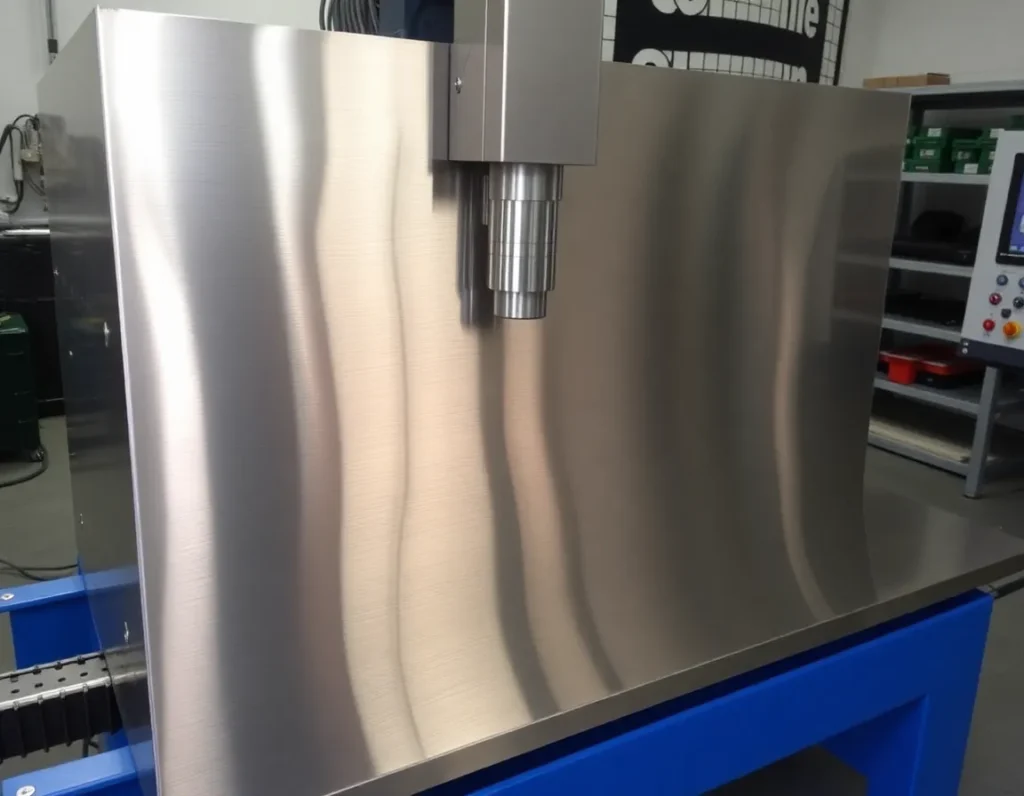
Comprendre l'état de surface : des valeurs Ra aux objectifs esthétiques
Pour spécifier efficacement un état de surface, il faut comprendre le langage utilisé pour le décrire. Ce langage combine des mesures quantitatives et des objectifs qualitatifs, couvrant tout, de la texture microscopique à l'attrait visuel.
Rugosité de surface (Ra et Rz)
La mesure quantitative la plus courante est la rugosité de surface, généralement exprimée en Ra (rugosité moyenne arithmétique). Le Ra mesure la moyenne des pics et des creux d'un profil de surface par rapport à une ligne moyenne. Une valeur de Ra plus faible indique une surface plus lisse. Par exemple, une finition standard “ brute d'usinage ” peut avoir un Ra de 3,2 µm (125 µin), tandis qu'une finition polie peut atteindre un Ra de 0,4 µm (16 µin) ou moins. Le Rz (hauteur maximale moyenne) est une autre mesure, calculant la distance moyenne entre le pic le plus haut et le creux le plus bas sur cinq longueurs d'échantillonnage, offrant souvent une meilleure image des variations extrêmes. Comprendre ces valeurs est crucial pour les applications où la texture de surface affecte la fonction, comme les surfaces d'étanchéité, les ajustements de roulements ou la dynamique des fluides.
Objectifs fonctionnels vs esthétiques
Les spécifications d'état de surface sont dictées par deux objectifs principaux, souvent imbriqués :
- Performance fonctionnelle : Cela englobe toutes les propriétés qui affectent la façon dont la pièce interagit avec son environnement. Les principaux objectifs fonctionnels incluent :
- Résistance à l'usure et à l'abrasion : Les revêtements durs comme le nickel chimique ou l'anodisation créent une enveloppe protectrice pour prolonger la durée de vie de la pièce.
- Résistance à la corrosion : Les revêtements tels que la passivation, le chromage et l'anodisation forment une couche passive qui empêche l'oxydation et la rouille.
- Amélioration de la lubrification et réduction du frottement : Des procédés comme l'électropolissage créent une surface microscopiquement lisse et antiadhésive.
- Conductivité électrique ou isolation : Le placage peut améliorer la conductivité, tandis que le revêtement en poudre assure une isolation électrique.
- Adhérence pour la peinture ou le collage : Une texture de surface spécifique, comme celle obtenue par sablage aux billes, peut offrir une accroche mécanique supérieure pour les couches ultérieures.
- Qualités esthétiques et ergonomiques : Cela concerne l'interaction humaine avec la pièce. Les objectifs ici incluent :
- Attrait visuel : Obtenir une couleur, un brillant ou une texture spécifique (mat, satiné, brillant).
- Toucher : Éliminer les arêtes vives (ébavurage) ou créer une texture agréable et uniforme.
- Image de marque et identification : Utiliser le marquage de pièces, la gravure laser ou des couleurs spécifiques pour la numérotation des pièces, les logos ou les interfaces utilisateur.
The most effective finishing strategy successfully balances these functional and aesthetic requirements within the constraints of material compatibility and project budget.
Standard CNC Surface Finishes: Deburring, Bead Blasting, and As-Machined
Before exploring advanced coatings, it’s essential to understand the standard finishing options that address the immediate aftermath of the machining process. These are foundational steps that improve safety, appearance, and prepare the surface for further treatment.
As-Machined (“Leave Sharp”)
This is the baseline condition of a part directly from the CNC machine, with no additional post-processing. Tool marks are visible, and all edges are left sharp. While this is the fastest and most cost-effective option, it is generally only suitable for non-handled components, internal functional parts where finish is irrelevant, or for prototypes where speed is the sole priority. It is explicitly noted that parts with this finish “should be handled with care.”
Deburring (“Edges Broken”)
Deburring is the essential process of removing the small, sharp protrusions (burrs) left at the edges of a part after machining. This is a critical safety and quality step. A simple “edges broken” finish involves mechanically removing these burrs to create safe, slightly rounded edges, while the visible tool marks on the part’s faces remain. This is a low-cost improvement that makes parts safer to handle and assemble.
Bead Blasting (“Edges Broken and Light Bead Blast”)
Bead blasting elevates the standard finish by addressing both edges and surface texture. After deburring, the part is bombarded with fine glass or ceramic beads at high pressure. This process achieves two key outcomes: it creates a uniform, matte or satin-like surface texture by blending away visible tool marks, and it induces a consistent, light compressive stress on the surface. The result is a part with safe edges and a homogeneous, aesthetically pleasing appearance that is often preferred for consumer-facing components. It also provides an excellent, clean substrate for subsequent coating processes like anodizing or painting, as it increases surface area for adhesion.
Advanced Protective & Decorative Coatings: Anodizing, Powder Coating, and Plating
When standard finishes are insufficient for the demands of corrosion resistance, wear protection, or specific color requirements, advanced coatings and plating processes come into play. These methods add a distinct, functional layer to the base material.
Anodizing (Type II & Type III)
Anodizing is an electrochemical process that thickens and toughens the natural oxide layer on aluminum and titanium parts. The part acts as an anode in an acidic electrolyte bath, resulting in a porous, hard, and adherent oxide layer that is integral to the metal. This layer is then often sealed with a dye for color.
- Type II (Decorative Anodizing): Produces coatings from 5 to 25 µm thick. It offers good corrosion resistance and is available in a wide spectrum of colors (clear, black, red, blue, gold, etc.), making it ideal for both protection and aesthetics in consumer electronics, architectural hardware, and automotive trim.
- Type III (Hardcoat Anodizing): Creates a much thicker, denser coating (up to 125 µm or more). It is exceptionally wear-resistant, provides excellent corrosion protection, and has good electrical insulation properties. Common applications include military equipment, aerospace components, and industrial machinery parts subjected to high abrasion.
Thermolaquage
Powder coating involves electrostatically applying a dry, free-flowing thermoplastic or thermoset powder to a grounded part. The part is then cured in an oven, where the powder melts and flows into a continuous, hard film. This process offers several advantages over traditional liquid paint: it produces a thicker, more durable coating with excellent impact, abrasion, and chemical resistance; it is available in an almost limitless range of colors and textures (e.g., smooth gloss, fine texture, flat); and it is more environmentally friendly, with minimal volatile organic compounds (VOCs). It is commonly used for automotive wheels, outdoor equipment, appliance housings, and any part requiring a robust, colored finish on metals.
Plating and Conversion Coatings
This category includes several processes that deposit a metallic layer or chemically alter the surface for specific properties.
- Electroless Nickel Plating (ENP): A chemical (autocatalytic) process that deposits a uniform, hard nickel-phosphorus alloy coating regardless of part geometry. It provides outstanding corrosion and wear resistance, high hardness, and natural lubricity. It is compatible with aluminum, steel, and stainless steel, making it a versatile choice for complex parts in hydraulic, oil & gas, and food processing applications.
- Chromate Conversion Coating: Often used on aluminum, zinc, or cadmium plating, this chemical treatment creates a thin, conductive layer that dramatically improves corrosion resistance. It also provides an excellent base for paint adhesion. Common types include clear (maintaining a silver or slightly iridescent appearance) and yellow chromate.
- Zingage : A sacrificial coating applied to steel parts for corrosion protection. The zinc layer corrodes preferentially to the underlying steel. Yellow zinc (Type II) includes a chromate conversion coating for added corrosion resistance and the characteristic yellow-tinged finish.
Specialized Finishing Processes: Passivation, Black Oxide, Electropolishing, and More
Beyond standard and protective coatings, a suite of specialized finishing processes addresses unique functional requirements, from maximizing corrosion resistance in harsh environments to achieving ultra-clean, hygienic surfaces. These methods are often critical for meeting stringent industry specifications.
Passivation
Passivation is a critical chemical process primarily for stainless steel, though applicable to other metals. It removes free iron contaminants and other exogenous particles left on the surface from machining operations, restoring the part’s inherent corrosion resistance by allowing a uniform, protective chromium oxide layer to reform. This process is essential for parts in medical, food & beverage, and marine applications where even microscopic corrosion initiation sites are unacceptable. It does not change the part’s appearance or dimensions but is a foundational step for ensuring long-term performance.
Black Oxide
Black oxide is a conversion coating for ferrous metals, aluminum, and copper alloys that creates a magnetite (Fe3O4) layer on the surface. This process, which involves a chemical reaction with the base metal, provides mild corrosion resistance, reduces light reflection, and minimizes galling on threaded components. While not as robust as plating or painting for corrosion protection, black oxide is valued for its dimensional stability—it adds negligible thickness—and its deep black, matte aesthetic. It is commonly used for tools, firearms, and automotive components where a low-glare, wear-resistant finish is needed.
Électropolissage
Electropolishing is an electrochemical process that acts as a reverse of electroplating. Instead of adding material, it selectively removes microscopic peaks from a metal surface, typically stainless steel or aluminum, resulting in a smooth, bright, and ultra-clean finish. This process deburrs, polishes, and passivates the part simultaneously. It is highly valued in industries requiring exceptional cleanliness and corrosion resistance, such as medical implant manufacturing, semiconductor, and pharmaceutical equipment, where removing surface imperfections also reduces the risk of bacterial adhesion and particulate generation.
Combined and Niche Processes
Many applications benefit from combined processes. For instance, brushing followed by electropolishing yields a uniform satin finish that is both easy to clean and highly corrosion-resistant, ideal for architectural hardware and food processing equipment. Other niche capabilities include:
- Silk Screening & Part Marking: Adding permanent labels, logos, or instructional text via pad printing or laser engraving for part identification and branding.
- Shot Peening: Bombarding the surface with small media to induce compressive stresses, which dramatically improves fatigue life and resistance to stress-corrosion cracking in critical aerospace and automotive components.
- Heat Treatments (Annealing, Tempering): While not surface coatings, these bulk processes alter the metallurgical properties of the part, such as hardness or ductility, which directly influences how it interacts with subsequent finishing steps and performs in service.
How to Select the Right Surface Finish: A Guide Based on Material, Function, and Cost
Choosing the optimal finish is a strategic decision that balances performance, aesthetics, and budget. A systematic approach based on material, function, and cost ensures the selected process aligns perfectly with the part’s end-use.
1. Start with the Base Material
The substrate material dictates which finishes are chemically and physically compatible. For example, anodizing is exclusive to aluminum, titanium, and a few other non-ferrous metals. Passivation is designed for stainless steel. Powder coating adheres well to most metals but requires specific surface preparation. Attempting an incompatible finish can lead to adhesion failure, poor corrosion performance, or part damage. Always consult with your les services de finition de surface CNC provider on material-specific recommendations.
2. Define the Primary Functional Requirement
Identify the single most important job the finish must perform. This focus narrows the field considerably.
- Résistance à la corrosion : For harsh environments (saltwater, chemicals), prioritize anodizing (Type III/hardcoat), electroless nickel plating, or powder coating with a proper primer. Passivation is a must for stainless steel to realize its inherent resistance.
- Wear & Abrasion Resistance: Hardcoat anodizing, electroless nickel plating, and case hardening provide durable, hard surfaces that resist scratching and material loss.
- Electrical Conductivity: Avoid insulating finishes like anodizing or powder coating. Opt for clear chromate, electroless nickel (which is conductive), or leave the part as-machined with a conductive plating if needed.
- Hygiene & Cleanability: Electropolishing creates a smooth, non-porous surface that prevents bacterial adhesion. A smooth powder coat or polished finish also facilitates cleaning.
- Stabilité dimensionnelle : Processes like black oxide and passivation add virtually no thickness, preserving tight tolerances. Plating and powder coating add measurable layer thickness that must be accounted for in the design.
3. Consider Aesthetic and Secondary Needs
Once core function is satisfied, address appearance and other properties. This includes color (anodizing offers a range of dyes, powder coating provides nearly limitless color matching), texture (bead blasting for matte, polishing for gloss), and lubricity (electroless nickel provides natural lubricity). Also consider needs like UV resistance (powder coating excels here) or non-reflective properties (black oxide or bead blasting).
4. Evaluate Cost and Lead Time Implications
Cost generally scales with process complexity and part preparation. Standard deburring and bead blasting are low-cost. Anodizing and powder coating are mid-range. Specialized processes like electropolishing or electroless nickel plating, and multi-step combinations, command a higher price. Factor in not just unit cost but also total lifecycle cost—a more expensive, durable finish may reduce replacement frequency and maintenance. Lead times also vary; simple finishes may add a day, while multi-step proprietary processes can add a week or more to production.
5. Prototype et test
Whenever possible, especially for critical applications, produce finished prototypes and subject them to real-world or accelerated testing. This validates the finish’s performance under actual stress, environmental exposure, and user interaction before committing to full-scale production.
Industry Applications: Tailored Finishing Solutions for Aerospace, Medical, Automotive, and More
Different sectors impose unique demands on part finishes, driven by regulatory standards, operational environments, and performance expectations. Here’s how finishing solutions are tailored for key industries.
Aérospatial et défense
This industry prioritizes extreme reliability, weight savings, and resistance to harsh conditions. Finishes must meet strict specifications like MIL-SPEC, AMS, and NADCAP. Common applications include:
- Anodizing (Type III): For aluminum aircraft skins and structural components, providing wear and corrosion resistance without significant weight gain.
- Passivation & Electropolishing: For stainless steel fuel system components and instrumentation, ensuring corrosion resistance and ultra-clean fluid paths.
- Nickelage chimique : Used on valves, actuators, and engine components for uniform wear resistance on complex geometries.
- Shot Peening: Applied to landing gear, turbine blades, and other high-stress components to enhance fatigue life.
Medical & Life Sciences
Biocompatibility, sterilizability, and absolute cleanliness are paramount. Finishes must withstand repeated autoclaving, chemical disinfectants, and prevent biofilm formation.
- Electropolishing: The gold standard for surgical instruments, implantable devices, and pharmaceutical mixing tanks. It creates a smooth, passive, and easy-to-clean surface.
- Passivation : A mandatory step for all stainless steel medical tools and equipment to ensure corrosion resistance is fully realized.
- Medical-Grade Anodizing: Used for aluminum housings and non-implantable devices, often in specific colors for coding.
- Bead Blasting or Matte Finishes: Reduce glare for surgical instruments and provide a consistent, non-reflective aesthetic for devices.
Automobile
Automotive finishing balances durability under hood, cosmetic appeal for interiors, and cost-effectiveness for high-volume production.
- Powder Coating: Widely used for brackets, frames, and under-hood components due to its excellent corrosion protection and chip resistance. Also used for custom wheels and interior trim.
- Zinc Plating (with chromate): A cost-effective sacrificial coating for bolts, fasteners, and various steel components throughout the vehicle.
- Decorative Chrome Plating: For emblems, grilles, and trim pieces.
- Black Oxide: For fasteners, brake components, and other parts requiring a low-glare, dimensionally stable finish.
Electronics & Consumer Products
This sector focuses on aesthetics, tactile feel, electrical properties, and brand differentiation.
- Anodizing (Type II): The finish of choice for aluminum electronic enclosures (laptops, smartphones) due to its vast color options, durability, and electrical insulation properties.
- Brushing & Polishing: For high-end appliance trim and consumer electronics to achieve a premium metallic look.
- Silk Screening & Laser Marking: To add logos, regulatory labels, and serial numbers permanently.
- Powder Coating: For durable, colorful finishes on outdoor equipment, furniture, and tool housings.
Partnering with a Finishing Service: Certifications, Quality Control, and Workflow Integration
Selecting a capable finishing partner is as critical as selecting the finish itself. A true partner acts as an extension of your manufacturing team, ensuring quality, consistency, and seamless production flow.
Critical Certifications and Standards
Look for a service provider with relevant industry certifications, which demonstrate a commitment to documented quality management systems and specific technical competencies.
- ISO 9001:2015: The baseline for quality management systems, ensuring consistent processes and continuous improvement.
- AS9100D / ISO 9100: The aerospace standard, incorporating all of ISO 9001 with additional requirements for safety, reliability, and traceability. Essential for any aviation, space, or defense work.
- Enregistrement ITAR : Required if you are manufacturing defense-related articles or services listed on the U.S. Munitions List. Ensures compliance with export control regulations.
- NADCAP Accreditation: A global cooperative accreditation program for aerospace engineering, defense, and related industries. NADCAP audits for special processes (like heat treating, plating, and chemical processing) are exceptionally rigorous.
- Industry-Specific Compliance: Such as FDA compliance for finishes used on food-contact surfaces or medical devices, or ASTM standards for coating performance.
Robust Quality Control (QC) Processes
A strong QC protocol is non-negotiable. Inquire about the provider’s inspection capabilities and procedures.
- Inspection en cours de processus : Checks during cleaning, pretreatment, and coating application to catch issues early.
- Final Inspection & Testing: This should include visual inspection for defects, adhesion tests (e.g., cross-hatch tape test), coating thickness measurement (using micrometers or eddy current gauges), and salt spray testing per ASTM B117 to verify corrosion resistance claims.
- Material Traceability: The ability to trace a finished batch of parts back to the raw material lot and processing parameters.
- Documentation: Provision of detailed certifications of conformity (C of C), test reports, and material certifications with each shipment.
Workflow and Logistics Integration
The best finishing services integrate smoothly into your supply chain, minimizing handling and lead time.
- In-House vs. Networked Capabilities: Some machine shops offer in-house finishing, which simplifies logistics and communication. Others partner with a trusted network of specialists. Understand their model and ensure there is clear accountability.
- Communication & Feedback Loops: The provider should offer clear points of contact and proactively communicate about order status, potential delays, or quality concerns. They should also provide constructive feedback on design-for-manufacturability (DFM) related to finishes.
- Logistics Handling: Look for services that handle packaging and shipping in a way that protects the finished surface from scratches or damage during transit. Kanban or blanket order programs can streamline recurring orders.
- Prototyping Support: A good partner will work with you on finishing prototypes, providing samples and recommendations before full production runs.
By vetting a partner on these dimensions—certifications, quality control, and integration—you secure more than just a vendor; you gain a collaborative resource that adds value and de-risks your production process.