
Si vous développez un châssis de drone léger, un prototype automobile ou un boîtier de dispositif médical, l'usinage CNC de l'aluminium est probablement au cœur de votre stratégie de fabrication. Ce procédé soustractif utilise des outils de coupe contrôlés par ordinateur pour transformer un bloc d'aluminium en composants de précision avec des tolérances aussi serrées que ±0,012 mm. Mais sous cette définition simple se cache un écosystème complexe de sélection d'alliages, de capacités des machines, de finition de surface et de décisions relatives à la chaîne d'approvisionnement qui peuvent faire ou défaire votre projet.
Ce guide s'appuie sur les retours des communautés d'ingénieurs sur Reddit et Facebook, où les professionnels débattent fréquemment de sujets tels que “ quel alliage d'aluminium s'usine le mieux ”, “ comment réduire les coûts d'usinage CNC ” et “ faut-il s'approvisionner localement ou en Chine ”. Nous avons synthétisé ces discussions avec une expertise technique pour créer une ressource complète destinée à quiconque navigue dans le monde de l'usinage CNC de l'aluminium.
Qu'est-ce que l'usinage CNC de l'aluminium et comment fonctionne-t-il ?
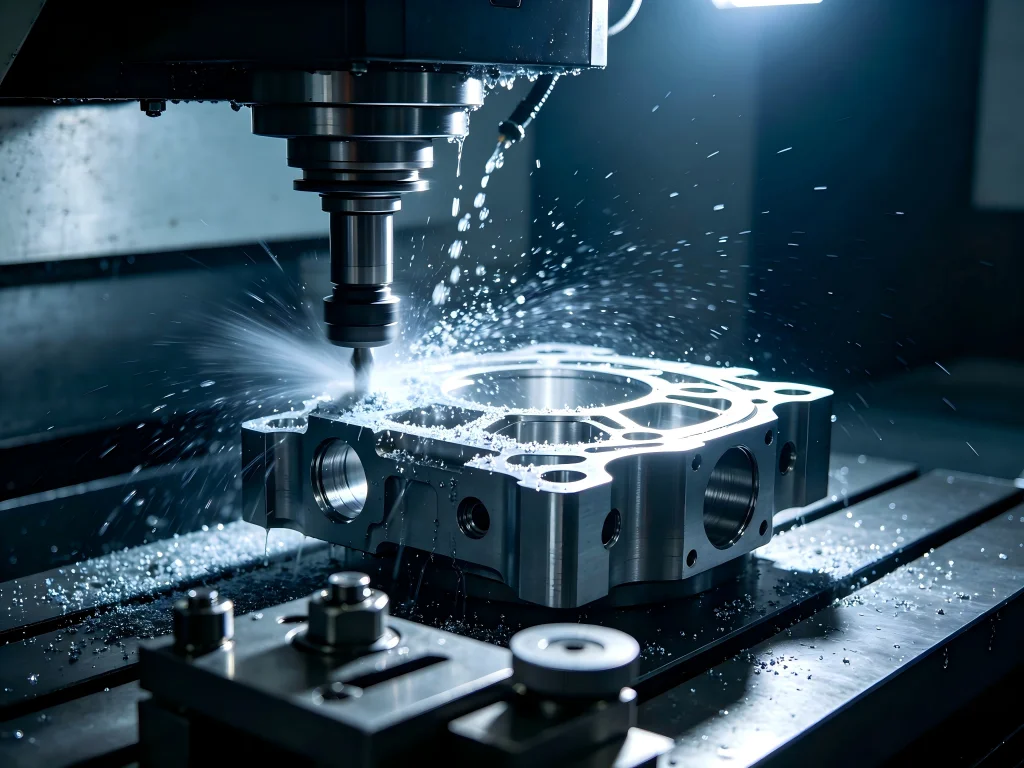
À la base, l'usinage CNC de l'aluminium est un procédé de fabrication qui enlève de la matière d'une pièce d'aluminium solide à l'aide d'outils de coupe rotatifs guidés par des instructions informatiques préprogrammées. “ CNC ” signifie Computer Numerical Control (commande numérique par ordinateur), ce qui signifie que la machine suit un plan numérique avec une intervention humaine minimale une fois la configuration effectuée.
Le flux de travail fondamental
Le processus suit généralement ces étapes :
- Conception CAO: les ingénieurs créent un modèle 3D de la pièce souhaitée à l'aide de logiciels comme SolidWorks ou Fusion 360.
- Programmation FAO: le fichier CAO est converti en trajectoires d'outils à l'aide d'un logiciel de fabrication assistée par ordinateur, déterminant exactement comment les outils de coupe se déplaceront.
- Préparation du matériau: L'alliage d'aluminium approprié — qu'il s'agisse du 6061-T6, du 7075-T6 ou d'une autre nuance — est sélectionné et fixé sur la table de la machine.
- Exécution de l'usinage: La machine CNC suit les trajectoires programmées, enlevant de la matière par fraisage, tournage, perçage ou d'autres opérations.
- Contrôle qualité: Les pièces finies sont soumises à une vérification dimensionnelle à l'aide de machines à mesurer tridimensionnelles (MMT), de projecteurs optiques et de spectromètres.
Types courants de machines CNC pour l'aluminium
Différentes configurations de machines conviennent à différentes géométries de pièces et volumes de production :
- Fraiseuses CNC 3 axes: La configuration la plus courante, déplaçant l'outil de coupe selon les axes X, Y et Z. Adaptée aux géométries plus simples et rentable pour de nombreuses applications.
- Centres d'usinage 4 axes et 5 axes: Ceux-ci ajoutent des axes de rotation, permettant à la machine d'accéder à plusieurs faces d'une pièce en un seul montage. Cela réduit les erreurs de montage et permet des géométries complexes comme les composants aérospatiaux à angles composés. Jucheng Precision exploite vingt-cinq centres 5 axes haut de gamme spécifiquement à cette fin.
- Tours CNC (centres de tournage): Utilisés pour les pièces cylindriques, où la pièce tourne tandis que des outils fixes la façonnent.
- Fraiseuses à commande numérique (routeurs CNC): Souvent utilisées pour des pièces en aluminium plus grandes et moins complexes, notamment en prototypage et en production de faible volume.
Comme l'a noté un utilisateur de Reddit dans la communauté r/Machinists, “ La différence entre un travail sur 3 axes et un travail sur 5 axes ne tient pas seulement à la complexité — elle tient au nombre de fois qu'un humain doit toucher la pièce. Chaque montage est une occasion d'erreur. ” Cette observation rejoint les meilleures pratiques de l'industrie qui privilégient la réduction du nombre de montages pour les composants critiques.
Principaux scénarios d'application : où l'usinage CNC de l'aluminium excelle
Le rapport résistance-poids exceptionnel de l'aluminium, sa résistance à la corrosion et son usinabilité en font un matériau de choix dans de nombreuses industries. Voici comment différents secteurs l'exploitent l'usinage CNC de l'aluminium:
Aérospatiale et aviation
L'industrie aérospatiale exige des composants légers mais extrêmement résistants. L'aluminium 7075-T6, dont la résistance à la traction approche celle de nombreux aciers, est fréquemment utilisé pour les cadres d'aéronefs, les nervures structurelles et les boîtiers d'instrumentation. La culture du zéro défaut exigée dans ce secteur signifie que chaque pièce subit une vérification rigoureuse de la composition du matériau par spectromètre et une inspection CMM de chaque dimension critique. Les fabricants opérant sous des systèmes de management de la qualité IATF 16949—bien qu'initialement développés pour l'automobile—partagent le même ADN que les normes aérospatiales AS9100 : une atténuation fanatique des risques et une traçabilité complète.
Automobile et sport automobile
Des blocs moteurs aux carters de transmission, l'usinage CNC de l'aluminium permet aux ingénieurs automobiles de tester de nouveaux designs sans attendre des mois pour l'outillage de production. L'approche de “ prototypage en billette ”—usiner des composants complexes à partir de blocs d'aluminium massifs—fournit des pièces avec une structure de grain plus fine et une densité supérieure aux alternatives moulées, offrant une résistance supérieure pour les applications hautes performances. La révolution des véhicules électriques a encore accéléré la demande de boîtiers de batteries en aluminium usiné et de composants structurels légers. La certification IATF 16949 est particulièrement importante ici, car elle démontre l'engagement d'un fournisseur envers la stabilité des processus et la prévention des défauts.
Dispositifs médicaux
L'instrumentation médicale exige des matériaux biocompatibles et une précision absolue. L'aluminium 6061-T6, lorsqu'il est correctement anodisé, offre une excellente résistance à la corrosion et peut être stérilisé de façon répétée. La certification ISO 13485, que Jucheng Precision détient aux côtés de l'IATF 16949, est la référence absolue pour la fabrication de dispositifs médicaux, garantissant un management rigoureux de la qualité tout au long de la production.
Robotique et automatisation
Les bras de robots, les pinces et les châssis nécessitent une rigidité élevée avec un poids minimal. L'usinage 5 axes permet la production d'articulations complexes et de supports moteurs avec des tolérances allant jusqu'à ±0,01 mm. La capacité d'usiner des assemblages entiers à partir d'un seul bloc d'aluminium élimine les fixations, réduisant le poids et les points de défaillance potentiels.
Électronique grand public et drones
L'industrie des drones a adopté l'usinage CNC de l'aluminium pour des cellules légères qui doivent résister à des manœuvres à fort facteur de charge et aux vibrations. L'aluminium 7075-T6 est le matériau de choix pour les drones haut de gamme, bien que sa tendance aux contraintes résiduelles internes exige des stratégies d'usinage soignées pour éviter la déformation.
Facteurs clés de sélection : ce qu'il faut considérer lors du choix de services d'usinage CNC de l'aluminium
Lors de l'approvisionnement l'usinage CNC de l'aluminium services, several critical factors determine project success. These considerations frequently appear in discussions on engineering forums and B2B sourcing platforms.
Material Selection: The Foundation of Performance
The choice of aluminum alloy directly impacts the part’s strength, machinability, corrosion resistance, and cost:
| Alloy | Propriétés clés | Applications typiques | Coût relatif |
|---|---|---|---|
| 6061-T6 | Excellent machinability, good strength (yield ~276 MPa), superior anodizing quality, weldable | Automotive brackets, semiconductor equipment, structural components, consumer products | Low-Moderate |
| 7075-T6 | Very high strength (comparable to steel), aerospace-grade, prone to residual stress | Aerospace frames, high-stress military prototypes, drone arms, racing components | Moderate-High |
| 5052 | Excellent formability and corrosion resistance, good weldability | Marine hardware, fuel tanks, sheet metal enclosures | Faible |
| 2024 | High strength, good fatigue resistance, lower corrosion resistance | Aerospace structures, aircraft fittings | Modéré |
As highlighted in a popular CNC machining Facebook group, “6061 is the universal donor of modern hardware—it offers a density of 2.70 g/cm³ and highly predictable machinability”. For most applications, 6061-T6 represents the best balance of performance and cost, which is why it accounts for the majority of aluminum production at many precision machining facilities.
Precision and Tolerances
Dimensional accuracy is often the deciding factor in supplier selection. Different applications demand different tolerance levels:
- Standard Tolerances: ±0.025mm to ±0.125mm (±0.001″ to ±0.005″) for most commercial applications.
- Precision Tolerances: As tight as ±0.012mm (±0.0005″) for critical features in aerospace, medical, and high-performance automotive components.
- Finition de surface: Standard machined finish is Ra 1.6-3.2 µm, with Ra 0.4-0.8 µm achievable through fine finishing passes.
It is worth noting that aluminum generally allows tighter tolerances than steel due to lower cutting forces and reduced distortion risk. However, achieving precision tolerances requires specialized equipment and significantly increases costs.
Machine Capabilities and Setup Strategy
The number of setups required to machine a part directly affects both quality and cost. Each time a part is repositioned, there is an opportunity for misalignment and “tolerance stack-up”—the cumulative effect of small errors across multiple setups. Five-axis machining addresses this by allowing access to five sides of a part in a single setup, maintaining feature-to-feature accuracy that fixed-table machines cannot replicate. As one engineer on Reddit’s r/CNC put it, “Designing for 5-axis isn’t about making curvy parts—it’s about killing setups. Every setup you eliminate is a quality problem you never have to solve.”
Quality Certifications and Inspection
Certifications provide third-party validation of a manufacturer’s quality systems:
- IATF 16949: The automotive industry standard, focused on defect prevention and process stability.
- ISO 13485: The medical device quality management standard.
- ISO 9001: The foundational quality management standard.
Inspection equipment matters as much as certifications. Advanced manufacturers use Coordinate Measuring Machines (CMMs), optical projectors, and spectrometers to verify material composition and dimensional accuracy. A 99.8% product qualification rate is achievable with rigorous in-process and final inspection protocols.
Lead Time and Production Capacity
Speed without quality is simply accelerated failure. However, when timelines are tight, manufacturers with significant capacity can deliver parts in as few as 4 days. Typical lead times range from 3-5 business days for simple prototypes to 2-4 weeks for complex, high-volume production. Facilities with 150+ CNC machines and 8,000 sq.ft. of production space can often outpace local bottlenecks through sheer scale.
Surface Finishing Capabilities
The finish applied to a machined aluminum part is often as critical as the machining itself. Common finishing options include:
- Anodizing (Type II & III): Creates a hard, durable, corrosion-resistant oxide layer. Type III (hard coat) provides increased wear resistance.
- Chemical Film Conversion Coating: Provides corrosion resistance and serves as a base for painting.
- Powder Coating and Painting: Used for durable, high-quality decorative finishes.
- Bead Blasting and Sandblasting: Creates uniform matte textures.
It is important to note that coatings like anodizing add material thickness (typically 25-50 microns for hard anodizing). For parts with critical functional dimensions, manufacturers must apply pre-plate compensation during machining.
Installation and Maintenance: Ensuring Long-Term Performance
While the end-user rarely installs CNC machines themselves, understanding installation and maintenance considerations helps when evaluating a supplier’s operational stability.
Machine Installation Considerations
Proper installation of CNC machining equipment involves several critical steps:
- Foundation Preparation: Heavy CNC machines require reinforced concrete foundations to prevent vibration and maintain alignment. For high-speed spindles operating up to 24,000 RPM, even minor foundation issues can affect part quality.
- Environmental Control: Temperature fluctuations can affect machine accuracy. Many precision machining facilities maintain climate-controlled environments to ensure dimensional stability.
- Power and Air Requirements: CNC machines require stable three-phase power and clean, dry compressed air for tool changers and cooling systems.
- Calibration and Leveling: Precision levels and laser interferometers are used to ensure the machine is perfectly level and all axes are square.
Daily Maintenance Practices
Regular maintenance prevents costly downtime and ensures consistent part quality:
- Coolant Management: Flood coolant is recommended for aluminum machining to flush chips and maintain thermal stability. Coolant should be regularly tested for concentration and pH levels.
- Tool Inspection: Cutting tools should be inspected for wear before each job. For aluminum, uncoated carbide tools or those with aluminum-specific coatings (like ZrN) prevent material build-up on the cutting edge (BUE).
- Way Lubrication: Machine ways and ball screws require regular lubrication to maintain accuracy and prevent wear.
- Chip Evacuation: Aluminum chips can be stringy and prone to wrapping around tools. Effective chip conveyors and regular cleaning are essential.
As one experienced machinist noted in a forum discussion, “The best CNC machine in the world is useless if you don’t maintain it. I’ve seen million-dollar machines produce scrap because someone forgot to check the way lube.”
Frequently Asked Questions About Aluminum CNC Machining
Based on common queries from engineering forums, Reddit discussions, and customer inquiries, here are answers to the most frequently asked questions about l'usinage CNC de l'aluminium.
1. What is the best aluminum alloy for CNC machining?
6061-T6 is the most versatile and widely used aluminum alloy for CNC machining. It offers an excellent balance of machinability, strength (yield ~276 MPa), corrosion resistance, and anodizing quality. For applications requiring higher strength, 7075-T6 is the aerospace-grade choice, though it is more expensive and requires more careful machining to manage residual stress.
2. How much does aluminum CNC machining cost?
CNC machining costs vary widely based on complexity, tolerances, and quantity. Machine time typically ranges from $30 to $150+ per hour for standard 3-axis operations, with 5-axis machining running $70 to $150+ per hour. Material costs for aluminum range from $2 to $6 per pound, with 7075-T6 costing more than 6061-T6. Per-part costs can range from $20 for simple components to $1,000+ for complex precision parts. Setup costs, programming, and fixturing add to the total, typically $50 to $200 per hour.
3. What tolerances can aluminum CNC machining achieve?
Standard tolerances for aluminum CNC machining are ±0.025mm to ±0.125mm (±0.001″ to ±0.005″). For critical features, precision tolerances as tight as ±0.012mm (±0.0005″) are achievable. Aluminum generally allows tighter tolerances than steel due to its lower cutting forces and reduced tendency to distort during machining.
4. How does anodizing affect aluminum CNC machined parts?
Anodizing creates a hard, corrosion-resistant oxide layer on the aluminum surface. Type II anodizing provides decorative and moderate wear protection, while Type III (hard anodizing) offers significantly increased wear resistance. However, anodizing adds material thickness—typically 25-50 microns for hard anodizing—so parts with critical dimensions require pre-anodizing compensation during machining.
5. Should I source aluminum CNC machining locally or from China?
This is a frequently debated topic in manufacturing forums. While “near me” searches imply a need for speed, speed without verifiable quality is simply accelerated failure. Chinese manufacturers with ISO 9001, IATF 16949, or ISO 13485 certifications can offer competitive pricing, significant capacity (150+ machines, 8,000 sq.ft. facilities), and delivery times as fast as 4 days. The key is evaluating the supplier’s quality systems, certifications, and inspection capabilities rather than focusing solely on location.
6. What is the difference between 3-axis and 5-axis CNC machining for aluminum?
3-axis machining moves the cutting tool along X, Y, and Z axes, requiring multiple setups to machine complex parts. 5-axis machining adds two rotational axes, allowing access to five sides of a part in a single setup. This reduces setup errors, improves feature-to-feature accuracy, and enables complex geometries that would be impossible with 3-axis machines. While 5-axis machines have higher hourly rates ($70-$150+ vs. $30-$60 for 3-axis), the reduced setup time and improved quality often justify the cost for complex components.
7. What surface finishes are available for aluminum CNC machined parts?
Common finishes include anodizing (Type II and III), chemical film conversion coating, powder coating and painting, bead blasting and sandblasting, and various plating options like nickel or chrome. Each finish offers different combinations of corrosion resistance, wear protection, and aesthetic appearance.
8. How do I protect my design IP when sourcing from a CNC machining service?
Reputable manufacturers take intellectual property protection seriously. They are willing to sign Non-Disclosure Agreements (NDAs) before discussing project details. Customer files should be stored on secure servers with access limited to essential project personnel. Designs should never be shared or used for any other purpose without explicit permission.
Why Jucheng Precision Stands Out in Aluminum CNC Machining
With over 13 years of experience and IATF 16949 and ISO 13485 certifications, Jucheng Precision has established itself as a trusted partner for l'usinage CNC de l'aluminium across aerospace, automotive, medical, and robotics industries.
Technical Capabilities That Deliver Results
Jucheng’s facility spans 8,000 sq.ft. and houses 150+ CNC machines, including twenty-five high-end 5-axis machining centers. This equipment enables complex contouring and access to five sides of an aluminum block in a single setup, drastically improving accuracy and surface finish. High-speed spindles operating up to 24,000 RPM achieve mirror-like surface finishes directly off the machine.
Quality Assurance That Builds Trust
Every aluminum component undergoes inspection using imported international advanced CMMs, optical projectors, and spectrometers. This rigorous quality control, combined with a 99.8% product qualification rate, ensures parts meet the most demanding specifications. Material verification using X-Ray Fluorescence (XRF) ensures all incoming stock meets ASTM B221 standards.
Finition de surface complète
In-house surface finishing capabilities include anodizing (Type II and III), chemical film conversion coating, powder coating, painting, bead blasting, and plating. This vertical integration ensures rapid turnaround and quality control.
Proven Industry Expertise
Jucheng’s specialized knowledge is derived from deep engagement in industries where l'usinage CNC de l'aluminium is paramount. From aerospace structural parts and automotive components to medical instrumentation and drone frames, the company has demonstrated the ability to deliver high-precision parts that meet rigorous industry standards.
Customer-Centric Service Model
Jucheng assigns a dedicated project manager to each order, providing clear communication throughout the manufacturing process. The standard workflow—from quoting and DFM feedback to first article inspection and final shipment—is transparent and designed to minimize surprises. With no strict Minimum Order Quantity (MOQ) and competitive pricing at any quantity, Jucheng serves both prototype developers and volume production customers.
Intellectual Property Protection
Jucheng takes client IP extremely seriously, signing NDAs before discussing project details and storing all customer files on secure servers with limited access. Designs are never shared or used for any other purpose without explicit permission.
Whether you are developing a prototype that requires precision tolerances of ±0.012mm or scaling to production volumes with IATF 16949-certified quality systems, Jucheng Precision offers the technical depth, capacity, and quality culture to bring your aluminum components to life.