
A rushed mold can lock draft, wall thickness, gate location, ejector strategy, shrinkage assumptions, and cosmetic expectations into expensive steel. Staying with CNC too long can also waste money when every repeat part consumes machine time and stock. This guide uses three project clocks—design, cash, and quality—to decide when to machine plastic parts, when to mold them, and what must change before a clean process transfer.
Three Clocks Control the Decision
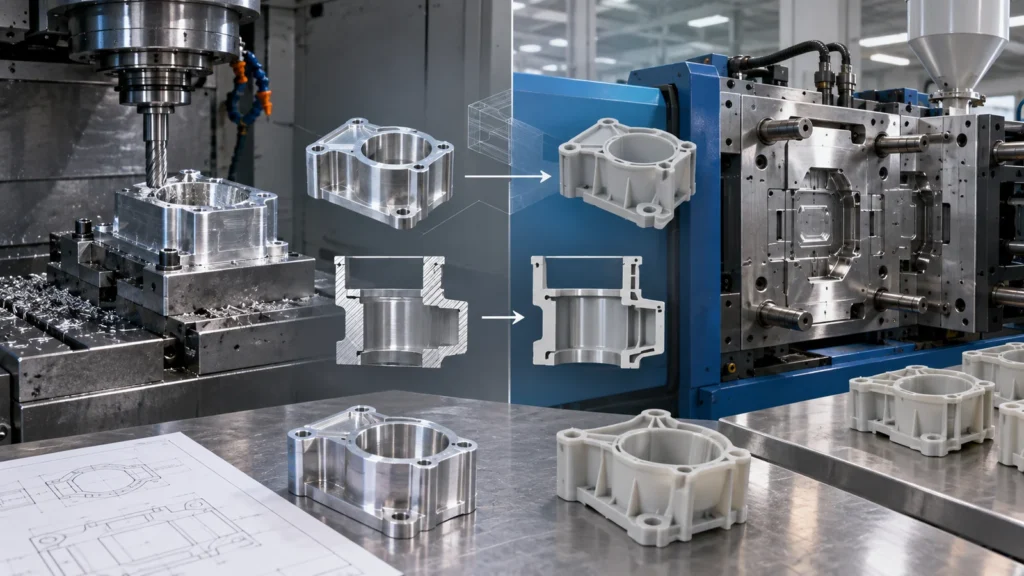 The design clock measures how quickly the CAD model and drawing are changing. If interfaces, wall sections, fastening, or user feedback are unresolved, machining allows revisions without altering a production mold. The cash clock measures when up-front tooling can be justified by credible demand. The quality clock measures when the team understands which dimensions, surfaces, material properties, and process records must remain stable from lot to lot.
These clocks rarely reach zero together. A sales forecast may justify tooling while the design is still immature. A technically stable part may have uncertain demand. A mold may be ordered before inspection datums are agreed. The best route follows the slowest clock. CNC machining can serve as a controlled bridge when one condition is not ready, while molding should begin only when the remaining uncertainty is small enough to manage through tool trials and validation.
The design clock measures how quickly the CAD model and drawing are changing. If interfaces, wall sections, fastening, or user feedback are unresolved, machining allows revisions without altering a production mold. The cash clock measures when up-front tooling can be justified by credible demand. The quality clock measures when the team understands which dimensions, surfaces, material properties, and process records must remain stable from lot to lot.
These clocks rarely reach zero together. A sales forecast may justify tooling while the design is still immature. A technically stable part may have uncertain demand. A mold may be ordered before inspection datums are agreed. The best route follows the slowest clock. CNC machining can serve as a controlled bridge when one condition is not ready, while molding should begin only when the remaining uncertainty is small enough to manage through tool trials and validation.
The Same CAD File Does Not Create the Same Part
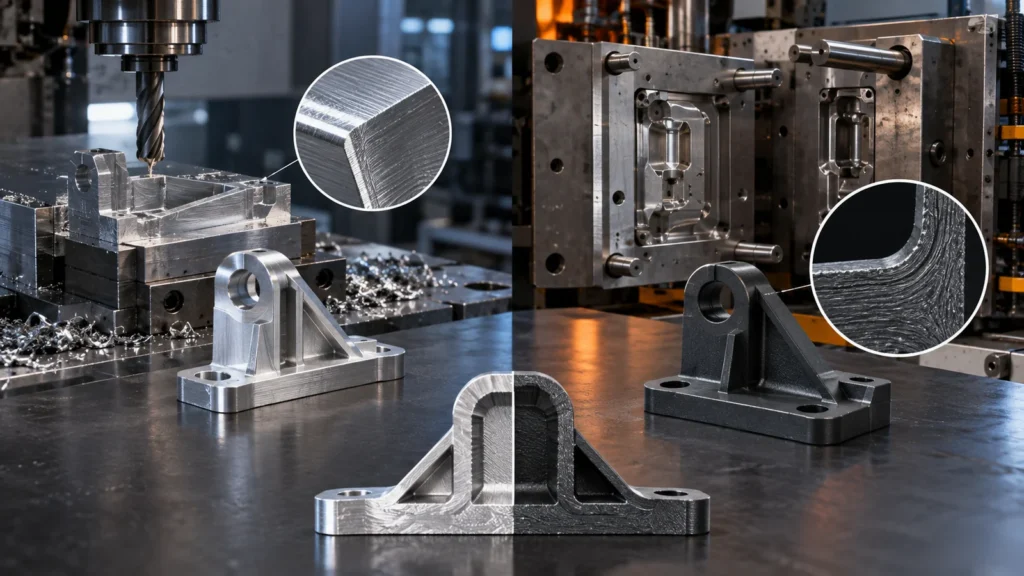
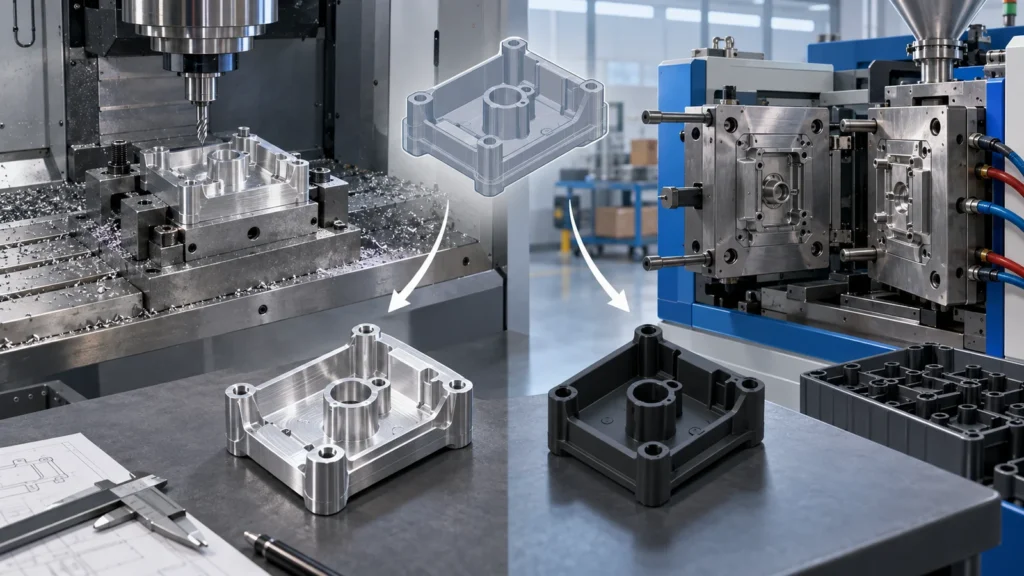 A machined plastic part is cut from sheet, plate, rod, or another solid stock form. Its walls can vary freely where tools have access, and sharp external details or deep local sections may be possible without considering polymer flow. An injection-molded part is formed as melt fills a cavity, cools, shrinks, and is ejected. Wall transitions, ribs, bosses, draft, gate position, weld lines, sink, and ejection all influence the result.
That means a machined prototype is not automatically a mold simulation. It can prove packaging, assembly, basic load paths, hole locations, and many functional interfaces. It cannot reproduce every molded residual stress, fiber orientation, knit line, shrinkage pattern, surface texture, or gate-related effect. Engineers should mark which findings are process-independent and which must be confirmed during molding trials.
The reverse problem also matters. A design created around molding may be inefficient to machine because thin ribs, deep pockets, and uniform shells require extensive material removal. During the CNC phase, temporary simplifications may reduce cost, but they should be documented so the final molded design does not inherit machining compromises that serve no production purpose.
A machined plastic part is cut from sheet, plate, rod, or another solid stock form. Its walls can vary freely where tools have access, and sharp external details or deep local sections may be possible without considering polymer flow. An injection-molded part is formed as melt fills a cavity, cools, shrinks, and is ejected. Wall transitions, ribs, bosses, draft, gate position, weld lines, sink, and ejection all influence the result.
That means a machined prototype is not automatically a mold simulation. It can prove packaging, assembly, basic load paths, hole locations, and many functional interfaces. It cannot reproduce every molded residual stress, fiber orientation, knit line, shrinkage pattern, surface texture, or gate-related effect. Engineers should mark which findings are process-independent and which must be confirmed during molding trials.
The reverse problem also matters. A design created around molding may be inefficient to machine because thin ribs, deep pockets, and uniform shells require extensive material removal. During the CNC phase, temporary simplifications may reduce cost, but they should be documented so the final molded design does not inherit machining compromises that serve no production purpose.
Read the Whole Cost Curve, Not One Unit Price
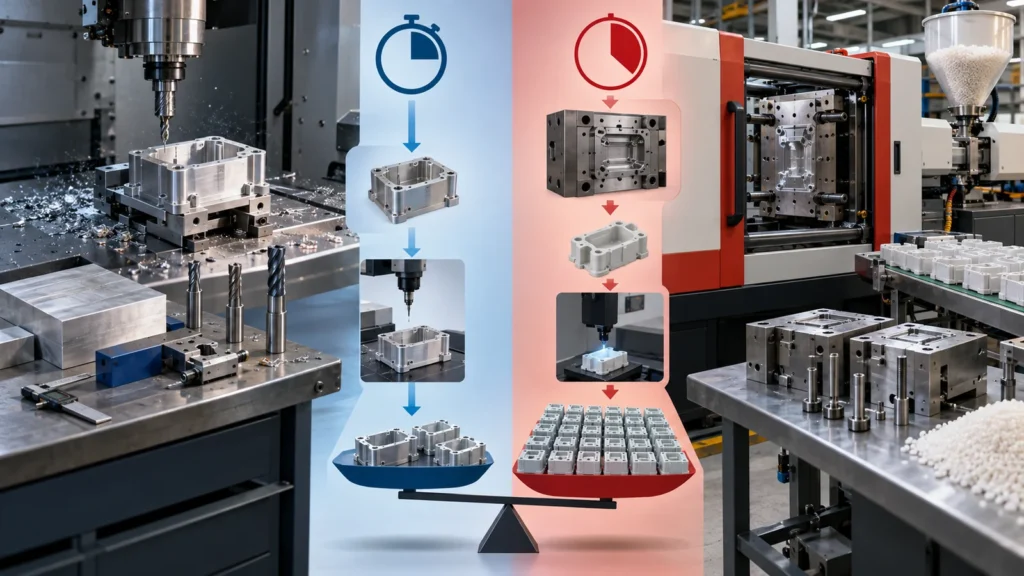
 CNC cost begins with programming, setup, stock, cutting time, tools, inspection, and finishing. Repeated orders can reuse process knowledge and sometimes fixtures, but each part continues to consume machine capacity. Injection molding moves much of the cost forward into mold design, mold manufacture, sampling, correction, and validation. Once the process is stable, cycle economics can favor repeat production.
There is no universal crossover quantity. A simple small component with a straightforward mold behaves differently from a large cosmetic housing with slides, inserts, texture, tight shutoffs, and demanding validation. Material utilization, cavities, cycle time, anticipated tool life, maintenance, scrap, secondary operations, packaging, and engineering changes all affect the result.
Compare total approved cost over the expected product life. Include the cost of design changes and the commercial impact of waiting for tooling. If CNC parts allow pilot sales, field tests, certification work, or assembly-line development while the mold is being completed, their higher piece price may purchase valuable schedule protection.
CNC cost begins with programming, setup, stock, cutting time, tools, inspection, and finishing. Repeated orders can reuse process knowledge and sometimes fixtures, but each part continues to consume machine capacity. Injection molding moves much of the cost forward into mold design, mold manufacture, sampling, correction, and validation. Once the process is stable, cycle economics can favor repeat production.
There is no universal crossover quantity. A simple small component with a straightforward mold behaves differently from a large cosmetic housing with slides, inserts, texture, tight shutoffs, and demanding validation. Material utilization, cavities, cycle time, anticipated tool life, maintenance, scrap, secondary operations, packaging, and engineering changes all affect the result.
Compare total approved cost over the expected product life. Include the cost of design changes and the commercial impact of waiting for tooling. If CNC parts allow pilot sales, field tests, certification work, or assembly-line development while the mold is being completed, their higher piece price may purchase valuable schedule protection.
A Machined Design Usually Needs a Molding Translation
Moving from CNC to molding is not a file-format conversion. Review wall thickness, transitions, ribs, boss proportions, draft, undercuts, parting direction, gate options, venting, ejector access, cosmetic faces, and expected shrinkage. Decide whether metal inserts, snap fits, living hinges, threads, or post-mold machining belong in the production route.
Functional datums deserve special attention. A machined prototype may reference a flat stock surface that will not exist naturally after molding. A molded part may need locating pads, controlled interfaces, or post-machined features to create reliable assembly references. A DFM review should therefore connect mold behavior to the drawing rather than treating the drawing and tool as separate documents.
Keep a transition register: list each prototype feature, how it was made, what it proved, how molding changes it, and what must be retested. This simple record prevents a successful CNC sample from becoming false evidence for an unvalidated molded detail.
Material Names Can Hide Different Evidence
 Stock and molding grades within the same polymer family may differ in molecular weight, reinforcement, additives, colorants, flame-retardant packages, moisture condition, or processing history. Fiber-filled materials may show directional behavior after molding that a machined stock sample does not reproduce. Transparent, wear-resistant, chemically exposed, or dimensionally sensitive applications require especially careful grade comparison.
Define the property being tested. If the objective is stiffness, creep, impact, sterilization resistance, dielectric behavior, wear, or chemical compatibility, confirm whether the machined stock is a valid proxy. The broader CNC machining materials guide helps frame stock selection, but the molding supplier must still confirm the production resin and processing implications.
Stock and molding grades within the same polymer family may differ in molecular weight, reinforcement, additives, colorants, flame-retardant packages, moisture condition, or processing history. Fiber-filled materials may show directional behavior after molding that a machined stock sample does not reproduce. Transparent, wear-resistant, chemically exposed, or dimensionally sensitive applications require especially careful grade comparison.
Define the property being tested. If the objective is stiffness, creep, impact, sterilization resistance, dielectric behavior, wear, or chemical compatibility, confirm whether the machined stock is a valid proxy. The broader CNC machining materials guide helps frame stock selection, but the molding supplier must still confirm the production resin and processing implications.
Tolerance and Appearance Need Functional Zones
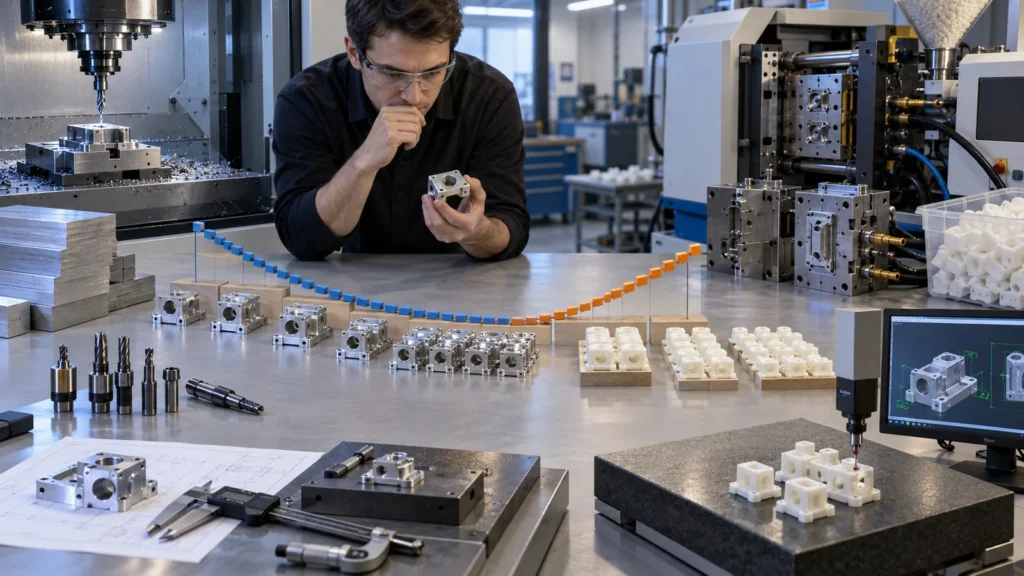 Machining can efficiently control accessible bores, faces, slots, and hole patterns, but forcing the same limits onto every molded surface can create an expensive and unstable specification. Separate critical assembly interfaces from nonfunctional envelope dimensions. For molded production, account for cavity layout, shrinkage, warpage, parting lines, gate vestige, ejector marks, and cosmetic classification.
Appearance should also be translated. A polished or bead-blasted machined prototype may communicate design intent but will not exactly predict molded texture, gloss, flow marks, knit lines, or color variation. Create an appearance specification with named zones and approved references instead of relying on the prototype alone.
Where a molded component still needs precision holes, sealing lands, or other controlled interfaces, a hybrid route may use molding for the body and machining for selected features. The drawing must identify the condition before and after secondary machining so inspection results remain unambiguous.
Machining can efficiently control accessible bores, faces, slots, and hole patterns, but forcing the same limits onto every molded surface can create an expensive and unstable specification. Separate critical assembly interfaces from nonfunctional envelope dimensions. For molded production, account for cavity layout, shrinkage, warpage, parting lines, gate vestige, ejector marks, and cosmetic classification.
Appearance should also be translated. A polished or bead-blasted machined prototype may communicate design intent but will not exactly predict molded texture, gloss, flow marks, knit lines, or color variation. Create an appearance specification with named zones and approved references instead of relying on the prototype alone.
Where a molded component still needs precision holes, sealing lands, or other controlled interfaces, a hybrid route may use molding for the body and machining for selected features. The drawing must identify the condition before and after secondary machining so inspection results remain unambiguous.
Five Gates Before Releasing Tooling
Failure at one gate does not always stop development. It may justify another machined batch targeted at the unresolved risk. This is where the prototype-to-production plan becomes more useful than a simple per-part comparison.
Quote Both Routes Without Creating False Equivalence
 Send the same revision, functional requirements, target material properties, quantities, finish expectations, inspection level, and delivery milestones. Then allow each supplier to state process-specific assumptions. For CNC, ask about stock form, setups, tool access, and reusable workholding. For molding, ask about tool construction, cavities, shrink assumptions, samples, corrections, maintenance, and secondary operations.
Do not compare a fully inspected machined part with an unvalidated molded estimate, or a production mold with a temporary prototype tool, as though they are identical offers. Normalize what is included, identify excluded risk, and model likely design changes. This is the practical way to evaluate the advantages and disadvantages of CNC machining against molding rather than declaring one process universally better.
Send the same revision, functional requirements, target material properties, quantities, finish expectations, inspection level, and delivery milestones. Then allow each supplier to state process-specific assumptions. For CNC, ask about stock form, setups, tool access, and reusable workholding. For molding, ask about tool construction, cavities, shrink assumptions, samples, corrections, maintenance, and secondary operations.
Do not compare a fully inspected machined part with an unvalidated molded estimate, or a production mold with a temporary prototype tool, as though they are identical offers. Normalize what is included, identify excluded risk, and model likely design changes. This is the practical way to evaluate the advantages and disadvantages of CNC machining against molding rather than declaring one process universally better.
Ask both suppliers to identify what happens after a failed first sample. For machining, the response may involve a program, tool, fixture, or drawing change. For molding, diagnosis may involve the tool, process window, resin condition, cooling, gate behavior, or part design. The quotation should distinguish included sampling loops from chargeable engineering changes so a low initial price does not hide an undefined approval path.
Packaging and handling should also match the surface and dimensional requirements. Machined prototypes may be individually protected, while molded production may move through automated handling or bulk packaging. Cosmetic scuffing, moisture uptake, deformation under stacking, and mixed-cavity traceability can become production issues even when individual samples pass.
Practical FAQs
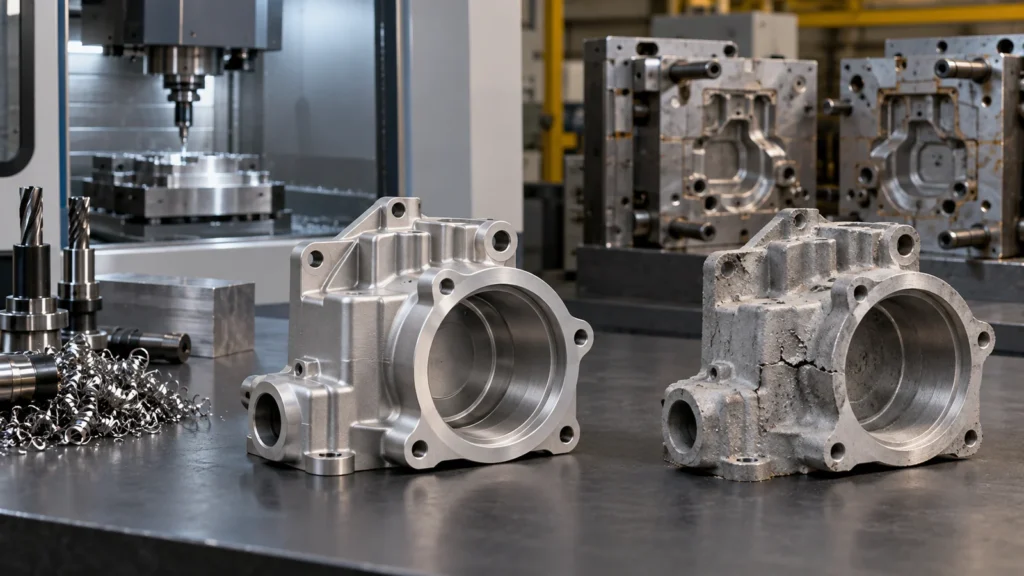
Only when the test authority and engineering team accept the material and process as representative. Document differences in grade, processing history, additives, geometry, and surface condition. Some tests evaluate the design; others evaluate the production material and process, so the answer depends on the evidence required.
Should every machined prototype be redesigned before molding?
Not every feature needs to change, but every part should receive a molding DFM review. Tool access limitations disappear while flow, cooling, shrinkage, draft, and ejection constraints appear. The production design should reflect those new constraints deliberately.
Can machining continue after the mold is released?
Yes. CNC can provide bridge quantities, support engineering changes, replace delayed molded parts, and machine critical features after molding. Revision control must keep temporary machined parts distinguishable from production molded parts.
What is the biggest warning sign that tooling is premature?
Frequent changes to functional interfaces are the clearest warning. Cosmetic refinements may be manageable, but moving datums, mating geometry, load paths, sealing features, or material requirements can force significant tool rework.