
In der sich schnell entwickelnden Landschaft der unbemannten Luftfahrzeuge war die Nachfrage nach Hochleistungskomponenten noch nie so kritisch. Piloten und Ingenieure gleichermaßen erkennen, dass das Rückgrat eines zuverlässigen Racing- oder Kinocopters in der Qualität seiner Strukturkomponenten liegt. FPV-Drohnenteile-Bearbeitung repräsentiert die Schnittstelle von Luft- und Raumfahrttechnik und agiler Fertigung und bietet die notwendige Präzision, die handelsübliche Kunststoffkomponenten einfach nicht erreichen können. Ob Sie einen Sub-250g Toothpick oder ein Schwerlast-Kino-Rig bauen, das Verständnis der Nuancen, wie diese Teile gefertigt werden, könnte der entscheidende Faktor zwischen einem Podiumsplatz und einem Absturz in der Luft sein.
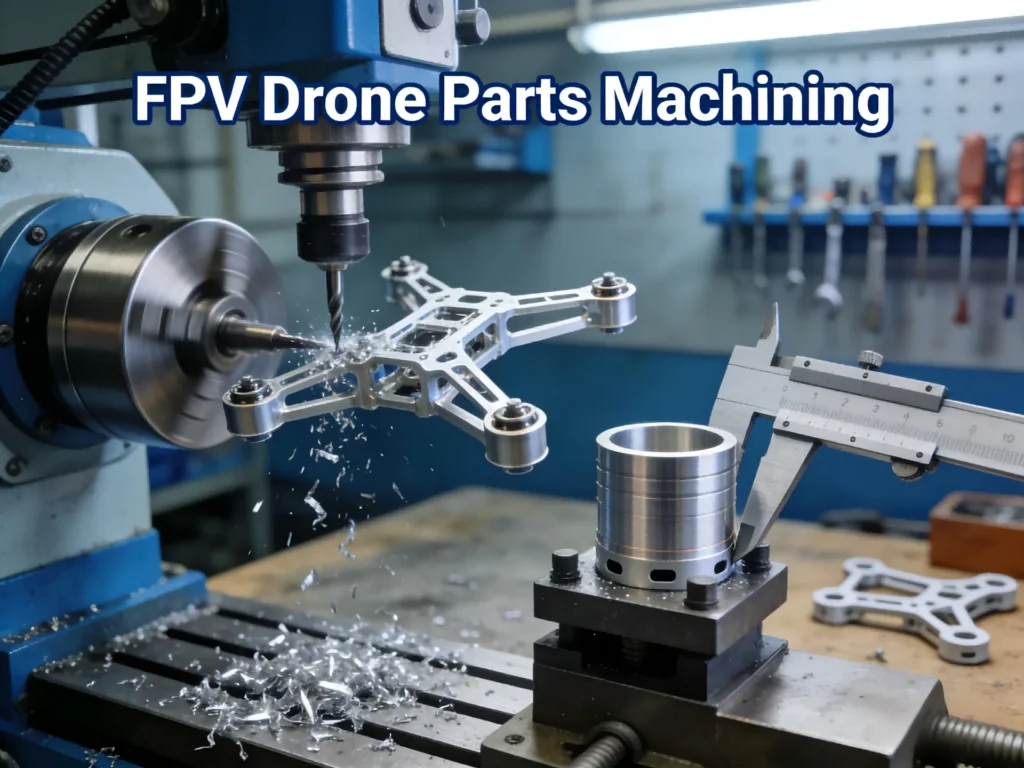
Verständnis der FPV-Drohnenteile-Bearbeitung: Definitionen und Kernprinzipien
Im Kern, FPV-Drohnenteile-Bearbeitung umfasst die Verwendung von computergesteuerter numerischer Steuerung (CNC)-Technologie zur subtraktiven Fertigung von Komponenten aus massiven Materialblöcken. Im Gegensatz zum traditionellen Formen ermöglicht die CNC-Bearbeitung unglaublich enge Toleranzen, oft im Mikrometerbereich, was für Komponenten wie Motorhalterungen und Kameragimbals, bei denen Vibrationsisolierung von größter Bedeutung ist, unerlässlich ist. Der Prozess beginnt mit einem digitalen CAD-Modell (Computer-Aided Design), das in G-Code übersetzt wird. Dieser Code weist spezialisierte Schneidwerkzeuge an, sich entlang mehrerer Achsen zu bewegen, um komplexe Geometrien herauszuarbeiten, die die moderne Drohnenästhetik und -funktionalität definieren.
Die Prinzipien dieser Fertigungsmethode beruhen stark auf der Materialintegrität. In der FPV-Community ist Gewicht der ultimative Feind. Daher konzentriert sich der Bearbeitungsprozess auf die Maximierung des Festigkeits-Gewichts-Verhältnisses. Dies wird durch Taschentechniken erreicht, bei denen nicht-strukturelles Material aus dem Inneren eines Teils entfernt wird, während ein starres äußeres Skelett erhalten bleibt. Fortgeschrittene 5-Achsen- FPV-Drohnenteile-Bearbeitung können für komplexe Designs eingesetzt werden, wie aerodynamische Motorglocken oder integrierte Rahmenstreben, um sicherzustellen, dass das Endprodukt so leicht wie möglich ist, ohne die strukturelle Sicherheit des Luftfahrzeugs zu beeinträchtigen.
Darüber hinaus stellt die Präzision von FPV-Drohnenteile-Bearbeitung sicher, dass jedes Schraubenloch und jeder Presssitz-Lagersitz perfekt ausgerichtet ist. Für Piloten, die ihr Equipment bei Hochgeschwindigkeitsmanövern bis an die absolute Grenze belasten, kann die thermische Stabilität, die durch bearbeitete Metalle geboten wird – insbesondere in hitzeintensiven Bereichen wie Motorbasen – einen signifikanten Leistungsvorteil gegenüber Verbundwerkstoff- oder Kunststoffalternativen bieten. Dieses Thermomanagement ist ein Schlüsselprinzip im modernen Drohnendesign und ermöglicht es der Elektronik, über längere Zeiträume mit Spitzeneffizienz zu arbeiten.
Kernanwendungsszenarien für bearbeitete Drohnenkomponenten
Die Vielseitigkeit von FPV-Drohnenteile-Bearbeitung ermöglicht es, eine breite Palette spezialisierter Branchen über den Hobby-Rennsport hinaus zu bedienen. Während die Wurzeln von FPV im Wettkampfflug liegen, haben sich die professionellen Anwendungen in den letzten Jahren exponentiell erweitert. Jedes Szenario erfordert einen anderen Ansatz bei der Bearbeitung und Materialauswahl, um spezifische Betriebsziele zu erreichen.
- Wettbewerbs-Drohnenrennen: In diesem Umfeld mit hohen Einsätzen sind Gewicht und Aerodynamik die primären Anliegen. Bearbeitete Aluminium-Motorhalterungen und ultradünne Kohlefaser-Arme sind Standard. Die Fähigkeit, identische Teile mit hoher Toleranz herzustellen, ermöglicht es Rennteams, eine Flotte von Drohnen mit konsistenten Flugeigenschaften zu unterhalten.
- Kinematografie und Luftbildfotografie: Professionelle Filmemacher benötigen stabile Plattformen für teures Kameraequipment. FPV-Drohnenteile-Bearbeitung wird verwendet, um kundenspezifische Gimbals, Dämpfungsplatten und Schnellwechselsysteme herzustellen, die den hohen G-Kräften eines aggressiven kinematografischen Flugs standhalten müssen.
- Industrielle Inspektion sowie Such- und Rettungseinsätze (SAR): Drohnen, die zur Inspektion von Stromleitungen oder zur Suche in unwegsamem Gelände eingesetzt werden, erfordern extreme Langlebigkeit. Bearbeitete Teile in diesen Drohnen weisen häufig Wetterdichtungsnuten und verstärkte Befestigungspunkte für Sensoren, Wärmebildkameras und GPS-Module auf.
- Landwirtschaftliche Überwachung: Großflächige landwirtschaftliche Drohnen verwenden bearbeitete Komponenten für Hochdrehmoment-Motorgehäuse und faltbare Armmechanismen. Diese Teile müssen korrosiven Umgebungen und wiederholter mechanischer Belastung während langer Betriebsstunden standhalten.
- Verteidigung und taktische Operationen: Für spezialisierte Missionsprofile ermöglicht kundenspezifisches FPV-Drohnenteile-Bearbeitung die Integration verschlüsselter Kommunikationsmodule und spezialisierter Nutzlastauslösemechanismen, die hochpräzise ineinandergreifende Teile erfordern.
Diese Anwendungen verdeutlichen, dass es bei FPV-Drohnenteile-Bearbeitung nicht nur um Ästhetik geht; es geht darum, Funktionalität zu ermöglichen, die die Standardfertigung nicht bieten kann. Durch die Wahl der CNC-Bearbeitung könnten Entwickler modulare Systeme schaffen, bei denen Teile im Feld leicht ausgetauscht werden können – eine kritische Anforderung sowohl für Rennteams als auch für industrielle Betreiber.
Wichtige Auswahlfaktoren für professionelle FPV-Bearbeitungsdienste
Bei der Suche nach einem Partner für FPV-Drohnenteile-Bearbeitung, müssen mehrere kritische Faktoren bewertet werden, um sicherzustellen, dass die endgültigen Komponenten den strengen Anforderungen des Flugs entsprechen. Der Unterschied zwischen einem hochwertigen bearbeiteten Teil und einer Budget-Alternative liegt oft in der Liebe zum Detail und der technischen Leistungsfähigkeit des Herstellers.
1. Dimensional Accuracy and Tolerances
In the world of FPV, a fraction of a millimeter can be the difference between a motor spinning freely and one that binds. A reputable provider of FPV-Drohnenteile-Bearbeitung should offer tolerances as tight as +/- 0.01mm. This is especially vital for motor bell housings and bearing seats, where any eccentricity can lead to excessive vibration and premature component failure.
2. Material Selection and Certification
The choice of material is fundamental. Most high-end FPV components utilize 7075-T6 aluminum or high-modulus carbon fiber. When evaluating a supplier, you should confirm they use certified materials. For instance, 7075 aluminum offers superior tensile strength compared to the more common 6061, making it ideal for high-impact areas like arm braces and frame standoffs. A professional shop will provide material data sheets upon request to verify these properties.
3. Surface Finish and Post-Processing
Beyond the raw cut, the surface treatment plays a dual role in protection and performance. Anodizing is a popular choice in FPV-Drohnenteile-Bearbeitung because it increases surface hardness and corrosion resistance while allowing for custom branding and color-coding. Additionally, smooth surface finishes reduce air resistance and prevent stress fractures from forming at micro-scratches on the surface of the metal.
4. Prototyping Speed and Scalability
The FPV industry moves fast. A manufacturer like jucheng that can pivot from a small prototyping run to full-scale production is invaluable. Look for shops that offer rapid turnaround times without sacrificing the quality of the FPV-Drohnenteile-Bearbeitung. This allows designers to iterate on designs quickly based on flight test data, which is common in the collaborative environments found on Reddit and specialized drone forums.
Material Performance Comparison Table
| Material Type | Zugfestigkeit | Weight Density | Best Use Case | Machining Difficulty |
|---|---|---|---|---|
| Aluminum 6061-T6 | Moderate (310 MPa) | Low (2.7 g/cm³) | General frame parts, standoffs | Easy |
| Aluminium 7075-T6 | High (570 MPa) | Low (2.8 g/cm³) | Motor mounts, high-stress braces | Mäßig |
| Titan Grade 5 | Very High (950 MPa) | Moderate (4.4 g/cm³) | Axles, ultra-durable fasteners | Hoch |
| Carbon Fiber (3K/12K) | Extremely High (Ratio) | Very Low (1.6 g/cm³) | Main frame plates, arms | Moderate (Tool wear) |
Installation and Maintenance Tips for Machined FPV Components
Once you have received your precision components from FPV-Drohnenteile-Bearbeitung, proper installation and ongoing maintenance are essential to preserving their performance. Machined parts, while durable, require specific care to avoid stripping threads or compromising their structural integrity.
During the assembly phase, it is highly recommended to use a mild thread-locking compound (such as blue Loctite) on all metal-to-metal connections. The high-frequency vibrations generated by FPV motors can easily loosen screws over time. However, be cautious not to over-tighten; machined aluminum threads could be damaged if excessive torque is applied. Using a calibrated torque driver is a best practice among professional builders who prioritize consistency.
Maintenance of components produced via FPV-Drohnenteile-Bearbeitung should include regular inspections for stress cracks, especially after crashes. While 7075 aluminum is incredibly strong, it can be more brittle than 6061, meaning it may crack rather than bend under extreme impact. Cleaning is also vital. Dust and debris can act as abrasives in moving parts or gimbals. Using compressed air and isopropyl alcohol will keep your machined surfaces looking new and functioning smoothly. For carbon fiber parts, checking for delamination at the edges of the FPV-Drohnenteile-Bearbeitung cuts is crucial; if any fraying is spotted, sealing the edges with a thin layer of cyanoacrylate (CA) glue can prevent further damage.
Häufig gestellte Fragen (FAQ)
1. Why is CNC machining preferred over 3D printing for FPV parts?
While 3D printing is excellent for rapid prototyping and non-structural accessories, FPV-Drohnenteile-Bearbeitung offers significantly higher strength and precision. CNC parts are isotropic, meaning they have uniform strength in all directions, whereas 3D prints have weak points between layers. For critical components like motor mounts, the heat resistance and structural rigidity of machined metal are unmatched.
2. Can I get custom designs machined for a single drone build?
Yes, many specialized shops like jucheng cater to both individual custom orders and large-scale production. Small-batch FPV-Drohnenteile-Bearbeitung is a common request from professional pilots who have developed their own unique frame geometries or mounting solutions.
3. How does machining affect the weight of my FPV drone?
In many cases, FPV-Drohnenteile-Bearbeitung actually helps reduce weight. Because CNC machines can remove material with extreme precision, designers can create “skeletonized” parts that only keep material where it is structurally necessary. This often results in a part that is both lighter and stronger than a molded or cast equivalent.
4. What are the most common materials used in drone machining?
The industry standard for FPV-Drohnenteile-Bearbeitung includes 6061 and 7075 aluminum for structural components, titanium for hardware and shafts, and high-quality carbon fiber for frames. Some specialized builds may also use engineering plastics like Delrin for spacers or insulators due to its excellent machinability and low friction.
5. Does the surface finish of a machined part impact flight performance?
While the impact on aerodynamics is minimal at typical FPV scales, a smooth finish from high-quality FPV-Drohnenteile-Bearbeitung reduces the likelihood of stress concentrations. Furthermore, anodized finishes provide a hard protective layer that prevents oxidation, which could otherwise degrade the material over time, especially in humid or coastal environments.
6. What is the typical lead time for custom machined drone parts?
Lead times vary based on complexity and quantity. However, for standard FPV-Drohnenteile-Bearbeitung, the process usually takes between 5 to 10 business days. Rapid prototyping services may offer faster turnarounds for pilots who need to get back in the air quickly after a design change.
Why Jucheng is the Premier Choice for FPV Drone Parts Machining
Im spezialisierten Bereich der FPV-Drohnenteile-Bearbeitung, jucheng stands out as a leader in both technical expertise and industry experience. The unique challenges of drone manufacturing—extreme weight constraints, high-vibration environments, and the need for absolute reliability—require a manufacturer that understands the “pilot’s perspective.”
At jucheng, we utilize state-of-the-art multi-axis CNC centers that are specifically calibrated for the tight tolerances required by the aerospace sector. Our engineering team doesn’t just execute a drawing; we provide “Design for Manufacturing” (DFM) feedback to help optimize your FPV-Drohnenteile-Bearbeitung for the best possible strength-to-weight ratio. This collaborative approach has made us a favorite among the innovative designers seen on platforms like Facebook drone groups and Reddit’s r/Multicopter.
Quality assurance is at the heart of our operation. Every component produced through our FPV-Drohnenteile-Bearbeitung process undergoes rigorous inspection, including coordinate measuring machine (CMM) checks and material verification. We understand that in a racing heat or a cinematic shoot, there is no room for part failure. By choosing jucheng, you are not just buying a part; you are investing in the peace of mind that comes from professional-grade engineering and a commitment to the FPV community’s growth. Our versatility in handling materials from advanced thermoplastics to aerospace-grade alloys ensures that whatever your vision for the next generation of flight, we have the tools and talent to bring it to life.
For those looking to push the boundaries of what is possible in the air, jucheng offers the precision and reliability that only a top-tier FPV-Drohnenteile-Bearbeitung specialist can provide. We invite you to experience the difference that expert manufacturing makes in your flight performance.
Elevate Your Flight with Precision Engineering
Are you ready to take your FPV builds to the next level? Whether you need a single custom prototype or a high-volume production run, our team of experts is here to help. At jucheng, we specialize in high-tolerance FPV-Drohnenteile-Bearbeitung that meets the needs of the most demanding pilots and industrial applications.
Contact us today for a free quote and technical consultation! Let’s build the future of FPV together.