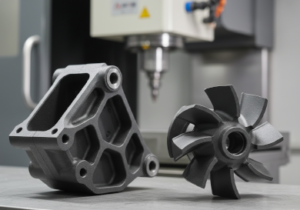
Available Nylon (PA) Grades
| Grade |
Common Name |
Key Characteristics |
Typical Applications |
| Nylon 6 (PA6) |
Cast Nylon |
Excellent toughness, impact resistance, and surface finish. Slightly higher water absorption than PA66. |
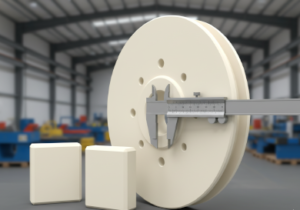
Large gears, wear pads, sheaves, rollers. |
| Nylon 6/6 (PA66) |
Extruded Nylon |
Higher mechanical strength, stiffness, and heat resistance than PA6. The most common grade for machining. |
Automotive parts, electrical insulators, high-load bearings. |
| Glass-Filled Nylon |
PA66 GF30 |
Reinforced with 30% glass fibers. significantly stiffer and stronger. Lower moisture absorption but abrasive to tools. |
Structural housings, power tool casings, pump impellers. |
| Nylon 12 (PA12) |
Low Moisture Nylon |
Lowest moisture absorption of any nylon. Excellent dimensional stability and chemical resistance. |
Fuel lines, precision gears, hydraulic seals. |
Nylon Machining Capabilities
| Capability |
Technical Description |
Jucheng Advantage |
| Gear Hobbing & Milling |
Machining precision plastic gears with optimized tooth profiles for noise reduction. |
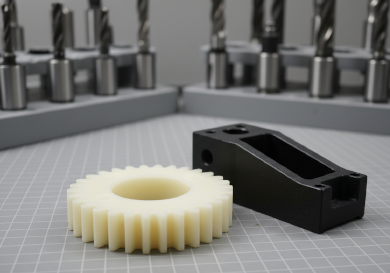
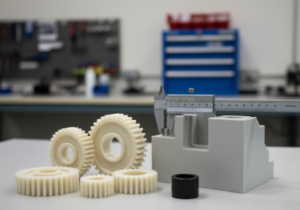
We produce silent-running nylon gears that outlast metal in low-lubrication environments. |
| Moisture Conditioning |
Managing the moisture content of Nylon parts pre- and post-machining. |
Ensures that the final dimensions delivered to the customer account for environmental expansion. |
| High-Speed Turning |
Turning bushings, washers, and spacers with rapid cycle times. |
Our automated bar-feeders allow for cost-effective mass production of nylon hardware. |
| Deep Hole Drilling |
Drilling deep bores in nylon without melting the material due to friction. |
We use specialized peck cycles and through-tool coolant to keep the material cool and chips evacuating. |
Fabrication Guidelines for Nylon
Moisture Management:
Nylon absorbs water (hygroscopic), which causes it to swell. We recommend machining dry stock and accounting for approx. 2-3% growth in humid environments during the design phase.
Coolant Strategy:
Nylon has a relatively low melting point compared to high-performance plastics. Sharp tools and abundant coolant are essential to prevent the material from melting and gumming up the cutter.
Tooling:
Very sharp, positive rake HSS or Carbide tools are best. Dull tools will generate excess heat, causing the nylon to smear and leaving a poor surface finish.
Deburring:
Nylon can be difficult to deburr because burrs tend to fold over rather than break off. We use specialized cryogenic deburring or manual trimming to ensure clean edges.
Primary Application Industries
Automotive
Key Parts: Air intake manifolds, engine covers, oil pans, bushings.
Why Nylon: Withstands high temperatures and oil exposure while significantly reducing vehicle weight.
Industrial Machinery
Key Parts: Conveyor rollers, wear pads, pulleys, gears.
Why Nylon: High wear resistance and self-lubricating properties reduce maintenance downtime.
Electrical & Electronics
Key Parts: Coil bobbins, cable ties, insulating washers, connector housings.
Why Nylon: Good dielectric strength and toughness make it ideal for protecting electrical components.
Consumer Products
Key Parts: Power tool housings, sports equipment bindings, furniture casters.
Why Nylon: Impact resistance ensures durability against drops and heavy usage.