
Introdução: O Poder de Precisão dos Serviços de Eletroerosão a Fio
No mundo da manufatura avançada, onde a complexidade encontra a precisão inexorável, um processo especializado se destaca. Serviços de eletroerosão a fio representam o ápice da usinagem de precisão, possibilitando a criação de peças que antes eram consideradas impossíveis ou proibitivamente caras de produzir. Este processo de usinagem térmica sem contato utiliza faíscas elétricas controladas para cortar até os metais mais duros com precisão surpreendente, deixando um acabamento superior e geometria perfeita. Para indústrias onde a falha não é uma opção — aeroespacial, médica, defesa e além — a eletroerosão a fio não é apenas um serviço; é um facilitador crítico da inovação. Ela transforma projetos desafiadores em realidade, de protótipos complexos a produções em larga escala, tudo mantendo tolerâncias que rivalizam com a largura de um fio de cabelo humano. Este artigo explora o poder desta tecnologia, examinando seus princípios, vantagens e as vastas capacidades que oferece à engenharia moderna.
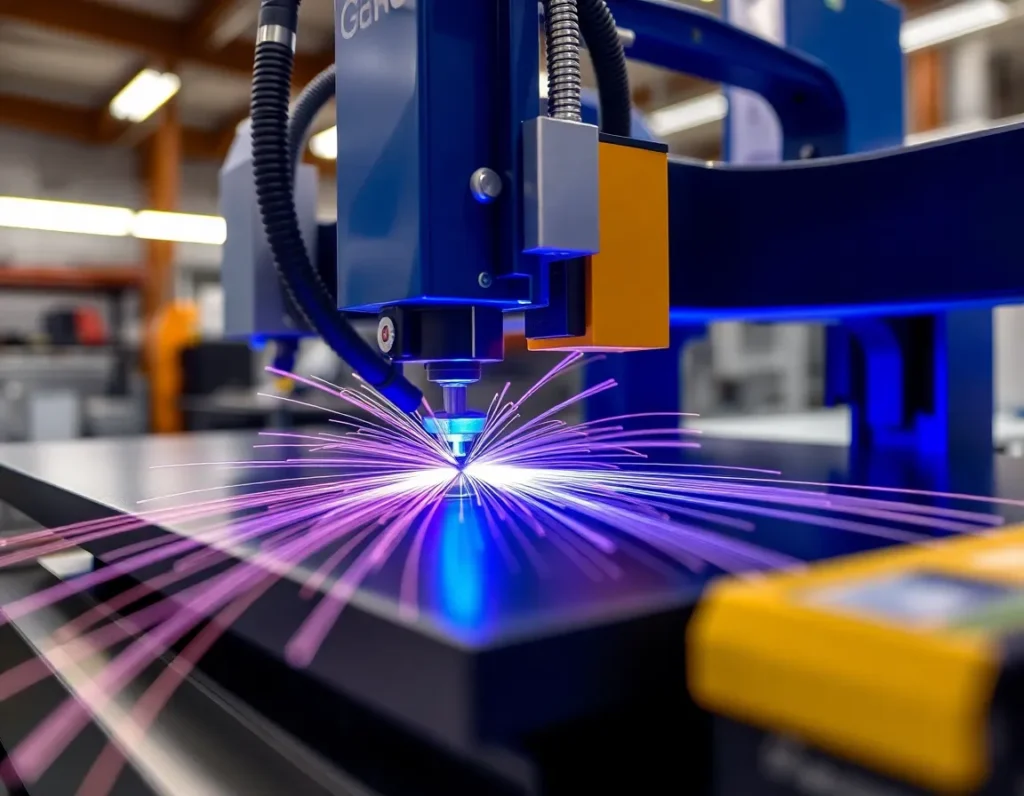
O que é Eletroerosão a Fio? Um Mergulho Profundo na Usinagem por Descarga Elétrica
A Usinagem por Descarga Elétrica (EDM) a Fio é um processo de remoção de metal de precisão que utiliza um fio fino, eletricamente carregado, como eletrodo para cortar um contorno programado em uma peça de trabalho. O princípio fundamental baseia-se na erosão controlada através de uma série de descargas elétricas rápidas e recorrentes (faíscas) entre o fio e o material condutor submerso em um fluido dielétrico, tipicamente água deionizada.
O Mecanismo Central: Erosão por Faísca
O processo começa com o fio controlado por CNC, que é constantemente alimentado a partir de um carretel, posicionado próximo à peça de trabalho, mas nunca fazendo contato físico. Um potencial elétrico poderoso é criado entre o fio (eletrodo negativo) e a peça de trabalho (eletrodo positivo). Quando a folga é suficientemente pequena, a propriedade isolante do fluido dielétrico se rompe e uma faísca salta através dela. Esta faísca gera um calor intenso e localizado — excedendo 10.000 graus Celsius — que instantaneamente derrete e vaporiza uma porção microscópica da peça de trabalho. O fluido dielétrico em fluxo então remove os pequenos detritos e resfria a área, prevenindo distorção térmica. Este ciclo se repete centenas de milhares de vezes por segundo, erodindo de forma constante e precisa um caminho através do material.
Componentes-Chave do Sistema de Eletroerosão a Fio
- O Eletrodo de Fio: Tipicamente feito de latão ou cobre estratificado, o diâmetro do fio pode variar de 0,004” para trabalhos de micro precisão até mais de 0,012” para cortes mais pesados. É um consumível, viajando de um carretel de alimentação para um carretel de recolhimento a uma taxa constante.
- O Fluido Dielétrico (Água Deionizada): Desempenha três funções críticas: atua como isolante até que a tensão da folga de faísca seja atingida, remove as partículas erodidas (as “lascas” do processo) e resfria a peça de trabalho e o fio.
- O Sistema de Controle CNC: O cérebro da operação. Ele guia com precisão o movimento do fio ao longo dos eixos X e Y (e frequentemente U e V para cortes cônicos) com base em um programa digital, controlando o intervalo de faísca, a taxa de alimentação do fio e as configurações de potência para alcançar a qualidade de corte, velocidade e acabamento superficial desejados.
- A Mesa de Trabalho e a Fonte de Alimentação: A peça de trabalho é fixada com segurança em uma mesa de trabalho controlada por servo. A fonte de alimentação gera a corrente CC pulsada que cria as faíscas, com parâmetros finamente ajustados para o material específico e os requisitos de acabamento.
Essa natureza de “sem contato” é o que confere à EDM a fio sua vantagem única: como não há força mecânica exercida sobre a peça, não há pressão de ferramenta, nem formação de rebarbas, nem risco de distorcer características delicadas ou de paredes finas. O processo pode usinar aço endurecido tão facilmente quanto alumínio, tornando-o uma solução singularmente versátil no arsenal da manufatura de precisão.
EDM a Fio vs. Usinagem Convencional: Quando e Por Que Escolher a EDM
Escolher o processo de manufatura correto é uma decisão de engenharia crítica. Embora a usinagem convencional (fresamento, torneamento) seja excelente para muitas aplicações, a EDM a fio oferece um conjunto distinto de vantagens para desafios específicos. A escolha geralmente se resume às propriedades do material, à geometria da peça, à precisão exigida e à relação custo-benefício.
Quando a EDM a Fio é a Escolha Superior
- Materiais Endurecidos: Ferramentas de corte convencionais têm dificuldade ou não conseguem usinar aços-ferramenta endurecidos, carbonetos e ligas exóticas. O processo de erosão por faísca da EDM a fio não é afetado pela dureza do material, permitindo que as peças sejam tratadas termicamente primeiro (para resistência e estabilidade ideais) e depois usinadas nas dimensões finais sem distorção.
- Complexidade Geométrica Extrema: Perfis intrincados, cantos internos agudos e características delicadas são onde a EDM a fio se destaca. O fio fino pode cortar contornos 2D e 3D complexos que seriam impossíveis para uma fresa de topo acessar ou exigiriam ferramentas de forma personalizadas proibitivamente caras.
- Tolerâncias e Acabamentos Exigentes: Para aplicações que exigem tolerâncias dentro de ±0,0001” e acabamentos superficiais ultrafinos, a EDM a fio é frequentemente o método mais confiável e repetível. O processo elimina vibração e deflexão da ferramenta, garantindo precisão consistente peça após peça.
- Sem Rebarbas, Baixa Tensão: Como não há contato físico, o processo produz bordas virtualmente livres de rebarbas. A zona termicamente afetada é mínima, e a ausência de forças de corte significa que nenhuma tensão mecânica é induzida na peça de trabalho, preservando sua integridade metalúrgica.
- Prototyping and Low-Volume Production: No custom tooling is required. A simple digital program is all that’s needed to cut a part, making wire EDM exceptionally fast and cost-effective for prototypes, one-off parts, and short runs compared to designing and fabricating hard tooling.
Limitations and Conventional Machining Advantages
Conventional machining typically holds the advantage in speed for large volumes of simple parts, bulk material removal, and machining non-conductive materials (like plastics or composites). It is also generally more economical for producing simple holes and pockets in soft materials. Wire EDM is a slower, more precise cutting process best suited for conductive materials where its unique benefits are required. The most effective manufacturing strategy often involves using both: conventional machining for roughing and basic shaping, followed by wire EDM for finishing critical features on a hardened part.
Core Wire EDM Services and Capabilities: From Prototyping to Production
Modern wire cut EDM services have evolved far beyond simple shape cutting. They encompass a sophisticated suite of capabilities designed to support every stage of the product lifecycle, from initial concept to full-scale manufacturing.
Prototyping and Rapid Turnaround
For engineers and designers, wire EDM is an invaluable prototyping tool. The ability to go directly from a CAD model to a finished, precision metal part without tooling enables rapid iteration and design validation. Service providers specializing in quick-turn EDM can often produce sample parts within days, allowing for functional testing of complex gears, medical implant prototypes, or aerospace components under real-world conditions. This agility accelerates development cycles and reduces time-to-market.
High-Volume Production and Palletized Systems
Contrary to common perception, wire EDM is not solely for prototypes. For high-volume production of intricate components, advanced EDM shops utilize palletized systems and automated wire threading. Multiple parts can be stacked or “nested” on a single fixture, and machines can run unattended for hours, cutting dozens of parts from a single thick block of material. This method ensures absolute accuracy and repeatability across thousands of parts, making it ideal for critical production runs in the medical device and automotive industries.
Advanced Technical Capabilities
- 4-Axis and Taper Cutting: Beyond simple vertical cuts, advanced wire EDMs can tilt the wire to create parts with drafted sides or complex 3D contours. Tapers up to 30 degrees or more allow for the creation of molds, dies, and aerospace components with clearance angles.
- Fine Wire and Micro-EDM: Using wire as small as 0.004” in diameter, this capability is essential for micro-miniature parts in medical, semiconductor, and electronics applications. It allows for incredibly small corner radii, narrow slots, and the machining of extremely delicate features.
- Submerged Cutting: Performing cuts fully submerged in dielectric fluid provides superior thermal stability, crucial for holding tight tolerances on tall or thick workpieces. It also results in a finer surface finish and more efficient flushing during interrupted cuts.
- Large-Part Capacity: Industrial wire EDM machines can handle massive workpieces, with travel capabilities exceeding 30” in X and Y axes and the ability to cut material thicknesses of 16” or more, accommodating large stamping dies, aerospace structural components, and industrial tooling.
- Anti-Electrolysis Power Supplies: For sensitive materials like medical-grade titanium or certain tool steels, this technology prevents the electrochemical pitting or corrosion that can sometimes occur with standard EDM, ensuring pristine surface integrity.
Integrated Manufacturing Support
Leading EDM service providers operate as full-service contract manufacturers. This means they offer complete machine shop support, including CNC milling and turning, quality inspection (with CMMs and optical comparators), and secondary operations like abrasive flow machining (AFM) to polish and remove the thin recast layer from EDM surfaces. This integrated approach provides a single source for the entire component, streamlining logistics and ensuring seamless quality control from raw material to finished part.
Key Industries Served: Aerospace, Medical, Defense, and Commercial Applications
The unique capabilities of wire EDM make it indispensable across sectors where precision, material integrity, and complex geometries are non-negotiable. Specialized wire cut edm services are not a one-size-fits-all solution; they are tailored to meet the stringent and often unique demands of each field.
Aerospace & Satellite Machining
In aerospace and satellite manufacturing, components must perform flawlessly under extreme stress, temperature fluctuations, and in vacuum conditions. Wire EDM is used to produce critical parts such as turbine engine components, fuel system elements, structural brackets, and satellite guidance mechanisms. The process’s ability to machine hardened, high-strength alloys and exotic materials like Inconel and titanium after heat treatment—without inducing stress or distortion—is paramount. Tolerances within .0002” and superior surface finishes ensure parts meet rigorous AS9100 and NADCAP standards for flight-worthiness and long-term reliability.
Medical & Surgical Device Manufacturing
The medical industry relies on wire EDM for life-saving and life-enhancing devices. This includes the production of intricate components for surgical tools, implants (such as knees, hips, and spinal devices), biopsy needles, and micro-scale parts for minimally invasive robotics. Medical-grade materials like stainless steels, titanium, and cobalt-chrome are machined to exceptional finishes to prevent bacterial adhesion and ensure biocompatibility. The process’s precision in creating sharp, burr-free edges and complex internal features in hardened materials is critical for device performance and patient safety, adhering to ISO 13485 and FDA guidelines.
Defense & Military Applications
Defense projects demand uncompromising accuracy, durability, and secrecy. Wire EDM services are employed to manufacture components for firearms, optical systems, armored vehicle systems, and communication devices. The technology excels at producing hardened tooling for ammunition production, intricate gears for guidance systems, and robust parts from tungsten alloys. The ability to handle classified ITAR-controlled projects and work with difficult-to-machine armor plate materials makes a capable EDM partner a strategic asset for defense contractors.
Commercial & Industrial Tooling
Beyond these high-stakes fields, wire EDM is the backbone of advanced commercial manufacturing. It is essential for producing precision tool and die sets for stamping, molding, and extrusion processes. This includes punches, dies, ejector pins, and mold inserts for plastic injection molding. The semiconductor industry uses EDM for wafer handling components and fixtures. Automotive manufacturers leverage it for prototype parts and production tooling. The commercial benefit lies in the technology’s ability to extend tool life by machining after hardening and to create complex geometries that improve end-product quality and manufacturing efficiency.
The Wire EDM Process: Technology, Techniques, and Tolerances
Understanding the mechanics behind wire EDM demystifies its precision. At its core, it is a thermoelectric process where material is removed by a series of controlled electrical sparks (discharges) between a traveling wire electrode and the conductive workpiece.
Core Technology and Setup
The workpiece is securely mounted on the machine table, submerged in a tank of deionized water, which acts as a dielectric fluid to cool the cut and flush away eroded particles. A thin, precisely spooled wire (typically brass or coated varieties) is fed from a supply spool through the workpiece and onto a take-up spool. The wire is constantly moving to present a fresh, erosive surface. A power supply generates a pulsed DC current, creating rapid sparks in the gap between the wire and the workpiece. These sparks, which can number in the tens of thousands per second, generate intense heat (around 10,000°C) that melts and vaporizes microscopic portions of the material.
Key Techniques for Enhanced Capability
- CNC Path Control: The wire’s path is dictated by sophisticated CNC programming, allowing for the cutting of intricate 2D profiles or complex 3D shapes with tapered sides.
- Submerged Cutting: Operating fully submerged stabilizes the wire thermally and mechanically, enabling higher accuracy and finer finishes, especially in tall or interrupted cuts.
- Automatic Wire Threading (AWT): This feature allows the machine to automatically re-thread the wire through a starter hole, enabling the unattended machining of multiple parts or complex internal features without operator intervention.
- Multiple Passes (Roughing & Skimming): A part is often cut using a series of passes. A first, faster pass removes the bulk of material, leaving a rough surface. Subsequent, slower “skim” passes with a reduced power setting use a slight wire offset to achieve the final dimension, a superior surface finish, and tight tolerances.
- Fine Wire EDM: Utilizing wire as small as 0.004” in diameter, this technique is for micro-machining, producing extremely small radii, slots, and delicate parts with exceptional precision.
Achievable Tolerances and Finishes
The precision of modern wire EDM is extraordinary. Standard tolerances for production work are routinely within ±0.0002” (0.005mm), with some applications holding tolerances as tight as ±0.0001”. Surface finishes of 8-10 microinches Ra (0.2-0.25 µm Ra) are achievable with multi-pass skimming, often eliminating the need for secondary polishing. The process can produce sharp inside corners with very small radii, limited only by the wire diameter and spark gap. This combination of dimensional accuracy and fine finish is what sets high-end wire cut EDM services apart from conventional machining for complex, hardened components.
Materials Mastery: Machining Hardened Steels, Exotics, and Conductive Materials
One of the most compelling advantages of wire EDM is its material agnosticism. Since the process cuts via electrical discharge rather than mechanical force, the hardness, toughness, or wear resistance of the material presents no barrier. This opens a world of possibilities for engineers designing with advanced materials.
Hardened Tool Steels and Alloys
Wire EDM is the preferred method for machining tool steels (like D2, A2, M2, H13) and high-speed steels after they have been fully hardened, often to 60 HRC or higher. Machining post-heat-treatment avoids the dimensional distortions that can occur during the quenching process, saving time and cost associated with secondary machining and correction. This capability is fundamental to the tool and die industry, ensuring cutting dies and mold inserts retain their precise geometry and durability.
Exotic and Difficult-to-Machine Alloys
Industries such as aerospace and medical regularly employ superalloys and exotic materials known for their strength and resistance to heat and corrosion. These materials, which are notoriously challenging for conventional machining, are readily processed by wire EDM. This includes:
- Nickel-Based Superalloys: Inconel, Monel, Hastelloy.
- Titanium Alloys: Ti-6Al-4V, CP Titanium.
- Carbides: Tungsten carbide, used for extreme wear applications.
- Other Exotics: Kovar, Molybdenum, and various beryllium-copper alloys.
Conductive Composites and Specialty Materials
The only strict requirement for wire EDM is that the material must be electrically conductive. This extends its use to advanced composites like metal matrix composites (MMCs) and certain graphite grades used in EDM electrodes. Even conductive ceramics and polycrystalline diamond (PCD) can be cut using specialized wire EDM techniques. This mastery over such a diverse material portfolio allows designers to select the ideal material for a component’s function without being constrained by manufacturability concerns.
Complementary EDM Services: Sinker EDM, Hole Drilling, and Abrasive Flow Machining
A full-service EDM provider offers more than just wire cutting. A suite of complementary processes addresses a wider range of geometric challenges and ensures complete part readiness, often within a single facility.
Sinker EDM (Ram EDM)
Also known as conventional or cavity-type EDM, sinker EDM uses a pre-shaped electrode (typically graphite or copper) that is lowered into the workpiece to create a negative impression. This is ideal for producing complex 3D cavities, blind features, sharp internal corners, and textured surfaces that are impossible for a wire to create. Common applications include intricate mold cavities for plastic injection or die casting, forging dies, and machining internal splines or gears. It is the perfect partner to wire EDM for complex tooling.
EDM Hole Drilling (Fast Hole EDM / Hole Popping)
This specialized process uses a rotating tubular electrode to rapidly drill small, deep, and accurate holes in conductive materials—regardless of hardness. It is indispensable for creating starter holes for wire EDM threading, cooling channels in mold tools, fuel injection nozzles, and turbine blade cooling holes. Capabilities include drilling holes as small as 0.010” in diameter with high depth-to-diameter ratios and at shallow angles to surfaces, a task extremely difficult for conventional drilling, especially in hardened materials.
Abrasive Flow Machining (AFM)
While EDM produces excellent finishes, it leaves behind a thin, recast layer or “white layer” on the surface, which can be microscopically fractured. For applications requiring ultimate fatigue resistance, corrosion resistance, or a polished surface (like medical implants or fluid flow paths), AFM is the ideal finishing step. AFM extrudes a viscous, abrasive-laden media through or across the part’s surfaces. It uniformly deburrs, polishes, and removes the EDM recast layer, producing radii and improving surface finishes without altering the part’s critical dimensions. This process is key to achieving the highest quality standards in finished EDM components.
Ensuring Quality: Certifications, Standards, and Quality Assurance in EDM
For industries where component failure is not an option, the quality assurance framework behind wire cut EDM services is as critical as the machining itself. The process’s precision is only as reliable as the system that governs it. Leading providers embed quality at every stage, from initial programming to final inspection, supported by a foundation of rigorous certifications and standardized procedures.
Certifications are the cornerstone of trust. The AS9100 standard, built upon ISO 9001, is the aerospace benchmark, mandating stringent controls for design, traceability, and risk management. For medical device manufacturing, ISO 13485 certification is essential, ensuring processes meet regulatory requirements for safety and efficacy. Specialized accreditations like NADCAP for EDM represent an even higher audit level, where technical processes are scrutinized by industry experts. A shop holding these credentials demonstrates a proven, audited commitment to systematic quality management.
This systemic approach translates into concrete shop-floor practices. First-article inspection reports (FAIR) meticulously validate that initial production parts meet all print specifications. In-process verification, using tools like optical comparators and coordinate measuring machines (CMM), ensures consistency throughout a production run. Advanced shops employ vision systems and laser scanners for non-contact inspection of delicate or complex geometries. Crucially, all inspection equipment is regularly calibrated against NIST-traceable standards to guarantee measurement integrity.
Material certification and traceability are non-negotiable, especially in aerospace and medical applications. Providers must be able to document a component’s material pedigree from mill to finished part. Process documentation, including detailed traveler packets that follow each job, ensures every step—from EDM cut parameters to post-process treatments like abrasive flow machining—is recorded and repeatable. This level of documentation not only assures quality but also provides vital data for continuous improvement and root-cause analysis should any deviation occur.
Ultimately, a true quality culture extends beyond certificates on the wall. It is reflected in a team of highly skilled personnel dedicated to perfection, a pledge to complete customer satisfaction, and a drive for continuous technical development. This holistic approach to quality assurance is what transforms a precision cutting service into a reliable manufacturing partner for mission-critical components.