
+86-188-7042-1176
project@jcproto.com
Lun-Ven : 8h-18h (GMT+8)
EN
Certifié ISO 9001:2015
PC-ABS
PC-ABS is a high-performance engineering alloy that represents the perfect synergy between Polycarbonate and ABS. It offers the high impact strength and thermal stability of PC along with the exceptional processability and aesthetic versatility of ABS. This makes it the premier choice for demanding applications in the automotive, telecommunications, and medical industries. Jucheng Precision specializes in the precision CNC machining of PC-ABS, delivering complex prototypes and low-volume production parts with integrated features like snap-fits and threaded bosses. Our expertise in advanced surface finishing—including custom painting and texturing—ensures your PC-ABS components provide the rugged durability and premium look required for high-stakes product development.
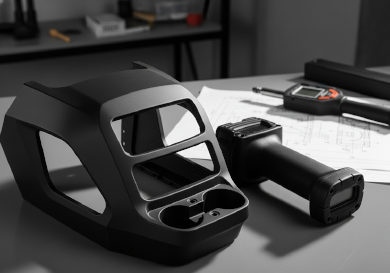
ABS & PC Alloy Variants
| Nuance | Nom courant | Caractéristiques clés | Applications typiques |
|---|---|---|---|
| PC-ABS | Polycarbonate/ABS Alloy | Best balance of toughness, heat resistance, and processability. High impact strength even at low temperatures. | Automotive interiors, rugged electronics, medical enclosures. |
| ABS standard | ABS à usage général | Excellent impact resistance and low cost. Best for basic functional prototypes and toys. | Consumer goods, simple housings, early-stage models. |
| PC standard | Polycarbonate | Highest impact strength and heat resistance, but more difficult to machine and finish than alloys. | Safety shields, lenses, high-heat structural parts. |
PC-ABS Machining Capabilities
| Capacité | Description technique | Avantage Jucheng |
|---|---|---|
| Ergonomic 5-Axis Milling | Machining complex, organic curves for handheld devices and automotive consoles. | Our 5-axis Haas/Mazak centers achieve seamless surface transitions, ensuring prototypes have the exact ergonomic feel of the final product. |
| Deep-Rib & Boss Machining | Milling tall, thin internal structural ribs and mounting bosses with high aspect ratios. | We utilize specialized long-reach tools and vibration-dampening strategies to ensure internal features are robust and dimensionally accurate. |
| Advanced Surface Finishing | Integrated post-processing including sand-blasting, chemical smoothing, and soft-touch painting. | Jucheng provides “A-Class” surface finishes that meet automotive and medical aesthetics, ready for assembly or marketing displays. |
| Insert Overmolding Simulation | CNC machining PC-ABS parts with precise recesses for the manual installation of brass or steel threaded inserts. | Ensures that prototypes can undergo rigorous mechanical testing and repeated assembly cycles without stripping threads. |
Fabrication Guidelines for PC-ABS
Thermal Balance:
PC-ABS has a higher heat deflection temperature than standard ABS. Conseil : We use high-speed spindles with optimized feed rates to prevent localized melting while maintaining high productivity.
Internal Stress Management:
The blend of two polymers can harbor internal stresses. Conseil : For large or asymmetrical parts, we perform a stabilizing rest period between roughing and finishing passes to ensure zero warping.
Sélection de l'outillage :
PC-ABS is tougher and slightly more abrasive than pure ABS. Conseil : We use sub-micrograin carbide tools with polished flutes to shear the alloy cleanly, resulting in a superior surface finish (Ra 0.8μm).
Post-Processing Compatibility:
PC-ABS reacts exceptionally well to adhesives and paints. Conseil : It is the best material for complex assemblies where multiple machined sections must be joined or cosmetically finished to a high standard.
Applications principales
Automotive Interior Components
Dashboards, center consoles, glove box latches, and trim panels where high impact strength and heat resistance are required.
Rugged Handheld Electronics
Enclosures for industrial scanners, mobile terminals, and diagnostic tools that must survive drop tests and daily abuse.
Boîtiers de dispositifs médicaux
Covers and structural frames for clinical equipment that require a balance of impact toughness and chemical resistance to disinfectants.
Power Tools & Appliances
Internal structural components and external housings for high-end appliances that operate under mechanical stress.
Propriétés
| Densité | 1.12 - 1.15 g/cm³ |
| Résistance à la traction | 50 - 60 MPa |
| Module d'élasticité | 2.3 - 2.7 GPa |
| Dureté | 110 Rockwell R |
| Résistance aux chocs | 450 - 600 J/m |
| Température de déformation à chaud | 105 - 125 °C |
| Température de service continu | 95 - 105 °C |
| Absorption d'eau | 0.25% |
| Rigidité diélectrique | 18 - 25 kV/mm |
| Indice d'usinabilité | Excellent |
| Taille max. de pièce | 2000 x 800 x 600 mm |