
Introduction : Le pont critique entre la conception et les pièces CNC finies
Le parcours d'un modèle CAO numérique à une pièce physique et fonctionnelle est rarement un processus en une seule étape. Bien que les logiciels de fabrication assistée par ordinateur (FAO) soient puissants, ils ne communiquent pas directement avec la machine de votre atelier. La sortie brute de la FAO est un ensemble d'instructions génériques, et non le langage spécifique que comprend votre fraiseuse ou votre tour CNC. Simultanément, une pièce fraîchement sortie de la machine, bien que dimensionnellement précise, n'est souvent pas prête pour son application finale. Elle peut présenter des marques d'outil visibles, des arêtes vives ou des propriétés de matériau inadaptées à son environnement d'exploitation. Cet écart entre la conception numérique et un composant prêt à l'emploi est comblé par une phase cruciale à deux volets : le post-traitement des pièces CNC.
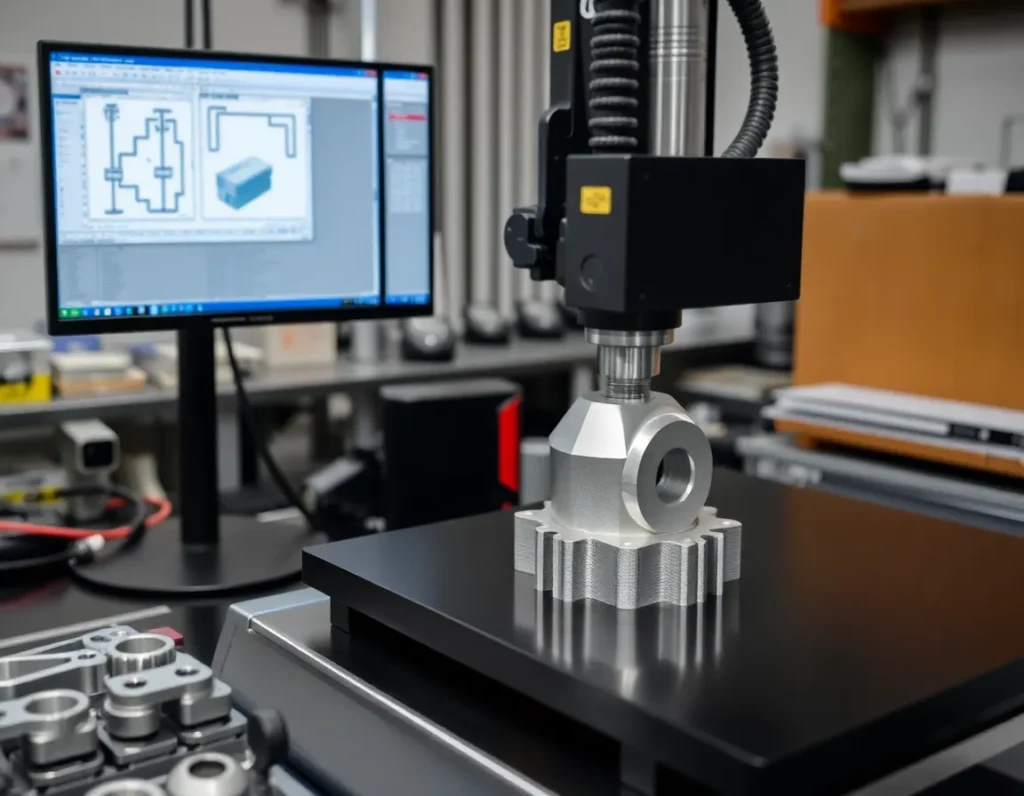
Cette étape à double concept est ce qui transforme une conception théorique en un composant pratique et de haute qualité. La négliger équivaut à construire une maison mais à sauter le câblage électrique et la peinture intérieure—la structure existe, mais elle n'est ni sûre ni finie. Un aspect concerne la traduction numérique du code, garantissant que la machine se déplace correctement et en toute sécurité. L'autre implique des traitements physiques appliqués à la pièce elle-même, améliorant sa surface, sa résistance et sa longévité. Comprendre ces deux significations est fondamental pour toute personne impliquée dans l'usinage CNC, des programmeurs et machinistes aux ingénieurs et chefs de projet. C'est le lien indispensable qui garantit que votre intention de conception est parfaitement réalisée dans le produit final.
Qu'est-ce que le post-traitement CNC ? Définition des deux significations clés
Le terme “ post-traitement CNC ” peut prêter à confusion car il désigne deux étapes distinctes mais tout aussi vitales du flux de travail de fabrication. Les deux se produisent après les opérations d'usinage principales sont programmées, d'où le terme “ post ”, mais elles répondent à des besoins complètement différents.
Signification 1 : Le traducteur numérique (post-processeur)
Dans le domaine numérique, le post-traitement est l'étape critique où les données de trajectoire d'outil du logiciel FAO sont converties en un programme G-code spécifique à la machine. Considérez votre logiciel FAO comme créant une recette parfaite et universelle pour une pièce. Le post-processeur est le traducteur qui réécrit cette recette dans le dialecte et les mesures exacts que votre cuisine spécifique (machine CNC) peut suivre. Ce processus est effectué par un composant logiciel ou une application autonome appelée post-processeur. Son rôle est d'interpréter les commandes de mouvement génériques et de les traduire dans la syntaxe, les codes et le formatage précis requis par le contrôleur de votre machine (par exemple, Fanuc, Siemens, Haas). Sans cette traduction sur mesure, la machine ne comprendrait pas les instructions ou les exécuterait incorrectement, entraînant des résultats catastrophiques.
Signification 2 : La finition physique (traitements de surface et fonctionnels)
Une fois la pièce physiquement usinée, le deuxième type de post-traitement commence. Cela englobe toutes les opérations de finition de surface et de traitement effectuées sur la pièce pour améliorer ses propriétés finales. Une pièce sortant directement de la machine CNC présente souvent des marques d'outil, des bavures et un état de surface brut. Selon son application, elle peut avoir besoin d'être plus lisse, plus dure, plus résistante à la corrosion ou esthétiquement agréable. Ce post-traitement physique comprend un vaste éventail de techniques telles que le sablage, le polissage, l'anodisation, le revêtement en poudre, le traitement thermique et le placage. Ces processus améliorent la fonction, l'apparence et la performance, transformant une “ ébauche ” usinée en un composant fini prêt pour l'assemblage ou l'utilisation.
En résumé, la première signification concerne la traduction du code pour la machine, et la seconde concerne amélioration de la pièce après usinage. Les deux sont des piliers essentiels d'une fabrication CNC réussie.
Le post-processeur CNC : le traducteur de votre machine du CAM au G-code
En approfondissant le côté numérique, le post-processeur CNC est un logiciel spécialisé qui agit comme un adaptateur indispensable. Le logiciel CAM génère ce que l'on appelle souvent des données de trajectoire d'outil (TPD) ou des données CL (Cutter Location). Ces données sont abstraites : elles définissent la géométrie des coupes, les outils à utiliser, les vitesses, les avances et la séquence des opérations, mais elles sont intentionnellement indépendantes de la machine. Elles ne savent pas si vous disposez d'une fraiseuse 3 axes, d'un centre d'usinage 5 axes ou d'un tour de type suisse.
Le post-processeur prend ces données neutres et effectue une traduction complexe. Voici comment cela fonctionne en pratique :
- Conversion de syntaxe : Il formate chaque commande dans la structure exacte attendue par le contrôleur de votre machine. Cela inclut l'utilisation appropriée des codes G (déplacements rapides, avances linéaires, interpolation circulaire), des codes M (arrosage on/off, changements d'outil) et le placement correct des parenthèses, des espaces et des numéros de ligne.
- Spécialisation du dialecte : Différentes marques de contrôleurs (Fanuc, Heidenhain, Mazak) ont des “ dialectes ” uniques du G-code. Une commande qui fonctionne sur l'un peut être dénuée de sens ou différente sur un autre. Le post-processeur mappe les instructions CAM vers le dialecte correct.
- Gestion de la cinématique et des limites de la machine : C'est ici que les post-processeurs avancés justifient leur valeur. Pour une machine 5 axes, le post-processeur calcule les mouvements coordonnés complexes des axes rotatifs. Il respecte les limites physiques de la machine, telles que les courses des axes, la vitesse de broche maximale et la capacité de charge de la table, en ajustant le code de sortie pour éviter les violations.
- Logique de configuration des outils et de la pièce : Il insère les commandes correctes pour la routine de changement d'outil spécifique à votre machine, qu'il s'agisse d'un carrousel, d'un bras ou d'une tourelle. Il prend également en compte votre système de coordonnées de pièce (G54, G55, etc.) et les décalages de longueur d'outil.
La sortie de ce processus est un fichier NC — un fichier texte contenant le G-code personnalisé qui peut être chargé directement dans votre machine CNC. Un post-processeur bien configuré signifie que l'opérateur reçoit un programme prêt à exécuter, nécessitant peu ou pas d'édition manuelle. Il comble le fossé entre l'environnement de fabrication virtuel et la réalité physique de votre équipement d'atelier spécifique.
Pourquoi un post-processeur adéquat est non négociable pour un usinage sûr et efficace
Viewing the post processor as a mere file converter is a dangerous underestimation. It is a critical safety and efficiency component in the CNC workflow. An incorrect, poorly configured, or generic post processor is one of the leading causes of machine crashes, scrapped parts, and wasted time. Here’s why investing in a proper post is non-negotiable:
1. Prevention of Catastrophic Machine Crashes
The most immediate risk of a bad post is a physical collision. If the post outputs a G-code command the machine doesn’t understand, or misinterprets a tool change position, the machine can move in an unexpected and violent manner. This can result in broken tools, a wrecked workpiece, and severe damage to the machine’s spindle, table, or axes. Repair costs can be astronomical, and downtime can halt production for days or weeks. A verified, machine-specific post processor is your first and most reliable line of defense against these costly disasters.
2. Elimination of Manual Code Editing and Errors
Without a good post, machinists are forced to manually edit G-code files—a tedious, time-consuming, and error-prone process. A programmer might spend hours “cleaning up” a program, inserting missing codes, or rewriting sections. Every manual edit is an opportunity for a typo or syntax error that the machine will not forgive. A proper post processor’s hallmark is that it produces clean, ready-to-run code, freeing up skilled personnel for more valuable tasks and eliminating a major source of human error.
3. Unlocking Full Machine Capability and Efficiency
A generic post might get the job done for simple 3-axis work, but it will fail to leverage advanced machine features. For high-efficiency machining techniques like rigid tapping, high-speed machining cycles (G05.1), or proprietary canned cycles, the post must output the exact code sequences these functions require. A sophisticated post for a 5-axis machine will correctly handle tool center point control (TCP) and optimize rotary axis movements to avoid singularities and provide the smoothest motion. This not only enables you to use your machine to its full potential but also optimizes cycle times and improves surface finish.
4. Ensuring Consistency and Standardization
In a professional shop, consistency is key. A properly configured post processor ensures that every program, regardless of the programmer, follows the same formatting, uses the same safety sequences (like probe routines or pallet changers), and adheres to company standards. This standardization makes programs easier to read, verify, and troubleshoot on the shop floor. It reduces the learning curve for new machinists and creates a reliable, repeatable manufacturing process.
In essence, the post processor is not just a convenience; it is the guardian of your machine’s physical integrity and the enabler of predictable, efficient, and safe production. Skipping on a quality post processor is a false economy that inevitably leads to far greater costs in damage, scrap, and lost productivity.
CNC Part Surface Finishing: Enhancing Function, Appearance, and Performance
While the digital post processor ensures the machine executes the program correctly, the physical le post-traitement des pièces CNC begins once the part is unclamped from the machine. This stage, often called surface finishing, encompasses a wide range of techniques applied to a machined component to enhance its final properties. It is the critical bridge between a raw, machined workpiece and a finished part ready for its end-use application. No matter how precise the CNC machining, the as-machined surface often requires further treatment to meet functional, aesthetic, or durability requirements.
Surface finishing is not merely cosmetic. It is a decisive factor in a component’s performance and lifespan. A part straight from the machine may have microscopic tool marks, sharp edges (burrs), and a surface chemistry that makes it susceptible to corrosion or wear. Post-processing addresses these issues systematically. It can increase wear resistance, improve corrosion protection, modify electrical conductivity, enhance paint adhesion, or simply provide a more visually appealing and tactile finish. The choice of method depends entirely on the part’s material, its operating environment, and its intended function, making surface finishing a fundamental aspect of the design-for-manufacturability process.
The Importance of Surface Treatment for CNC Machined Components
Neglecting surface treatment can undermine the precision engineering invested in CNC machining. The importance of these processes extends across several critical dimensions of part quality and performance.
First and foremost, surface finishing directly impacts functional performance and longevity. Burrs left from machining can interfere with assembly, create stress concentrators that lead to cracking, or break off during operation and cause damage. Processes like deburring and edge rounding eliminate these risks. Furthermore, many applications demand specific surface properties. A shaft running in a bearing needs a smooth, hard surface to minimize friction and wear. A component exposed to seawater requires a robust barrier against corrosion. A part handling electrical signals might need specific conductive or insulating properties. Surface treatments like hardening, plating, or anodizing are engineered to impart these exact characteristics.
Secondly, appearance and perceived quality are often governed by surface finish. In consumer electronics, automotive interiors, or medical devices, the look and feel of a part are integral to the product’s value and user experience. A uniform, clean finish—whether it’s a brushed metal texture, a glossy color, or a matte bead-blasted look—signals quality and precision. For branding purposes, colors can be added through anodizing or painting, allowing for part identification or aesthetic alignment with corporate identity.
Finally, surface treatment is essential for improving manufacturability and assembly. A smoother surface can reduce friction in moving assemblies, leading to better efficiency and less heat generation. Certain coatings can act as dry lubricants. Treatments like passivation for stainless steel remove free iron from the surface, restoring its inherent corrosion resistance which can be compromised during machining. Proper surface preparation is also the foundation for any secondary coating; paint or powder coat will not adhere properly to a dirty, oily, or poorly prepared surface, leading to premature failure.
In summary, surface treatment transforms a CNC machined part from a precision-shaped blank into a fully realized, high-performance component ready to withstand the demands of its real-world application.
A Comprehensive Guide to Mechanical Surface Finishing Methods
Mechanical finishing methods physically alter the surface of a part through abrasion, impact, or plastic deformation. These techniques are primarily used to refine surface texture, remove material, and prepare surfaces for further treatment.
Grinding and Polishing
Grinding uses a rotating abrasive wheel to remove small amounts of material, achieving very tight dimensional tolerances and a consistent surface finish. It’s often used to achieve fine finishes on flat or cylindrical surfaces. Polishing takes this further, using progressively finer abrasives (often in a compound or on a cloth wheel) to eliminate microscopic scratches and produce a reflective, mirror-like surface. The goal is to improve surface finish (reducing Ra value) and enhance aesthetics and cleanability, crucial for food processing or pharmaceutical components.
Sablage (microbillage)
This process involves propelling a stream of abrasive media at high pressure against the part’s surface. The media type—such as glass beads, aluminum oxide, or plastic granules—determines the effect. Glass bead blasting peens the surface, creating a uniform, matte, satin-like finish without significant material removal. It is excellent for visual appeal and hiding minor tool marks. Heavier media like aluminum oxide is used for more aggressive cleaning, deburring, or creating a textured surface for paint adhesion. The process is highly versatile for both metals and plastics.
Vibratory and Barrel Tumbling
These are mass finishing techniques ideal for deburring, edge rounding, descaling, and polishing large quantities of small to medium-sized parts. Parts are placed in a container with abrasive media and either vibrated or rotated. The constant rubbing action between the parts and the media smooths edges and surfaces uniformly. It is a cost-effective method for achieving consistent results on many parts simultaneously, though it is not suitable for delicate or precision-machined features that could be damaged.
Brossage
Using abrasive brushes (wire, nylon, or fiber), this method creates a directional, linear grain pattern on the surface. It effectively removes light burrs, surface oxides, and contaminants while providing a distinctive brushed metal aesthetic, commonly seen on appliances and architectural hardware. The process can be done manually or with automated brushing machines for consistency.
Burnishing
This is a chipless finishing process where a hard, smooth tool (like a ball or roller) is pressed against the machined surface. The pressure causes plastic deformation of the surface asperities, smoothing the peaks into the valleys. This not only improves surface finish but also work-hardens the surface layer, increasing its hardness and wear resistance. It is commonly applied to bores, shafts, and other cylindrical features.
Exploring Chemical Surface Treatment and Coating Techniques
Chemical and electrochemical methods alter the surface layer of a part at a molecular level, often building up a new, functional layer on top of the base material. These techniques are pivotal for corrosion resistance, aesthetic coloring, and modifying surface properties.
Anodizing (For Aluminum)
Anodizing is an electrochemical process that thickens and toughens the natural oxide layer on aluminum. The part is immersed in an acid electrolyte and serves as the anode. This controlled oxidation creates a hard, porous, and adherent aluminum oxide coating. This coating is then often sealed with hot water or a sealant to close the pores. Anodizing provides excellent corrosion and wear resistance. The porous layer before sealing can also be dyed in a vast array of colors, making it immensely popular for both protective and decorative purposes. Type II (sulfuric acid) anodizing is common for color work, while Type III (hard coat) produces a thicker, more durable layer for extreme wear applications.
Plating (Electroplating and Electroless Plating)
Plating deposits a thin layer of a different metal onto the part’s surface. In electroplating, the part (cathode) is submerged in a solution containing ions of the plating metal (e.g., nickel, chrome, zinc, gold). An electric current reduces these ions, causing them to form a metallic coating on the part. Chromium plating offers extreme hardness and a bright, decorative finish. Nickel plating provides corrosion resistance, wear resistance, and can be a base for chrome. Zinc plating (often with a chromate conversion coating for added color and protection) is a cost-effective sacrificial coating for steel to prevent rust.
Electroless plating uses a chemical reduction reaction instead of electricity to deposit metal, most commonly electroless nickel. It produces a very uniform coating thickness even on complex geometries, offers good corrosion and wear resistance, and can coat non-conductive materials.
Revêtements de conversion
These treatments convert the surface of the metal into a protective layer. A prime example is passivation for stainless steel. The part is treated with a citric or nitric acid solution, which removes free iron contaminants left from machining and enhances the formation of a passive chromium oxide layer, restoring the material’s full corrosion resistance. For steel, phosphating creates a micro-crystalline layer of iron, zinc, or manganese phosphate that improves corrosion resistance and provides an excellent base for paint adhesion.
Thermolaquage et peinture
These are applied coatings where a decorative and protective polymer layer is added to the part. Powder coating involves electrostatically spraying a dry powder onto a grounded part, which is then cured in an oven, melting the powder into a continuous, hard film. It is durable, environmentally friendly (no solvents), and available in many colors and textures (matte, gloss, wrinkled). Liquid painting (spray or dip) applies a solvent- or water-based paint, which then air-dries or is heat-cured. Both methods require proper surface preparation, such as cleaning and possibly phosphating, to ensure strong adhesion.
Chemical Etching
Also known as chemical milling, this process uses controlled chemical reactions to remove material from the surface. It can be used for precision deburring, creating specific surface textures, or even thinning parts in precise areas. It is particularly useful for complex parts where mechanical methods cannot reach.
Heat Treatment and Other Functional Post-Processing Methods
Beyond surface aesthetics and corrosion protection, a critical category of post-traitement pour pièces CNC focuses on altering the internal microstructure and bulk properties of the material. These functional treatments, such as heat treatment, are not about appearance but about engineering performance—enhancing strength, hardness, wear resistance, or dimensional stability to meet demanding operational requirements.
Procédés de traitement thermique
Heat treatment involves controlled heating and cooling cycles to achieve desired material properties. Common methods include:
- Recuit : This process softens the metal, relieving internal stresses induced during machining and improving ductility and machinability. It involves heating the part to a specific temperature and then slowly cooling it.
- Quenching and Tempering: This two-step process is used to achieve high strength and toughness. First, the part is heated and then rapidly cooled (quenched) to create a very hard, but brittle, martensitic structure. It is then reheated to a lower temperature (tempered) to reduce brittleness while retaining much of the hardness.
- Case Hardening (Carburizing, Nitriding): These processes create a hard, wear-resistant surface layer (“case”) while maintaining a softer, tougher core. Carburizing adds carbon to the surface of low-carbon steel before quenching. Nitriding introduces nitrogen into the surface of alloy steels, offering exceptional hardness and corrosion resistance with minimal distortion.
- Relaxation des contraintes : A lower-temperature heat treatment specifically aimed at reducing residual stresses from machining, welding, or forming without significantly altering the material’s hardness. This improves dimensional stability and prevents warping during subsequent operations or in service.
Other Functional and Specialized Treatments
Several other processes fall under the umbrella of functional post-processing:
- Impregnation: Primarily used for porous materials like powdered metal or castings, impregnation seals the part by vacuum-filling pores with a resin or sealant. This is essential for creating pressure-tight components for hydraulic or pneumatic systems.
- Passivation : A chemical treatment for stainless steel that removes free iron from the surface and promotes the formation of a uniform, protective chromium oxide layer. This maximizes the part’s inherent corrosion resistance, which can be compromised during machining.
- Électropolissage : A reverse plating process that uses an electrical current and acidic electrolyte to remove a thin layer of surface material. It deburrs, polishes, and passivates simultaneously, resulting in a microscopically smooth, clean, and corrosion-resistant surface ideal for medical, food, and semiconductor applications.
- Plating for Function: While often decorative, plating serves critical functional roles. Hard chrome plating adds exceptional wear and abrasion resistance to components like hydraulic rods. Electroless nickel plating provides a uniform, hard coating with excellent corrosion and wear resistance, even on complex geometries.