
Introduzione: il ponte critico tra progettazione e parti CNC finite
Il percorso da un modello CAD digitale a una parte fisica e funzionale raramente è un processo a singolo passaggio. Sebbene il software di Computer-Aided Manufacturing (CAM) sia potente, non comunica direttamente con la macchina presente nel vostro reparto. L'output grezzo del CAM è un insieme di istruzioni generiche, non il linguaggio specifico che la vostra fresatrice o il vostro tornio CNC comprende. Allo stesso tempo, una parte appena uscita dalla macchina, pur essendo dimensionalmente accurata, spesso non è pronta per la sua applicazione finale. Può presentare segni visibili degli utensili, bordi taglienti o proprietà dei materiali non adatte al suo ambiente operativo. Questo divario tra progettazione digitale e componente pronto all'uso viene colmato da una fase cruciale a due binari: post-elaborazione per parti CNC.
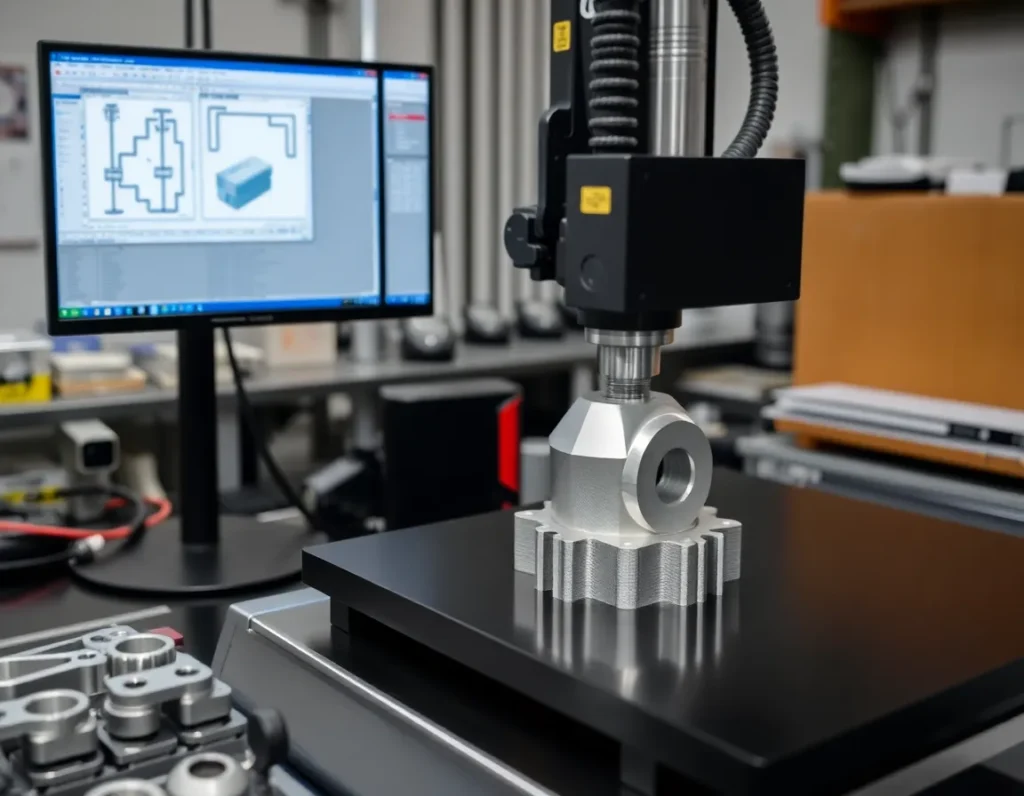
Questa fase dal duplice concetto è ciò che trasforma un progetto teorico in un componente pratico e di alta qualità. Trascurarla equivale a costruire una casa ma saltare il cablaggio elettrico e la pittura degli interni: la struttura esiste, ma non è né sicura né finita. Un aspetto riguarda la traduzione digitale del codice, garantendo che la macchina si muova correttamente e in sicurezza. L'altro comporta trattamenti fisici applicati alla parte stessa, migliorandone la superficie, la resistenza e la longevità. Comprendere entrambi i significati è fondamentale per chiunque sia coinvolto nella lavorazione CNC, dai programmatori e operatori alle macchine fino a ingegneri e project manager. È il collegamento indispensabile che assicura che la vostra intenzione progettuale sia perfettamente realizzata nel prodotto finale.
Che cos'è la post-elaborazione CNC? Definizione dei due significati chiave
Il termine “post-elaborazione CNC” può creare confusione perché si riferisce a due fasi distinte ma ugualmente vitali nel flusso di lavoro produttivo. Entrambe avvengono dopo le operazioni di lavorazione primarie sono programmate, quindi “post”, ma rispondono a esigenze completamente diverse.
Significato 1: il traduttore digitale (post processor)
In ambito digitale, la post-elaborazione è la fase critica in cui i dati dei percorsi utensile del software CAM vengono convertiti in un programma G-code specifico per la macchina. Immaginate il vostro software CAM come se creasse una ricetta perfetta e universale per una parte. Il post processor è il traduttore che riscrive quella ricetta nel dialetto e nelle misure esatte che la vostra cucina specifica (macchina CNC) può seguire. Questo processo viene eseguito da un componente software o da un'applicazione autonoma nota come post processor. Il suo compito è interpretare i comandi di movimento generici e tradurli nella sintassi, nei codici e nella formattazione precisi richiesti dal controller della vostra macchina (ad es. Fanuc, Siemens, Haas). Senza questa traduzione su misura, la macchina o non comprenderebbe le istruzioni o le eseguirebbe in modo errato, portando a risultati catastrofici.
Significato 2: la finitura fisica (trattamenti superficiali e funzionali)
Una volta che la parte è stata fisicamente lavorata, inizia il secondo tipo di post-elaborazione. Questa comprende tutte le operazioni di finitura superficiale e trattamento eseguite sul pezzo per migliorarne le proprietà finali. Una parte appena uscita dalla macchina CNC presenta spesso segni degli utensili, bave e una finitura superficiale grezza. A seconda dell'applicazione, potrebbe dover essere più liscia, più dura, più resistente alla corrosione o esteticamente gradevole. Questa post-elaborazione fisica include una vasta gamma di tecniche come sabbiatura, lucidatura, anodizzazione, verniciatura a polvere, trattamento termico e placcatura. Questi processi migliorano funzione, aspetto e prestazioni, trasformando un “grezzo” lavorato in un componente finito pronto per l'assemblaggio o l'uso.
In sintesi, il primo significato riguarda la traduzione del codice per la macchina, e il secondo riguarda il miglioramento del pezzo dopo la lavorazione. Entrambi sono pilastri essenziali di una produzione CNC di successo.
Il Post Processor CNC: Il Traduttore della Tua Macchina dal CAM al G-Code
Addentrandoci più a fondo nel lato digitale, il post processor CNC è un software specializzato che funge da adattatore indispensabile. Il software CAM genera quello che viene spesso chiamato Toolpath Data (TPD) o dati CL (Cutter Location). Questi dati sono astratti: definiscono la geometria dei tagli, gli utensili da utilizzare, velocità, avanzamenti e la sequenza delle operazioni, ma sono intenzionalmente indipendenti dalla macchina. Non sanno se hai una fresatrice a 3 assi, un centro di lavorazione a 5 assi o un tornio di tipo svizzero.
Il post processor prende questi dati neutri ed esegue una traduzione complessa. Ecco come funziona nella pratica:
- Conversione della Sintassi: Formatta ogni comando nella struttura esatta che il controller della tua macchina si aspetta. Ciò include l'uso corretto dei codici G (movimenti rapidi, avanzamenti lineari, interpolazione circolare), dei codici M (refrigerante on/off, cambi utensile) e il corretto posizionamento di parentesi, spazi e numeri di riga.
- Specializzazione del Dialetto: Diverse marche di controller (Fanuc, Heidenhain, Mazak) hanno “dialetti” unici del codice G. Un comando che funziona su uno potrebbe essere privo di significato o diverso su un altro. Il post processor mappa le istruzioni CAM sul dialetto corretto.
- Gestione della Cinematica e dei Limiti della Macchina: È qui che i post avanzati si guadagnano il loro valore. Per una macchina a 5 assi, il post calcola i complessi movimenti coordinati degli assi rotativi. Rispetta i limiti fisici della macchina, come le corse degli assi, la velocità massima del mandrino e la capacità di carico della tavola, adattando il codice di output per evitare violazioni.
- Logica di Setup di Utensili e Pezzo: Inserisce i comandi corretti per la routine di cambio utensile specifica della tua macchina, che si tratti di un carosello, di un tipo a braccio o di una torretta. Tiene inoltre conto del tuo sistema di coordinate del pezzo (G54, G55, ecc.) e degli offset di lunghezza utensile.
L'output di questo processo è un file NC: un file di testo contenente il codice G personalizzato che può essere caricato direttamente nella tua macchina CNC. Un post processor ben configurato significa che l'operatore riceve un programma pronto per l'esecuzione, che richiede poca o nessuna modifica manuale. Colma il divario tra l'ambiente di produzione virtuale e la realtà fisica delle attrezzature specifiche della tua officina.
Why a Proper Post Processor is Non-Negotiable for Safe, Efficient Machining
Viewing the post processor as a mere file converter is a dangerous underestimation. It is a critical safety and efficiency component in the CNC workflow. An incorrect, poorly configured, or generic post processor is one of the leading causes of machine crashes, scrapped parts, and wasted time. Here’s why investing in a proper post is non-negotiable:
1. Prevention of Catastrophic Machine Crashes
The most immediate risk of a bad post is a physical collision. If the post outputs a G-code command the machine doesn’t understand, or misinterprets a tool change position, the machine can move in an unexpected and violent manner. This can result in broken tools, a wrecked workpiece, and severe damage to the machine’s spindle, table, or axes. Repair costs can be astronomical, and downtime can halt production for days or weeks. A verified, machine-specific post processor is your first and most reliable line of defense against these costly disasters.
2. Elimination of Manual Code Editing and Errors
Without a good post, machinists are forced to manually edit G-code files—a tedious, time-consuming, and error-prone process. A programmer might spend hours “cleaning up” a program, inserting missing codes, or rewriting sections. Every manual edit is an opportunity for a typo or syntax error that the machine will not forgive. A proper post processor’s hallmark is that it produces clean, ready-to-run code, freeing up skilled personnel for more valuable tasks and eliminating a major source of human error.
3. Unlocking Full Machine Capability and Efficiency
A generic post might get the job done for simple 3-axis work, but it will fail to leverage advanced machine features. For high-efficiency machining techniques like rigid tapping, high-speed machining cycles (G05.1), or proprietary canned cycles, the post must output the exact code sequences these functions require. A sophisticated post for a 5-axis machine will correctly handle tool center point control (TCP) and optimize rotary axis movements to avoid singularities and provide the smoothest motion. This not only enables you to use your machine to its full potential but also optimizes cycle times and improves surface finish.
4. Ensuring Consistency and Standardization
In a professional shop, consistency is key. A properly configured post processor ensures that every program, regardless of the programmer, follows the same formatting, uses the same safety sequences (like probe routines or pallet changers), and adheres to company standards. This standardization makes programs easier to read, verify, and troubleshoot on the shop floor. It reduces the learning curve for new machinists and creates a reliable, repeatable manufacturing process.
In essence, the post processor is not just a convenience; it is the guardian of your machine’s physical integrity and the enabler of predictable, efficient, and safe production. Skipping on a quality post processor is a false economy that inevitably leads to far greater costs in damage, scrap, and lost productivity.
CNC Part Surface Finishing: Enhancing Function, Appearance, and Performance
While the digital post processor ensures the machine executes the program correctly, the physical post-elaborazione per parti CNC begins once the part is unclamped from the machine. This stage, often called surface finishing, encompasses a wide range of techniques applied to a machined component to enhance its final properties. It is the critical bridge between a raw, machined workpiece and a finished part ready for its end-use application. No matter how precise the CNC machining, the as-machined surface often requires further treatment to meet functional, aesthetic, or durability requirements.
Surface finishing is not merely cosmetic. It is a decisive factor in a component’s performance and lifespan. A part straight from the machine may have microscopic tool marks, sharp edges (burrs), and a surface chemistry that makes it susceptible to corrosion or wear. Post-processing addresses these issues systematically. It can increase wear resistance, improve corrosion protection, modify electrical conductivity, enhance paint adhesion, or simply provide a more visually appealing and tactile finish. The choice of method depends entirely on the part’s material, its operating environment, and its intended function, making surface finishing a fundamental aspect of the design-for-manufacturability process.
The Importance of Surface Treatment for CNC Machined Components
Neglecting surface treatment can undermine the precision engineering invested in CNC machining. The importance of these processes extends across several critical dimensions of part quality and performance.
First and foremost, surface finishing directly impacts functional performance and longevity. Burrs left from machining can interfere with assembly, create stress concentrators that lead to cracking, or break off during operation and cause damage. Processes like deburring and edge rounding eliminate these risks. Furthermore, many applications demand specific surface properties. A shaft running in a bearing needs a smooth, hard surface to minimize friction and wear. A component exposed to seawater requires a robust barrier against corrosion. A part handling electrical signals might need specific conductive or insulating properties. Surface treatments like hardening, plating, or anodizing are engineered to impart these exact characteristics.
Secondly, appearance and perceived quality are often governed by surface finish. In consumer electronics, automotive interiors, or medical devices, the look and feel of a part are integral to the product’s value and user experience. A uniform, clean finish—whether it’s a brushed metal texture, a glossy color, or a matte bead-blasted look—signals quality and precision. For branding purposes, colors can be added through anodizing or painting, allowing for part identification or aesthetic alignment with corporate identity.
Finally, surface treatment is essential for improving manufacturability and assembly. A smoother surface can reduce friction in moving assemblies, leading to better efficiency and less heat generation. Certain coatings can act as dry lubricants. Treatments like passivation for stainless steel remove free iron from the surface, restoring its inherent corrosion resistance which can be compromised during machining. Proper surface preparation is also the foundation for any secondary coating; paint or powder coat will not adhere properly to a dirty, oily, or poorly prepared surface, leading to premature failure.
In summary, surface treatment transforms a CNC machined part from a precision-shaped blank into a fully realized, high-performance component ready to withstand the demands of its real-world application.
A Comprehensive Guide to Mechanical Surface Finishing Methods
Mechanical finishing methods physically alter the surface of a part through abrasion, impact, or plastic deformation. These techniques are primarily used to refine surface texture, remove material, and prepare surfaces for further treatment.
Grinding and Polishing
Grinding uses a rotating abrasive wheel to remove small amounts of material, achieving very tight dimensional tolerances and a consistent surface finish. It’s often used to achieve fine finishes on flat or cylindrical surfaces. Polishing takes this further, using progressively finer abrasives (often in a compound or on a cloth wheel) to eliminate microscopic scratches and produce a reflective, mirror-like surface. The goal is to improve surface finish (reducing Ra value) and enhance aesthetics and cleanability, crucial for food processing or pharmaceutical components.
Sabbiatura (Bead Blasting)
This process involves propelling a stream of abrasive media at high pressure against the part’s surface. The media type—such as glass beads, aluminum oxide, or plastic granules—determines the effect. Glass bead blasting peens the surface, creating a uniform, matte, satin-like finish without significant material removal. It is excellent for visual appeal and hiding minor tool marks. Heavier media like aluminum oxide is used for more aggressive cleaning, deburring, or creating a textured surface for paint adhesion. The process is highly versatile for both metals and plastics.
Vibratory and Barrel Tumbling
These are mass finishing techniques ideal for deburring, edge rounding, descaling, and polishing large quantities of small to medium-sized parts. Parts are placed in a container with abrasive media and either vibrated or rotated. The constant rubbing action between the parts and the media smooths edges and surfaces uniformly. It is a cost-effective method for achieving consistent results on many parts simultaneously, though it is not suitable for delicate or precision-machined features that could be damaged.
Spazzolatura
Using abrasive brushes (wire, nylon, or fiber), this method creates a directional, linear grain pattern on the surface. It effectively removes light burrs, surface oxides, and contaminants while providing a distinctive brushed metal aesthetic, commonly seen on appliances and architectural hardware. The process can be done manually or with automated brushing machines for consistency.
Burnishing
This is a chipless finishing process where a hard, smooth tool (like a ball or roller) is pressed against the machined surface. The pressure causes plastic deformation of the surface asperities, smoothing the peaks into the valleys. This not only improves surface finish but also work-hardens the surface layer, increasing its hardness and wear resistance. It is commonly applied to bores, shafts, and other cylindrical features.
Exploring Chemical Surface Treatment and Coating Techniques
Chemical and electrochemical methods alter the surface layer of a part at a molecular level, often building up a new, functional layer on top of the base material. These techniques are pivotal for corrosion resistance, aesthetic coloring, and modifying surface properties.
Anodizing (For Aluminum)
Anodizing is an electrochemical process that thickens and toughens the natural oxide layer on aluminum. The part is immersed in an acid electrolyte and serves as the anode. This controlled oxidation creates a hard, porous, and adherent aluminum oxide coating. This coating is then often sealed with hot water or a sealant to close the pores. Anodizing provides excellent corrosion and wear resistance. The porous layer before sealing can also be dyed in a vast array of colors, making it immensely popular for both protective and decorative purposes. Type II (sulfuric acid) anodizing is common for color work, while Type III (hard coat) produces a thicker, more durable layer for extreme wear applications.
Plating (Electroplating and Electroless Plating)
Plating deposits a thin layer of a different metal onto the part’s surface. In electroplating, the part (cathode) is submerged in a solution containing ions of the plating metal (e.g., nickel, chrome, zinc, gold). An electric current reduces these ions, causing them to form a metallic coating on the part. Chromium plating offers extreme hardness and a bright, decorative finish. Nickel plating provides corrosion resistance, wear resistance, and can be a base for chrome. Zinc plating (often with a chromate conversion coating for added color and protection) is a cost-effective sacrificial coating for steel to prevent rust.
Electroless plating uses a chemical reduction reaction instead of electricity to deposit metal, most commonly electroless nickel. It produces a very uniform coating thickness even on complex geometries, offers good corrosion and wear resistance, and can coat non-conductive materials.
Conversion Coatings
These treatments convert the surface of the metal into a protective layer. A prime example is passivation for stainless steel. The part is treated with a citric or nitric acid solution, which removes free iron contaminants left from machining and enhances the formation of a passive chromium oxide layer, restoring the material’s full corrosion resistance. For steel, phosphating creates a micro-crystalline layer of iron, zinc, or manganese phosphate that improves corrosion resistance and provides an excellent base for paint adhesion.
Powder Coating and Painting
These are applied coatings where a decorative and protective polymer layer is added to the part. Powder coating involves electrostatically spraying a dry powder onto a grounded part, which is then cured in an oven, melting the powder into a continuous, hard film. It is durable, environmentally friendly (no solvents), and available in many colors and textures (matte, gloss, wrinkled). Liquid painting (spray or dip) applies a solvent- or water-based paint, which then air-dries or is heat-cured. Both methods require proper surface preparation, such as cleaning and possibly phosphating, to ensure strong adhesion.
Chemical Etching
Also known as chemical milling, this process uses controlled chemical reactions to remove material from the surface. It can be used for precision deburring, creating specific surface textures, or even thinning parts in precise areas. It is particularly useful for complex parts where mechanical methods cannot reach.
Heat Treatment and Other Functional Post-Processing Methods
Beyond surface aesthetics and corrosion protection, a critical category of post processing for cnc parts focuses on altering the internal microstructure and bulk properties of the material. These functional treatments, such as heat treatment, are not about appearance but about engineering performance—enhancing strength, hardness, wear resistance, or dimensional stability to meet demanding operational requirements.
Processi di trattamento termico
Heat treatment involves controlled heating and cooling cycles to achieve desired material properties. Common methods include:
- Ricottura: This process softens the metal, relieving internal stresses induced during machining and improving ductility and machinability. It involves heating the part to a specific temperature and then slowly cooling it.
- Quenching and Tempering: This two-step process is used to achieve high strength and toughness. First, the part is heated and then rapidly cooled (quenched) to create a very hard, but brittle, martensitic structure. It is then reheated to a lower temperature (tempered) to reduce brittleness while retaining much of the hardness.
- Case Hardening (Carburizing, Nitriding): These processes create a hard, wear-resistant surface layer (“case”) while maintaining a softer, tougher core. Carburizing adds carbon to the surface of low-carbon steel before quenching. Nitriding introduces nitrogen into the surface of alloy steels, offering exceptional hardness and corrosion resistance with minimal distortion.
- Stress Relieving: A lower-temperature heat treatment specifically aimed at reducing residual stresses from machining, welding, or forming without significantly altering the material’s hardness. This improves dimensional stability and prevents warping during subsequent operations or in service.
Other Functional and Specialized Treatments
Several other processes fall under the umbrella of functional post-processing:
- Impregnation: Primarily used for porous materials like powdered metal or castings, impregnation seals the part by vacuum-filling pores with a resin or sealant. This is essential for creating pressure-tight components for hydraulic or pneumatic systems.
- Passivazione: A chemical treatment for stainless steel that removes free iron from the surface and promotes the formation of a uniform, protective chromium oxide layer. This maximizes the part’s inherent corrosion resistance, which can be compromised during machining.
- Elettrolucidatura: A reverse plating process that uses an electrical current and acidic electrolyte to remove a thin layer of surface material. It deburrs, polishes, and passivates simultaneously, resulting in a microscopically smooth, clean, and corrosion-resistant surface ideal for medical, food, and semiconductor applications.
- Plating for Function: While often decorative, plating serves critical functional roles. Hard chrome plating adds exceptional wear and abrasion resistance to components like hydraulic rods. Electroless nickel plating provides a uniform, hard coating with excellent corrosion and wear resistance, even on complex geometries.