
Cuando su proyecto requiere mecanizado CNC de ABS, la decisión no siempre se trata de si el material puede hacer el trabajo, sino de si puede hacerlo mejor, más rápido y de forma más rentable que las alternativas. Los ingenieros y profesionales de compras se preguntan con frecuencia: ¿deberíamos mecanizar esta pieza en plástico ABS, o sería el aluminio u otro metal la opción más segura? La respuesta, como es de esperar, depende de lo que esté construyendo, de cuántas unidades necesite y del tipo de rendimiento que realmente busque.
Esta guía adopta un enfoque práctico y centrado en la decisión para el mecanizado de precisión de ABS. En lugar de limitarnos a enumerar datos, analizaremos las principales ventajas y desventajas, compararemos el ABS con las alternativas metálicas comunes y le mostraremos cómo evaluar si el ABS es la elección adecuada para su aplicación específica. Al final, tendrá un marco claro para tomar esa decisión y una comprensión sólida de lo que Jucheng aporta cuando decida seguir adelante.
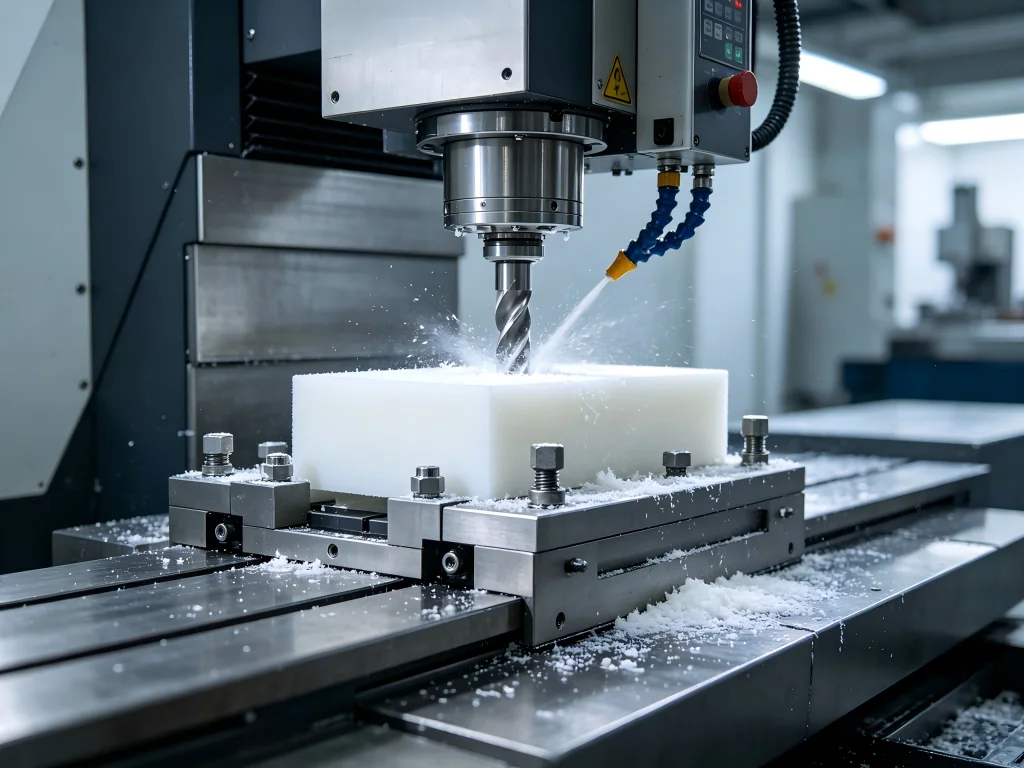
¿Por qué ABS? Comprender el atractivo principal del material
El acrilonitrilo butadieno estireno, más conocido como ABS, es un polímero termoplástico que se ha ganado su lugar como uno de los plásticos de ingeniería más utilizados en el mecanizado CNC. Su popularidad no es casual. El ABS combina tres monómeros —acrilonitrilo (que aporta resistencia química y estabilidad térmica), butadieno (que proporciona resistencia al impacto y tenacidad) y estireno (que imparte rigidez y facilidad de procesamiento)— en un material que se mecaniza de forma limpia, mantiene tolerancias ajustadas y ofrece un rendimiento mecánico fiable a una fracción del costo de la mayoría de los metales.
Para corte CNC de ABS y fresado CNC de ABS operaciones, el material ofrece varias ventajas distintivas:
- Maquinabilidad excepcional: El ABS es uno de los plásticos más fáciles de mecanizar. Admite fresado, torneado y taladrado CNC con un desgaste mínimo de la herramienta y produce bordes limpios y estables. A diferencia de algunos plásticos que se funden o se embadurnan durante el corte, el ABS responde de forma predecible a las herramientas estándar.
- Estabilidad dimensional: Con una temperatura de transición vítrea de alrededor de 105 °C, el ABS permanece dimensionalmente estable en condiciones ambientales normales. El mecanizado CNC puede alcanzar una precisión de hasta ±0,02 mm, lo que lo hace adecuado para piezas que requieren tolerancias estrictas.
- Eficiencia de costos: El costo del material ABS es de aproximadamente $2–$4 por kilogramo, y el tiempo de mecanizado suele ser 30% más corto que para los metales. Para la creación de prototipos y la producción de volumen bajo a medio, esto se traduce en ahorros significativos.
- Resistencia al impacto: Con valores de impacto Izod con muesca que van de 200 a 400 J/m, el ABS ofrece una tenacidad excelente que se mantiene incluso a bajas temperaturas.
Dicho esto, el ABS no está exento de limitaciones. Las calidades estándar se degradan bajo una exposición prolongada a los rayos UV, lo que las hace menos adecuadas para aplicaciones en exteriores sin recubrimientos protectores. El material también es inherentemente inflamable, aunque existen calidades ignífugas. Quizás lo más crítico para el mecanizado es que el ABS tiene una conductividad térmica baja: la acumulación de calor durante el corte puede causar ablandamiento, deformación o defectos superficiales si no se gestiona adecuadamente.
El verdadero desafío: la gestión del calor en el mecanizado CNC del ABS
Si hay un problema que separa los proyectos de mecanizado de ABS exitosos de los problemáticos, es el control del calor. El ABS tiene una conductividad térmica baja y una temperatura de deflexión térmica relativamente baja (aproximadamente 70–100 °C). Cuando el corte genera un calor excesivo, el material puede ablandarse en la zona de corte, lo que provoca embadurnamiento, fusión o inexactitud dimensional.
Los maquinistas experimentados en foros como r/CNC enfatizan con frecuencia que gestionar el calor es el factor más importante para lograr buenos resultados con el ABS. Un usuario de Reddit señaló que “el ABS se fundió más” en comparación con otros plásticos como el Delrin, lo que resalta la necesidad de un control cuidadoso de los parámetros. El consenso entre aficionados y profesionales por igual es que las herramientas afiladas, las velocidades de avance adecuadas y una refrigeración eficaz marcan toda la diferencia.
Para mecanizado de precisión de ABS, esto significa prestar mucha atención a:
- Selección de herramientas: Se recomiendan herramientas de carburo afiladas y pulidas con un ángulo de ataque positivo de 10° a 15° y un ángulo de incidencia de 5° a 10° para minimizar la fricción y la generación de calor.
- Parámetros de corte: Velocidades del husillo moderadas (1.000–3.000 rpm) con profundidades de corte ligeras (0,5 mm a 2 mm) ayudan a reducir las fuerzas de corte y la acumulación de calor.
- Estrategia de refrigeración: La refrigeración por aire comprimido suele ser suficiente para el mecanizado de ABS, aunque algunos operarios prefieren refrigerante en niebla o inundación para garantizar una disipación de calor constante. La clave es evitar que el calor se acumule desde el principio.
- Sujeción de la pieza: Una fuerza de sujeción excesiva puede deformar las piezas de ABS, especialmente las secciones de pared delgada. Se recomiendan mesas de vacío o pestañas para soportar láminas delgadas.
¿Qué significa esto para usted como comprador? Significa que la calidad de sus piezas mecanizadas de ABS depende no solo del material en sí, sino de la experiencia del taller que realiza el trabajo. Un operario que entiende cómo gestionar el calor, elegir las herramientas adecuadas y optimizar los parámetros de corte entregará piezas que cumplan con sus especificaciones de manera confiable. Un taller que trate el ABS como metal y aumente demasiado agresivamente los avances y las velocidades producirá piezas con bordes derretidos, mal acabado superficial o desviación dimensional.
ABS vs. aluminio: una comparación directa
La comparación más común que hacen los compradores es entre ABS y aluminio. Ambos materiales se utilizan ampliamente para prototipos y piezas de producción, pero cumplen propósitos fundamentalmente diferentes. Así se comparan en los factores que más importan:
| Factor | Plástico ABS | Aluminio (6061) |
|---|---|---|
| Costo del material | $2–$4 por kg | $5–$40 por kg |
| Tiempo de mecanizado | ~30% más corto que los metales | Baseline reference |
| Maquinabilidad | Easy; forgiving on tools | Good; standard tooling works well |
| Tensile strength | 30–60 MPa | 200–600 MPa |
| Impact resistance | Excellent (200–400 J/m) | Good but lower than ABS per weight |
| Heat deflection | ~70–100°C | ~200°C+ (melting point ~660°C) |
| Weight | 1.04–1.06 g/cm³ | 2.7 g/cm³ |
| Typical applications | Housings, brackets, prototypes, enclosures | Structural components, brackets, functional prototypes |
| UV resistance | Poor (degrades outdoors) | Good (natural oxide layer) |
The choice between ABS and aluminum often comes down to a simple question: what does your part actually need to do? If your part needs to withstand high temperatures, carry significant loads, or survive in outdoor environments, aluminum is the clear winner. But if your priorities are cost, speed, weight reduction, and impact resistance—and your operating environment stays within ABS’s thermal limits—then ABS offers compelling advantages.
One engineer on a CNC forum put it this way: “ABS is a go-to option for low-stress prototypes that don’t require high thermal or mechanical performance. It cuts cleanly and gets the job done without breaking the bank”. For many projects, that’s exactly what’s needed.
ABS vs. Other Engineering Plastics: Where Does It Fit?
Beyond the metal comparison, buyers often consider other plastics. Here’s a quick breakdown of how ABS compares to common alternatives:
ABS vs. Polycarbonate (PC)
Polycarbonate offers superior impact resistance and transparency, but it’s harder to machine and more expensive. PC is prone to stress whitening, cracking, and heat-related distortion if cutting parameters aren’t carefully controlled. ABS, by contrast, is easier to machine, more forgiving on tools, and significantly cheaper. Choose ABS when cost, speed, and stable tolerances are the priority; choose PC when transparency or extreme impact resistance is non-negotiable.
ABS vs. Delrin (POM)
Delrin (acetal) offers higher stiffness, lower friction, and better dimensional stability than ABS. However, it’s more brittle and can be more challenging to machine without specialized tooling. ABS is often preferred for parts that need impact resistance and a good surface finish, while Delrin is better for gears, bearings, and precision mechanical components.
ABS vs. Nylon (PA)
Nylon offers higher tensile strength and better heat resistance than ABS, but it absorbs moisture, which can affect dimensional stability. ABS is more dimensionally stable and easier to machine, making it a better choice for parts that require tight tolerances without the complications of moisture management.
Making the Right Choice: A Decision Framework
When evaluating whether mecanizado CNC de ABS is right for your project, consider these questions:
- What’s your operating temperature range? If your part will be exposed to temperatures above 70–100°C, ABS may not be suitable. Consider PC, nylon, or aluminum instead.
- Does the part need to be transparent? ABS is opaque. If clarity is required, PC is the practical choice.
- Will the part be used outdoors? Standard ABS degrades under UV exposure. For outdoor use, consider ASA (a UV-stable cousin of ABS) or specify a UV-resistant coating.
- What’s your production volume? For prototypes and low-volume runs (1–500 units), CNC machining is cost-effective and fast. For high-volume production (5,000+ units), injection molding may be more economical.
- What tolerances do you need? ABS can achieve ±0.02mm with proper machining. If you need tighter than that, you may need to consider metal or a different plastic with better dimensional stability.
- What’s your budget? ABS offers one of the lowest material and machining costs among engineering plastics. If cost is a primary constraint, ABS is hard to beat.
Why Jucheng for ABS CNC Machining?
Choosing the right material is only half the equation. The other half is choosing the right manufacturing partner. Jucheng brings a combination of technical expertise, advanced equipment, and quality systems that make it a strong choice for mecanizado de precisión de ABS proyectos.
Technical Expertise in ABS Machining
Jucheng’s team understands the nuances of machining ABS—from tool selection and cutting parameters to heat management and workholding. The company has published extensive technical resources on ABS and nylon manufacturing, guiding B2B buyers through the upgrade path from FDM prototyping to high-precision CNC machining. This depth of knowledge translates into parts that meet specifications consistently, without the defects that plague less experienced shops.
Advanced Equipment Capabilities
Jucheng’s facility houses 150+ CNC machines, including 25+ Haas and Mazak 5-axis systems. This isn’t just about capacity—it’s about capability. Multi-axis machining enables complex geometries, tighter tolerances, and better surface finishes. For ABS parts that require intricate features or tight assembly fits, this equipment makes a measurable difference.
Quality Systems and Certifications
Jucheng operates under ISO 9001:2015 quality management systems and maintains additional certifications including ISO 13485 (medical devices), IATF 16949 (automotive), and ISO 14001 (environmental management). For buyers in regulated industries, these certifications provide assurance that parts will meet rigorous quality standards. The company also works with CNAS-accredited labs for material testing and dimensional inspection.
Value-Added Services
Beyond machining, Jucheng offers services that simplify the supply chain: cleaning, deburring, press-fit assembly, thread locking, and adhesive bonding. This means you can receive finished, ready-to-use parts rather than raw machined components that require secondary operations. The company also provides CMM inspection, optical comparators, and full dimensional reporting to verify part quality.
Material Selection and Sourcing
Jucheng machines ABS in natural, black, and flame-retardant grades, as well as ABS/PC blends. The company sources high-quality raw materials and maintains strict quality control over incoming stock. This attention to material quality is critical for ABS machining, where impurities or inconsistent material properties can lead to surface defects or machining problems.
Common Applications for ABS CNC Machined Parts
mecanizado CNC de ABS finds applications across a wide range of industries. Here are some of the most common use cases:
- Automoción: Instrument panels, interior trim, mirror housings, dashboard components, and center console brackets. One notable example is a new energy vehicle’s center console bracket machined from ABS+PC alloy, achieving a 0.05mm assembly tolerance.
- Electrónica: Housing parts, enclosures, and structural components for consumer electronics. ABS’s combination of impact resistance and dimensional stability makes it ideal for protecting sensitive electronics.
- Medical devices: Prototypes and production parts for medical equipment, where ABS’s machinability and ability to achieve tight tolerances are valuable.
- Consumer products: Product housings, jigs and fixtures, and tooling enclosures. ABS is widely used in consumer goods due to its low cost and excellent mechanical properties.
- Prototyping: Functional prototypes that need to look and perform like production parts. ABS machines quickly and finishes well, making it a favorite for design verification and testing.
One production case study illustrates the process: the main housing of a joystick unit, produced in a quantity of 500 units from ABS+PC blend. The project combined 5-axis CNC machining for the outer geometry and hole features, followed by 3-axis machining for the internal structure. This hybrid approach optimized cost and delivery time while ensuring shape accuracy and hole position precision.
Installation and Maintenance Considerations
While CNC-machined ABS parts are typically ready for use upon delivery, a few considerations can help ensure long-term performance:
- Expansión térmica: ABS has a relatively high coefficient of thermal expansion compared to metals. For assemblies that will experience temperature variations, ensure that clearance and fit allowances account for this expansion.
- Chemical exposure: ABS is resistant to many chemicals but can be damaged by solvents like acetone and certain hydrocarbons. Check chemical compatibility for your specific operating environment.
- UV protection: For parts used outdoors or in sunlight, specify UV-stabilized ABS or apply a protective coating to prevent degradation and discoloration.
- Handling: Machined ABS parts can be scratched or damaged if handled roughly. Proper packaging and handling procedures help maintain surface quality.
Preguntas frecuentes
Can ABS be machined using CNC?
Yes, ABS is one of the most machinable thermoplastics available. It is successfully machined using CNC milling, turning, and drilling operations. The material produces clean cuts, stable dimensions, and good surface finish when proper machining practices are followed.
What are the most important tips for ABS CNC machining?
Prioritize heat management to prevent melting. Use sharp, uncoated carbide tools; cut at moderate speeds (1,000–3,000 rpm); use light cutting depths (0.5 mm to 2 mm); avoid excessive clamping force; and use compressed air or appropriate coolant for cooling. Proper tool selection and parameter control are the keys to successful ABS machining.
What tolerances can ABS CNC machining achieve?
CNC machining can achieve precision down to ±0.02mm or even tighter for ABS parts. This makes ABS suitable for parts that require tight fits and precise dimensions. However, achieving these tolerances requires proper machining practices, including heat management and stable workholding.
Which is better for CNC machining, ABS or PC?
The better choice depends on your requirements. ABS offers superior machinability, lower cost, and good dimensional stability. PC offers higher impact resistance and transparency but is harder to machine and more expensive. For most non-transparent parts where cost and speed matter, ABS is the better choice.
What are the challenges of ABS machining?
The primary challenges are low thermal conductivity and low heat deflection temperature, which can cause melting, warping, or poor surface finish if heat isn’t managed properly. Other challenges include potential surface defects from dull tools, deformation from excessive clamping force, and dimensional instability if thermal expansion isn’t accounted for.
What industries use ABS CNC-machined parts?
ABS CNC-machined parts are used across automotive, electronics, medical devices, consumer products, and prototyping applications. The material’s combination of cost, machinability, and mechanical properties makes it suitable for a wide range of industries and use cases.
How does ABS machining compare to ABS injection molding?
CNC machining is better for prototyping and low-volume production (1–500 units) without the need for expensive tooling. It can achieve tighter tolerances (±0.02mm vs. ±0.1mm for injection molding) and allows easy design modifications. Injection molding is more cost-effective for high-volume production (5,000+ units).
Is ABS suitable for outdoor applications?
Standard ABS degrades under prolonged UV exposure and is not recommended for outdoor use without protective measures. For outdoor applications, consider UV-stabilized ABS grades, ASA (a UV-resistant alternative), or apply a protective coating to shield the material from sunlight.
Making Your Decision: A Practical Summary
mecanizado CNC de ABS offers a compelling combination of cost, machinability, and mechanical performance that makes it suitable for a wide range of applications. It excels in prototyping, low-volume production, and parts that require impact resistance, dimensional stability, and good surface finish—all at a fraction of the cost of metal alternatives.
The key to success lies in two areas: first, ensuring that ABS is the right material for your specific application based on operating conditions, performance requirements, and budget; second, choosing a manufacturing partner with the expertise, equipment, and quality systems to machine ABS reliably and consistently.
Jucheng brings both to the table. With 150+ CNC machines, multi-axis capabilities, ISO-certified quality systems, and deep technical expertise in ABS machining, Jucheng is well-positioned to deliver precision ABS parts that meet your specifications—on time and on budget. Whether you’re prototyping a new product, producing functional test parts, or scaling up to low-volume production, Jucheng’s capabilities and commitment to quality make it a partner worth considering.
Ready to discuss your ABS machining project? Visit jccncmachining.com to learn more about Jucheng’s capabilities, request a quote, or speak with a technical expert about your specific requirements.