
In the high-stakes world of precision manufacturing, a single broken tool can result in thousands of dollars in wasted material and hours of downtime. Many engineers and procurement managers have faced the dreaded scenario where a traditional tap snaps off inside a nearly finished, expensive component. Whether you are working on aerospace housings or complex medical manifolds, the risk associated with internal threading is a constant concern. This is precisely where professional thread milling services emerge as the superior solution, offering a level of control and safety that traditional tapping simply cannot match.
At Jucheng, we understand that manufacturing is not just about making parts; it is about mitigating risk and ensuring consistency. When a project requires high-precision internal or external threads in difficult-to-machine materials like Titanium or Inconel, the thread milling process provides a strategic advantage. This technique utilizes helical interpolation to create threads, allowing for adjustable thread fits and significantly reducing the mechanical stress on the workpiece. If you have been searching for a reliable thread manufacturer in china to handle your most demanding geometries, understanding the technical nuances of this process is the first step toward optimizing your supply chain.
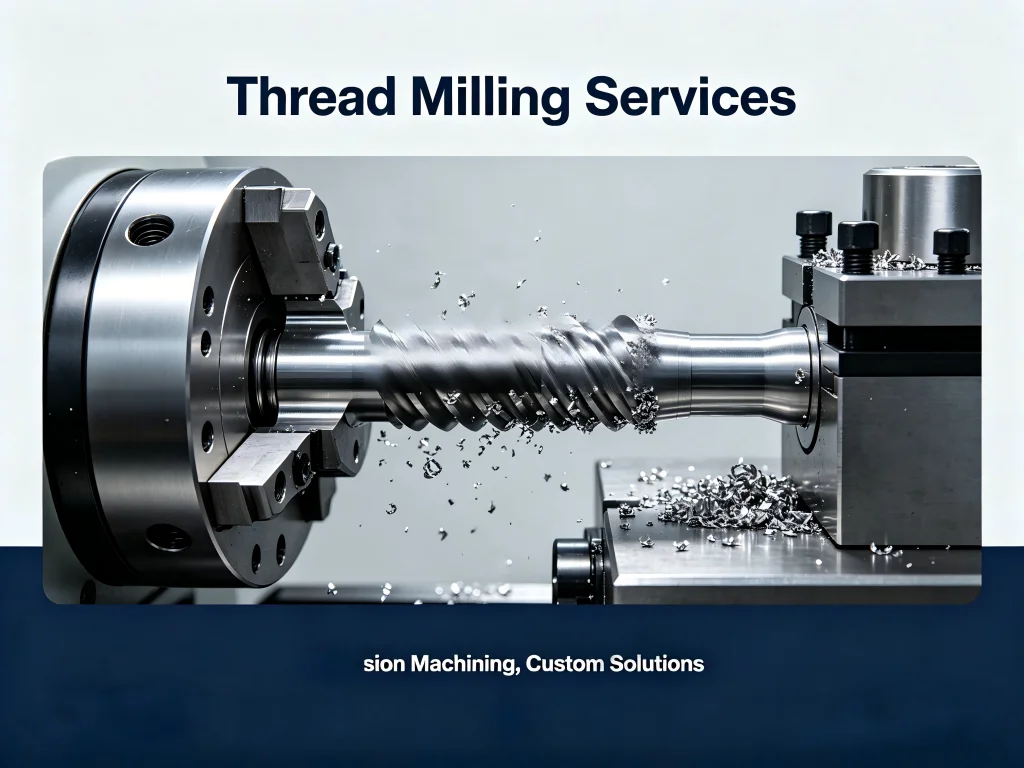
The Tapping Trap: Identifying the Core Pain Points in Traditional Threading
Traditional tapping has been the industry standard for decades, but it comes with inherent flaws that can jeopardize modern production cycles. The primary issue is the lack of chip control. During tapping, the tool is in full contact with the material, leading to high torque and heat. If the chips do not evacuate properly, the tap binds and breaks. This is a common complaint found in Reddit’s machining communities and Facebook engineering groups, where users often vent about the “nightmare” of extracting a broken tap from a 5,000-dollar engine block.
Furthermore, traditional tapping offers zero flexibility. A specific tap size can only produce one specific thread size and pitch. If the customer requires a slightly looser or tighter fit, a different tool must be purchased. For companies looking for a milling service malaysia or elsewhere, the realization often hits that rigid tapping lacks the versatility needed for custom prototype development. This is where thread milling services provide a breath of fresh air. By using a tool smaller than the hole diameter, the thread milling process allows for chip clearance and the ability to adjust the thread diameter via CNC offsets, ensuring a perfect fit every single time.
Module 1: Defining the Thread Milling Process and Its Mechanics
To appreciate why this method is so effective, we must look at its fundamental definition. A thread milling service involves using a specialized rotating tool that moves in a three-axis helical path. Unlike a tap, which is essentially a screw that is forced into a hole, a thread mill creates the thread by following a spiral trajectory. This is often referred to as helical interpolation. One of the most advanced iterations of this is drill thread milling, where a single tool can drill the hole, chamfer the edge, and mill the threads in one continuous operation, drastically reducing cycle times.
The mechanical advantage here is profound. Since the tool diameter is smaller than the thread diameter, the chips are easily flushed out by coolant or air. This prevents the “clogging” effect that causes tool failure. High-end tool options, such as a thread mill guhring, are often employed by top-tier facilities like Jucheng to ensure the highest surface finish and tool longevity. When you partner with an expert thread manufacturer in china, you are gaining access to this high-level equipment and the programming expertise required to execute these complex paths flawlessly.
Module 2: Core Application Scenarios in Modern Industry
Where does this technology truly shine? The application of thread milling services is widespread across industries where failure is not an option. In the automotive sector, engine components and suspension mounts require high-strength threads that can withstand vibration. Here, the precision of a thread milling process ensures that every bolt has maximum engagement and load distribution.
In the hardware and mold-making industry, where components are often made of hardened tool steel, tapping is nearly impossible. Thread milling allows us to create threads after the heat treatment process, ensuring that the dimensions remain stable. We also see significant demand for these services in the medical field. When manufacturing orthopedic implants or surgical instruments, the threads must be burr-free and geometrically perfect. A professional milling service malaysia or a specialized Chinese facility like Jucheng can provide the necessary clean-room compatible finishes that these parts demand. Even in specialized searches like treadmill service (often used by those misidentifying the technical term), the underlying need is the same: high-quality, durable mechanical components that function under stress.
Industry-Specific Application Table
| Industry | Typical Components | Key Material Requirements | Why Thread Milling? |
|---|---|---|---|
| Aerospace | Turbine housings, structural brackets | Titanium, Inconel, Stainless Steel | Prevents tool breakage in high-value alloys. |
| Medical | Bone screws, dental implants | 316L Stainless, PEEK, Titanium | Excellent surface finish and burr control. |
| Automotive | Engine blocks, transmission cases | Aluminum alloys, Cast iron | Ability to create large diameter threads easily. |
| Oil & Gas | Valves, manifolds, connectors | Duplex steel, High-carbon alloys | Deep hole threading with high accuracy. |
Module 3: Critical Factors When Choosing Thread Milling Services
Selecting the right partner for your thread milling services involves more than just looking at the lowest price. Accuracy is the foremost consideration. You must ensure that the provider has the metrology equipment, such as CMM (Coordinate Measuring Machines), to verify thread pitch and diameter. If you are comparing a thread supplier india with a thread manufacturer in china, look at their quality certifications. Jucheng, for instance, maintains strict ISO standards to ensure that every part meets the global quality benchmark.
Delivery and lead times are also crucial. A common pain point in the industry is the delay caused by tool procurement. A professional service provider should have a wide array of tools on hand, including specialized options like a thread mill guhring for hard-to-cut materials. Furthermore, consider the machine quality. High-speed CNC centers with stable spindles are necessary to prevent chatter during the thread milling process. If the machine vibrates even slightly, the thread profile will be compromised, leading to a weak joint and potential assembly failure.
Module 4: Installation and Maintenance of Threaded Components
Once your parts have been produced via high-quality thread milling services, proper handling is essential. Unlike tapped threads, milled threads are often much cleaner and sharper. During installation, it is vital to ensure that the mating parts are free of debris. We recommend a light application of lubricant to prevent galling, especially when dealing with stainless steel or titanium components. Maintenance of these threads involves regular inspections for wear, particularly in high-vibration environments.
From the manufacturer’s side, maintenance involves the constant calibration of the CNC machines. At Jucheng, we perform daily checks on our spindle runout and axis positioning. This ensures that the thread milling process remains consistent across a batch of 1,000 parts. If you are working with a thread manufacturer in china, you should ask about their tool wear monitoring systems. Modern CNC controllers can detect when a tool is becoming dull, allowing for a proactive change before the thread quality degrades.
Module 5: Frequently Asked Questions (FAQ)
1. What is the main difference between tapping and thread milling?
Tapping uses a tool that matches the thread size and is driven into the hole. Thread milling uses a smaller tool that follows a helical path. The thread milling process is generally safer for expensive parts because if the tool breaks, it does not get stuck in the hole and can be easily replaced without scrapping the part.
2. Can I use thread milling for both internal and external threads?
Yes, thread milling services are highly versatile and can be used for both internal and external applications. This is particularly useful for creating large or non-standard external threads that would otherwise require specialized dies.
3. Why is Jucheng considered a top thread manufacturer in china?
Jucheng combines advanced CNC technology with deep material expertise. We offer comprehensive thread milling services that include 5-axis machining and rapid prototyping, all backed by a rigorous quality control system that ensures every thread meets your exact specifications.
4. Is thread milling slower than tapping?
In some cases, tapping can be faster for small, simple holes in soft materials. However, when you consider the time saved by not having to remove broken taps and the ability to combine operations with drill thread milling, thread milling is often more efficient for complex or high-precision projects.
5. What materials can be processed with a thread mill guhring?
High-end tools like those from Guhring can handle almost any material, including hardened steels, exotic alloys, and abrasive plastics. This versatility is why professional milling service malaysia and Chinese experts prefer high-quality tooling.
6. How do I ensure the thread fit is correct?
One of the greatest benefits of the thread milling process is the ability to adjust the thread diameter through the CNC program. We can perform a test cut, measure the fit with a thread gauge, and then make micro-adjustments to achieve the perfect Class 2B or 3B fit.
7. Does the thread milling process work for deep holes?
Yes, but it requires careful tool selection to avoid deflection. Long-reach thread mills are designed for this purpose, and using a high-quality thread supplier india or China with the right technical experience is key to success in deep-hole applications.
Module 6: Why Choose Jucheng for Your Thread Milling Needs?
Choosing Jucheng as your partner for thread milling services means choosing peace of mind. We have invested heavily in the latest CNC technology and high-precision tooling to ensure that we remain a leading thread manufacturer in china. Our team of engineers does not just “run parts”; they analyze your designs to suggest the most efficient thread milling process, potentially saving you significant costs in production.
Our commitment to quality is evident in our facility’s certifications and our track record with international clients. Whether you are looking for a milling service malaysia alternative or need a specialized drill thread milling solution for a new product, Jucheng offers the technical depth and manufacturing capacity to deliver. We pride ourselves on our transparency, providing detailed inspection reports and maintaining open communication throughout the production cycle. In a world where precision is everything, Jucheng is the reliable foundation your project deserves.
If you are tired of the risks associated with traditional threading and are ready to experience the precision of professional thread milling services, our team is ready to assist. We may be able to help you optimize your design for better manufacturability and lower overall costs. Contact Jucheng today to discuss your next project and see why we are the preferred choice for companies worldwide.
For more information on our full range of CNC capabilities, please visit our official website or reach out to our technical support team for a detailed consultation.
Article 2: The Encyclopedia of Thread Milling – A Comprehensive Guide to Modern Threading Technology
Welcome to the ultimate guide to thread milling services. In the modern manufacturing landscape, the ability to create precise, clean, and repeatable threads is a cornerstone of mechanical assembly. While many are familiar with the basic concept of a screw, the industrial thread milling process is a sophisticated blend of geometry, material science, and advanced CNC programming. This guide will walk you through everything you need to know about this essential service, from its basic principles to the nuances of selecting a thread manufacturer in china.
The Evolution of Threading: What is a Thread Milling Service?
At its core, a thread milling service utilizes a specialized cutting tool on a CNC machine to generate a thread through a combination of circular and axial movement. This helical movement creates the thread profile with extreme precision. Unlike other methods, the tool diameter is always smaller than the thread itself, allowing for ample space for chip evacuation and coolant flow. This is a critical factor when dealing with expensive materials where a mistake can be catastrophic.
The term drill thread milling refers to a modern innovation where a single tool can perform multiple tasks. It starts by drilling the hole, then creates a chamfer, and finally mills the thread as it retracts. This “3-in-1” approach is a game-changer for high-volume production, significantly reducing the “tool change” time on the machine. For those searching for treadmill service in a manufacturing context, it is almost certain that they are looking for the reliability and speed offered by these integrated milling solutions.
The Global Landscape: Choosing the Right Thread Milling Partner
In today’s interconnected economy, sourcing thread milling services can lead you across the globe. You might consider a thread supplier india for certain bulk components or a milling service malaysia for specific regional projects. However, a thread manufacturer in china like Jucheng often provides the optimal balance of high-tech capability and cost-effectiveness. The key is to look beyond the geographic location and focus on the technical infrastructure.
A top-tier provider should use world-class tooling, such as a thread mill guhring, which is known for its exceptional hardness and precision. The use of such high-end tools is a strong indicator of a manufacturer’s commitment to quality. At Jucheng, we integrate these premium tools with our state-of-the-art CNC centers to ensure that every thread, whether for a small medical device or a large aerospace component, meets the strictest global standards.
Technical Deep-Dive: How the Thread Milling Process Works
The thread milling process relies on “Helical Interpolation.” Imagine the tool moving in a perfect circle while simultaneously moving upward or downward. The pitch of the thread is determined by the distance the tool moves axially during one full 360-degree rotation. This allows a single tool to create multiple different thread diameters as long as the pitch remains the same. This flexibility is a primary reason why engineers prefer thread milling services for custom or low-volume work.
Furthermore, the cutting forces in thread milling are radial rather than axial. This means there is much less pressure on the machine’s spindle and the part itself. This is particularly advantageous when machining thin-walled parts that could easily be deformed by the high pressure of a traditional tap. When you work with a professional thread manufacturer in china, their programmers could optimize these paths to minimize tool wear and maximize surface finish.
Selection Factors: What You Must Consider
-
- Material Compatibility: Not all tools are created equal. Harder materials require specialized coatings and geometries. A thread mill guhring might be necessary for stainless steel, while a different grade might be better for aluminum.
- Thread Tolerance: Do you need a standard fit or a high-precision aerospace fit? Professional thread milling services can adjust the “D-offset” on the CNC to hit exact tolerances.
Machine Rigidity:
- Ensure your provider uses high-quality machines. Vibration is the enemy of a good thread.
- Quality Certification: Look for ISO 9001:2015 or AS9100 certifications to ensure consistent quality management.
Maintenance and Long-Term Reliability
Maintaining the integrity of threads produced by the thread milling process involves protecting them from corrosion and physical damage. For the manufacturer, it involves a rigorous schedule of tool inspection. At Jucheng, we do not wait for a tool to fail; we track the number of holes milled and replace the tool before it reaches the end of its predictable life. This proactive approach is what separates a world-class thread manufacturer in china from a standard machine shop.
Frequently Asked Questions
- Is thread milling better for large diameters? Absolutely. Tapping large holes requires massive amounts of torque that many machines cannot provide. Thread milling can create any diameter thread with relatively low power.
- Can I mill threads in blind holes? Yes, thread milling is excellent for blind holes because the chips are easily removed, and the tool can cut much closer to the bottom of the hole than a tap can.
- What is the cost difference? While the initial tooling for thread milling services can be higher, the cost per part is often lower due to reduced scrap rates and faster cycle times in complex materials.
Ready to elevate your manufacturing quality? Jucheng provides the expertise and technology to handle your most complex thread milling services. Whether you are in the initial design phase or ready for full-scale production, our team is here to ensure your threads are perfect every time. Contact us through our contact page to get a quote and start your journey toward precision excellence.