
Before programming a phenolic insulating plate, identify the laminate. Phenolic machining can involve paper, cotton or linen reinforcement, and those constructions should not be treated as one uniform plastic. The reinforcement, feature direction and support at tool exit influence the route. A drawing that specifies only “Bakelite” leaves the machinist without enough information to choose or verify the intended material.
In this article
The laminate description changes the manufacturing question
A thermoset laminate contains layers of reinforcement bonded by a resin system. Supplier fabrication guidance distinguishes paper and cotton fabric grades from glass-based grades, including differences in tooling and machining practice. Confirm the exact producer grade and applicable material specification. A commercial family name may include multiple constructions; it is not a reliable substitute for a grade description.
Do not call every brown electrical laminate phenolic, or assume that G10 glass-epoxy is the same material. Color is not a resin identification method. If the assembly requires a particular electrical, moisture or mechanical property, obtain the right material documentation and define what must be verified. The machining route cannot correct an incorrectly chosen laminate.
| Information to resolve | Why it matters to the part |
|---|---|
| Producer grade and resin/reinforcement construction | Establishes which fabrication guidance and material data apply. |
| Sheet, rod or tube product form | Changes the available geometry, layer arrangement and holding approach. |
| Required orientation or material direction | Prevents an arbitrary blank layout from replacing the intended construction. |
| Working environment and delivered condition | Defines relevant moisture, temperature, surface and inspection requirements. |
For a plate, keep the blank identity and any required orientation traceable through cutting and drilling. Nesting that saves material can still be wrong if it rotates a controlled direction. Where the drawing does not define orientation, ask whether the application needs it before treating every nesting arrangement as equivalent.
Support the last layer, not just the first surface
A drill entering a supported face and leaving an unsupported laminate edge sees different conditions at the two ends of the hole. The exit layers can be damaged even when the entry looks clean. Arrange suitable backing and support, and include the exit surface in the trial inspection. A check that looks only at the visible top of a stacked plate misses the area most likely to reveal an unsuitable route.
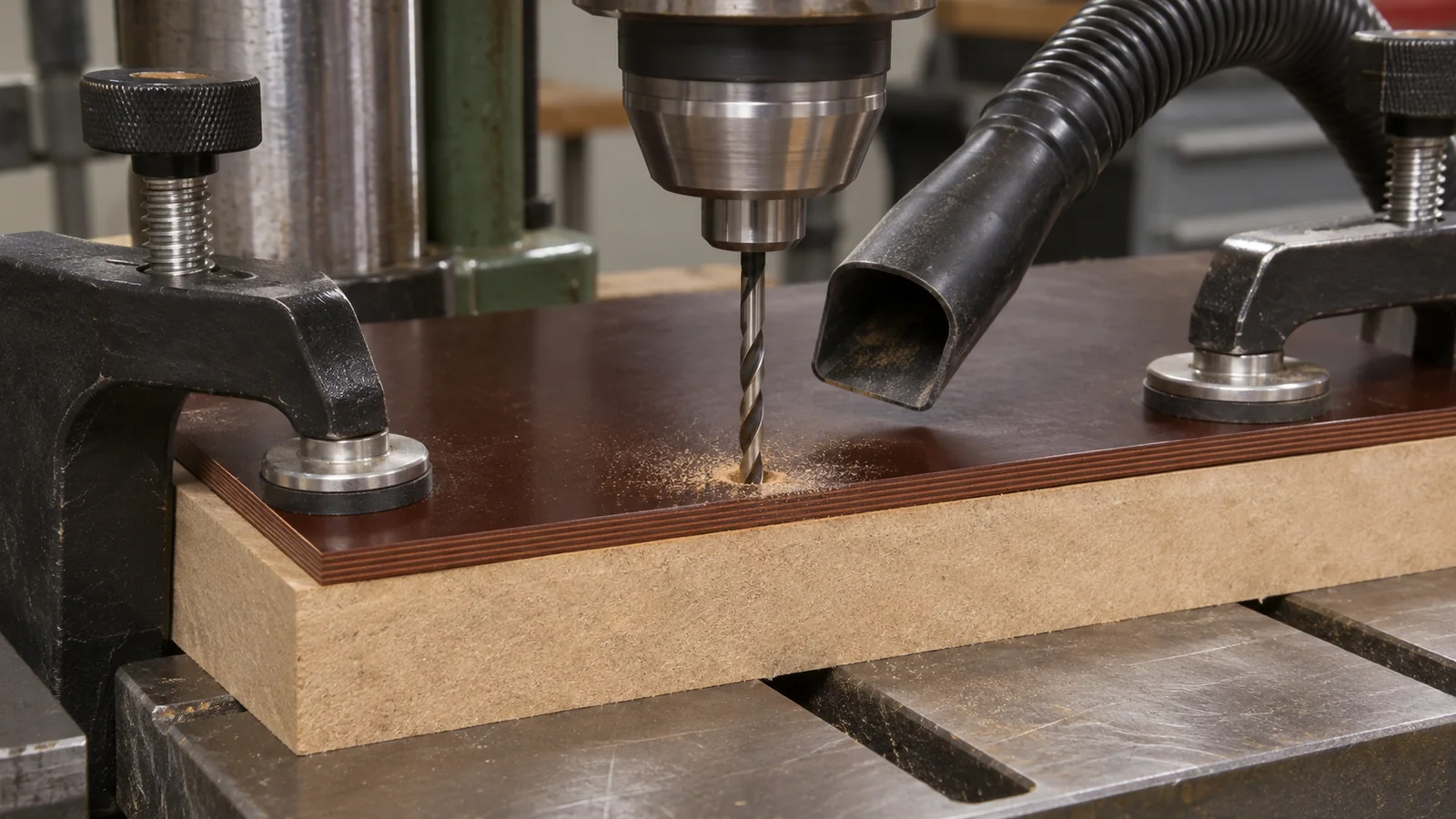 For hole patterns and milled edges, phenolic machining should use tools and cutting practice suitable for the identified grade. Producer guidance emphasizes sharp tools and distinguishes tooling needs by laminate construction. Tool wear can change both size and edge quality, so check the complete feature rather than extending tool life until a hole finally measures out of tolerance.
Stacked drilling can be practical in some routes, but the stack must be supported and the result qualified through its depth. An acceptable first plate does not prove that the lowest plate has the same exit quality or location. Review clamping, chip removal and the backing surface. Do not assume that stacking more blanks is a free productivity increase.
Near an outside edge, consider the material left between the hole and the profile. A hole that meets diameter can still leave a damaged or weak local edge. Define the functional edge distance and allowed damage with the designer. A broad instruction to “deburr all edges” does not say whether a breakout, exposed layer or local recession is acceptable.
Heat and moisture belong in the route
Norplex-Micarta’s fabrication guidance describes dry machining practices for paper and cotton fabric grades and cautions about heat damage. It also explains why liquid coolants can be difficult to remove from certain laminates. Apply the guidance for the identified construction and operation; do not turn it into a claim that every laminate must be processed by the same method.
The practical inspection question is whether the delivered surface remains intact and suitable for its duty. Discoloration, scorching, raised fibers and edge separation are different observations. Agree how to judge them in the working area and avoid covering a process problem with an unspecified finishing operation. A cosmetic improvement does not necessarily restore a damaged layer.
Moisture exposure can also affect the conditions under which dimensions or electrical properties are evaluated. Define any required conditioning, cleaning and storage with the material and application specifications. The responsible team should decide whether those requirements affect the final measurement stage. A dimension taken immediately after an uncontrolled wet process is not automatically comparable with one taken from dry stock.
Plan chip and dust collection appropriate to the material and equipment using the producer’s fabrication and safety information. This is part of choosing a workable process, not evidence that a particular workshop has a validated extraction system. The purchase agreement should identify any special cleanliness requirements without inventing a site capability or a universal cleaning procedure.
An insulating plate needs more than a clean top face
In a hypothetical drawing review, a rectangular insulating plate carries a row of mounting holes and a central milled opening. Its top face is visible during inspection, but the opposite face seats against a metal bracket. A small exit breakout at a mounting hole can affect seating even if it is hidden after assembly. Inspecting only the visible side would miss the functional consequence.
The revised review distinguishes the mounting face, clearance surfaces and the opening’s working edges. It adds an appropriate exit-edge acceptance criterion, identifies the laminate grade and confirms the relevant orientation. The trial checks the bottom of the drilled pattern and the corners of the milled opening as well as size and location. These are targeted checks, not a demand for identical cosmetic perfection everywhere.
Phenolic machining for this plate also has to preserve the intended electrical duty. A correct hole pattern does not certify dielectric performance, creepage design or the assembled equipment. The designer’s application requirements and the material documentation remain necessary. This example illustrates a manufacturing review; it is not a customer installation or a test result.
Specify an edge condition that inspection can recognize
Define where an edge break is allowed, which edges must retain their geometry and what damage is unacceptable in the functional region. A chamfer that is harmless on a clearance edge may remove too much material around a small locating hole. Link the requirement to the actual assembly task rather than using one default edge note for the whole drawing.
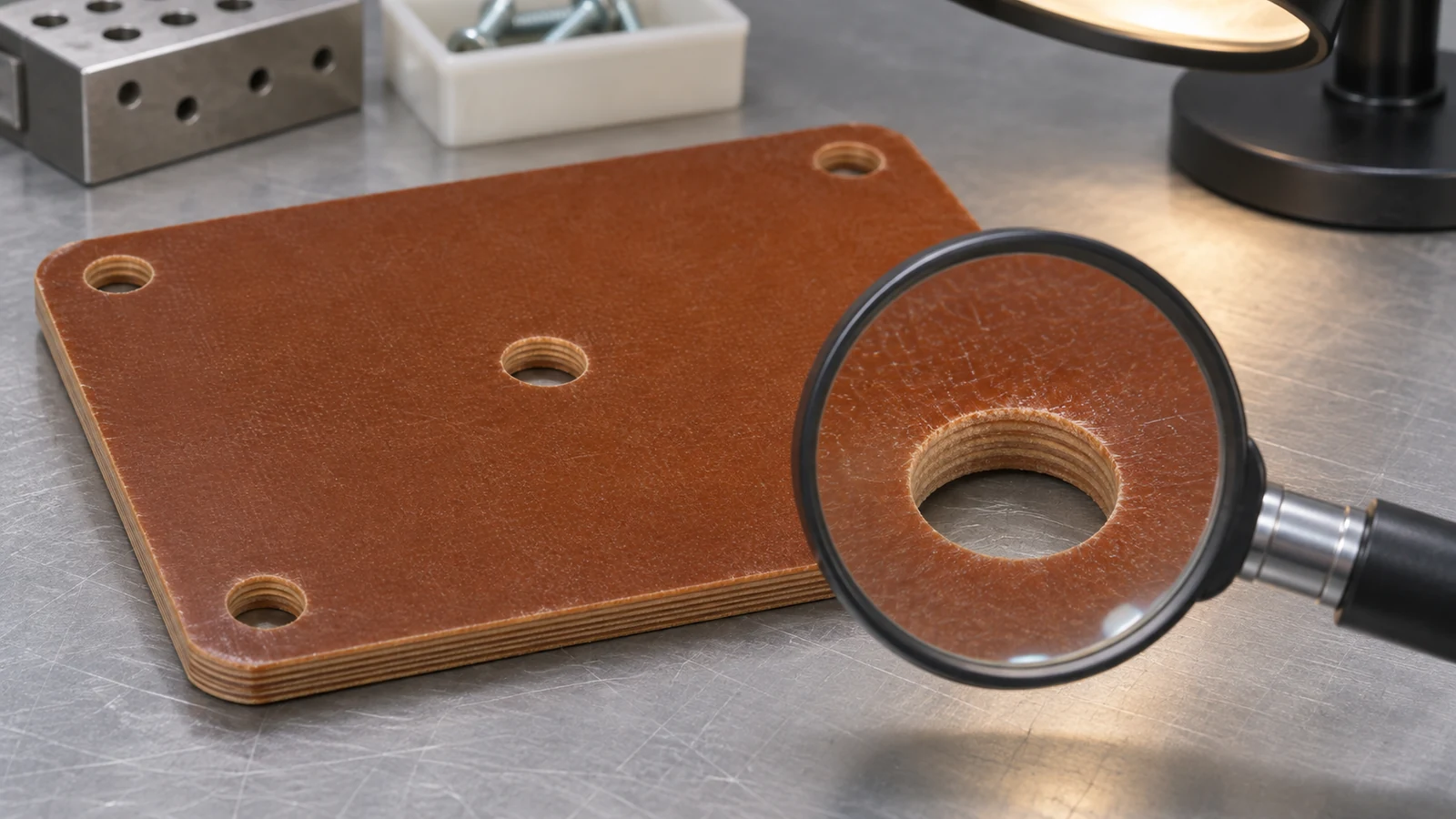 Use inspection methods that can distinguish size, position and local laminate damage. A diameter reading does not describe the entire circumference or the exit condition. A photograph can document a defect location, but it should not silently replace an agreed dimensional method or material test. State which side and which region each acceptance requirement concerns.
The quality and inspection page provides general context for discussing documentation. For this part, the order should identify the drawing revision, laminate grade, critical features, delivered condition and evidence required. Add packaging that prevents accepted edges from being knocked against adjacent parts during transport.
Use the site’s plastic materials overview when comparing material families, but keep this article’s task narrower: selecting a workable fabrication and inspection approach for the specified phenolic laminate. It is not a generic wear-part procurement page and does not assume that paper, cotton, linen and glass constructions are interchangeable.
Phenolic laminate machining questions
Is “Bakelite” enough information for a machining order?
Usually it leaves important details unresolved. Identify the intended producer grade, resin and reinforcement construction, product form and relevant material specification before purchasing stock or programming the part.
Why can the entry face look good while the exit is damaged?
Support and cutting conditions differ at tool exit. Inspect the last layers, review backing and tool condition, and qualify the route on the actual construction and geometry.
Can G10 machining instructions be used for paper phenolic?
Not without checking applicability. G10 is a glass-epoxy construction, while paper phenolic has a different reinforcement and resin system. Use the grade-specific producer guidance.
Does a dimensional report establish electrical compliance?
No. It establishes only the measurements within its stated scope. Electrical material and assembly requirements need their own documentation and verification by the responsible parties.