
Choose MONEL 400 when the design requires the established alloy 400 specification and its combination of service properties; consider MONEL R-405 when the part is suited to free-machining stock and the operation benefits from that grade. R-405 is not simply “400 but easier to cut”: Special Metals identifies it as the free-machining version, with more sulfur, chiefly intended for automatic screw-machine stock and not generally recommended for other applications. That caveat matters if the component must be welded, formed, or substituted into a broader assembly.
For CNC procurement, decide from the part’s product form and operation, then verify the exact material specification and service requirement. A machining convenience should not silently override the alloy required by the drawing.
The short answer is about the operation
If the job is automatic screw-machine production from suitable bar stock and the drawing permits R-405, its free-machining intent can be relevant. If the part needs broader fabrication, a different product form, or a specification explicitly calling for alloy 400, use the grade that meets that requirement and do not treat R-405 as an automatic replacement. The right choice depends on the component’s route from raw stock through joining and final service.
Special Metals reports that R-405 has essentially the same corrosion resistance and physical properties as alloy 400, with a slightly different range of mechanical properties. Its technical bulletin also says R-405 is chiefly used for automatic-screw-machine stock and is not generally recommended for other applications. Read those statements together: similarity in some properties does not remove the application boundary.
What R-405 changes in the specification
R-405’s greater sulfur content is used to enhance machinability. The chemistry and product requirements are grade-specific, so purchasing should name the exact UNS designation and governing specification instead of relying on “Monel 400 equivalent.” The alloy 400 and R-405 bulletins are separate documents; use the one matching the order and confirm the supplied form and certificate.
| Decision point | Alloy 400 | R-405 review |
|---|---|---|
| Machining intent | General wrought alloy requirements; machining route is job-specific | Free-machining grade aimed chiefly at automatic screw-machine stock |
| Joining or fabrication | Review the applicable joining specification and service conditions | Do not assume the free-machining grade is broadly interchangeable; seek engineering approval |
| Mechanical-property limits | Use the exact product-form and condition requirements | Bulletin notes a slightly different mechanical-property range |
| Purchase records | Specify grade, form, condition, and certificate | Specify R-405 explicitly and confirm the intended stock/application |
The site’s corrosion-resistant materials overview can help frame material selection, but it cannot replace the actual chemical environment, grade specification, or supplier certificate.
Choose by the part’s route, not its nickname
Map the operations in order: incoming product form, turning or milling, secondary holes or threads, any joining or forming, finishing, and inspection. A short turned spacer from bar stock may fit a different purchasing decision from a large machined housing that must be joined into a pressure or fluid assembly. Ask whether the selected form is available in the required size and condition before design release.
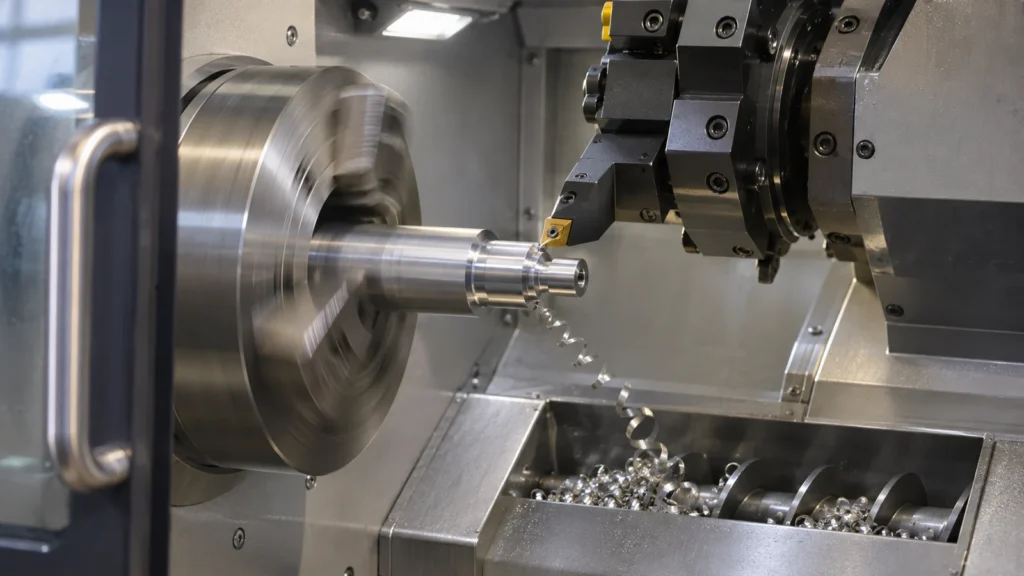
For turned parts, identify the bar diameter, cutoff face, thread form, cross holes, and any features that affect automatic feeding or tool access. For milled shapes, evaluate whether the chosen stock form is practical and whether the grade remains consistent with subsequent fabrication. The CNC turning capability page and CNC milling page describe the site’s process categories; confirm the actual material form and part requirements at quotation.
Where the free-machining tradeoff matters
R-405 is attractive only when its machinability purpose aligns with the part’s production route and the design accepts the grade’s defined application. If the component is welded, brazed, formed, or exposed to a service environment with special qualification rules, involve the design authority and material supplier before substituting. The sulfur addition is not a footnote to ignore; it is part of why this grade has a distinct use recommendation.
Likewise, do not infer that a faster cycle automatically lowers total cost. Stock availability, scrap risk, secondary operations, tool changes, documentation, and assembly requirements can outweigh cutting time. Compare delivered part cost and technical risk across the whole route, not only the spindle cycle.
Write a substitution review that can be approved
When a supplier proposes changing 400 to R-405 or the reverse, request a documented comparison of standard, UNS designation, product form, condition, chemistry certificate, mechanical properties, joining needs, and service environment. Identify the drawing owner who can approve the change. A supplier cross-reference is useful input, not a unilateral design revision.

Keep material identity traceable through machining and any outside operation. If a heat number is transferred to a traveler or part marking, define where and how it is preserved so the finished component remains tied to its records. The quality page provides general quality context; project-specific traceability and acceptance must be stated in the purchase documents.
RFQ checklist for Monel parts
- Alloy 400 or R-405, exact specification, UNS designation, product form, and condition.
- Part route, including automatic screw-machine, turning, milling, joining, or forming steps.
- Service medium, temperature range, load, and any design qualification conditions.
- Material certification, heat/lot traceability, and approval path for substitutions.
- Required dimensions, finish, inspection records, and marking locations.
These inputs prevent a machinability-driven grade choice from becoming an undocumented service-material change.