
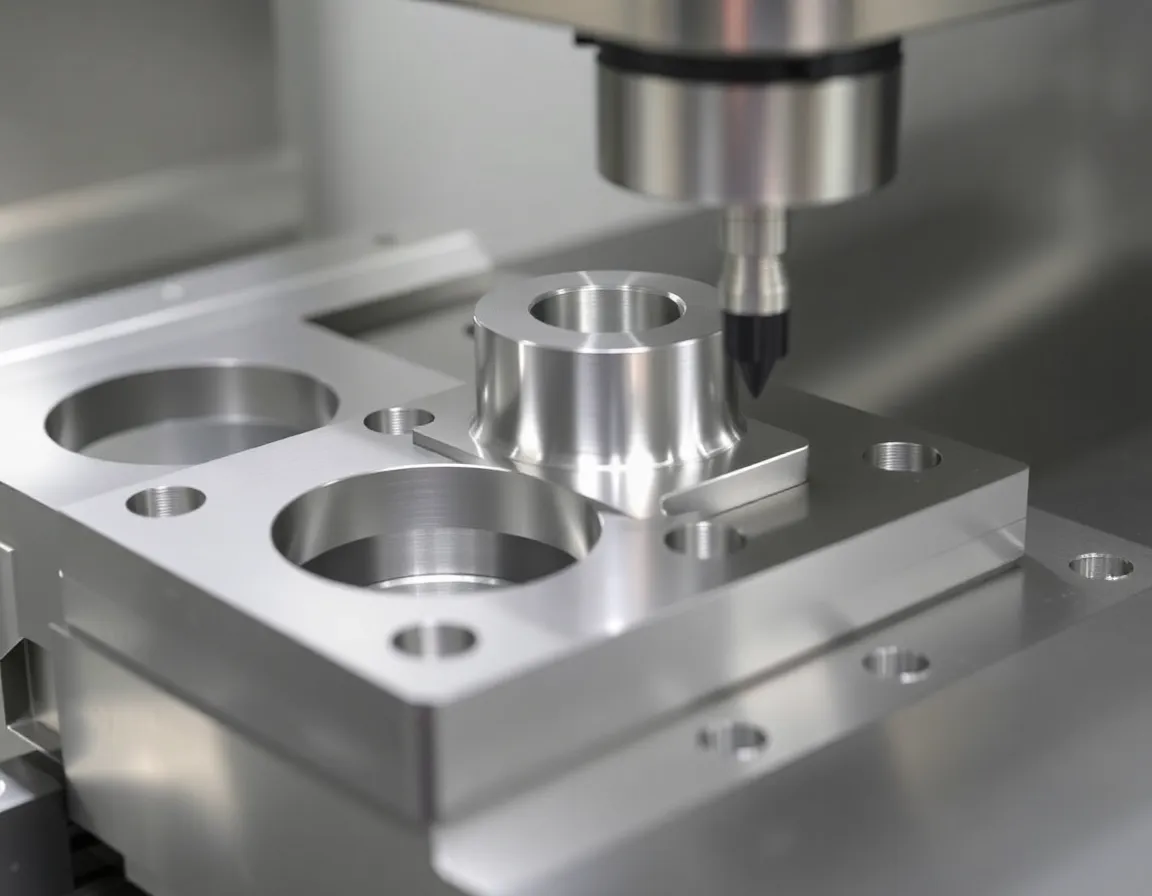
Beyond the Flatlands: An Introduction to Simultaneous 5-Axis Machining
In the relentless pursuit of precision, efficiency, and complexity in modern manufacturing, a technology stands apart for its transformative capabilities: simultaneous 5-axis machining. Moving far beyond the linear movements of traditional 3-axis milling, this advanced process unlocks the ability to create highly intricate, organic, and precise geometries in a single setup. It represents not just an incremental improvement, but a paradigm shift in how engineers and machinists approach the fabrication of complex parts. At its core, simultaneous 5-axis machining involves a cutting tool that can move linearly along the X, Y, and Z axes while simultaneously rotating on two additional axes (typically A and B, or B and C). This synchronized dance of five axes of motion allows the tool to approach the workpiece from virtually any direction, opening a world of design freedom previously constrained by the limitations of simpler machines.
Deconstructing the Mechanics: How Simultaneous 5-Axis Works
Understanding the mechanics is key to appreciating its power. While 3+2 axis machining (positional 5-axis) uses the two rotational axes to tilt the workpiece to a fixed angle and then performs a 3-axis cut, simultaneous 5-axis keeps all five axes in coordinated motion during the entire cutting operation. This fundamental difference is what enables the machining of complex contoured surfaces.
Common Machine Configurations
The two most prevalent machine configurations are defined by where the rotational movement occurs:
- Table-Table / Dual Rotary Table: The workpiece is mounted on a table that rotates on two axes (e.g., A and C). The spindle head primarily moves linearly. This style is excellent for machining smaller, cube-like parts.
- Head-Head / Trunnion Style: The workpiece is mounted on a single-axis rotary table (typically the C-axis), while the spindle head tilts on another axis (the A-axis). This configuration often offers a larger work envelope and is well-suited for larger components.
- Table-Head / Hybrid: A combination where one rotary axis is on the table and one is on the head. This offers a flexible compromise between the two main styles.
The Role of Advanced CAM Software
The machine itself is only half the story. The true brain behind the operation is sophisticated Computer-Aided Manufacturing (CAM) software. Programming simultaneous 5-axis toolpaths is a complex task that involves:
- Collision Avoidance: The software must constantly calculate and prevent collisions between the tool, holder, spindle, and the workpiece or machine table.
- Kinematic Simulation: A virtual twin of the machine model is used to simulate the entire machining process, verifying toolpaths and ensuring they are physically possible.
- Tool Vector Control: Precisely controlling the orientation of the cutting tool relative to the surface being machined is critical for maintaining optimal cutting conditions and surface finish.
The Compelling Advantages: Why Industry Demands 5-Axis
The adoption of simultaneous 5-axis machining is driven by a powerful set of benefits that directly impact quality, cost, and capability.
Unmatched Geometric Complexity
This is the primary advantage. It can effortlessly produce parts with undercuts, deep cavities, complex organic surfaces (like impellers, blisks, and molds), and features that are simply impossible to machine in a single setup on a 3-axis machine. It brings the design intent to life with fidelity.
Single-Setup Machining
By allowing access to five sides of a workpiece in one clamping, it eliminates the need for multiple setups. This drastically reduces non-cut time associated with repositioning and re-fixturing, while also virtually eliminating cumulative errors that can occur when a part is moved between setups.
Superior Surface Finish and Accuracy
The ability to maintain the optimal tool orientation (tool tip cutting) and use shorter, more rigid tools improves surface finish and dimensional accuracy. It allows for constant engagement with the material, reducing vibrations and enabling higher feed rates.
Reduced Cycle Times and Increased Tool Life
Complex parts can be machined more efficiently. By tilting the tool, the effective cutting diameter can be increased for finishing operations, allowing for larger step-overs. Furthermore, better chip evacuation and more consistent cutting forces contribute to extended tool life.
Real-World Applications: Where 5-Axis Excels
Simultaneous 5-axis machining is no longer a niche technology; it is essential in industries where performance, weight, and complexity are non-negotiable.
- Aerospace: Manufacturing monolithic structural components, turbine blades, blisks (bladed disks), and airframe parts with complex aerodynamic profiles from high-strength materials like titanium and Inconel.
- Medical & Dental: Producing patient-specific implants (knee, hip, cranial), surgical guides, and dental prosthetics with the required biocompatible materials and intricate organic shapes.
- Automotive & Motorsport: Creating lightweight engine blocks, cylinder heads, complex intake manifolds, and aerodynamic components where every gram and contour matters.
- Mold & Die: Machining complex injection molds, forging dies, and die-casting molds with deep draws, textured surfaces, and intricate cooling channels in hardened tool steels.
- Energy: Fabricating critical components like turbine impellers, vanes, and valves for the oil, gas, and power generation sectors.
Best Practices for Successful Implementation
Harnessing the full potential of simultaneous 5-axis machining requires more than just purchasing a machine. It demands a holistic approach to people, processes, and technology.
Invest in Training and Skills Development
The complexity shifts from the manual skill of the machinist to the digital skill of the programmer and process engineer. Comprehensive training in advanced CAM programming, machine kinematics, and simulation is absolutely critical for success and safety.
Prioritize Tooling and Workholding
Specialized tooling, such as short-gage-length, necked-down end mills, is often required to reach deep features without collision. Similarly, rigid and reliable workholding solutions (e.g., precision vises, tombstones, custom fixtures) are paramount to withstand the dynamic forces of multi-axis movement.
Start with Simulation and Verification
Never run a first-part program directly on the machine. Utilize the CAM system's full machine simulation to visually verify every move. For mission-critical parts, consider using a virtual machine model or a software-based numerical control (NC) verification system to catch any post-processor errors.
Adopt a Strategic Approach to Programming
Effective 5-axis programming involves strategic planning of tool axis limits, smooth linking motions, and efficient roughing strategies before fine finishing. Understanding when to use 3+2 positioning versus simultaneous motion can optimize cycle times.
In conclusion, simultaneous 5-axis machining is a cornerstone of advanced manufacturing, enabling the creation of parts that push the boundaries of design and performance. While it presents a steeper learning curve and requires significant investment in technology and talent, the rewards—in the form of unprecedented part complexity, reduced lead times, and superior quality—are substantial. For any organization aiming to compete at the forefront of precision engineering in aerospace, medical, automotive, or energy sectors, mastering this technology is not just an option; it is an imperative for the future.
