
Se você está especificando materiais para componentes elétricos ou térmicos de alta condutividade, provavelmente já se deparou com usinagem de cobre C11000 como uma capacidade crítica. O C11000, também conhecido como cobre Electrolytic Tough Pitch (ETP), é o grau comercial de cobre mais amplamente especificado, valorizado por sua excepcional condutividade elétrica e térmica. No entanto, a usinagem desse material apresenta desafios distintos que separam as oficinas CNC experientes das demais. Este guia baseia-se em insights de fóruns de usinagem, dados do setor e pesquisas metalúrgicas para oferecer um panorama completo — desde o que o cobre C11000 realmente é, até como é produzido, e as estratégias precisas de CNC que transformam este material “pegajoso” em componentes de alto desempenho.
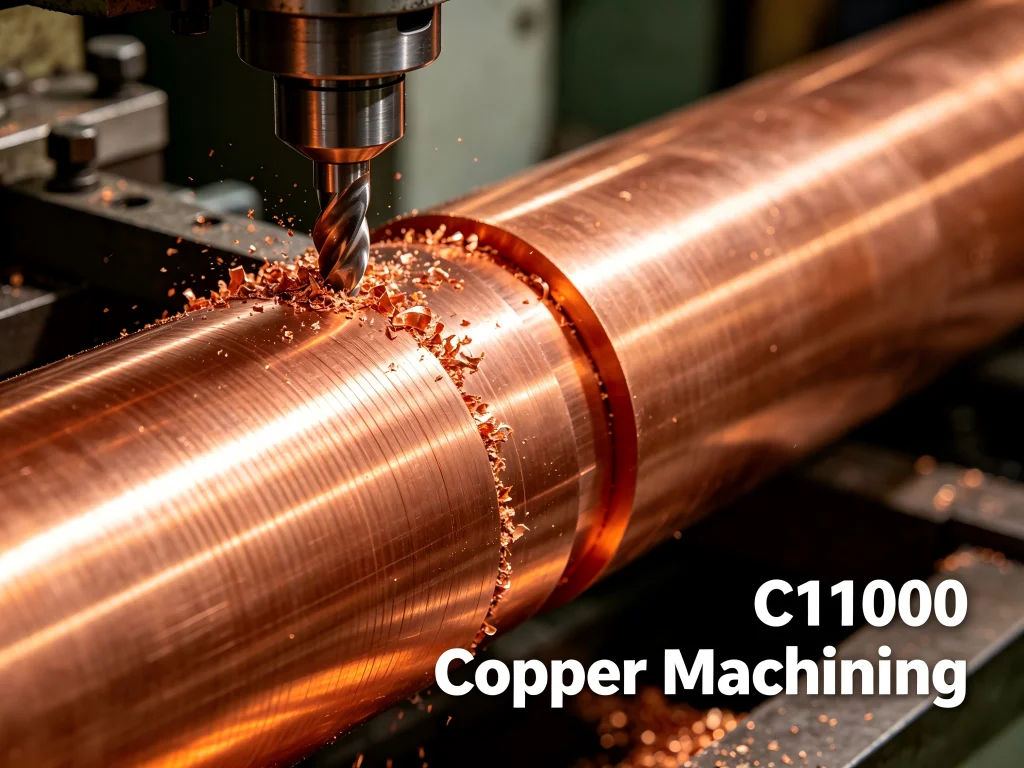
O Que É o Cobre C11000? Definição, Composição e Origem
Antes de mergulhar nas técnicas de usinagem, é útil entender o que é o cobre C11000 e de onde ele vem. A designação “C11000” vem do Unified Numbering System (UNS) para metais e ligas. É um cobre refinado eletroliticamente que contém no mínimo 99,90% de cobre com um teor de oxigênio controlado de aproximadamente 300–400 ppm (0,04%). Esse oxigênio residual é um subproduto deliberado do processo de refino — ele fixa impurezas como o ferro na forma de óxidos, o que na verdade otimiza a condutividade elétrica em vez de degradá-la.
A composição química se decompõe da seguinte forma:
- Cobre + Prata (Cu + Ag): ≥ 99,90%
- Oxigênio (O): ≤ 0,061%
- Estanho (Sn): ≤ 0,002%
- Zinco (Zn): ≤ 0,005%
- Chumbo (Pb): ≤ 0,005%
- Ferro (Fe): ≤ 0,005%
Mas como o cobre é extraído do mate de cobre para atingir esse nível de pureza? A jornada do minério ao C11000 refinado é um processo metalúrgico fascinante. O mate de cobre — uma mistura de sulfetos de cobre e ferro produzida durante a fundição — é carregado em um conversor, e ar quente é soprado através dele. As seguintes reações ocorrem:
- O sulfeto de ferro oxida: 2FeS + 3O₂ → 2FeO + 2SO₂
- A sílica é adicionada para fundir o óxido de ferro: FeO + SiO₂ → FeSiO₃ (escória)
- O sulfeto de cobre oxida: 2Cu₂S + 3O₂ → 2Cu₂O + 2SO₂
- O óxido de cobre reage com o sulfeto de cobre remanescente para produzir cobre blister: 2Cu₂O + Cu₂S → 6Cu + SO₂
Este cobre blister é então refinado eletroliticamente para atingir a pureza de 99,90%+ que define o C11000. O resultado é um material que oferece aproximadamente 100% IACS (International Annealed Copper Standard) condutividade elétrica—cerca de quatro vezes melhor que o alumínio e muito superior a qualquer aço. Para gestão térmica, a condutividade térmica do C11000 de aproximadamente 390 W/m·K o torna o substrato preferido para trocadores de calor de alta potência e placas frias resfriadas a líquido.
O cobre é difícil de usinar? Entendendo o desafio
Esta é uma das perguntas mais comuns nos fóruns de usinagem, e a resposta curta é: sim, o cobre puro é difícil de usinar—mas não pelos motivos que você poderia esperar. Como disse um membro do fórum Practical Machinist: “Se você tiver alguma escolha na questão, recomendo fortemente o cobre telúrio em vez do C110 ou C101. O Telco é muito mais fácil de usinar…o 0,21% de telúrio nele faz com que forme cavacos facilmente”. Outro usuário da comunidade Carbide 3D observou: “O cobre é difícil de fresar, exceto o C145. Este fresar como um encanto, mas parece impossível de encontrar em chapas”.
A questão central é a classificação de usinabilidade de apenas 20% do C11000 compared to free-cutting brass. Copper’s high ductility and plasticity mean it resists shearing cleanly. Instead of forming small, manageable chips, it tends to produce long, stringy chips that can wrap around tools and create a built-up edge (BUE). As one machining guide explains: “Copper may seem easy to cut due to its softness, but its high ductility and thermal conductivity create unique machining challenges. These properties affect chip formation, cutting stability, surface finish, and tool life”.
There is also the phenomenon of work hardening. Unlike aluminum or brass, pure copper hardens significantly when subjected to mechanical stress. The material work hardens slowly with increasing amounts of cold work, which means it can be worked extensively before annealing is required—but that also means cutting forces remain elevated and tool wear accelerates.
On Reddit and other forums, machinists frequently discuss the “gummy” nature of pure copper. One user observed: “Copper is soft and will just do this. Something is allowing the material to deform downward, or the stock to lift upward”. Another recommended: “Try to find a machinable alloy. Use a new single flute end mill SHALLOW depth of cut HIGH feed rate”. These community insights highlight a crucial point: C11000 copper machining is not impossible—it simply requires the right approach, tooling, and expertise.
CNC Machining Strategies for C11000 Copper
Successfully machining C11000 copper requires a combination of proper tool selection, optimized cutting parameters, and effective workholding. Here is what the data and machining community recommend.
Tool Selection and Geometry
Sharp tooling is non-negotiable when machining C11000 copper. The material’s ductility means that dull tools will push the material rather than shear it, leading to poor surface finish and rapid work hardening. High-speed steel (HSS) and carbide tools are both viable options, but carbide generally provides better wear resistance and allows for higher cutting speeds.
For CNC turning operations, the cutting tool edge angle should be set between 70° and 95°, with a near 90° angle being preferred for softer copper types. Positive rake angles help reduce cutting forces and improve chip flow.
Cutting Speeds and Feeds
For pure copper (C11000), recommended cutting speeds typically fall in the range of 60–100 meters per minute (200–330 feet per minute). However, these are starting points—the optimal parameters depend on your specific machine, tooling, and part geometry.
One of the most important pieces of advice from the machining community is to maintain chip formation. As one forum member noted: “The issue will be adjusting feeds and speeds so that you’re still forming a chip (which will carry away heat)”. If you are not forming a proper chip, you are likely rubbing the material rather than cutting it, which generates excessive heat and accelerates tool wear.
Gerenciamento de Refrigerante e Cavacos
Copper’s high thermal conductivity means it efficiently draws heat away from the cutting zone—but that heat has to go somewhere. Flood coolant is generally recommended to lubricate the cutting interface and flush chips away from the work area. As one source explains: “Copper is good at carrying away heat but the bits are not as good. Slowing down your feedrate and your RPMs will help with the heat”.
Chip management is particularly critical with C11000. The long, stringy chips characteristic of copper can wrap around the tool, workpiece, or fixture, potentially causing tool breakage or surface damage. Using chip breakers or optimizing feed rates to promote chip fracture can help mitigate this issue.
Workholding Considerations
Because C11000 copper is relatively soft, it can deform more easily than harder steels. As one machining guide points out: “Copper can deform more easily than harder steels, so clamping strategy and tool condition have a stronger effect on part quality”. Secure, even clamping is essential to prevent workpiece movement or distortion during machining. Soft jaws or custom fixtures may be necessary for complex geometries.
Core Applications of C11000 Copper Machining
C11000 copper’s combination of exceptional conductivity and good formability makes it the material of choice for a wide range of applications across multiple industries.
Electrical and Power Distribution
This is perhaps the most significant application area for C11000 copper. The material is standard for electrical bus bars, power conductors, and general-purpose conductive components. Custom-machined copper bus bars outperform off-the-shelf extruded stock when the geometry must fit a tight enclosure or connect non-standard terminal layouts. CNC machining allows for precise hole patterns, bends, and complex cross-sections that would be difficult or impossible to achieve with standard extrusion.
Thermal Management and Heat Sinks
When aluminum heat sinks cannot keep up—common in IGBT modules, laser diode arrays, and high-density power supplies—machined copper provides the thermal headroom. A notable example from the aerospace industry involved CNC milling a C11000 copper heat sink measuring 9 inches in length, 4 inches in width, and 0.5 inch thick, with tolerances of ±0.0005 inches. After machining, each part was nickel plated per AMS 2404.
Skived fin geometries and vapor-chamber interface surfaces are both achievable with CNC, offering design freedom that extrusion-based heat sinks cannot match at low volumes. The thermal conductivity of approximately 390 W/m·K makes C11000 the preferred substrate for high-power heat exchangers and liquid-cooled cold plates.
RF Shielding and Electronics Enclosures
Copper’s combination of high conductivity and natural EMI/RFI shielding effectiveness makes it suitable for custom RF enclosures, waveguide components, and grounding straps. Unlike conductive coatings that can wear or scratch, solid copper shielding is bulk-effective and does not degrade with handling or thermal cycling.
High-Current Connectors and Industrial Components
High-current connectors, charging contacts, and resistance-welding electrodes all benefit from copper’s low electrical resistance and good thermal mass. Surface finish on contact faces is critical—even minor tool marks can create hot spots under high current density. This is where precision CNC machining becomes essential.
Key Factors in Selecting a C11000 Copper Machining Partner
Not every CNC shop is equipped to handle the unique challenges of C11000 copper machining. Here are the critical factors to evaluate when selecting a manufacturing partner.
Material Expertise and Experience
Ask potential suppliers about their specific experience with C11000 and other copper alloys. Have they machined similar geometries? Do they understand the material’s work hardening characteristics and chip formation challenges? A shop that primarily works with aluminum or steel may not have the nuanced understanding required for successful copper machining.
Quality Management Systems and Certifications
For industries such as automotive, aerospace, and medical devices, quality certifications are non-negotiable. Look for suppliers with IATF 16949 certification, which ensures rigorous process control, material traceability, and CMM-verified data. As Jucheng Precision demonstrates, operating under an IATF 16949 quality management system means a “zero-defect culture” is embedded in every aspect of production.
Equipment Capabilities
Machining C11000 copper effectively requires machines with adequate rigidity to handle the material without flexing or vibrating. Multi-axis CNC milling and turning capabilities allow for complex geometries. Tolerance capabilities are also critical—can the shop consistently hold the ±0.005–0.02 mm tolerances that many copper components require?
Post-Processing and Finishing Options
Copper components often require additional finishing to meet application requirements. Common finishes include sandblasting, anodizing (for aluminum components in assemblies), powder coating, plating (nickel, silver, or tin), passivation, and black oxide. Your supplier should offer a range of post-processing options or have established partnerships with finishing providers.
Lead Times and Production Volume Flexibility
Whether you need a single prototype or low-volume production, your supplier should be able to accommodate your needs. Look for shops that offer global delivery within days and can handle orders from 1 piece to thousands.
Installation and Maintenance Considerations for C11000 Copper Components
While this guide focuses primarily on machining, it is worth briefly addressing what happens after the parts are delivered.
Melhores Práticas de Instalação
When installing C11000 copper components—particularly electrical bus bars and connectors—observe these guidelines:
- Clean contact surfaces thoroughly before assembly. Any contamination can increase electrical resistance and create hot spots.
- Use appropriate torque on fasteners. Over-tightening can deform the soft copper, while under-tightening can lead to loose connections and arcing.
- Consider plating for applications where oxidation could affect performance. Tin or silver plating on contact surfaces prevents oxidation without sacrificing conductivity.
- Allow for thermal expansion. Copper has a higher coefficient of thermal expansion than many other materials, so designs should accommodate movement.
Maintenance Tips
When C11000 is exposed to the outdoors for long periods, it produces a relatively impervious protective film which eventually forms the familiar green patina of weathered copper. In most environments, its corrosion resistance is excellent to good. However, C11000 is not suitable for use with certain materials, including acetylene, ammonia, chromic acid, and nitric acid. Regular inspection of electrical connections for signs of overheating or oxidation is recommended.
For machined components, periodic cleaning may be necessary to remove accumulated debris or oxidation products, particularly in high-humidity or corrosive environments.
Comparison: C11000 vs. Alternative Copper Alloys
When specifying materials for CNC machining, it helps to understand how C11000 compares to other copper alloys. The table below summarizes key differences.
| Propriedade | C11000 (ETP Copper) | C10100 (Oxygen-Free) | C14500 (Tellurium Copper) |
|---|---|---|---|
| Copper Content | ≥ 99,90% | ≥ 99.99% | ~99.5% |
| Condutividade Elétrica | 100% IACS | ~101% IACS | ~90% IACS |
| Condutividade Térmica | ~390 W/m·K | ~391 W/m·K | ~350 W/m·K |
| Classificação de Maquinabilidade | 20% of free-cutting brass | ~20% | ~85% of free-cutting brass |
| Key Advantage | Most widely available, excellent conductivity | No oxygen outgassing, ideal for vacuum/high-temp | Superior machinability, easier to drill/tap |
| Aplicações Típicas | Bus bars, conductors, heat sinks | Semiconductor, vacuum systems, aerospace | Intricate machined components |
As the table shows, C11000 offers the best combination of availability and conductivity, while C14500 is significantly easier to machine. If your design requires complex features and you can accept slightly lower conductivity, tellurium copper may be worth considering. If you are operating in a vacuum or high-temperature environment where oxygen outgassing is a concern, C10100 may be the better choice.
Frequently Asked Questions About C11000 Copper Machining
1. What is the machinability rating of C11000 copper?
C11000 copper has a machinability rating of approximately 20% compared to free-cutting brass (C36000). This means it is significantly more difficult to machine than brass but is still workable with the right techniques and tooling.
2. Why is C11000 copper considered “gummy” to machine?
The term “gummy” refers to copper’s high ductility and tendency to form long, stringy chips rather than breaking cleanly. This can lead to chip wrapping, built-up edge on tools, and poor surface finish if not properly managed.
3. Can C11000 copper be welded?
Soldering C11000 is excellent, and brazing is good. However, brazing in hydrogen-bearing atmospheres is not recommended due to potential hydrogen embrittlement. Inert-gas arc welding can produce sound welds with good strength, but these processes are generally not recommended for C11000 copper.
4. What are the main applications for C11000 copper?
Applications include electrical bus bars, power conductors, heat sinks, RF shielding, high-current connectors, and general-purpose conductive components. The material is used across automotive, aerospace, electronics, and power distribution industries.
5. How does C11000 compare to oxygen-free copper?
C11000 (ETP) contains a controlled amount of oxygen (~300–400 ppm), while oxygen-free grades like C10100 are refined to eliminate residual oxygen. C10100 is preferred for vacuum and high-temperature applications where oxygen outgassing could be an issue. C11000 is more widely available and less expensive.
6. What cutting tools work best for C11000 copper?
Sharp carbide tools with positive rake angles are generally recommended. HSS tools can also work but may wear more quickly. The cutting tool edge angle for turning operations should be between 70° and 95°.
7. Does C11000 copper work harden during machining?
Yes. C11000 work hardens slowly with increasing amounts of cold work. This means cutting forces can increase during machining if the material is not cut cleanly. Proper tool selection and sharp edges help mitigate this issue.
8. What surface finishes are available for C11000 copper components?
Common finishes include as-machined, polishing, sandblasting, tumbling, electropolish, and various plating options (tin, silver, nickel). Plating is often used on contact surfaces to prevent oxidation without sacrificing conductivity.
Why Choose Jucheng Precision for C11000 Copper Machining
When your project demands the specialized expertise required for C11000 copper machining, Jucheng Precision offers a compelling combination of capabilities, quality systems, and industry experience.
Quality Systems That Ensure Consistency
Jucheng Precision operates under an IATF 16949 quality management system, ensuring rigorous process control, material traceability, and CMM-verified data for every project. This “zero-defect culture” is embedded in every aspect of production, from raw material inspection to final quality assurance. The facility also holds ISO 9001:2015 certification.
Advanced Equipment for Complex Geometries
Com 3-axis and 5-axis CNC milling and turning capabilities, Jucheng Precision can machine complex geometries that would be challenging for less equipped shops. The ability to hold tolerances down to ±0.01mm ensures that even the most demanding specifications can be met.
Material Expertise Across the Copper Family
Jucheng Precision’s experience extends across a wide range of materials, including various copper alloys. This breadth of experience means the team understands the nuances of machining different copper grades—from the conductivity-focused C11000 to the more machinable C14500 tellurium copper.
Flexible Production Volumes
Whether you need a single functional prototype or low-volume production, Jucheng Precision can accommodate your requirements. The company’s rapid prototyping capabilities allow for global delivery within days, helping you accelerate your product development timeline.
Comprehensive Post-Processing Options
From sandblasting and anodizing to plating and powder coating, Jucheng Precision offers a full range of finishing services. This means you can receive fully finished, ready-to-install components from a single source.
Industry-Specific Experience
Jucheng Precision has deep experience serving demanding industries including automotive, medical devices, aerospace, and robotics. This experience translates into an understanding of industry-specific quality requirements and application needs.
For engineers and procurement professionals seeking a reliable partner for C11000 copper machining, Jucheng Precision offers the technical expertise, quality systems, and production flexibility needed to turn challenging materials into precision components.
Ready to discuss your C11000 copper machining project? Contact Jucheng Precision to learn how their expertise can bring your designs to life.