Available Polycarbonate (PC) Grades
| Grade |
Common Name |
Key Characteristics |
Typical Applications |
| Standard PC |
General Purpose (GP) |
High impact strength, good heat resistance, and transparency. The most common grade for machining. |
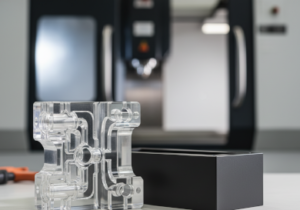
Machine guards, transparent manifolds, structural housings, electrical connectors. |
| Optical Grade PC |
Lexan® / Makrolon® |
Formulated for low haze and high light transmission. Optimized for polishing. |
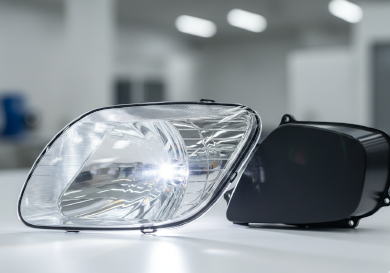
Lenses, light pipes, windows, display screens, automotive lighting. |
| Glass-Filled PC |
GF10 / GF20 / GF30 |
Reinforced with glass fibers (10-30%). Significantly increased stiffness and tensile strength, but opaque. |
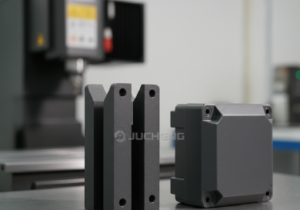
Structural components, rigid housings, industrial brackets. |
| Machine Grade PC |
Stress-Relieved |
Processed to reduce internal stress, making it easier to machine without cracking. |
Precision prototypes, tight-tolerance insulators. |
Polycarbonate Machining Capabilities
| Capability |
Technical Description |
Jucheng Advantage |
| Vapor Polishing |
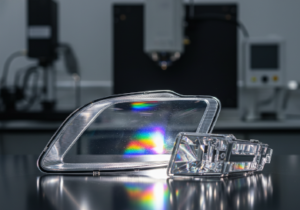
Exposing machined PC parts to chemical vapor to melt the surface microscopic layer, creating an optically clear finish. |
We can turn a translucent machined part into a glass-like clear component for internal verification. |
| Stress-Free Machining |
PC is prone to “crazing” (micro-cracking). We use sharp tools and annealing cycles to manage stress. |
Ensures durability and chemical resistance of the final part, preventing failure in service. |
| Complex 5-Axis Milling |
Machining complex automotive light guides and headlight bezels with organic curves. |
Our 5-axis machines allow for continuous contouring required for optical surfaces. |
| High-Speed Drilling |
Drilling precise hole patterns without melting or cracking the material. |
Optimized peck cycles and coolant prevent heat buildup, crucial for deep holes in PC. |
Fabrication Guidelines for PC
Coolant Sensitivity:
Polycarbonate is highly sensitive to chemical attack. Standard cutting fluids can cause immediate stress cracking. We use strictly compatible, non-aromatic water-soluble coolants or air blast.
Polishing Strategy:
To achieve optical clarity, the part must first be machined with a very fine step-over to minimize tool marks, followed by sanding (up to 2000 grit) and final vapor polishing or buffing.
Annealing:
Machining induces stress. For parts with tight tolerances or those requiring heavy solvent bonding/polishing, we anneal the parts in an oven to relieve internal stresses.
Tooling:
We use extremely sharp, uncoated carbide tools with high clearance angles. Coated tools can sometimes be too dull for plastic, causing heat friction that melts the PC.
Primary Application Industries
Automotive
Key Parts: Headlight lenses, interior light pipes, dashboard instrument panels.
Why PC: Combines optical clarity with high impact resistance to withstand road debris.
Medical Devices (ISO 13485)
Key Parts: Blood oxygenators, surgical reservoirs, manifolds.
Why PC: Clear visibility of fluids, biocompatible grades available, and withstands sterilization (Gamma/EtO).
Safety & Security
Key Parts: Blast shields, riot gear visors, machine guards.
Why PC: Its legendary impact toughness (bullet-resistant in thick sections) protects personnel.
Electronics
Key Parts: LED covers, robust handheld device housings, battery cases.
Why PC: Flame retardance (UL94 V-0 grades) and durability against drops.