
+86-188-7042-1176
project@jcproto.com
Mon-Fri: 8am-6pm (GMT+8)
EN
ISO 9001:2015 Certified
Machine Grade PC
Machine Grade PC (Polycarbonate) is specifically processed through a proprietary stress-relieving cycle to ensure maximum dimensional stability during and after machining. Unlike standard grades that may crack or warp when material is removed, this grade allows for the fabrication of complex, high-tolerance components without "crazing." At Jucheng Precision, we leverage Machine Grade PC to produce robust industrial manifolds, semiconductor nests, and high-impact housings. Our advanced CNC processes, combined with optional vapor polishing, deliver parts that offer the legendary "unbreakable" toughness of polycarbonate with the microscopic precision required for the most demanding engineering applications.
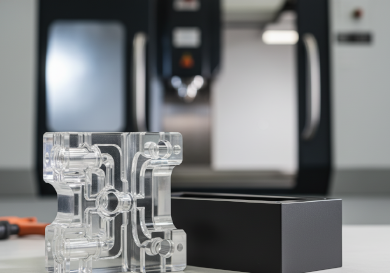
Polycarbonate (PC) Material Variants
| Grade | Common Name | Key Characteristics | Typical Applications |
|---|---|---|---|
| Machine Grade PC | Stress-Relieved PC | Specially annealed to remove internal stresses. Best for machining tight tolerances without cracking or warping. | Manifolds, complex structural housings, semiconductor parts. |
| Optical Grade PC | Lexan® / Makrolon® | Highest light transmission and clarity. Optimized for vapor polishing to achieve glass-like finishes. | Lenses, sight glasses, light guides, protective visors. |
| Glass-Filled PC | PC GF20 / GF30 | Reinforced with glass fibers. Much higher stiffness and heat resistance, but opaque and abrasive to tools. | Industrial brackets, load-bearing electronics frames. |
Machine Grade PC Machining Capabilities
| Capability | Technical Description | Jucheng Advantage |
|---|---|---|
| Vapor Polishing | Using solvent vapor to smooth machined surfaces, restoring optical clarity to internal channels and external faces. | We achieve near-glass transparency on complex PC manifolds, allowing for visual inspection of fluid flows in medical devices. |
| Tight-Tolerance Milling | Leveraging the stability of stress-relieved PC to hold dimensions within +/- 0.02mm across large, complex geometries. | Our 5-axis CNC machines deliver highly accurate electronic housings and semiconductor nests with zero dimensional drift. |
| Precision Boring & Tapping | Drilling and threading without the “crazing” or micro-cracking common in non-annealed polycarbonate. | We utilize sharp, high-speed spindles to achieve burr-free threads that maintain structural integrity under mechanical load. |
| In-House Stress Management | Post-machining annealing cycles to ensure the part remains stable after heavy material removal. | Jucheng guarantees that your PC components won’t “snap” or warp over time, even when exposed to fluctuating industrial temperatures. |
Fabrication Guidelines for Machine Grade PC
Chemical Compatibility Warning:
Polycarbonate is highly sensitive to certain cutting oils and solvents, which cause immediate stress cracking. Tip: We use strictly compatible, water-soluble coolants or air-blast cooling to protect the material during CNC runs.
Sharp Tooling Strategy:
PC is ductile and can smear if the tool is dull. Tip: We use ultra-sharp, uncoated carbide tools with high positive rake angles to shear the plastic cleanly and minimize frictional heat.
Impact Resistance Preservation:
While PC is the “unbreakable” plastic, surface scratches or stress risers from improper machining can reduce its impact strength. Tip: We use fine-step finishes to ensure the surface is smooth and free of microscopic stress points.
Annealing and Sizing:
For critical tolerances, we perform a rough-machining pass, followed by a stabilizing period, and then a final finish pass to account for any microscopic material movement.
Primary Applications
Semiconductor Equipment
Structural frames, nests, and wafer handling components that require high impact strength and dimensional stability.
Medical Device Housings
Transparent or opaque manifolds and housings that must withstand impact while providing visibility into fluid systems.
Industrial Machine Guards
Clear structural panels and safety shields that must provide absolute protection to operators from flying debris.
Aerospace & Defense
Internal structural components and electronic enclosures that benefit from PC’s light weight and extreme durability.
Properties
| Density | 1.20 g/cm³ |
| Tensile Strength | 60 - 70 MPa |
| Elastic Modulus | 2.3 - 2.5 GPa |
| Hardness | 118 Rockwell R |
| Impact Strength | 600 - 800 J/m |
| Heat Deflection Temp | 135 - 145 °C |
| Continuous Service Temp | 115 - 125 °C |
| Water Absorption | 0.15% |
| Dielectric Strength | 15 - 17 kV/mm |
| Machinability Rating | Excellent |
| Max Part Size | 2000 x 800 x 600 mm |