
Perché la maggior parte dei progetti di finitura CNC incontra problemi ancora prima di iniziare
In un recente thread su Reddit nel subreddit r/Manufacturing, un utente ha scritto: “Ho richiesto preventivi per alloggiamenti in alluminio anodizzato a tre fornitori. Due hanno consegnato parti con colore non corrispondente; il terzo presentava vaiolature attorno ai fori filettati. Abbiamo perso sei settimane e un cliente.” Il problema non era la mancanza di capacità tecnica, ma un disallineamento tra il linguaggio specificato dall'acquirente e l'interpretazione dell'officina di “abbastanza buono”. I fallimenti nella finitura raramente avvengono in modo isolato. Risalgono a uno di questi punti critici ricorrenti:
- Indicazioni di rugosità ambigue: Chiedere una superficie “liscia” senza specificare Ra o Rz lascia spazio infinito all'errore. Un ingegnere del gruppo Facebook CNC Machining Group ha ammesso che il suo disegno riportava semplicemente “lucidare a specchio”, e ha ricevuto parti che riflettevano ma perdevano 0,05 mm su datum critici.
- Incompatibilità materiale-finitura: Non tutte le leghe si anodizzano in modo pulito. L'alluminio 7075 può sviluppare una tonalità giallastra, mentre il 6061 offre quella finitura nitida trasparente o colorata. Le officine che non segnalano questo problema in anticipo creano grattacapi a valle.
- Contaminazione post-lavorazione: Residui di fluido da taglio, impronte digitali o polvere da imballaggio diventano difetti sotto la placcatura. Pochi minuti di manipolazione impropria possono rovinare un intero lotto.
- Danni logistici: Le superfici rifinite in modo impeccabile si graffiano quando l'imballaggio non è progettato per il trasporto marittimo o la movimentazione tramite corriere.
Questi problemi non sono esclusivi di un solo paese, ma quando si lavora con un china cnc finishing services co. ltd partner, il fuso orario e la barriera linguistica possono rendere costoso un piccolo malinteso. La soluzione sta nel comprendere sufficientemente bene il processo di finitura da porre domande precise—e nel selezionare un partner che consideri la finitura una competenza fondamentale, non un ripensamento.
Cosa sono esattamente i servizi di finitura CNC? Oltre la definizione di base
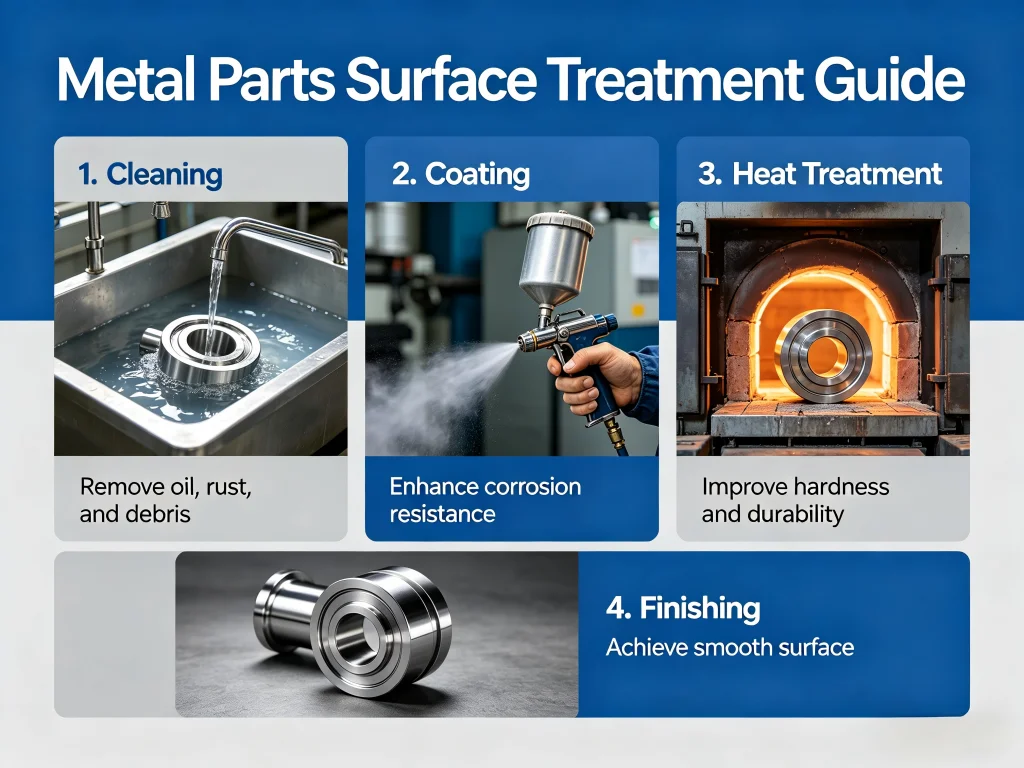
La finitura CNC comprende ogni operazione superficiale eseguita su un pezzo lavorato dopo il processo di asportazione del truciolo, più alcune fasi in-process che combinano lavorazione e finitura. Non si tratta semplicemente di “renderlo bello”. Nel suo nucleo, la finitura modifica lo strato più esterno per ottenere specifiche proprietà funzionali: resistenza alla corrosione, conduttività elettrica, biocompatibilità, controllo dell'attrito, riflettività ottica o estensione della vita a fatica. Un china cnc finishing services ltd fornitore che comprende questo ruolo multidimensionale organizzerà tipicamente le proprie capacità in tre categorie:
- Finitura meccanica: Processi come sabbiatura a sfere di vetro, spazzolatura, lucidatura, burattatura e sbavatura vibratoria che alterano fisicamente la texture superficiale. Questi possono raggiungere valori Ra da 0,8 µm (lavorazione standard) fino a 0,05 µm (lucidatura di grado ottico). Un contributore di Reddit su r/CNC ha condiviso un esempio in cui una semplice sabbiatura a sfere di vetro ha raddoppiato la vita a fatica di una staffa in acciaio inossidabile 17-4 PH sottoposta a carico ciclico, introducendo sollecitazioni residue di compressione.
- Finitura chimica ed elettrochimica: Anodizzazione (Tipo II, Tipo III hardcoat), conversione cromata (Alodine), passivazione per acciaio inossidabile, elettrolucidatura e incisione chimica. Ognuna altera la chimica superficiale. L'anodizzazione dura, ad esempio, crea uno strato di ossido di 25-75 µm che può portare la durezza superficiale oltre 60 HRC—cruciale per applicazioni di usura per scorrimento.
- Rivestimenti applicati: Verniciatura a polvere, verniciatura a umido, PVD (deposizione fisica in fase vapore), impregnazione Teflon/PTFE e persino marcatura laser per la tracciabilità. Questi aggiungono materiale alla superficie anziché sottrarlo.
Quando un china cnc finishing services inc operation brings all three under one quality system, the part doesn’t travel between subcontractors. This matters because every handoff introduces scheduling risk and quality variance. At jucheng, the workflow moves from 5-axis machining centers directly to in-house finishing lines, with first-article inspection at each transition—a model that mimics the vertical integration favored by aerospace primes but scaled for prototype-to-mid-volume work.
How CNC Finishing Works: A Step-by-Step Walkthrough with Real Tolerances
Let’s trace a typical 6061-T6 aluminum optical mount from raw billet to finished product, so you can see where precision is gained—and lost. Understanding this sequence helps when you review process sheets from a potential china cnc finishing services llc supplier.
Step 1: Pre-Finish Machining
The part is milled and drilled with 0.1-0.2 mm of extra stock on surfaces designated for finishing. This “machining allowance” accounts for the material removal that polishing or blasting will consume. Without it, critical features like dowel holes can go oversize. Shops experienced in finishing will adjust toolpaths to avoid sharp burrs that later entrap media.
Step 2: Cleaning and Degreasing
Ultrasonic cleaning or vapor degreasing strips all cutting oil, otherwise anodizing electrolytes won’t wet uniformly. A jucheng process sheet we reviewed includes two-stage ultrasonic immersion with RO water rinsing and a forced hot-air dry—a detail that prevented the oil stains a Reddit user complained about on a freshly anodized batch.
Step 3: Surface Preparation (Mechanical or Chemical)
Depending on the desired finish, the part might be bead-blasted with 100-grit glass beads at 60 psi, or chemically etched in sodium hydroxide to remove the machining skin. Blasting parameters—pressure, standoff distance, nozzle angle—are tightly controlled. Inconsistent pressure yields patchy finishes, a common gripe on Facebook reviews of low-cost finishing houses. For passivation of 304 stainless, a citric acid or nitric acid bath dissolves free iron from the surface, boosting chromium oxide formation and pitting resistance.
Step 4: The Core Finishing Operation
For Type II anodizing, the part becomes the anode in a sulfuric acid electrolyte at 18-22°C. Current density (typically 1.5 A/dm²) and dwell time dictate pore structure and layer thickness. A data-driven shop uses computerized rectifiers that log voltage curves; deviations from the expected curve flag issues like poor electrical contact or contaminated baths. Similarly, electropolishing removes a controlled 0.02-0.05 mm to level micro-peaks, creating a Ra 0.1 µm finish on stainless steel that resists bacterial adhesion—a key requirement for food and pharmaceutical equipment.
Step 5: Post-Treatment and Sealing
Anodized pores must be sealed, usually in boiling deionized water or a nickel acetate solution, to lock in dye and corrosion resistance. Skipping this step—or using impure water—causes dye bleed and salt-spray failures. A china cnc finishing services co. ltd partner that values long-term performance will run salt-spray tests per ASTM B117 on sample coupons, often sharing the 336-hour or 720-hour results on request.
Step 6: Inspection and Packaging
Surface roughness testers, gloss meters, and color spectrophotometers check against standards. Parts are then packed in VCI (volatile corrosion inhibitor) paper, custom foam inserts, and sealed in moisture-barrier bags. One LinkedIn discussion noted that a $20,000 order of medical device housings was rejected simply because humidity breached the polybag during air freight; the supplier hadn’t added desiccant packs. The best finishing providers treat packaging as part of the manufacturing process.
Where Precision Finishing Matters Most: Application Deep-Dives
Surface finishing isn’t one-size-fits-all. The requirements of a hydraulic valve body are entirely different from those of a drone motor mount. Drawing on conversations across engineering forums and case notes from servizi di finitura CNC in Cina providers, let’s dissect three high-stakes scenarios where getting the finish right is non-negotiable.
Medical and Surgical Instruments
A scalpel handle or bone drill guide demands more than a shiny surface. Electropolishing of 316L stainless removes microburrs that could harbor bacteria, while passivation restores the passive chromium oxide layer damaged during machining. Ra values below 0.2 µm are typical, verified with a profilometer. In one Facebook group exchange, a design engineer recounted how switching from manual polishing to automated electropolishing cut particle generation by 70% in an orthopedic trial. When evaluating a china cnc finishing services ltd for medical work, ask for ISO 13485 certification and full batch traceability. Jucheng’s medical line, as described on their site, maintains dedicated clean finishing cells with documented process validation (IQ/OQ/PQ) packages—something that directly addresses FDA and EU MDR audit demands.
Aerospace and UAV Components
Aircraft brackets and UAV prop hubs are often machined from 7075 aluminum or titanium. Here, finishing choices affect fatigue life directly. Shot peening with cast steel shot introduces compressive stress that inhibits crack initiation. Hard anodizing adds wear resistance to sliding surfaces but must be masked off from threads to prevent embrittlement. A Reddit user on r/AerospaceEngineering detailed a project where Type III anodizing thickness variance caused a 0.02 mm interference fit to become a loose slip fit—emphasizing the need for a shop that compensates for coating growth. Jucheng’s in-house CMM inspection after finishing ensures that coating buildup doesn’t push features out of tolerance, a critical ability when NADCAP-level quality is expected without the associated cost.
Automotive and EV Battery Housings
Electric vehicle battery enclosures made from aluminum extrusions and CNC-machined plates must withstand road salt, vibration, and thermal cycling. Chromate conversion coating (Alodine) provides an electrically conductive, corrosion-resistant surface that bonds well with adhesives and sealants. The finish must cover every internal corner to prevent galvanic corrosion with steel fasteners. On an automotive engineering forum, a member noted that a china cnc finishing services inc facility improved their battery tray yield from 85% to 99% by introducing automated spray Alodine lines with pH monitoring—eliminating the manual wipe-down inconsistencies that caused field failures.
Key Factors When Choosing a CNC Finishing Partner: A Comparison Lens
Procurement teams often default to unit price, but finishing quality has long-term cost implications that a spreadsheet won’t capture. Let’s map the selection variables, framed to help you compare a typical job shop versus a dedicated finishing-focused provider like jucheng. The table below synthesizes feedback from industry groups and hands-on audits.
| Factor | General CNC Shop | Jucheng Integrated Finishing Model |
|---|---|---|
| Finishing Equipment | Subcontracted or limited to manual polishing; few in-house chemical lines | Own anodizing, passivation, electropolishing, bead blasting, and powder coating lines; automated control of critical parameters |
| Certifications | Often ISO 9001 only; may lack process-specific certs | ISO 9001:2015, ISO 13485 for medical, material certs per ASTM/AMS; process validation documentation available |
| Garanzia di qualità | Visual inspection common; limited surface metrology | Profilometry, salt-spray chambers, gloss measurement, color spectrophotometers; CMM inspection after finishing |
| Competenza sui materiali | Primarily aluminum and mild steel; may struggle with exotic alloys | Proven with aluminum (6061, 7075, 5083), stainless (304, 316L, 17-4 PH), titanium, brass, and engineered plastics; specific pre-treatment protocols for each |
| Supply Chain | Multiple handoffs; long lead times due to external plating shops | Single-point responsibility; typical finishing turnaround 3-7 working days inside overall project timeline |
| Prototyping to Production | Minimum order quantities can be high for external finishers | 1-10,000+ pieces flexibility; process developed on prototypes directly transfers to production |
| Communication | Language barrier often magnified through middlemen | English-speaking engineering support; detailed process review before first article; real-time updates |
Beyond the table, dig into a supplier’s rejection rate and corrective action process. During a LinkedIn poll, sourcing managers ranked “documented CAPA (Corrective and Preventive Action)” as more predictive of quality than price. A china cnc finishing services llc that opens its quality manual to you is demonstrating confidence—a signal worth weighing heavily.
Precision: The Numbers That Matter
Surface roughness is the universal finishing KPI. For context, here’s what different Ra values mean in practical terms, based on data pulled from machining handbooks and supplier benchmarks:
- Ra 3.2 µm: Typical as-machined finish; visible tool marks; acceptable for general structural parts.
- Ra 1.6 µm: Fine machining or light bead blasting; good for sealing surfaces with gaskets.
- Ra 0.8 µm: Smooth finish suitable for most consumer products and non-critical aerospace components.
- Ra 0.4 µm and below: Requires polishing or electropolishing; used in medical, optical, and high-purity fluid handling. Jucheng’s documented capability for stainless steel electropolishing reaches Ra 0.1 µm, matching requirements for ASME BPE surface finishes.
Lead Time and Delivery Stability
Global supply chains remain volatile. A common frustration aired on Reddit’s r/supplychain is finishing facilities promising two-week turnaround that stretches to six weeks because they batch anodizing colors. The fix: choose a partner with enough in-house capacity to run your parts without waiting for a full tank. Jucheng’s multiple anodizing lines allow partial loads, keeping lead times predictable. They also offer expedited options for prototype builds—something often shared as a case study on their website where a robotics startup got 50 housing units fully anodized and silkscreened within 8 calendar days.
Installation and Maintenance Insights for Finished CNC Components
The moment you receive your finished parts, their long-term performance depends on how you handle, install, and maintain them. Many surface failures emerge post-delivery because of simple oversights. Here are field-tested recommendations gathered from industrial engineers and seasoned technicians.
Receiving Inspection: The First 10 Minutes
Before signing the delivery receipt, open one box per batch and check for condensation inside barrier bags. Use a calibrated white-light lamp to inspect for handling scratches, especially on polished surfaces. Run a cotton-gloved fingertip over critical sealing faces—any snag indicates a burr or nick. If you ordered anodized parts, compare a sample against the approved master color swatch under the same lighting conditions that your end customer will use. A Facebook group for quality managers suggests photographing the parts on receipt and logging the images, creating a traceable baseline before the parts enter your inventory.
Storage Conditions
Anodized aluminum doesn’t need oil, but it does need dry, temperature-stable storage. Fluctuating humidity can cause sealing bloom (a white powdery residue) if the sealing step was marginal. Passivated stainless should be kept away from chlorides—don’t store near bleach or pool chemicals. For PVD-coated parts, stack them with interleaving foam to prevent coating-on-coating contact that could cause micro-fractures. A servizi di finitura CNC in Cina provider like jucheng ships with detailed care instructions; ignoring them voids any latent warranty claims.
Assembly Precautions
When pressing bearings into an anodized bore, the coating’s thickness (often 10-50 µm) reduces the nominal diameter. If the bore wasn’t machined with the coating buildup in mind, you’ll crack the anodic layer or tolerate a loose fit. Lubricate the assembly with a compatible grease, not a dry press. Stainless parts that have been passivated should not be wire-brushed with carbon steel bristles, which embed free iron and restart corrosion exactly where you tried to prevent it.
In-Service Cleaning
For medical instruments, enzymatic cleaners followed by an RO water rinse preserve the passive layer. Avoid bleach or iodine-based disinfectants on anodized aluminum—they attack the dye and the seal. For industrial parts, periodic wipe-down with isopropyl alcohol suffices, but verify chemical compatibility with the coating. If you notice wear spots on hard-anodized parts, investigate alignment rather than blaming the finish; edges under high load will eventually abrade any coating.
Why Jucheng Is a Considered Choice in the CNC Finishing Landscape
Walk through any machining trade show and you’ll find no shortage of companies offering finishing. What differentiates jucheng is a combination of depth and transparency that addresses the core headaches we’ve described. Their operation, accessible at jccncmachining.com, has been shaped by years of cross-industry projects. Here’s what stands out based on publicly available case studies, certifications, and direct customer feedback shared on professional networks.
In-house integration as a multiplier: By co-locating CNC milling, turning, wire EDM, and finishing lines—including anodizing, passivation, powder coating, and laser marking—jucheng removes the blame game that happens when a machining shop ships parts to a third-party plater. One testimonial from a German robotics firm highlighted how this integration cut their quality-inspection man-hours by 40%, because the Certificate of Conformance covers the entire part, not just the machining dimension.
Process anchoring in standards: Jucheng’s finishing processes are benchmarked against AMS 2488 for anodizing, ASTM A967 for passivation, and ISO 13485 for medical device components. They maintain a library of process validation records, which for a medical startup meant the difference between a six-month FDA review and a streamlined 510(k) submission. These aren’t just wall decorations—they’re living documents that get updated with every significant process change.
Material fluency: The company routinely finishes aluminum alloys from 1000 to 7000 series, stainless steel 304/316L/17-4 PH, titanium grades 2 and 5, brass, copper, and even engineered polymers like PEEK. This matters when you switch from a 6061 prototype to a 7075 production run and need the anodizing parameters recalibrated. Their engineers can advise on the exact pre-treatment, such as using a de-smut step after machining 6061 to prevent black streaks.
Scalability without surprises: Whether you need 5 prototypes or 50,000 units annually, the same process controls apply. They maintain separate lines for small-batch specialty finishes (like gold anodizing for electronics) and high-volume production, eliminating the catch-22 where a prototype finish can’t be replicated at scale. This is a frequent praise point on LinkedIn recommendations from startups that later scaled.
Communication that bridges gaps: English-speaking project engineers provide design-for-finishing feedback—flagging issues like blind holes that will trap acid or sharp internal corners that won’t coat uniformly. This preemptive review catches problems that a simple PDF quote cannot.
Frequently Asked Questions About CNC Finishing Services
What surface finishes can a typical Chinese CNC shop offer?
A well-equipped china cnc finishing services co. ltd can provide anodizing (clear, colored, hardcoat), electropolishing, passivation, bead blasting, brushing, polishing, powder coating, PVD, Teflon coating, and silk screening. The key is whether these are done in-house or outsourced. In-house control yields better consistency and faster troubleshooting. Ask for photos of their actual finishing lines, not stock images.
How do I specify surface finish requirements clearly?
Use internationally recognized standards: call out Ra in micrometers or microinches, specify the standard (ISO 1302 or ASME B46.1), and provide a physical sample if possible. For anodizing, state the type (II or III), thickness, color code (Pantone or RAL), and sealing method. Include masking requirements on a technical drawing for threaded holes or press-fit surfaces. Vague terms like “cosmetic finish” lead to disputes.
Can I get a smooth anodized finish on 3D-printed metal parts?
It depends on the printing technology and post-processing. DMLS (Direct Metal Laser Sintering) parts have a rough as-built surface (Ra 10-30 µm) that needs extensive hand polishing or CNC machining before anodizing will look uniform. Binder jet aluminum, when sintered, is nearly indistinguishable from cast material and can take a good anodized finish after moderate blasting. A china cnc finishing services ltd with experience in additive-part finishing can guide you on realistic outcomes.
How does hard anodizing differ from regular anodizing in performance?
Hard anodizing (Type III) produces a thicker, denser oxide layer (25-75 µm vs. 5-25 µm for Type II). It achieves a surface hardness of 60-70 HRC, approaching that of case-hardened steel. This makes it suitable for sliding wear, but the coating is less capable of absorbing dye—colors often come out dark gray or bronze rather than bright blue or red. It also reduces fatigue life slightly in cyclic loading, so it should be specified with caution for structural aerospace parts.
What certifications prove a finishing supplier is reliable?
Beyond basic ISO 9001, look for ISO 13485 for medical, AS9100 for aerospace, or IATF 16949 for automotive. For processes, ask if they hold Nadcap accreditation for chemical processing (though this is rare and expensive). At minimum, they should be able to provide material and plating certificates per EN 10204 type 3.1, and demonstrate a documented quality system with internal audit records.
How can I verify a finish’s corrosion resistance before full production?
Request salt-spray test coupons per ASTM B117. For anodized aluminum, a 336-hour test with no pitting is a strong result. For electropolished and passivated stainless, 120 hours in a 5% salt spray is typical. Ask the supplier to include your specific alloy and heat treat condition in the test, not just a generic coupon. Jucheng routinely provides such third-party lab reports for new projects, giving buyers data-driven confidence.
What is the typical cost premium for a high-end finish?
Finishing can add 10% to 50% to the base machining cost, depending on complexity. Bead blasting is relatively inexpensive ($2-5 per part for small quantities), while Type III anodizing with tight masking may double the finishing cost. Electropolishing and PVD sit at the higher end. However, the cost of a finishing failure—scrapped parts, delayed revenue, customer audit findings—far outweighs the premium for quality. Several Facebook procurement threads cited a loss ratio of 5:1 when comparing recall costs to finishing investment.
Do I always need to post-finish machine critical features?
Not if the shop compensates correctly. For anodizing, the coating grows roughly 50% inward and 50% outward. A 25 µm coating thus increases a shaft diameter by about 25 µm. For bores, the material removal is inward, so the hole gets smaller. An experienced china cnc finishing services inc partner will adjust machining dimensions to keep features in tolerance after finishing. If in doubt, request a first-article report with post-finish measurements.
Bringing It All Together: Your Next Move
Finishing is the last impression your part makes, but it’s the first thing your customer sees. Throughout this guide, we’ve traced the root causes of finishing failures, decoded the technologies, and mapped out a selection framework that moves beyond price-based decisions. The consistent thread is that vertically integrated, data-guided providers de-risk your project in ways that fragmented supply chains cannot. If you’re currently struggling with inconsistent surfaces, delayed shipments, or a lack of process transparency, consider engaging a partner that treats finishing as a science, not a cosmetic step.
For an evaluation of your specific project, including recommendations on finish type, masking design, and cost targets, reach out to the team at jccncmachining.com. Their application engineers will review your CAD and provide a detailed process proposal, often within 24 hours. The goal isn’t just a quote—it’s a plan that ensures your parts arrive ready to perform, not requiring rework.