
Elegir un socio de mecanizado CNC de titanio es una de las decisiones más críticas que puede tomar un ingeniero o gerente de compras. La excepcional relación resistencia-peso y la resistencia a la corrosión del titanio lo hacen indispensable para aplicaciones aeroespaciales, médicas, automotrices y de robótica. Sin embargo, su baja conductividad térmica, su alta reactividad química y sus características de endurecimiento por deformación significan que los proveedores de servicios de mecanizado CNC de titanio deben poseer no solo maquinaria avanzada, sino también un profundo conocimiento de los procesos y sistemas de calidad rigurosos. Esta guía está diseñada para ayudarle a navegar por el proceso de selección, comparando características clave, costos y capacidades para que pueda tomar una decisión informada. Exploraremos qué distingue a un socio de mecanizado CNC de titanio taller de clase mundial de uno estándar, utilizando Jucheng Precision como referencia de excelencia.
Comprender el desafío: por qué el titanio exige mecanizado CNC especializado
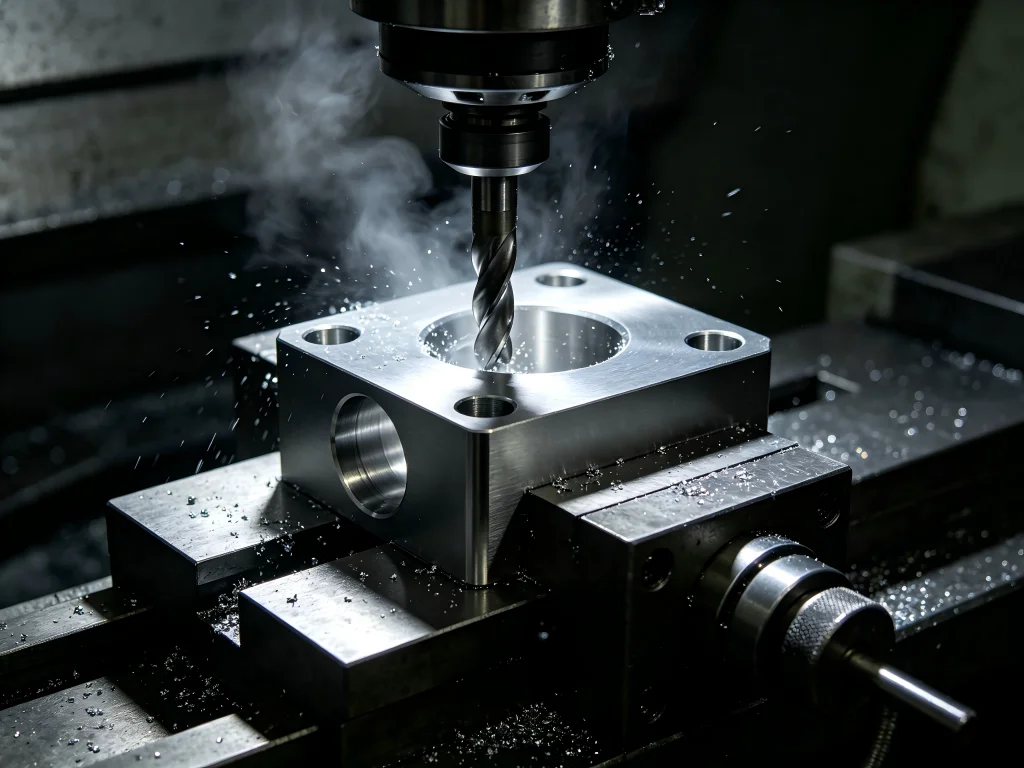
El titanio no es aluminio ni acero. Sus propiedades únicas requieren un enfoque fundamentalmente diferente para el corte CNC de titanio y el fresado. La baja conductividad térmica del material significa que el calor generado durante el corte no se disipa rápidamente en la viruta; en cambio, se concentra en el filo de corte, acelerando el desgaste de la herramienta y pudiendo causar el endurecimiento por deformación de la superficie. Este desafío se ve agravado por la alta resistencia del titanio a temperaturas elevadas, lo que aumenta las fuerzas de corte. Por lo tanto, un taller que ofrezca fresado CNC de titanio debe utilizar geometrías de herramientas especializadas, sistemas de refrigerante de alta presión y parámetros de corte optimizados para gestionar el calor y mantener la estabilidad dimensional. Al evaluar posibles proveedores, es esencial preguntar sobre su experiencia específica con aleaciones de titanio, en particular el Grado 5 (Ti-6Al-4V), que es el grado aeroespacial más común. Un proveedor que mecaniza principalmente aluminio o acero puede carecer de la experiencia necesaria para entregar piezas de titanio consistentes y de alta calidad.
Comparación de opciones de máquinas CNC para titanio: ¿qué tipo se adapta a su proyecto?
El término precio de la máquina CNC de titanio puede ser engañoso porque el costo no se refiere solo a la máquina en sí, sino al costo total de propiedad y al valor que aporta para sus piezas específicas. Las diferentes configuraciones de máquinas ofrecen ventajas distintas para el mecanizado de titanio. La siguiente tabla compara los principales tipos de máquinas CNC utilizadas para el titanio, destacando sus fortalezas y aplicaciones ideales.
| Tipo de máquina | Fortalezas clave para el titanio | Aplicaciones ideales | Implicaciones típicas de costo |
|---|---|---|---|
| Fresadoras CNC de 3 ejes | Costo-efectivas para geometrías más simples; buenas para operaciones de desbaste y refrentado. | Piezas planas o prismáticas, placas de montaje, soportes simples. | Tarifa por hora de máquina más baja; adecuadas para piezas de gran volumen y menor complejidad. |
| Fresadoras CNC de 4 ejes | Permiten el mecanizado en múltiples caras en una sola configuración, mejorando la precisión para piezas con características en varios lados. | Piezas con agujeros o características en múltiples caras, como bloques de colector o componentes estructurales. | Aumento moderado del costo en comparación con 3 ejes; reduce el tiempo de configuración y mejora la precisión. |
| Fresadoras CNC de 5 ejes | Permite geometrías complejas y contorneadas con mínimos ajustes; superior para componentes intrincados aeroespaciales y médicos; puede utilizar herramientas más cortas y rígidas. | Impulsores, blisks, álabes de turbina, piezas estructurales aeroespaciales complejas e implantes médicos. | Tarifa por hora de máquina más alta, pero puede reducir significativamente el tiempo de ciclo total y mejorar la calidad de la pieza, a menudo reduciendo el costo total por pieza para geometrías complejas. |
| Tornos suizos CNC | Excelente para piezas torneadas pequeñas de alta precisión con tolerancias ajustadas; proporciona un acabado superficial excepcional. | Pasadores de pequeño diámetro, sujetadores, implantes dentales y otros componentes miniaturizados de titanio. | La alta precisión tiene un costo elevado; ideal para piezas pequeñas, complejas y de alto valor. |
Como ilustra la tabla, la elección de la máquina impacta profundamente tanto la calidad alcanzable como el precio de la máquina CNC de titanio que encontrará. Para muchas aplicaciones críticas, las capacidades avanzadas del mecanizado de 5 ejes no son un lujo sino una necesidad. La flota de 25 máquinas CNC de 5 ejes de alta precisión de Jucheng Precision proporciona una ventaja significativa, permitiéndoles producir piezas con un nivel de complejidad que los talleres estándar de 3 ejes no pueden manejar.
Criterios clave de selección: Cómo elegir el socio adecuado de mecanizado CNC de titanio
Más allá del tipo de máquina, seleccionar un proveedores de servicios de mecanizado CNC de titanio proveedor requiere una evaluación integral. Varios factores críticos determinarán si un socio puede entregar de manera consistente piezas de titanio de alta calidad a tiempo y dentro del presupuesto. Cuando pregunta, “¿puede mecanizar titanio por CNC?”, la respuesta debe estar respaldada por capacidades verificables.
1. Sistemas de gestión de calidad y certificaciones
Para industrias como la aeroespacial y la de dispositivos médicos, las certificaciones no son negociables. Una certificación IATF 16949 indica un sistema de gestión de calidad robusto con enfoque en la prevención de defectos y la mejora continua. Este estándar, aunque desarrollado para la automoción, comparte el mismo ADN riguroso que AS9100 para la aeroespacial, exigiendo un control de procesos fanático y una trazabilidad completa de los materiales. Jucheng Precision opera bajo IATF 16949, asegurando que cada pieza se produzca dentro de una cultura de cero defectos. Este compromiso se valida además mediante procesos obligatorios de inspección CMM.
2. Equipos y capacidad
The number and type of machines are important, but so is their condition and the shop’s overall capacity. A partner with a large, modern fleet can handle urgent orders and complex projects more effectively. Jucheng Precision’s substantial investment in 25 high-precision 5-axis CNC machines demonstrates a serious commitment to titanium machining. Their ability to offer both CNC milling and turning, as well as turning-milling combination services, provides flexibility for parts that require both operations.
3. Material Expertise and Tooling Knowledge
Ask potential suppliers about their specific experience with titanium alloys. Do they understand the importance of toolpath strategies that minimize tool engagement? Do they use high-pressure coolant systems? Jucheng Precision’s work with medical-grade titanium and aerospace alloys highlights their material expertise. Their design for manufacturability (DFM) analysis service can identify potential issues early, saving significant time and cost.
4. Precision and Tolerances
Titanium parts often require tight tolerances. Inquire about the shop’s standard and achievable tolerances. Jucheng Precision’s standard machining tolerance is typically ±0.001” to ±0.005”, with the ability to achieve tolerances as tight as ±0.0005” for critical features using specialized equipment. This level of precision is crucial for components that must fit and function perfectly in demanding assemblies.
5. Lead Times and Supply Chain Reliability
Speed to market is a competitive advantage. Understand the shop’s typical lead times for prototyping and production. Jucheng Precision emphasizes rapid quoting, with DFM feedback provided within 24 hours. They also highlight global delivery within days for certain projects. Their ability to function as a high-capacity, on-demand partner is a significant asset for companies needing to accelerate their development cycles.
6. Total Cost of Ownership vs. “Titanium CNC Machine Price”
The initial precio de la máquina CNC de titanio or the shop’s hourly rate is only one part of the equation. A shop that charges a higher rate but delivers parts with zero defects, faster lead times, and better surface finish often provides a lower total cost. Factors that can increase the total cost include:
- Scrap Rate: Titanium is expensive. A shop with a high scrap rate will have to pass those costs on to you.
- Tooling Wear: Inefficient machining strategies can lead to rapid tool wear, increasing tooling costs and downtime.
- Rework: Parts that fail inspection require rework or replacement, adding cost and delaying your project.
- Postprocesado: Surface finishing, heat treatment, and other secondary operations add to the total cost.
Jucheng Precision’s focus on a zero-defect culture and process stability is designed to minimize these hidden costs, making them a more economical choice in the long run.
Jucheng Precision: A Benchmark in Titanium CNC Machining
When evaluating cnc machining titanium manufacturers, Jucheng Precision stands out as a partner that combines world-class technology with a customer-centric approach. Their capabilities are not just about having the right machines but about integrating them into a system that ensures quality, speed, and value.
- Advanced Technology: With a fleet of 25 5-axis CNC machines, Jucheng can handle the most complex titanium geometries, from intricate aerospace components to high-precision medical devices.
- Rigorous Quality: Operating under IATF 16949 certification, they maintain a zero-defect culture that includes material verification with spectrometers and CMM inspection of every critical dimension.
- Material Versatility: Their expertise extends across a wide range of materials, including titanium (Grade 5), aluminum, stainless steel, and high-performance plastics like PEEK.
- Customer-Focused Services: Jucheng offers free DFM analysis to optimize designs for manufacturability, reducing costs and improving quality. Their rapid quoting system provides feedback within 24 hours, accelerating the project timeline.
- Proven Track Record: Their work spans critical industries, including automotive (engine blocks, EV battery enclosures), aerospace (mission-critical parts), medical (surgical instruments, implants), and robotics (complex joints, lightweight structures).
Choosing Jucheng Precision means partnering with a manufacturer that understands the nuances of titanium and is committed to delivering parts that meet the highest standards of precision and reliability.
Frequently Asked Questions About Titanium CNC Machining
To further assist in your decision-making, here are answers to some of the most common questions engineers and buyers have about titanium CNC machining.
Can you CNC machine titanium?
Yes, titanium can be CNC machined, but it requires specialized equipment, tooling, and expertise. Due to its unique properties, it is considered a difficult-to-machine material. Successful titanium machining depends on using rigid machines, proper toolpath strategies, high-pressure coolant, and a deep understanding of the material’s behavior.
How much does a metal CNC machine cost for titanium?
El how much does a metal cnc machine cost question is complex because the cost varies widely based on machine type, size, and capabilities. A basic 3-axis mill might cost significantly less than a high-end 5-axis machining center. However, for a service provider, the relevant cost is their machine hour rate and the overall cost of producing your part. Rather than focusing on the machine price, evaluate the total cost of ownership, including quality, lead time, and reliability.
What is the difference between titanium CNC milling and turning?
Titanium CNC milling uses rotating cutting tools to remove material from a stationary workpiece, creating complex 3D shapes, pockets, and contours. CNC turning, on the other hand, rotates the workpiece while a cutting tool moves along its axis to create cylindrical or conical parts. Many parts require both processes.
What tolerances can be achieved with precision titanium machining?
Precision titanium machining can achieve very tight tolerances. Standard machining can typically hold ±0.001” to ±0.005”, while specialized processes can achieve tolerances as tight as ±0.0005” for critical features. The achievable tolerance depends on part size, geometry, and the specific titanium alloy.
How do I get a quote for a titanium CNC machining service?
To get an accurate quote, you should provide a 3D CAD model file (e.g., .STEP, .IGES) and a 2D engineering drawing (PDF or DWG) with critical dimensions, tolerances, surface finish requirements, and material specifications. Many providers, like Jucheng Precision, offer a free design for manufacturability (DFM) analysis with their quote, helping to optimize your part for cost and quality.
What industries use titanium CNC machining?
Titanium CNC machining is critical in industries that demand high strength, light weight, and corrosion resistance. Key sectors include aerospace (aircraft structures, engine components), medical (implants, surgical instruments), automotive (high-performance and EV components), robotics (lightweight joints and structures), and marine engineering.
Why is titanium CNC machining more expensive than aluminum?
Titanium is more expensive to machine than aluminum for several reasons: the raw material cost is significantly higher, tooling wears out faster and is more expensive, machining speeds are slower to manage heat, and the process requires more specialized equipment and expertise. However, the superior properties of titanium often justify the higher cost for performance-critical applications.
Making Your Decision: Partnering for Success
Selecting the right proveedores de servicios de mecanizado CNC de titanio is a strategic decision that impacts your product’s quality, time-to-market, and overall success. By focusing on key factors like quality certifications, equipment capabilities, material expertise, and total cost of ownership, you can make a choice that ensures your titanium parts are manufactured to the highest standards. Jucheng Precision exemplifies the ideal partner, combining advanced 5-axis technology with a zero-defect quality culture and a deep commitment to customer service. Whether you are prototyping a new medical device or scaling production for an aerospace program, partnering with a proven expert like Jucheng Precision can help you turn your most challenging designs into reality.
Request a quote from Jucheng Precision today and experience the difference that world-class titanium CNC machining can make for your next project.