
Choosing a titanium CNC machining partner is one of the most critical decisions an engineer or procurement manager can make. Titanium’s exceptional strength-to-weight ratio and corrosion resistance make it indispensable for aerospace, medical, automotive, and robotics applications. However, its poor thermal conductivity, high chemical reactivity, and work-hardening characteristics mean that titanium CNC machining service providers must possess not just advanced machinery, but also deep process knowledge and rigorous quality systems. This guide is designed to help you navigate the selection process, comparing key features, costs, and capabilities so you can make an informed decision. We will explore what distinguishes a world-class titanium CNC machining shop from a standard one, using Jucheng Precision as a benchmark for excellence.
Understanding the Challenge: Why Titanium Demands Specialized CNC Machining
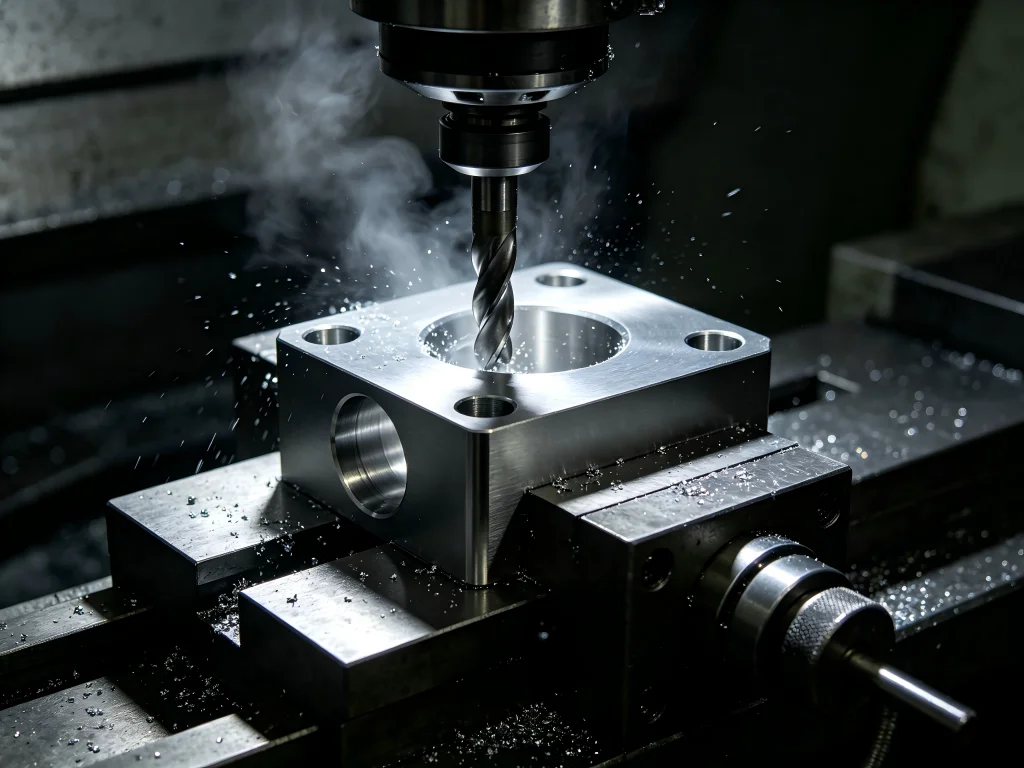
Titanium is not aluminum or steel. Its unique properties require a fundamentally different approach to titanium CNC cutting and milling. The material’s low thermal conductivity means heat generated during cutting does not dissipate quickly into the chip; instead, it concentrates at the cutting edge, accelerating tool wear and potentially causing work-hardening of the surface. This challenge is compounded by titanium’s high strength at elevated temperatures, which increases cutting forces. Therefore, a shop offering titanium CNC milling must use specialized tooling geometries, high-pressure coolant systems, and optimized cutting parameters to manage heat and maintain dimensional stability. When evaluating potential suppliers, it is essential to ask about their specific experience with titanium alloys, particularly Grade 5 (Ti-6Al-4V), which is the most common aerospace grade. A provider that primarily machines aluminum or steel may lack the necessary expertise to deliver consistent, high-quality titanium parts.
Comparing Titanium CNC Machine Options: Which Type Fits Your Project?
The term titanium CNC machine price can be misleading because the cost is not just about the machine itself, but the total cost of ownership and the value it delivers for your specific parts. Different machine configurations offer distinct advantages for titanium machining. The table below compares the primary types of CNC machines used for titanium, highlighting their strengths and ideal applications.
| Machine Type | Key Strengths for Titanium | Ideal Applications | Typical Cost Implications |
|---|---|---|---|
| 3-Axis CNC Mills | Cost-effective for simpler geometries; good for roughing and facing operations. | Flat or prismatic parts, mounting plates, simple brackets. | Lower machine hour rate; suitable for high-volume, less complex parts. |
| 4-Axis CNC Mills | Allows machining on multiple faces in a single setup, improving accuracy for parts with features on several sides. | Parts with holes or features on multiple faces, such as manifold blocks or structural components. | Moderate increase in cost compared to 3-axis; reduces setup time and improves precision. |
| 5-Axis CNC Mills | Enables complex, contoured geometries with minimal setups; superior for intricate aerospace and medical components; can use shorter, more rigid tools. | Impellers, blisks, turbine blades, complex aerospace structural parts, and medical implants. | Higher machine hour rate but can significantly reduce overall cycle time and improve part quality, often lowering the total cost per part for complex geometries. |
| CNC Swiss Lathes | Excellent for small, high-precision turned parts with tight tolerances; provides exceptional surface finish. | Small-diameter pins, fasteners, dental implants, and other miniature titanium components. | High precision comes at a premium; best for small, complex, high-value parts. |
As the table illustrates, the choice of machine profoundly impacts both the achievable quality and the titanium CNC machine price you will encounter. For many mission-critical applications, the advanced capabilities of 5-axis machining are not a luxury but a necessity. Jucheng Precision’s fleet of 25 high-precision 5-axis CNC machines provides a significant advantage, allowing them to produce parts with a level of complexity that standard 3-axis shops cannot handle.
Key Selection Criteria: How to Choose the Right Titanium CNC Machining Partner
Moving beyond the machine type, selecting a titanium CNC machining service provider requires a holistic evaluation. Several critical factors will determine whether a partner can consistently deliver high-quality titanium parts on time and within budget. When you ask, “can you CNC titanium?” the answer must be backed by verifiable capabilities.
1. Quality Management Systems and Certifications
For industries like aerospace and medical devices, certifications are non-negotiable. An IATF 16949 certification indicates a robust quality management system with a focus on defect prevention and continuous improvement. This standard, while developed for automotive, shares the same rigorous DNA as AS9100 for aerospace, demanding fanatical process control and complete material traceability. Jucheng Precision operates under IATF 16949, ensuring every part is produced within a zero-defect culture. This commitment is further validated by mandatory CMM inspection processes.
2. Equipment and Capacity
The number and type of machines are important, but so is their condition and the shop’s overall capacity. A partner with a large, modern fleet can handle urgent orders and complex projects more effectively. Jucheng Precision’s substantial investment in 25 high-precision 5-axis CNC machines demonstrates a serious commitment to titanium machining. Their ability to offer both CNC milling and turning, as well as turning-milling combination services, provides flexibility for parts that require both operations.
3. Material Expertise and Tooling Knowledge
Ask potential suppliers about their specific experience with titanium alloys. Do they understand the importance of toolpath strategies that minimize tool engagement? Do they use high-pressure coolant systems? Jucheng Precision’s work with medical-grade titanium and aerospace alloys highlights their material expertise. Their design for manufacturability (DFM) analysis service can identify potential issues early, saving significant time and cost.
4. Precision and Tolerances
Titanium parts often require tight tolerances. Inquire about the shop’s standard and achievable tolerances. Jucheng Precision’s standard machining tolerance is typically ±0.001” to ±0.005”, with the ability to achieve tolerances as tight as ±0.0005” for critical features using specialized equipment. This level of precision is crucial for components that must fit and function perfectly in demanding assemblies.
5. Lead Times and Supply Chain Reliability
Speed to market is a competitive advantage. Understand the shop’s typical lead times for prototyping and production. Jucheng Precision emphasizes rapid quoting, with DFM feedback provided within 24 hours. They also highlight global delivery within days for certain projects. Their ability to function as a high-capacity, on-demand partner is a significant asset for companies needing to accelerate their development cycles.
6. Total Cost of Ownership vs. “Titanium CNC Machine Price”
The initial titanium CNC machine price or the shop’s hourly rate is only one part of the equation. A shop that charges a higher rate but delivers parts with zero defects, faster lead times, and better surface finish often provides a lower total cost. Factors that can increase the total cost include:
- Scrap Rate: Titanium is expensive. A shop with a high scrap rate will have to pass those costs on to you.
- Tooling Wear: Inefficient machining strategies can lead to rapid tool wear, increasing tooling costs and downtime.
- Rework: Parts that fail inspection require rework or replacement, adding cost and delaying your project.
- Post-Processing: Surface finishing, heat treatment, and other secondary operations add to the total cost.
Jucheng Precision’s focus on a zero-defect culture and process stability is designed to minimize these hidden costs, making them a more economical choice in the long run.
Jucheng Precision: A Benchmark in Titanium CNC Machining
When evaluating cnc machining titanium manufacturers, Jucheng Precision stands out as a partner that combines world-class technology with a customer-centric approach. Their capabilities are not just about having the right machines but about integrating them into a system that ensures quality, speed, and value.
- Advanced Technology: With a fleet of 25 5-axis CNC machines, Jucheng can handle the most complex titanium geometries, from intricate aerospace components to high-precision medical devices.
- Rigorous Quality: Operating under IATF 16949 certification, they maintain a zero-defect culture that includes material verification with spectrometers and CMM inspection of every critical dimension.
- Material Versatility: Their expertise extends across a wide range of materials, including titanium (Grade 5), aluminum, stainless steel, and high-performance plastics like PEEK.
- Customer-Focused Services: Jucheng offers free DFM analysis to optimize designs for manufacturability, reducing costs and improving quality. Their rapid quoting system provides feedback within 24 hours, accelerating the project timeline.
- Proven Track Record: Their work spans critical industries, including automotive (engine blocks, EV battery enclosures), aerospace (mission-critical parts), medical (surgical instruments, implants), and robotics (complex joints, lightweight structures).
Choosing Jucheng Precision means partnering with a manufacturer that understands the nuances of titanium and is committed to delivering parts that meet the highest standards of precision and reliability.
Frequently Asked Questions About Titanium CNC Machining
To further assist in your decision-making, here are answers to some of the most common questions engineers and buyers have about titanium CNC machining.
Can you CNC machine titanium?
Yes, titanium can be CNC machined, but it requires specialized equipment, tooling, and expertise. Due to its unique properties, it is considered a difficult-to-machine material. Successful titanium machining depends on using rigid machines, proper toolpath strategies, high-pressure coolant, and a deep understanding of the material’s behavior.
How much does a metal CNC machine cost for titanium?
The how much does a metal cnc machine cost question is complex because the cost varies widely based on machine type, size, and capabilities. A basic 3-axis mill might cost significantly less than a high-end 5-axis machining center. However, for a service provider, the relevant cost is their machine hour rate and the overall cost of producing your part. Rather than focusing on the machine price, evaluate the total cost of ownership, including quality, lead time, and reliability.
What is the difference between titanium CNC milling and turning?
Titanium CNC milling uses rotating cutting tools to remove material from a stationary workpiece, creating complex 3D shapes, pockets, and contours. CNC turning, on the other hand, rotates the workpiece while a cutting tool moves along its axis to create cylindrical or conical parts. Many parts require both processes.
What tolerances can be achieved with precision titanium machining?
Precision titanium machining can achieve very tight tolerances. Standard machining can typically hold ±0.001” to ±0.005”, while specialized processes can achieve tolerances as tight as ±0.0005” for critical features. The achievable tolerance depends on part size, geometry, and the specific titanium alloy.
How do I get a quote for a titanium CNC machining service?
To get an accurate quote, you should provide a 3D CAD model file (e.g., .STEP, .IGES) and a 2D engineering drawing (PDF or DWG) with critical dimensions, tolerances, surface finish requirements, and material specifications. Many providers, like Jucheng Precision, offer a free design for manufacturability (DFM) analysis with their quote, helping to optimize your part for cost and quality.
What industries use titanium CNC machining?
Titanium CNC machining is critical in industries that demand high strength, light weight, and corrosion resistance. Key sectors include aerospace (aircraft structures, engine components), medical (implants, surgical instruments), automotive (high-performance and EV components), robotics (lightweight joints and structures), and marine engineering.
Why is titanium CNC machining more expensive than aluminum?
Titanium is more expensive to machine than aluminum for several reasons: the raw material cost is significantly higher, tooling wears out faster and is more expensive, machining speeds are slower to manage heat, and the process requires more specialized equipment and expertise. However, the superior properties of titanium often justify the higher cost for performance-critical applications.
Making Your Decision: Partnering for Success
Selecting the right titanium CNC machining service is a strategic decision that impacts your product’s quality, time-to-market, and overall success. By focusing on key factors like quality certifications, equipment capabilities, material expertise, and total cost of ownership, you can make a choice that ensures your titanium parts are manufactured to the highest standards. Jucheng Precision exemplifies the ideal partner, combining advanced 5-axis technology with a zero-defect quality culture and a deep commitment to customer service. Whether you are prototyping a new medical device or scaling production for an aerospace program, partnering with a proven expert like Jucheng Precision can help you turn your most challenging designs into reality.
Request a quote from Jucheng Precision today and experience the difference that world-class titanium CNC machining can make for your next project.