
In the contemporary landscape of high-precision manufacturing, the demand for intricate, miniature components has never been higher. Whether it involves the life-saving components of a medical implant or the mission-critical connectors in aerospace technology, the margin for error is virtually non-existent. This is where swiss turning services emerge as the gold standard for production. Unlike traditional CNC machining, Swiss-style machining provides a unique combination of speed, accuracy, and structural integrity for long, slender parts that other methods simply cannot replicate. At jucheng, we have refined this process to ensure that our global clientele receives the highest tier of engineering excellence.
Understanding the nuances of swiss turning requires a deep dive into the mechanical philosophy of the sliding headstock. For many engineers and procurement specialists, the journey begins with a simple question: How can we produce thousands of complex parts with micron-level tolerances without skyrocketing costs? The answer lies in the specialized architecture of the Swiss lathe, a machine originally designed for the Swiss watchmaking industry, which has now evolved into a powerhouse for diverse industrial sectors. By integrating advanced swiss customer care and technical expertise, jucheng bridges the gap between complex design requirements and physical reality.
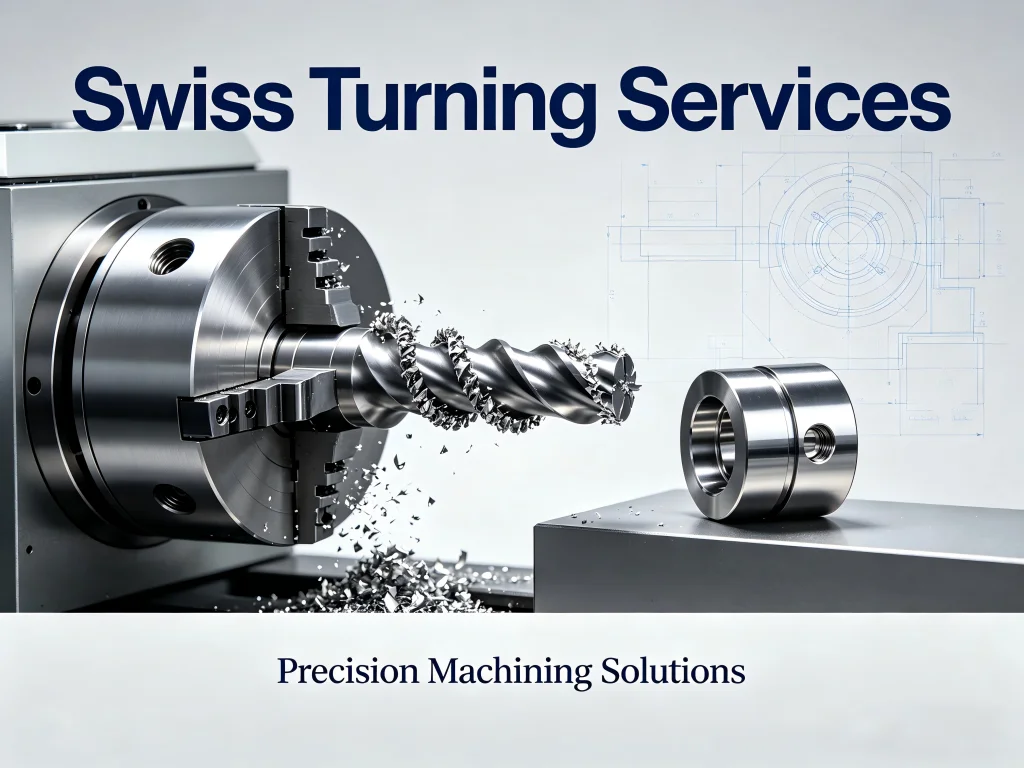
What Exactly Are Swiss Turning Services?
To define swiss turning services, one must first distinguish them from conventional lathe operations. In a standard CNC lathe, the workpiece is held firmly in a chuck and rotated while a cutting tool moves along it. This is effective for short, thick parts. However, as the part becomes longer and thinner, the pressure of the cutting tool causes the material to deflect or “push away,” leading to inaccuracies and poor surface finishes.
The swiss turning process solves this through a revolutionary design. The workpiece is held by a collet and passes through a guide bushing. The cutting tool remains fixed near the guide bushing, and the material itself moves forward (z-axis) through the bushing. Because the cutting action occurs mere millimeters from the point of support, tool pressure does not cause the part to bend. This allows for the production of extremely long parts with small diameters, often achieving tolerances as tight as +/- 0.0002 inches. This level of precision is why swissen trading firms often prioritize suppliers who utilize genuine Swiss-style machinery for their most sensitive hardware needs.
The Role of the Guide Bushing
The guide bushing is the heart of swiss turning. It acts as a primary support system, ensuring that the workpiece remains stable even when subjected to high-speed rotation and heavy cutting forces. This stability allows for higher RPMs and faster feed rates, which directly translates to improved efficiency. When discussing swissen trading & transport of high-volume components, the speed of the Swiss process becomes a significant competitive advantage, reducing the “time-to-market” for critical innovations.
Core Application Scenarios for Swiss Machining
The versatility of swiss turning services allows them to serve a wide range of industries where miniaturization and complexity are paramount. At jucheng, we have observed that the most demanding applications often fall into the following categories:
- Medical and Dental: Perhaps the most well-known application. Bone screws, dental implants, surgical needles, and various orthopedic devices require biocompatible materials like Titanium or Stainless Steel. These parts are often long and thin, making them perfect candidates for swiss turning.
- Aerospace and Defense: High-density connectors, fuel system components, and specialized fasteners must withstand extreme environments. The repeatability of Swiss machining ensures that every part in a batch of 10,000 is identical.
- Electronics and Telecommunications: As devices shrink, the pins, sockets, and connectors inside them must be smaller than ever. Swiss machines can handle parts with diameters as small as a few millimeters with ease.
- Automotive Technology: Modern fuel injectors and sensor housings benefit from the high-speed production capabilities of swiss turning services, where cost-per-part is a critical metric.
In many of these sectors, the concept of switzerland service tax or similar international logistics considerations may arise, but the inherent value of the precision provided by jucheng far outweighs the complexities of international trade. Our swiss customer service team is well-versed in navigating these global supply chain requirements to ensure seamless delivery.
Critical Selection Factors for Your Machining Partner
Choosing a provider for swiss turning services is a strategic decision that goes beyond price. When evaluating a potential partner like jucheng, several technical and operational factors should be considered to ensure the success of your project.
1. Precision and Tolerance Capabilities
The primary reason for selecting swiss turning is precision. You must verify if the shop can consistently hold the tolerances required by your blueprints. At jucheng, our equipment is calibrated to handle sub-micron adjustments, ensuring that even the most complex geometries remain within specification. This is a core component of our swiss customer care philosophy: delivering exactly what is promised.
2. Material Expertise
Not all materials behave the same way under the heat and pressure of machining. A high-quality service provider must have experience with exotic alloys, such as Inconel, Nitinol, and various grades of Titanium. Each material requires specific tooling and coolant strategies. jucheng excels in material science, providing insights that might help optimize your part for both performance and manufacturability.
3. Lead Times and Scalability
In the world of swissen trading, time is money. You should ask about the shop’s capacity. Do they have enough machines to handle a sudden surge in demand? jucheng maintains a robust fleet of Swiss CNC machines, allowing us to scale production from prototype batches to high-volume runs without compromising on delivery dates. Our swissen trading & transport network is optimized to get parts from our floor to your facility with minimal delay.
4. Quality Certifications
Certifications like ISO 9001:2015 are non-negotiable. They provide an objective benchmark for the quality management systems in place. jucheng is committed to rigorous inspection protocols, utilizing advanced CMM (Coordinate Measuring Machines) and optical gauging to verify part integrity at every stage of the swiss turning process.
Comparison: Swiss Turning vs. Conventional CNC Turning
To help you make the best decision for your project, the following table highlights the key differences between these two common machining methods:
| Feature | Swiss Turning Services | Conventional CNC Turning |
|---|---|---|
| Workpiece Support | Supported by a guide bushing near the tool. | Held in a chuck, unsupported at the far end. |
| Ideal Part Length | Excellent for long, slender parts (high L/D ratio). | Better for short, larger diameter parts. |
| Tolerance | Extreme precision (micron level). | High precision, but prone to deflection. |
| Secondary Operations | Often “done in one” with live tooling. | May require multiple setups on different machines. |
| Setup Time | Generally longer and more complex. | Faster for simple parts. |
| Best Volume | Medium to very high volume. | Low to high volume. |
As illustrated, swiss turning services are the superior choice when the complexity of the part and the length-to-diameter ratio exceed the capabilities of standard lathes. This is where jucheng truly shines, offering specialized solutions that eliminate the need for secondary grinding or finishing operations.
Installation and Maintenance: Behind the Scenes of Quality
While the end-user may only see the finished part, the reliability of swiss turning depends heavily on the maintenance of the machines. At jucheng, we follow a strict preventative maintenance schedule that ensures our machines perform with “like-new” accuracy at all times.
The Setup Phase
The installation of a new job on a Swiss machine is an art form. It involves precisely aligning the guide bushing, selecting the correct collets, and programming the synchronized movement of the headstock and the tool posts. This complex setup is why swiss customer care involves detailed consultation during the design phase—to ensure the part is optimized for the machine’s specific kinematics.
Daily Maintenance Protocols
To maintain high standards, several daily tasks are performed:
- Thermal Compensation: Machines are allowed to reach a stable operating temperature to account for metal expansion.
- Coolant Management: High-pressure oil is often used in swiss turning to clear chips and dissipate heat. This oil must be filtered and monitored constantly.
- Tool Wear Monitoring: Small tools can break or wear down quickly. Our systems use automated sensors to detect tool wear and swap for fresh inserts before a failure occurs.
By investing in these “behind-the-scenes” efforts, jucheng ensures that the swissen trading & transport of our products is never hindered by unexpected production downtimes or quality lapses. We treat our machinery with the same level of care that we treat our customers.
Why Choose Jucheng for Your Swiss Turning Needs?
In a global marketplace, jucheng distinguishes itself not just through technology, but through a holistic approach to manufacturing. Our swiss turning services are backed by decades of research and a deep commitment to the E-E-A-T (Experience, Expertise, Authoritativeness, and Trustworthiness) principles that modern industries demand.
We understand that our clients are often dealing with complex international regulations, including switzerland service tax structures or intricate swissen trading logistics. Our team acts as a partner, not just a vendor. We provide comprehensive swiss customer service that includes engineering support, material selection advice, and transparent communication throughout the production cycle.
At jucheng, we don’t just make parts; we solve problems. If you have a design that other shops have deemed “too difficult” or “too small,” our swiss turning experts may be able to find a path forward. Our facility is equipped with the latest multi-axis Swiss lathes, capable of performing milling, cross-drilling, and back-working in a single setup. This “one-and-done” capability reduces handling errors and ensures the highest possible concentricity for your components.
Frequently Asked Questions (FAQ)
1. What is the maximum diameter for swiss turning services?
Most Swiss machines are designed for smaller diameters, typically ranging from 1mm up to 32mm. However, some specialized machines can handle up to 38mm. At jucheng, we specialize in the 3mm to 25mm range, where the benefits of the guide bushing are most pronounced.
2. Why is Swiss machining more expensive for small batches?
The setup time for a swiss turning center is more involved than a standard lathe. You have to align the guide bushing and synchronize multiple axes. However, for larger volumes, the extremely fast cycle times and the ability to drop finished parts off the machine without secondary ops make it much more cost-effective in the long run.
3. How does jucheng handle international shipping and swissen trading logistics?
We have a dedicated logistics team that understands the nuances of swissen trading & transport. We work with reliable carriers to ensure that parts are packaged securely to prevent damage and are accompanied by all necessary customs documentation to minimize delays.
4. Can you machine medical-grade Titanium?
Yes, absolutely. Swiss turning is the preferred method for Titanium Grade 5 (Ti-6Al-4V) and other biocompatible materials. Our tooling and high-pressure coolant systems are specifically configured to handle the heat and toughness of Titanium.
5. What is the typical lead time at jucheng?
Lead times vary based on complexity and volume. Standard orders usually take 2-4 weeks, but we offer expedited swiss turning services for urgent prototypes. Our swiss customer service team provides regular updates so you are never in the dark about your order status.
6. Do you provide finishing services like plating or anodizing?
Yes, jucheng provides a complete solution. Through our network of vetted partners, we can manage heat treating, plating, anodizing, and laser marking, delivering a part that is ready for assembly.
7. Is there a minimum order quantity (MOQ)?
While swiss turning services are optimized for high volume, jucheng supports our clients’ growth by offering flexible MOQs. Whether you need 50 pieces for testing or 50,000 for production, we can accommodate your needs.
8. How do you ensure the precision of long, thin parts?
This is the core advantage of swiss turning. By supporting the part with a guide bushing right at the point of the cut, we eliminate deflection. Even if the part is 100mm long and only 2mm wide, it remains perfectly straight and true.
The Future of Precision with Jucheng
As industries move toward even greater miniaturization—driven by the “Internet of Things” (IoT) and robotic surgery—the importance of swiss turning services will only grow. jucheng remains at the forefront of this evolution, continuously investing in new software and hardware to push the boundaries of what is possible. Our commitment to swiss customer care ensures that as your technology advances, our machining capabilities will be right there to support you.
When you partner with jucheng, you are choosing a legacy of quality and a future of innovation. From the initial consultation to the final swissen trading & transport of your parts, we maintain a standard of excellence that reflects the high-precision heritage of the Swiss name. Let us help you turn your most ambitious designs into reality with the speed and accuracy that only professional swiss turning can provide.
Ready to Elevate Your Production?
Contact the experts at jucheng today to discuss your next project. Our engineering team is ready to provide a detailed quote and manufacturability analysis for your swiss turning services needs.
Email: info@jccncmachining.com
Website: www.jccncmachining.com