
Engineering teams in the aerospace, medical, and high-performance automotive sectors frequently encounter a paradox. They require the exceptional strength-to-weight ratio and corrosion resistance of titanium, yet these very properties make the material a nightmare to process using conventional cutting tools. Traditional CNC milling often results in rapid tool wear, work hardening, and thermal distortion. This is where titanium wire edm emerges as the definitive solution. By utilizing electrical sparks rather than mechanical force, this process allows manufacturers to navigate the complexities of titanium with surgical precision. At Jucheng, we have observed a growing trend among engineers who ask, can titanium be wire edm processed without compromising its structural integrity? The answer is a resounding yes, provided the operator understands the unique metallurgical interactions involved.
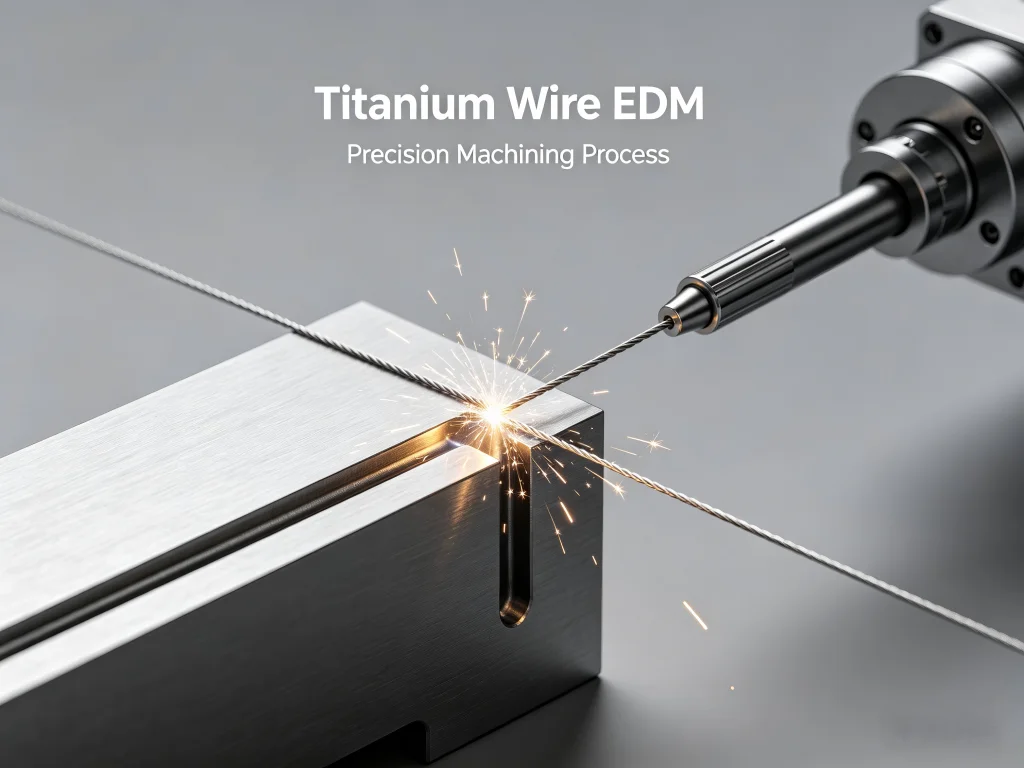
Understanding the Mechanics: What is Titanium Wire EDM?
To appreciate why titanium wire edm is the preferred method for complex geometries, one must first understand the underlying physics of Electrical Discharge Machining. Unlike a lathe or a mill that uses a hardened bit to physically peel away material, wire EDM uses a thin copper or brass wire—often thinner than a human hair—to act as an electrode. This wire never actually touches the titanium workpiece. Instead, a controlled series of electrical discharges, or sparks, occur in a dielectric fluid environment.
When the spark jumps the gap, it creates a localized plasma zone reaching temperatures upward of 8,000 to 12,000 degrees Celsius. This microscopic explosion melts and vaporizes a tiny portion of the titanium. The dielectric fluid then flushes the debris away, and the wire moves to the next position. Because there is no physical contact, the process eliminates the cutting forces that lead to vibration and tool deflection. Many technicians on forums like Reddit’s r/Machining often highlight that titanium wire cut services are the only way to achieve tolerances within +/- 0.002mm on deep, narrow slots that would otherwise snap a traditional end mill.
Furthermore, when discussing titanium wiring or intricate electrical components made of titanium, the EDM process ensures that the conductivity and mechanical properties are preserved. Because the Heat Affected Zone (HAZ) is remarkably shallow in a well-tuned EDM setup, the bulk material retains its fatigue resistance, which is critical for aerospace fasteners and medical bone plates.
The Solution to Common Titanium Machining Challenges
Why do industry leaders migrate toward titanium wire edm? The primary reason lies in the material’s “gummy” nature during traditional machining. Titanium tends to stick to cutting tools, leading to built-up edge (BUE) and catastrophic tool failure. If you have ever wondered, can you edm titanium for high-volume production, the answer depends on the complexity of the part. For simple blocks, milling might be faster; however, for intricate profiles, EDM is more cost-effective because it eliminates the need for expensive, specialized cutters and frequent tool changes.
Consider the challenge of manufacturing a titanium tube malaysia based project or a subsea sensor housing. These parts often require thin walls and deep internal geometries. Conventional machining would exert too much pressure, causing the thin walls to deform. Titanium wire edm solves this by applying zero mechanical pressure. The dielectric fluid also acts as a constant coolant, preventing the localized overheating that can lead to the formation of the brittle “alpha case” layer on the titanium surface. By maintaining a stable temperature, Jucheng ensures that every titanium wire cut component meets the rigorous metallurgical standards required by international certification bodies.
Key Applications Across Global Industries
The versatility of titanium wire edm allows it to serve niche markets that demand extreme reliability. In the medical field, for instance, orthopedic implants must be biocompatible and perfectly contoured to human anatomy. Wire EDM allows for the creation of porous structures and custom shapes that promote osseointegration.
- Aerospace Components: Turbine blades, fuel system manifolds, and structural brackets where weight reduction is mandatory.
- Medical Implants: Custom hip joints, spinal cages, and dental abutments that require microscopic precision.
- Subsea and Marine: High-pressure housings and sensors that must withstand salt-water corrosion while maintaining tight seals.
- High-End Automotive: Valve train components and connecting rods for Formula 1 or endurance racing engines.
For those sourcing specialized components like a titanium tube malaysia or high-precision connectors in Southeast Asia, the integration of titanium wire edm into the supply chain has been a game-changer. It allows local manufacturers to compete on a global scale by offering parts that were previously only obtainable from a handful of high-end European or American labs.
Critical Factors When Selecting a Wire EDM Partner
Choosing a provider for titanium wire edm is not merely about finding the lowest price. Titanium is an expensive raw material, and a single mistake during the EDM process can lead to costly scrap. When evaluating a partner like Jucheng, you should consider the following technical parameters:
| Factor | Impact on Quality | Jucheng Standard |
|---|---|---|
| Positioning Accuracy | Determines the final dimensional tolerance of the part. | Up to ±0.002 mm |
| Surface Roughness (Ra) | Critical for fatigue life and medical biocompatibility. | 0.1 μm Ra possible with skim cuts |
| Recast Layer Control | Minimizes the brittle layer formed by the EDM sparks. | Optimized pulse settings for minimal HAZ |
| Wire Material Choice | Affects cutting speed and prevents zinc contamination. | High-grade coated wires available |
| Lead Time | Essential for R&D and rapid prototyping cycles. | 7-10 days for standard custom orders |
A frequent discussion point on Facebook engineering groups involves the “recast layer.” This is the thin layer of material that re-solidifies on the surface after being melted by the spark. For titanium wire cut parts used in aerospace, this layer may need to be minimized or removed through secondary polishing. A high-tier provider like Jucheng utilizes advanced multi-pass “skim” cycles to practically eliminate this layer, ensuring the part is ready for mission-critical use.
Installation, Setup, and Maintenance of EDM Equipment
While most clients outsource their titanium wire edm needs, understanding the maintenance involved helps in appreciating the value of the service. Operating a wire EDM machine at peak performance requires a pristine environment. The dielectric fluid—usually deionized water—must be constantly filtered to remove titanium particles. If these particles accumulate, they can cause “DC arcs,” which damage the workpiece.
The titanium wiring and power delivery systems within the machine also require calibration. Titanium is less conductive than aluminum or copper, meaning the generator settings must be precisely tuned to prevent the wire from snapping. At Jucheng, our maintenance protocols include daily conductivity checks of the water and weekly alignment of the diamond wire guides. This level of rigor ensures that every titanium wire cut we perform is as accurate as the first.
Why Jucheng is the Leader in Titanium Wire EDM
Jucheng (https://www.jccncmachining.com/) is not just a machine shop; we are a dedicated research and application center for advanced CNC technologies. Our expertise in titanium wire edm stems from years of handling Grade 5 (Ti-6Al-4V) and Grade 23 (ELI) materials for the world’s most demanding industries. We understand that when a client asks can you edm titanium, they are looking for a partner who understands the material’s nuances.
Our facility is equipped with state-of-the-art Swiss and Japanese EDM machines that offer unparalleled stability. Furthermore, our engineering team provides DFM (Design for Manufacturing) feedback, helping you optimize your titanium wire cut designs to reduce costs without sacrificing performance. Whether you are developing a titanium tube malaysia based infrastructure project or a micro-electronic component, Jucheng offers the technical depth to bring your vision to life. We hold various ISO certifications, ensuring that our quality management systems meet the highest international benchmarks.
Frequently Asked Questions About Titanium Wire EDM
1. Can titanium be wire edm processed without losing its strength?
Yes, titanium wire edm is a thermal process, but the heat is extremely localized. By using advanced power settings and multiple skim cuts, the core mechanical properties of the titanium remain unchanged. It is often safer for the material’s integrity than heavy milling, which can introduce significant residual stress.
2. Is wire EDM more expensive than CNC milling for titanium?
For simple shapes, milling might be cheaper. However, for complex geometries, thin walls, or very hard grades of titanium, titanium wire edm becomes more cost-effective. It eliminates the cost of broken drill bits and end mills, which are common when working with titanium.
3. What is the typical surface finish of a titanium wire cut part?
A standard single-pass cut produces a functional finish, but with multiple skim passes, we can achieve a mirror-like finish with an Ra of 0.1 μm. This is often required for medical implants and high-vacuum components.
4. Does wire EDM leave any contamination on the titanium?
Because the process often uses brass or copper wire, there can be trace amounts of these elements left in the recast layer. For critical medical or aerospace applications, Jucheng uses specialized “clean” settings and secondary chemical etching or mechanical polishing to ensure 100% purity of the titanium wiring or surface.
5. Can you perform EDM on a titanium tube malaysia sourced material?
Absolutely. We can process titanium sourced from any reputable global supplier. Wire EDM is particularly effective for cutting precise profiles or holes into titanium tube malaysia stock without causing the tube to collapse or vibrate during the cut.
6. What are the size limitations for titanium wire edm?
While the wire itself is small, the machines can handle workpieces weighing several hundred kilograms. The primary limitation is the X-Y travel of the machine and the Z-axis height. Most of our projects fit within a 400mm x 300mm x 250mm envelope.
7. How does Jucheng ensure the precision of complex titanium parts?
We use high-resolution glass scales and laser-calibrated axes. Additionally, our climate-controlled facility prevents thermal expansion of the machine or the titanium, which is vital for maintaining micron-level accuracy.
Optimizing Your Next Project with Jucheng
The transition from traditional manufacturing to titanium wire edm represents a significant leap in capability. By removing the constraints of mechanical cutting tools, you may explore geometries that were once considered impossible. If you are currently struggling with tool breakage, long lead times, or inconsistent quality in your titanium components, it is time to consult with the experts at Jucheng. We may provide the technical bridge between a difficult design and a perfected product. Visit Jucheng CNC Machining today to request a quote and discover how our titanium wire cut expertise can elevate your engineering standards.