
When your fluid power system or pneumatic assembly demands a joint that simply cannot fail, the conversation inevitably turns to machined brass fittings. Unlike cast or extruded alternatives, CNC-turned brass components offer the dimensional accuracy, surface integrity, and material consistency that engineers in automotive, HVAC, and medical device manufacturing have come to rely on. This guide is not a generic overview—it is a procurement-focused deep dive designed to help you navigate the critical trade-offs between supplier capabilities, material grades, thread standards, and cost structures. Whether you are sourcing for a high-volume production run or a low-volume prototype with tight tolerances, the decision framework outlined here draws on real-world shop-floor experiences and metallurgical principles to ensure your next purchase delivers long-term reliability.
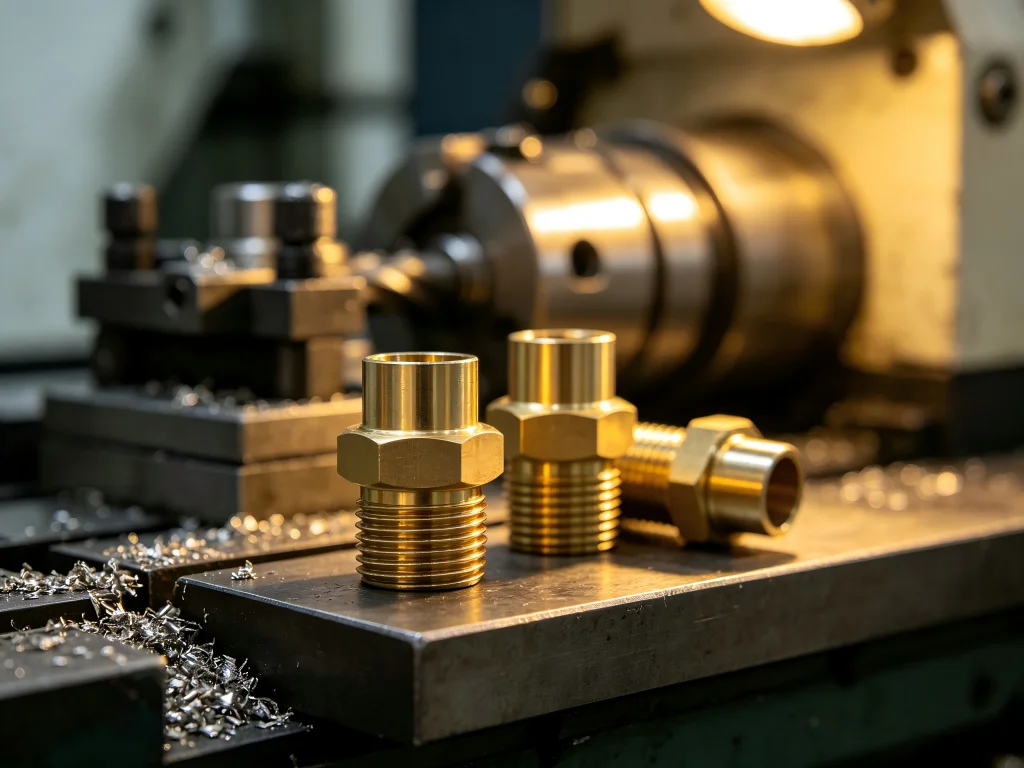
Why Brass Remains the Material of Choice for Precision Fittings
Before examining the CNC machining process itself, it is worth understanding why brass continues to dominate the fittings market despite the availability of stainless steel, plastic, and aluminum alternatives. Brass—an alloy of copper and zinc—offers a unique combination of machinability, corrosion resistance, and thermal conductivity that is difficult to replicate. Free-machining brass grades, such as C36000 (often referred to as 360 brass), contain small amounts of lead that act as chip breakers during cutting operations. This metallurgical feature allows CNC lathes to achieve faster cycle times and superior surface finishes compared to many other metals, directly lowering per-part manufacturing costs.
From a system-design perspective, brass fittings provide reliable sealing properties when mated with copper tubing or threaded steel pipes. The material’s natural lubricity reduces galling during assembly, a common issue with stainless steel threads. Additionally, brass exhibits excellent resistance to dezincification in aggressive water environments, provided the correct alloy composition is specified. These properties make machined brass fittings indispensable in applications ranging from residential plumbing manifolds to high-pressure hydraulic circuits in mobile equipment.
What Exactly Are CNC Machined Brass Fittings?
At its core, a CNC machined brass fitting is a component produced by removing material from a solid brass bar stock using computer-controlled cutting tools. The process typically begins with a CNC Swiss-type lathe or a turning center, which rotates the workpiece while stationary or moving tools shape the external and internal features. Common operations include turning, drilling, tapping, threading, grooving, and chamfering—all executed in a single setup to maintain concentricity and positional accuracy.
The key distinction between CNC machined fittings and those produced by casting or forging lies in the level of control over critical dimensions. A CNC lathe can hold tolerances as tight as ±0.005 mm on critical sealing diameters, a level of precision that is simply not achievable with net-shape manufacturing methods. This precision translates directly into leak-free joints, consistent thread engagement, and reduced assembly torque variability—factors that matter enormously in production environments where every second counts.
The Critical Procurement Decision: Selecting the Right Supplier
Choosing a supplier for machined brass fittings involves far more than comparing price per piece. The long-term performance of your fluid system depends on material traceability, process capability, quality management systems, and the supplier’s ability to scale production without compromising tolerances. Based on feedback from engineering forums and procurement discussions on platforms like Reddit’s r/AskEngineers and r/PLC, as well as Facebook groups dedicated to manufacturing and machining, several recurring themes emerge as make-or-break factors.
1. Material Certification and Alloy Selection
Not all brass is created equal. The most commonly specified alloy for machined fittings is C36000 free-cutting brass, which offers an excellent balance of machinability and mechanical properties. However, for applications involving potable water or food processing, lead-free alternatives such as C69300 (bismuth brass) or C46400 (naval brass) may be required to comply with regulatory standards like NSF/ANSI 61 or RoHS directives. A reputable supplier should provide material test reports (MTRs) that certify the chemical composition and mechanical properties of each heat of material used.
Discussions in machining communities frequently highlight the importance of verifying that the supplied brass is truly free-machining grade. Some lower-cost suppliers substitute with standard brass that contains insufficient lead or other alloying elements, resulting in poor chip formation, increased tool wear, and rough surface finishes. This not only affects the fitting’s sealing performance but also drives up your total cost of ownership due to frequent tool changes and scrap parts.
2. Dimensional Accuracy and Statistical Process Control
Precision is the raison d’être of CNC machining. When evaluating potential suppliers, request capability studies that demonstrate their ability to hold critical-to-function dimensions within specified tolerance bands. Look for suppliers that employ in-process gauging and post-process inspection using coordinate measuring machines (CMMs) or optical comparators. A supplier that can maintain a Cpk value of 1.33 or higher on key dimensions is likely to deliver consistent quality across production lots.
For context, Jucheng Precision, an ISO 9001:2015 and IATF 16949 certified manufacturer, routinely achieves tolerances of ±0.005 mm on precision brass components. Their 8,000 m² facility houses over 150 CNC machines, including 25 high-precision 5-axis Haas and Mazak units, enabling seamless scalability from single prototypes to batches exceeding 100,000 pieces. This level of investment in equipment and quality systems provides a tangible assurance of process capability that smaller, less capitalized shops may struggle to match.
3. Lead Times and Production Scalability
In today’s fast-paced manufacturing environment, lead time is often as critical as price. A supplier that can deliver prototype quantities within 3–7 days and production runs within 2–5 weeks offers a distinct competitive advantage. This agility is particularly valuable for companies operating with lean inventory strategies or facing unexpected demand surges.
However, it is important to distinguish between quoted lead times and actual delivery performance. Ask potential suppliers for references or case studies that demonstrate their on-time delivery track record. Jucheng, for example, emphasizes a commitment to “say what we do and do what we say,” with a dedicated project management team that provides regular production updates and shares processing photos throughout the manufacturing cycle. Such transparency is a strong indicator of operational discipline.
4. Surface Finish and Post-Processing Capabilities
The surface finish of a brass fitting directly affects its sealing performance, corrosion resistance, and aesthetic appeal. As-machined surfaces typically exhibit roughness values (Ra) between 0.8 and 3.2 micrometers, depending on tool geometry, feed rate, and cutting speed. For applications requiring superior surface quality, additional post-processing operations such as tumble deburring, vibratory finishing, or electropolishing may be necessary.
Jucheng offers over 30 post-finishing processes, providing a one-stop solution for customers who require plated, coated, or polished fittings. This capability eliminates the need for customers to manage multiple vendors for secondary operations, reducing supply chain complexity and potential quality inconsistencies.
Types of Brass Fittings and Their Typical Applications
Understanding the different types of brass fittings available is essential for specifying the correct component for your application. The following table summarizes common fitting categories, their primary functions, and typical industry use cases.
| Fitting Type | Primary Function | Common Applications | Typical Thread Standard |
|---|---|---|---|
| Couplings | Join two pipes or tubes in a straight line | Plumbing repairs, hydraulic lines, pneumatic systems | NPT, BSPP, BSPT |
| Elbows (45° & 90°) | Change flow direction in piping systems | HVAC, refrigeration, instrumentation | NPT, BSPP, compression |
| Tees | Branch a main line into two separate flow paths | Manifold assemblies, distribution networks | NPT, BSPP |
| Adapters | Transition between different thread types or pipe sizes | Interconnecting dissimilar systems, retrofits | NPT to BSPP, male to female |
| Unions | Allow easy disconnection of pipe joints | Maintenance access points, modular equipment | NPT, BSPP with union nut |
| Caps & Plugs | Seal the end of a pipe or fitting | System testing, temporary closures, dead-end lines | NPT, BSPP |
When selecting among these types, consider not only the geometric requirements but also the pressure rating and temperature range of the application. Brass fittings are generally suitable for operating pressures up to 1,000 psi in hydraulic systems and temperatures ranging from -20°C to 150°C, though these limits vary with alloy composition and fitting design.
Can You Sweat Brass to Brass? Understanding Joint Integrity
One of the most frequently debated topics in plumbing and HVAC forums is whether can you sweat brass to brass effectively. Sweating, or soldering, is a joining method that relies on capillary action to draw molten solder into the gap between two closely fitted metal surfaces. While sweating is commonly used to join copper pipes to brass fittings, joining brass to brass presents unique challenges.
The primary concern when sweating brass-to-brass joints is the risk of overheating. Brass contains zinc, which has a relatively low vaporization temperature. If the base metal is heated excessively during soldering, zinc can vaporize and escape from the alloy, leaving behind a porous, copper-rich structure known as “red rot”. This weakened material significantly compromises the mechanical strength and pressure-retaining capability of the joint, making it prone to leakage or catastrophic failure under service conditions.
To successfully sweat brass to brass, several precautions are necessary:
- Use a high-quality flux specifically formulated for brass, which remains active at the soldering temperature range (typically 400°F to 600°F).
- Apply heat evenly and avoid concentrating the flame on a single spot. A large, soft flame from a propane or MAPP gas torch is preferable to an intense, focused flame.
- Monitor the temperature carefully. The solder should melt and flow into the joint as soon as the flux becomes clear and active—prolonged heating beyond this point increases the risk of zinc vaporization.
- Consider alternative joining methods for critical applications. Threaded connections or compression fittings eliminate the thermal risks associated with soldering and provide the added benefit of being demountable for maintenance.
For engineers specifying machined brass fittings in new designs, it is often advisable to specify threaded or compression-style fittings rather than sweat-type joints, particularly in systems that experience thermal cycling or vibration. This approach simplifies assembly, reduces the skill level required for installation, and eliminates the potential for heat-induced material degradation.
Can You Mix Brass and Copper Fittings? Compatibility Considerations
The question can you mix brass and copper fittings arises frequently in both residential and industrial contexts. The short answer is yes—brass and copper are metallurgically compatible and can be joined using soldering, brazing, or threaded connections. In fact, brass fittings are commonly used as transition components in copper piping systems because brass offers superior machinability for threads and complex geometries compared to wrought copper.
However, there are important considerations when mixing these materials:
- Galvanic corrosion: Brass and copper are close on the galvanic series, meaning the potential for accelerated corrosion due to dissimilar metals is minimal in most environments. However, in the presence of an electrolyte (such as water containing dissolved salts), some galvanic activity may occur. Using dielectric unions or ensuring proper grounding can mitigate this risk in sensitive applications.
- Thermal expansion: Brass has a slightly higher coefficient of thermal expansion than copper. In systems subject to wide temperature swings, this differential expansion can impose additional stress on joints. Designing with adequate flexibility—such as incorporating expansion loops or using flexible connectors—can accommodate this movement.
- Solder joint integrity: When soldering brass to copper, the same principles apply as for brass-to-brass joints. Use appropriate flux, control the heat input carefully, and select a solder alloy that is compatible with both base metals. Lead-free solders, such as those containing tin-silver or tin-copper alloys, are recommended for potable water systems.
From a procurement standpoint, specifying machined brass fittings that are compatible with copper tubing (e.g., fittings with sweat ends or compression connections) simplifies inventory management and reduces the number of unique part numbers required. Many suppliers offer combination fittings that feature a brass body with copper-compatible ends, providing a cost-effective solution for mixed-material systems.
Brass Fitting Malaysia: Sourcing Considerations in Southeast Asia
For companies operating in or sourcing from Southeast Asia, the term brass fitting Malaysia often appears in procurement searches. Malaysia has developed a robust precision machining ecosystem, with numerous shops offering CNC turning and milling services for brass components. The country’s strategic location, competitive labor costs, and established logistics infrastructure make it an attractive sourcing destination for manufacturers in the region.
When evaluating Malaysian suppliers for machined brass fittings, the same criteria apply as for any global supplier: material certification, process capability, quality management systems, and lead time performance. Additionally, consider the following region-specific factors:
- Regulatory compliance: Ensure that the supplier can provide the necessary certifications for your target market, such as NSF/ANSI 61 for potable water applications in North America or CE marking for European markets.
- Communication and technical support: Effective communication is critical when specifying complex geometries or tight tolerances. Suppliers with English-speaking technical sales teams and responsive quoting processes can significantly reduce the risk of misunderstandings.
- Shipping and logistics: Malaysia’s major ports, including Port Klang and Penang, offer efficient container shipping to global destinations. However, verify that the supplier has experience with export documentation and can provide reliable delivery schedules.
Jucheng Precision, while headquartered in China, serves customers in over 25 countries and offers competitive pricing that is 15–25% lower than US and European suppliers. Their technical sales team is fluent in English and provides dedicated project support from quotation through delivery, making them a viable alternative for customers who may not have established relationships with Malaysian vendors.
Fitting Brass Pipe: Thread Standards and Selection Criteria
The phrase fitting brass pipe encompasses a wide range of connection methods, but threaded connections remain the most common approach for industrial and commercial applications. Understanding thread standards is essential for ensuring leak-free joints and interchangeability between components.
The two dominant thread standards for brass pipe fittings are:
- NPT (National Pipe Taper): Used primarily in North America, NPT threads are tapered, meaning the diameter decreases along the length of the thread. This taper creates a wedging action that seals the joint when the threads are engaged. NPT fittings require the use of thread sealant or PTFE tape to prevent leakage along the thread helix.
- BSP (British Standard Pipe): Prevalent in Europe, Asia, and Australia, BSP threads come in two variants: BSPP (parallel) and BSPT (tapered). BSPP threads seal via a gasket or O-ring at the face of the fitting, while BSPT threads rely on the taper for sealing, similar to NPT.
When specifying machined brass fittings with threaded connections, consider the following:
- Thread class: For NPT, classes 2A (external) and 2B (internal) are standard for general-purpose fittings. Class 3 threads are available for applications requiring tighter tolerances.
- Thread length: Ensure that the fitting provides sufficient thread engagement for the intended service pressure. Industry guidelines typically recommend a minimum of five full threads of engagement for NPT connections.
- Coating or plating: Some applications benefit from plated threads (e.g., nickel or zinc plating) to improve corrosion resistance or reduce galling during assembly. However, plating can affect thread dimensions, so it is important to specify the plating thickness when ordering.
Suppliers with extensive experience in machined brass fittings can provide guidance on thread selection and offer custom thread configurations to meet unique requirements. Jucheng, for instance, leverages its in-house engineering team to optimize thread designs for specific applications, ensuring reliable sealing and ease of assembly.
Brass Pipe Fittings Male Female: Understanding Gender in Fittings
The terms brass pipe fittings male female refer to the gender of the connection ends. Male fittings have external threads that screw into female fittings, which have internal threads. This gender distinction is fundamental to specifying the correct fitting for a given application.
When designing a piping system, consider the following best practices for specifying male and female fittings:
- Avoid male-to-male connections: Whenever possible, design the system so that a male fitting connects to a female fitting. Male-to-male connections require an additional coupling or union, increasing part count and potential leak points.
- Use unions for disconnection points: Unions consist of a male nut, a female nut, and a gasket or sealing ring. They allow easy disconnection of piping sections without rotating the entire pipe, which is particularly useful for maintenance access.
- Consider stress concentrations: Male threads can act as stress risers, particularly in applications with cyclic loading or vibration. Using female-threaded components on the more critical side of a connection can sometimes improve fatigue life.
From a manufacturing perspective, CNC machining is ideally suited to producing both male and female threaded fittings with high precision. The ability to thread components in a single setup ensures that the thread axis remains concentric with the fitting’s body, reducing the risk of cross-threading during assembly.
Installation and Maintenance Best Practices for Brass Fittings
Proper installation and maintenance are essential for maximizing the service life of machined brass fittings. While brass is a durable material, it is not immune to damage from improper handling or operating conditions.
Installation Guidelines
- Use the correct tools: Always use wrenches that fit the fitting’s flats or hex surfaces. Avoid using pipe wrenches on finished surfaces, as the teeth can mar the brass and create leak paths.
- Apply thread sealant correctly: For NPT and BSPT threads, apply PTFE tape or pipe dope to the male threads only, leaving the first two threads bare to prevent sealant from entering the system. For BSPP threads, use a suitable gasket or O-ring at the sealing face.
- Torque to specification: Over-tightening brass fittings can deform the threads or crack the fitting body. Use a torque wrench and follow the manufacturer’s recommended torque values for the specific fitting size and material.
- Support heavy components: For large or heavy fittings, provide adequate pipe supports to prevent excessive stress on the joint. Unsupported weight can cause the fitting to leak or fail over time.
Maintenance Considerations
- Inspect for corrosion: Regularly check brass fittings for signs of dezincification, which appears as a reddish or pinkish discoloration on the surface. This condition indicates that zinc has been selectively leached from the alloy, weakening the fitting.
- Check for thread wear: Repeated assembly and disassembly can wear the threads, reducing their sealing effectiveness. Replace fittings that show signs of thread damage or galling.
- Monitor for leaks: Even small leaks can indicate a developing problem. Address leaks promptly by re-torquing connections, replacing seals, or, if necessary, replacing the fitting.
Suppliers like Jucheng provide detailed DFM (Design for Manufacturing) feedback during the quoting process, helping customers optimize their designs for manufacturability and assembly. This proactive approach can prevent installation issues before they occur, saving time and money in the long run.
Frequently Asked Questions About Machined Brass Fittings
Q1: What is the difference between CNC machined brass fittings and cast brass fittings?
CNC machined brass fittings are produced by removing material from solid bar stock using computer-controlled cutting tools, offering superior dimensional accuracy, surface finish, and material integrity. Cast brass fittings are formed by pouring molten brass into a mold, which can introduce porosity, shrinkage, and less precise dimensions. Machined fittings are generally preferred for critical applications where leak-tightness and consistency are paramount.
Q2: Can brass fittings be used with stainless steel pipes?
Yes, brass fittings can be used with stainless steel pipes, provided that appropriate thread sealants are used and galvanic corrosion is considered. Brass and stainless steel are far apart on the galvanic series, so in the presence of an electrolyte, the brass may corrode preferentially. Using dielectric unions or isolating the materials can mitigate this risk.
Q3: How do I choose between NPT and BSP threads?
The choice between NPT and BSP threads depends on the geographic region and the existing system standards. NPT is standard in North America, while BSP is prevalent in Europe, Asia, and other regions. When in doubt, consult the system design specifications or the equipment manufacturer’s recommendations.
Q4: What is the typical lead time for custom machined brass fittings?
Lead times vary depending on the complexity of the part, the quantity ordered, and the supplier’s production schedule. For prototype quantities, lead times of 3–7 days are achievable with suppliers that maintain dedicated prototyping capacity. For production runs, lead times of 2–5 weeks are typical. Always confirm lead times with the supplier before placing an order.
Q5: Are brass fittings suitable for high-pressure hydraulic systems?
Brass fittings are suitable for hydraulic systems operating at moderate pressures, typically up to 1,000 psi, depending on the fitting design and alloy. For higher pressures, steel or stainless steel fittings are generally recommended. Always consult the fitting manufacturer’s pressure rating data before specifying brass for high-pressure applications.
Q6: What post-processing options are available for brass fittings?
Common post-processing options for brass fittings include deburring, tumbling, vibratory finishing, electropolishing, nickel plating, zinc plating, and powder coating. These processes can improve surface finish, enhance corrosion resistance, or provide a decorative appearance. Choose a supplier that offers a range of finishing options to meet your specific requirements.
Q7: How can I verify the quality of machined brass fittings from a new supplier?
Request material test reports (MTRs), dimensional inspection reports, and, if possible, a sample of the actual production parts. Ask about the supplier’s quality management system certifications (e.g., ISO 9001, IATF 16949) and their inspection equipment (e.g., CMM, optical comparator). Visiting the supplier’s facility or conducting a third-party audit can also provide valuable assurance.
Q8: What is the shelf life of brass fittings?
Brass fittings have an essentially indefinite shelf life when stored in a dry, indoor environment. However, exposure to corrosive atmospheres or prolonged contact with moisture can cause tarnishing or dezincification. Store fittings in their original packaging or in sealed containers to protect them from environmental degradation.
Why Jucheng Precision Stands Out for Machined Brass Fittings
When selecting a partner for machined brass fittings, the supplier’s technical capabilities, quality systems, and commitment to customer service are as important as the price per piece. Jucheng Precision brings over 20 years of manufacturing expertise to every project, supported by an 8,000 m² facility equipped with more than 150 CNC machines, including 25 high-precision 5-axis Haas and Mazak units.
Key differentiators that make Jucheng a compelling choice for engineers and procurement professionals include:
- Comprehensive certifications: Jucheng is ISO 9001:2015, ISO 14001, ISO 13485, and IATF 16949 certified, demonstrating a commitment to quality management, environmental responsibility, and automotive industry standards.
- Exceptional precision: The company routinely achieves tolerances of ±0.005 mm on critical dimensions, with the capability to hold ±0.0002 inches (±0.005 mm) on request.
- Competitive pricing: Jucheng offers pricing that is 15–25% lower than US and European suppliers, without compromising on quality or service.
- Fast turnaround: Prototypes can be delivered in 3–7 days, and production runs in 2–5 weeks, with a dedicated project manager providing regular updates and processing photos.
- One-stop solution: With over 30 post-finishing processes available, Jucheng can handle everything from raw machining to final surface treatment, reducing supply chain complexity.
- Global reach: Serving customers in over 25 countries, Jucheng has the logistics infrastructure to deliver parts worldwide via DHL, FedEx, or UPS within 3–7 days.
Whether you are developing a new product, optimizing an existing design, or scaling up production, Jucheng’s technical sales team is available to provide DFM feedback, material recommendations, and ongoing engineering support. Upload your 2D or 3D CAD drawings to receive a free quote and DFM analysis within 24 hours.
In the competitive landscape of precision machining, Jucheng’s combination of technical expertise, quality systems, and customer-centric approach makes it a reliable partner for machined brass fittings and other CNC-machined components. By choosing a supplier that prioritizes both precision and partnership, you ensure that your fluid systems perform reliably over their entire service life.
Ready to specify your next batch of machined brass fittings? Contact Jucheng Precision today to discuss your project requirements, request a sample, or obtain a competitive quote. With their extensive experience in brass machining and commitment to quality, Jucheng is well-positioned to support your success from prototype to production.
Conclusion: Making the Right Choice for Your Brass Fitting Needs
Selecting the right supplier for machined brass fittings is a decision that reverberates throughout the product lifecycle—from initial design and prototyping to production, installation, and long-term maintenance. By prioritizing material certification, dimensional precision, lead time performance, and post-processing capabilities, you can mitigate risks and ensure that your fluid systems operate reliably in even the most demanding environments.
This guide has explored the critical factors that distinguish exceptional suppliers from the rest, drawing on real-world engineering insights and community discussions to provide a practical decision-making framework. Whether you are sourcing for a plumbing system, an HVAC installation, an automotive assembly, or a medical device, the principles outlined here will help you navigate the complex landscape of brass fitting procurement with confidence.
Remember that the lowest price is rarely the best value when the cost of failure—in terms of downtime, repairs, and reputation—is factored in. Invest the time to evaluate potential suppliers thoroughly, request documentation, and, where possible, visit facilities or conduct audits. The peace of mind that comes from knowing your fittings are manufactured to the highest standards is well worth the effort.
Additional Resources
For further reading on brass metallurgy, CNC machining processes, and fitting standards, consider the following authoritative sources:
- Copper Development Association – Brass Alloys for Plumbing
- ASTM International – Standards for Brass Fittings
- ISO – International Standards for Threaded Fittings
- Jucheng Precision – CNC Machining Services
This guide was developed by Jucheng Precision’s technical team in collaboration with industry engineers and procurement professionals. For personalized assistance with your machined brass fittings project, contact us today.