
Когда вам нужны цилиндрические компоненты с исключительной круглостью и качеством поверхности, услуги бесцентрового шлифования предлагают решение для механической обработки, которое обычные методы просто не могут обеспечить. В отличие от традиционного круглого шлифования, требующего установки заготовки между центрами, при бесцентровом шлифовании деталь удерживается между шлифовальным кругом и ведущим кругом с опорой на опорный нож. Такая уникальная конфигурация позволяет производителям достигать допусков по диаметру вплоть до ±0,0001 дюйма, сохраняя при этом высокие скорости серийного производства. Независимо от того, закупаете ли вы автомобильные валы, медицинские направляющие проволоки или компоненты шасси для аэрокосмической отрасли, понимание этого процесса может значительно улучшить качество вашей продукции и снизить стоимость на деталь.
В этом подробном руководстве мы рассмотрим всё, что вам нужно знать о бесцентровом шлифовании — от принципов его работы и промышленного применения до выбора надёжного поставщика услуг и поддержания долгосрочной стабильности качества. Мы также использовали сведения из реальных обсуждений на Practical Machinist, отраслевых публикаций и ведущих поставщиков, таких как Boston Centerless и Jucheng Precision чтобы это руководство отражало реальные условия цеха, а не только теорию из учебников.
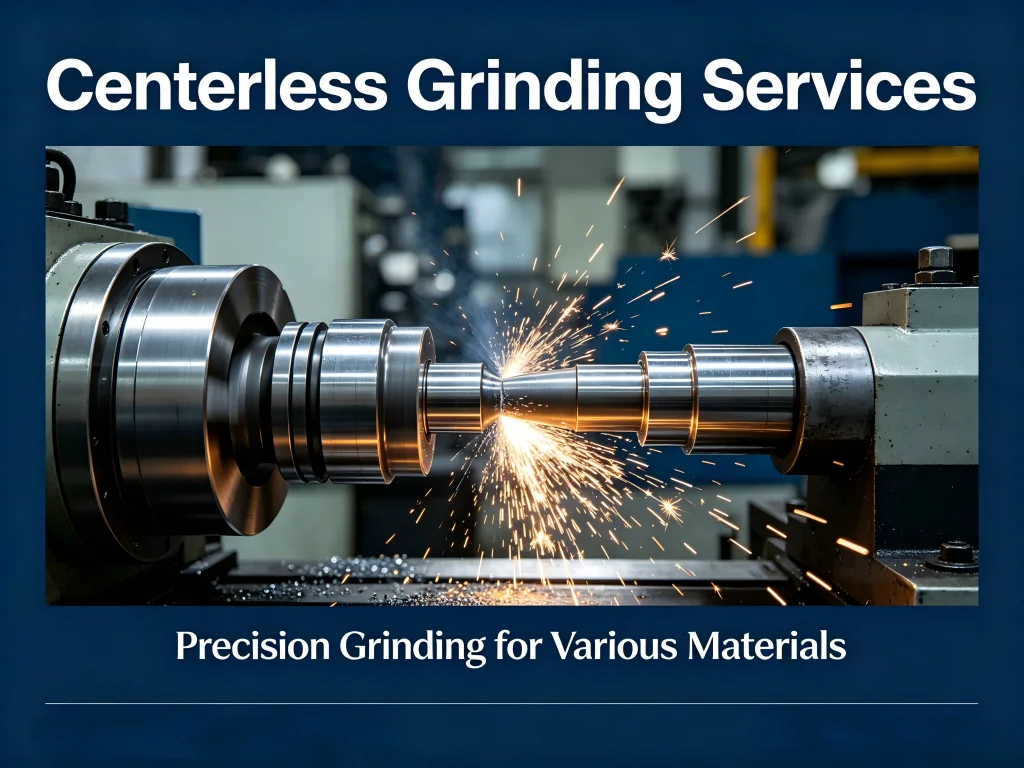
Содержание
- Часть 1: Понимание бесцентрового шлифования — определение, принципы работы и типы
- Часть 2: Почему стоит выбрать бесцентровое шлифование? Ключевые преимущества и ограничения
- Часть 3: Основные промышленные применения — где бесцентровое шлифование превосходит другие методы
- Часть 4: Ключевые факторы при выборе услуг бесцентрового шлифования
- Часть 5: Лучшие практики по установке, настройке и техническому обслуживанию
- Часть 6: Техническое сравнение – бесцентровое шлифование против круглого шлифования
- Часть 7: Часто задаваемые вопросы (FAQ)
- Часть 8: Почему Jucheng Precision обеспечивает превосходство в бесцентровом шлифовании
- Часть 9: Заключительные мысли – принятие правильного решения для вашего проекта
Часть 1: Понимание бесцентрового шлифования — определение, принципы работы и типы
Прежде чем углубляться в области применения и выбор поставщика, необходимо заложить прочную основу. Услуги бесцентрового шлифования относятся к процессу обработки наружного диаметра (OD), при котором материал удаляется с цилиндрической заготовки без использования центров или патронов для фиксации детали. Вместо этого заготовка опирается на опорный нож и располагается между двумя вращающимися кругами — высокоскоростным шлифовальным кругом, который удаляет материал, и более медленным ведущим кругом, который управляет вращением и подачей заготовки.
Эта, казалось бы, простая конфигурация обеспечивает исключительную точность, поскольку заготовка непрерывно поддерживается по всей своей длине. Любая погрешность центрирования — которая обычно свойственна традиционным методам — устраняется, а естественный эффект округления геометрии трёхточечного контакта фактически улучшает круглость по мере шлифования.
Как работает бесцентровое шлифование – шаг за шагом
- Размещение заготовки – Цилиндрическая деталь укладывается на опорный нож между шлифовальным и ведущим кругами.
- Вращение и подача – Ведущий круг вращается и приводит в движение заготовку. Шлифовальный круг вращается с гораздо более высокой скоростью для снятия материала.
- Съём материала – По мере вращения заготовки шлифовальный круг постепенно удаляет припуск до достижения требуемого диаметра.
- Непрерывная обработка – В конфигурациях сквозной подачи детали входят в станок с одной стороны и выходят с противоположной, что обеспечивает непрерывное крупносерийное производство.
Три основных вида бесцентрового шлифования
Ваш выбор между этими тремя методами полностью зависит от геометрии ваших деталей и требований к объёму производства.
Сквозное шлифование
Заготовка входит с одной стороны и выходит с противоположной. Этот метод идеален для простых цилиндрических деталей без буртиков и других элементов, таких как прутки, стержни и длинные валы. Сквозное шлифование обеспечивает наивысшую производительность, что делает его идеальным для обработки пруткового материала в больших объёмах. Ведущий круг слегка наклонён, чтобы протягивать заготовку вперёд, а производительность может превышать несколько тысяч деталей в час.
Врезное (поперечное) шлифование
Заготовка подаётся радиально в шлифовальный круг, а не перемещается аксиально. Этот метод подходит для деталей сложной геометрии, включая ступенчатые валы, заготовки зубчатых колёс и компоненты с несколькими диаметрами. Ведущий круг правят в соответствии с требуемой формой, а шлифовальный круг врезается на полную глубину за один проход. Врезное шлифование обеспечивает большую гибкость, но меньшую производительность по сравнению со сквозными методами.
Торцевое шлифование
Гибридный метод, при котором детали подаются аксиально до контакта с торцевым упором, а затем шлифуются врезным способом. Этот подход используется для конических роликов и других деталей, у которых один торец должен быть обработан до выхода детали из станка. Торцевое шлифование обеспечивает превосходную точность для деталей с головками или буртиками.
Современные станки с ЧПУ автоматизировали переход между этими методами, позволяя цехам переключаться со сквозной на врезную наладку за считанные минуты. Однако фундаментальная геометрия остаётся неизменной — заготовка всегда опирается на собственный диаметр и никогда не зажимается и не центрируется.
Часть 2: Почему стоит выбрать бесцентровое шлифование? Ключевые преимущества и ограничения
Если вы никогда не работали с услуги бесцентрового шлифования раньше, вы можете задаться вопросом, чем оправдан отказ от более привычных методов, таких как точение или шлифование с центрированием. Ответ кроется в сочетании точности, производительности и геометрических возможностей, которые мало какие другие процессы могут обеспечить.
Advantages That Matter on the Shop Floor
Exceptional roundness and surface finish – Centerless grinding, if set up properly, will achieve roundness, surface finish, and dimensional tolerances that are among the best available in metalworking. Surface finishes down to 2 Ra microinches and roundness within 20 millionths of an inch are routinely achievable. Some specialty shops even report tolerances below 3 micrometers in diameter.
Continuous operation and high throughput – Unlike cylindrical grinding where each part must be loaded, clamped, processed, and unclamped, centerless grinding essentially runs continuously. The loading time is exceedingly small, and larger quantities of smaller parts can be ground automatically using magazine, gravity chute, or hopper feeder attachments.
No axial thrust or deflection – Because the workpiece is supported directly under the grinding cut along its full length, no deflection occurs during the grinding operation. This allows heavier passes than grinding between centers and makes it possible to grind long, slender, or brittle parts without distortion.
Less material waste – The elimination of centering errors means less stock is needed to achieve final dimensions. Stock removal is measured on the diameter rather than the radius, so any setup error is effectively halved. This translates to longer wheel life and higher material yield.
Lower maintenance costs – Centerless grinding is a mature process with few wear surfaces in the machine and automatic lubrication, making maintenance a small part of the total cost.
Limitations You Should Know
No manufacturing process is perfect for every application. Centerless grinding has several limitations that might make it unsuitable for certain projects.
- Limited geometry types – The process works best for simple cylindrical parts. Complex shapes, splines, keyways, or non-round profiles require alternative processes.
- Higher setup sensitivity – Small errors in wheel dressing, blade height, regulating wheel angle, or coolant delivery can quickly turn into roundness errors, surface defects, or unstable size control. Setup requires trained, experienced operators.
- Material-specific challenges – Some alloys present grinding difficulties. On a Practical Machinist forum, an operator working with Nitinol noted that the material “sucks to grind” and required a specialized CBN wheel setup to maintain tolerances consistently.
- Workpiece size constraints – Most centerless grinders have a practical diameter range between 0.005 inches and 6 inches. Very large or very tiny parts push the boundaries of the process.
Часть 3: Основные промышленные применения — где бесцентровое шлифование превосходит другие методы
Understanding the theoretical aspects of услуги бесцентрового шлифования is one thing—seeing where the process actually delivers value in production environments is another. The global centerless grinding market was valued at USD 9.6 billion in 2024 and is projected to reach USD 14.3 billion by 2031, growing at a CAGR of 5.90%. This growth is driven by increasing demand for precision machining in automotive, aerospace, and healthcare sectors. Let us break down how each industry uses this process.
Автомобильная промышленность
The automotive sector remains the single largest consumer of centerless grinding capacity. Typical components include fuel injector needles, camshafts, piston pins, valve stems, roller bearings, and transmission shafts. Production volumes often exceed millions of parts annually, and centerless grinding is frequently the only process capable of maintaining diameter consistency across such high volumes. A single centerless grinder equipped with an automated parts feeder can produce thousands of fuel injector components per hour while holding tolerances within 5 micrometers.
Аэрокосмическая и оборонная промышленность
Aerospace applications demand the highest levels of material traceability and process validation. Landing gear components, turbine shafts, actuation rods, and fastener blanks all rely on centerless grinding for their final dimensions. Some aerospace components use thin-wall hypotubes, core wires, core pins, mandrels, and multi-diameter shafts that require sub-micron repeatability at scale. Suppliers serving this industry typically hold AS9100 certification and maintain detailed process control documentation for every batch.
Производство медицинских изделий
Perhaps the most demanding applications come from the medical sector. Surgical instruments, orthopedic implants, dental tools, guidewires, and biopsy needles all require exceptional surface finish and dimensional accuracy. For example, a guidewire for cardiovascular procedures might start at 0.0098 inches and need to be ground down to 0.0025 inches while maintaining a consistent taper and flawless surface. Medical grinding suppliers often operate under ISO 13485 compliance and maintain cleanroom capabilities. Jucheng Precision, for instance, operates under a triple mandate of ISO 13485, IATF 16949, and ISO 14001, making it a qualified partner for global medical OEMs.
Industrial Machinery and Hydraulics
Hydraulic cylinder rods, pneumatic pistons, pump shafts, and linear bearing shafts all benefit from centerless grinding. These applications prioritize straightness as much as diameter accuracy. A hydraulic rod that is out of straightness by even a few thousandths of an inch will cause premature seal wear and fluid leakage. The ability to hold straightness to 0.0005 inches per foot makes centerless grinding the preferred finishing method for fluid power components.
Consumer Goods and Electronics
Small, high-precision cylindrical components in power tools, office equipment, and consumer electronics often start as centerless-ground blanks. Printer rollers, copier shafts, and power tool armature shafts all rely on the surface finish and straightness that only grinding can provide. Even the ballpoint pen industry—producing millions of tiny stainless steel balls daily—uses specially adapted centerless grinding machines to achieve sphericity tolerances measured in microns.
Часть 4: Ключевые факторы при выборе услуг бесцентрового шлифования
Choosing the right provider for услуги бесцентрового шлифования could be the difference between consistent, repeatable quality and constant production headaches. Based on industry sourcing guides and real-world supplier evaluation criteria, here are the factors that matter most when vetting a grinding partner.
Factor 1: Technical Capabilities and Equipment Readiness
Not every grinder can handle your specific diameter range, length, material hardness, or finish requirements. You should ask potential suppliers several specific questions:
- What is your practical diameter range? (Most shops range from 0.005 inches to 6 inches)
- What maximum part length can you accommodate? (Some suppliers can handle bars up to 20 feet)
- Do you have dedicated through-feed, in-feed, or end-feed machines?
- What surface finishes can you routinely achieve? (Look for Ra 8 or better)
- What dimensional tolerances do you guarantee? (Leading shops hold ±0.0001 inches)
For context, some advanced shops can achieve diameter tolerances to 0.000040 inches (40 millionths) and roundness to 0.000020 inches (20 millionths). However, these capabilities come at a premium and are typically reserved for aerospace and medical applications where the tighter tolerances are functionally necessary.
Factor 2: Quality Certifications and Compliance
Certifications provide objective evidence that a supplier has documented processes, regular audits, and continuous improvement systems in place. Prioritize suppliers with relevant certifications for your industry:
- ISO 9001:2015 – Baseline quality management (minimum for any serious supplier)
- IATF 16949 – Automotive-specific requirements (includes defect prevention and continuous improvement)
- AS9100 – Aerospace quality management (includes stricter traceability and risk management)
- ISO 13485 – Medical device quality management (includes regulatory compliance requirements)
For regulated industries, also verify that the supplier can provide full traceability from raw stock to finished part, including material test reports and batch records.
Factor 3: Material Expertise
Grinding stainless steel is not the same as grinding carbon steel or aluminum. Different materials generate varying amounts of heat, respond differently to abrasives, and require different wheel compositions. Stainless grades such as 304, 316, and duplex alloys generate more heat and are more sensitive to work hardening. A supplier without specific experience with your material might cause burn marks, surface streaking, or geometry distortion.
One Practical Machinist discussion highlighted how even an experienced shop struggled with Nitinol grinding until they switched from a diamond wheel to a CBN wheel and adjusted their dressing frequency. The takeaway: material-specific expertise matters enormously.
Factor 4: Quality Control and Process Monitoring
Even small inconsistencies in blade height, wheel dressing, feed rate, or machine alignment can create out-of-round bars, taper, or tolerance drift. A reliable provider should demonstrate:
- Regular wheel dressing schedules (documented)
- Frequent diameter checks during production runs (using micrometers or automated gauging)
- Statistical Process Control (SPC) charts showing capability indices (Cpk/Ppk)
- Coordinate Measuring Machine (CMM) verification for critical dimensions
- In-process or post-process automatic size compensation systems
Factor 5: Operational Transparency and Responsiveness
A responsive, transparent partner reduces project risk significantly. Key indicators include an on-time delivery rate of 97% or higher, response times measured in hours rather than days, and willingness to provide video facility tours, remote audits, and digital documentation sharing.
Third-party inspection services like SGS or Bureau Veritas can independently verify supplier claims before you place large orders. Many procurement managers also request sample parts with full inspection reports before committing to production quantities.
Factor 6: Geographic Location and Logistics
If you are searching for centerless grinding services near me, local suppliers offer faster turnaround times and lower shipping costs. However, you should not sacrifice quality for proximity. Many domestic buyers have successfully sourced high-precision grinding from specialized suppliers in other states or even overseas, provided that quality systems and communication channels are robust.
Часть 5: Лучшие практики по установке, настройке и техническому обслуживанию
If you operate your own grinding equipment or work closely with a service provider, understanding setup and maintenance requirements will help you communicate effectively and avoid common problems. Most quality issues do not originate from the machine itself but from subtle changes in geometry and wheel condition during production.
Initial Installation Considerations
When installing a centerless grinding machine, several factors determine long-term accuracy:
- Foundation requirements – Machines typically require a reinforced concrete foundation isolated from other production equipment to prevent vibration transmission.
- Leveling and alignment – The machine base must be precisely leveled using precision machinist levels, usually within 0.0005 inches per foot.
- Environmental control – Temperature fluctuations affect grinding accuracy. Many precision grinding facilities maintain 68°F ±2°F year-round.
- Electrical and coolant connections – Proper filtration and temperature control of coolant are as important as the grinding process itself.
Critical Setup Parameters
The relationship between three components determines grinding quality: the grinding wheel, regulating wheel, and workrest blade. Small errors in any one component affect all three.
- Workpiece centerline height – The workpiece center should sit slightly above the wheel centers (typically 0.5–1 mm depending on diameter). Setting the centerline too low prevents the natural rounding mechanism from working effectively.
- Workrest blade angle – The most common top blade angle used is 30 degrees. Lower angles are used for heavier workpieces to minimize vibration.
- Regulating wheel tilt – For through-feed grinding, the regulating wheel is tilted 0 to 6 degrees to pull the workpiece forward. Higher angles increase feed rate but reduce finish quality.
- Wheel dressing frequency – Dull or loaded wheels stop cutting and begin rubbing, generating friction and heat instead of clean material removal. Regular dressing maintains sharp abrasive grains.
Daily and Periodic Maintenance Checklist
Maintenance Tip #1 – Daily cleaning after each shift is the single most effective way to prevent cumulative damage. Remove swarf, grinding dust, and coolant residue from the grinding wheel, regulating wheel, and workrest blade using brushes, air blowers, or vacuum systems.
Maintenance Tip #2 – Monitor coolant quality. Check coolant tanks regularly for contamination and replace coolant according to manufacturer schedules. Inadequate coolant delivery into the grinding zone allows heat to build up and damage the workpiece surface or even its metallurgical structure.
Maintenance Tip #3 – Inspect wheel condition before every shift. Check the grinding wheel for cracks, chips, or uneven wear. Dress the wheel regularly to maintain its shape and remove any glazing or loading. Replace wheels when they become too worn.
Maintenance Tip #4 – Verify alignment periodically. Misalignment between the grinding and regulating wheels, uneven wheel wear, or an incorrectly angled workrest blade causes one end of the workpiece to be ground more than the other. Careful realignment and maintaining consistent dressing schedules prevent taper and dimensional drift.
Maintenance Tip #5 – Establish a lubrication schedule. Proper lubrication reduces friction and prevents wear. Pay attention to spindle bearings, slides, and other moving parts. Over-lubrication attracts dust while under-lubrication leads to excessive wear.
Maintenance Tip #6 – Implement automatic size compensation. Many quality problems develop gradually as wheels wear, blades deteriorate, and machine geometry shifts slightly during production. Automatic compensation systems or scheduled wheel correction maintain dimensional stability during extended runs.
Maintenance Tip #7 – Keep maintenance records. Document every dressing, alignment check, and component replacement. Trend analysis of these records helps predict when wear-related problems will occur before they affect production quality.
Часть 6: Техническое сравнение – бесцентровое шлифование против круглого шлифования
When planning a manufacturing process, you might need to choose between услуги бесцентрового шлифования and cylindrical grinding. Each method has distinct strengths, and understanding these differences helps you make the right decision for your specific application.
The fundamental difference between these two ways of grinding cylindrical shapes is how the workpiece is held. In cylindrical grinding, the workpiece is held on its axis of rotation between centers or in a chuck. In centerless grinding, the workpiece is supported along its axial length between a grinding wheel and a regulating wheel.
| Characteristic | Centerless Grinding | Круглое шлифование |
|---|---|---|
| Workpiece holding method | Supported by workrest blade, no centers required | Held between centers or in a chuck |
| Ideal application | High-volume cylindrical parts, long shafts, bar stock | Complex shapes, tapers, shoulders, short runs |
| Throughput | Very high – continuous processing | Moderate – each part requires loading/unloading |
| Setup complexity | Higher – requires precise alignment of three components | Moderate – primarily wheel selection and workholding |
| Typical diameter tolerance | ±0.0001 to ±0.0005 inches | ±0.00005 to ±0.0002 inches |
| Surface finish capability | 2–16 Ra microinches | 4–16 Ra microinches |
| Diameter range | 0.005–6 inches (specialty machines go smaller/larger) | 0.010–12+ inches |
| Automatic loading capability | Excellent – hopper, magazine, or gravity feeders | Limited – robotic loading adds complexity |
| Brittle or slender parts | Excellent – no axial thrust or deflection | Difficult – centers can induce bending |
In general, cylindrical grinding offers slightly better accuracy for complex geometries, while centerless grinding is the clear winner for high-volume, simple cylindrical parts where throughput matters as much as precision.
Часть 7: Часто задаваемые вопросы (FAQ)
Based on thousands of conversations from engineering forums, supplier Q&A sections, and procurement discussions, here are the most common questions about услуги бесцентрового шлифования answered concisely.
Q1: What is centerless grinding, and how is it different from regular grinding?
Centerless grinding is a machining process that removes material from the outside diameter of a cylindrical workpiece without the need for centers or chucks to hold the part. Unlike centered grinding where the workpiece is fixed between centers, centerless grinding holds the part between a grinding wheel and a regulating wheel while supported by a workrest blade. This unique geometry eliminates centering errors and enables continuous high-volume production.
Q2: What materials can be centerless ground?
A wide range of materials can be processed, including carbon steels, alloy steels, stainless steel grades (304, 316, 17-4, etc.), aluminum, brass, titanium, medical alloys (such as Nitinol), hardened tool steels, and even some engineering plastics. However, each material requires specific wheel selection, feed rates, and coolant strategies. Some difficult materials like Nitinol demand specialized CBN wheels and precise temperature control.
Q3: What tolerances can centerless grinding achieve?
With proper setup and skilled operation, centerless grinding routinely holds diameter tolerances of ±0.0001 inches (±0.0025 mm). Top-tier precision shops can achieve tolerances to ±0.000040 inches (40 millionths) for critical applications. Roundness values below 20 millionths of an inch are possible, and surface finishes as low as 2 Ra microinches are achievable under optimal conditions.
Q4: How do I find reliable centerless grinding companies near me?
Start by searching for “centerless grinding companies” followed by your city or region. Look for companies with ISO certification, positive customer reviews, and documented experience with your specific materials. Industry directories like Thomasnet.com allow filtering by location and certification. Ask for sample parts with inspection reports before committing to production quantities. Many buyers also find qualified suppliers through industry forums like Practical Machinist, where real users share their experiences with specific shops.
Q5: What causes out-of-round parts in centerless grinding?
Out-of-round workpieces—particularly three-lobed or multi-lobed shapes—are most commonly caused by incorrect workpiece centerline height relative to the grinding and regulating wheels. If the centerline is set too low, the natural rounding mechanism cannot function. Other causes include worn wheels, incorrect dressing geometry, or improper blade alignment. Raising the workpiece center slightly above the wheel centers (typically 0.5–1 mm depending on diameter) and re-dressing both wheels usually restores roundness.
Q6: How often should grinding wheels be dressed?
Dressing frequency depends on material hardness, wheel type, and production volume. As a general guideline, wheels should be dressed whenever surface finish degrades, when burning appears, or when dimensional drift exceeds tolerance. For high-volume production of difficult materials, some shops dress every 50–100 parts. For easier materials, dressing every 500–1000 parts might suffice. The key is establishing a documented dressing schedule and monitoring part quality to adjust frequency as needed.
Q7: Can centerless grinding handle hollow tubes or thin-walled parts?
Yes, centerless grinding is actually well-suited for thin-walled tubing because the workpiece is supported along its entire length rather than clamped at the ends. The absence of axial thrust means no buckling or distortion. However, hollow parts require careful selection of wheel pressure and feed rates to prevent crushing. Many medical device manufacturers use centerless grinding for thin-wall hypotubes down to 0.005-inch wall thickness.
Q8: How much do centerless grinding services cost?
Pricing varies significantly based on material, tolerance requirements, order volume, and geographic location. Typical pricing models include per-piece rates (ranging from $0.50 to $5.00+ per part depending on complexity), per-pound rates for bar stock processing, or hourly machine rates ($80–$200 per hour). Most reputable suppliers provide free quotes with volume-based discounts. For large production runs exceeding 10,000 pieces, per-part costs often drop by 40–60% compared to prototype pricing.
Q9: What is the difference between through-feed and in-feed centerless grinding?
Through-feed grinding processes parts continuously, with workpieces entering one side of the machine and exiting the opposite side. This method offers the highest throughput and is ideal for simple cylindrical parts without shoulders or features. In-feed (plunge) grinding feeds the workpiece radially into the grinding wheel rather than moving axially. This method handles complex geometries, stepped shafts, and parts with multiple diameters but has lower throughput. The choice between them depends entirely on part geometry and production volume requirements.
Q10: How do I verify a grinding supplier is capable of my required quality level?
Start by requesting sample parts with full inspection reports. Review their CMM data, roundness testing results, and surface finish measurements. Ask for SPC charts showing process capability (Cpk/Ppk values above 1.33 indicate stable processes). Request documentation of their calibration program for measuring equipment. If possible, conduct a facility audit or video tour to observe their quality control practices firsthand. For regulated industries, verify relevant certifications (ISO 9001, AS9100, IATF 16949, ISO 13485) and ask about their non-conformance and corrective action processes.
Часть 8: Почему Jucheng Precision обеспечивает превосходство в бесцентровом шлифовании
With decades of accumulated expertise in precision manufacturing, Jucheng Precision has established itself as a trusted partner for global OEMs requiring high-quality услуги бесцентрового шлифования. Operating from a state-of-the-art facility in the Shenzhen precision manufacturing hub, Jucheng combines advanced equipment, rigorous quality systems, and deep material science knowledge to deliver consistent, repeatable results across industries including automotive, aerospace, medical devices, and industrial machinery.
Advanced Equipment and Technical Depth
Jucheng operates a massive fleet of 150+ CNC machines, including 25 elite 5-axis Haas and Mazak units, providing the technical infrastructure necessary for high-precision grinding. This equipment depth allows Jucheng to handle a wide range of part sizes, materials, and volume requirements—from small-batch prototype runs to full-scale production of 50,000+ parts per month. The facility maintains separate work cells optimized for different grinding methods (through-feed, in-feed, and end-feed), ensuring each project receives the appropriate technical approach.
Comprehensive Quality Certifications
Jucheng operates under a triple mandate of ISO 13485 compliance (medical devices), IATF 16949 certification (automotive quality), and ISO 14001 (environmental management), serving as a trusted contract manufacturing partner for global medical and robotics OEMs. These certifications validate that processes are documented, monitored, audited, and continuously improved. For customers in regulated industries, Jucheng provides full traceability from raw material to finished part, including material test reports, inspection records, and batch documentation.
Material Science Expertise
Jucheng specializes in processing challenging alloys including titanium grades (Grade 2, Grade 5 Ti-6Al-4V), stainless steels (303, 304, 316, 17-4 PH), Inconel, Monel, Nitinol, and hardened tool steels. Their engineering team understands how different materials respond to grinding pressure, heat, and abrasive selection. For difficult materials, they perform material-specific process validation before entering full production, ensuring that wheel selection, feed rates, and coolant strategies are optimized for each alloy.
Rapid Response and Customer Support
Jucheng provides comprehensive DFM (Design for Manufacturing) analysis within 24 hours of receiving CAD files and specifications. This rapid feedback loop allows engineering teams to optimize their designs before committing to production—saving time and reducing cost overruns. Their responsive communication and willingness to provide remote facility tours, digital documentation, and regular production updates make them an accessible partner for both domestic and international buyers.
Competitive Advantage in the Global Market
By combining Shenzhen’s advanced manufacturing infrastructure with rigorous quality management, Jucheng offers a compelling value proposition: world-class precision at globally competitive pricing. Their integrated ecosystem allows seamless access to raw materials, heat treatment services, metrology labs, and logistics partners—all under one roof. This vertical integration translates to shorter lead times, consistent quality control, and scalable production capacity that smaller shops cannot match.
When you choose Jucheng for your grinding needs, you are not just hiring a vendor—you are partnering with a dedicated manufacturing ally committed to your success.
Часть 9: Заключительные мысли – принятие правильного решения для вашего проекта
Услуги бесцентрового шлифования represent one of the most efficient, precise methods available for processing cylindrical components. When you understand the fundamentals—how the process works, which applications benefit most, and how to evaluate potential suppliers—you position yourself to make informed decisions that improve product quality and reduce manufacturing costs.
Start by clearly defining your requirements: part geometry, material, volume, tolerance needs, and delivery timeline. Use this information to shortlist potential suppliers, then evaluate them against the criteria outlined in this guide—technical capabilities, certifications, material expertise, quality control practices, and operational transparency. Request sample parts with full inspection reports before committing to production quantities.
If you are ready to take the next step, Jucheng Precision stands ready to discuss your project requirements. Their engineering team offers free DFM analysis within 24 hours and provides competitive quotes based on your specific drawings and volume needs.
Ready to transform your cylindrical components with precision grinding excellence?
📧 Contact Jucheng Precision Today – Submit your CAD files for a free consultation and quote.
📞 Запросить расценки – Get pricing and lead time information within 24 hours.
🔗 Visit www.jccncmachining.com – Explore our full range of precision machining services.