
Se você já especificou usinagem de PEEK com carga de carbono para um componente crítico, você já conhece o nó no estômago que isso traz. O material é extraordinário — rígido como alumínio, leve como plástico e quimicamente à prova de tudo. Mas tirá-lo da máquina-ferramenta com as dimensões corretas, acabamento superficial adequado e sem fissuras de tensão ocultas? Isso é uma história completamente diferente. Engenheiros e profissionais de compras nos setores aeroespacial, de dispositivos médicos e automotivo de alto desempenho relatam consistentemente a mesma frustração: o material tem desempenho brilhante em serviço, mas o caminho do estoque bruto até a peça acabada é repleto de empenamento, desgaste de ferramentas e lotes rejeitados. Este guia aborda esse problema de frente, percorrendo o que torna o PEEK com carga de carbono tão desafiador de usinar, como abordá-lo sistematicamente e por que fazer parceria com uma oficina CNC experiente como a Jucheng pode transformar um projeto de alto risco em um fluxo de produção confiável.
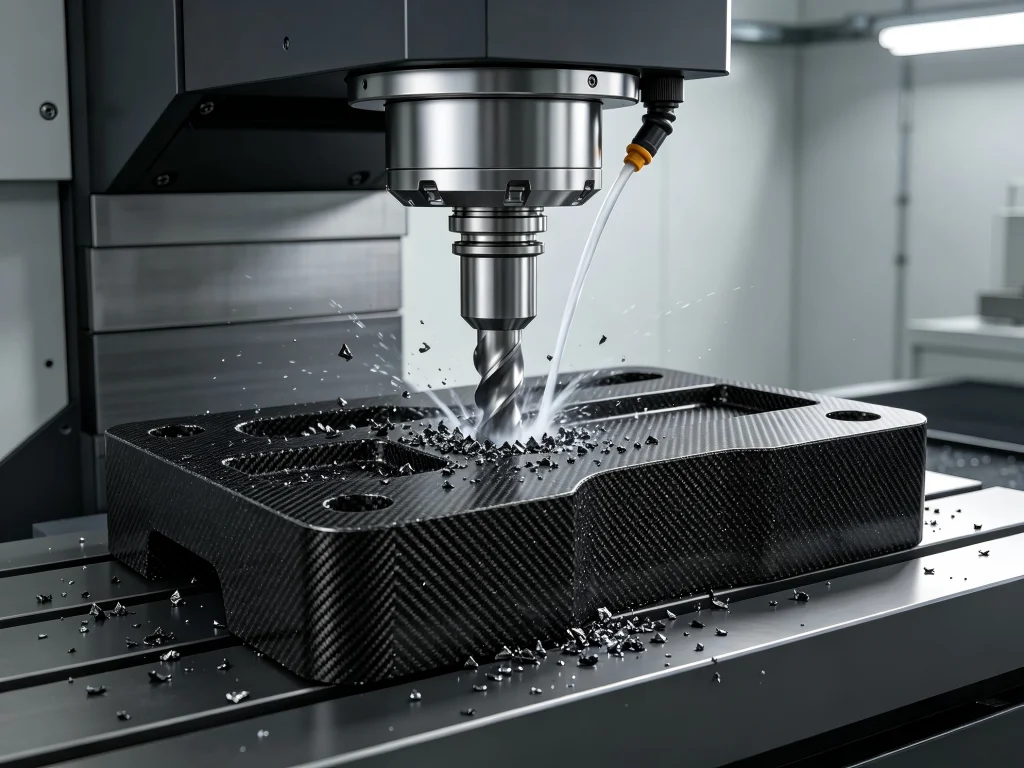
O Problema: Por Que a Usinagem de PEEK com Carga de Carbono Parece Lutar com um Fantasma
Vamos começar com o que os engenheiros dizem em fóruns como o r/Machinists do Reddit e vários grupos de fabricação no Facebook. As conversas seguem um padrão previsível. Alguém publica uma foto de uma bela peça de PEEK com carga de carbono recém-saída da máquina, e os comentários inundam: “Que velocidades e avanços você usou?” “Quantas fresas de topo você queimou?” “Você recozou primeiro?” A sabedoria coletiva é que PEEK com carga de carbono é um material que pune a ignorância e recompensa a preparação. Um maquinista descreveu como “usinar um bloco de borracha abrasiva que também é tão rígido quanto metal.” Outro observou que “você pode acertar seus números na primeira peça, mas a segunda se move 0,005 polegadas porque a tensão se aliviou durante a noite.”
A questão central está na natureza dupla do material. O material PEEK com carga de carbono combina uma matriz termoplástica semicristalina — polieteretercetona — com fibras curtas de carbono que normalmente constituem 30% do peso. A matriz de PEEK fornece tenacidade, resistência química e capacidade de suportar temperaturas de serviço contínuas de até 260°C (500°F). As fibras de carbono proporcionam rigidez excepcional, resistência ao desgaste e condutividade térmica. Juntas, elas criam um compósito que supera muitos metais em relação resistência-peso. Mas as mesmas propriedades que tornam o material desejável também o tornam difícil de usinar.
As fibras de carbono são abrasivas. Elas desgastam as ferramentas de corte mais rápido do que o PEEK não carregado ou a maioria dos metais. A matriz de PEEK tem uma temperatura de transição vítrea relativamente baixa — cerca de 143°C — o que significa que ela amolece e fica pegajosa se as temperaturas de corte subirem demais. Quando a matriz amolece, ela pode se espalhar pela aresta de corte, levando a aresta postiça, acabamento superficial ruim e imprecisão dimensional. A estrutura heterogênea de fibras de carbono “fortes-frágeis” e resina “macia-tenaz” cria um conjunto único de desafios de usinagem que não existem com materiais homogêneos.
Depois há a questão da tensão interna. O estoque de PEEK — seja extrudado ou moldado por compressão — contém tensões travadas do processo de fabricação. Você não pode vê-las. Você não pode medi-las com ferramentas de inspeção convencionais. Mas no momento em que você começa a remover material, essas tensões se redistribuem. A peça se move. Uma característica que estava perfeitamente posicionada na montagem acaba deslocada. Superfícies planas ficam arqueadas. Furos ficam fora de circularidade. Este é o “fantasma” do qual os maquinistas experientes falam — a força invisível que transforma um trabalho aparentemente simples em um caixote de refugo.
Surface quality is another recurring pain point. Can carbon fiber be machined to a smooth finish? Yes, but it requires specific strategies. Micro-cracking and edge chipping are common, especially at entry and exit points where the cutting tool engages and disengages the material. These defects may be invisible to the naked eye but can compromise mechanical performance or create contamination risks in sensitive environments like medical implants or semiconductor manufacturing.
The problem, in short, is that usinagem de PEEK com carga de carbono demands a level of discipline, equipment, and expertise that many job shops simply do not possess. The material does not forgive shortcuts. It does not tolerate guesswork. And it certainly does not reward the “run it like aluminum” approach that works for less demanding plastics.
The Solution: A Systematic Approach to Carbon Filled PEEK Machining
The good news is that PEEK com carga de carbono is entirely machinable. The material’s machinability is rated as good by major suppliers like Ensinger, provided the right techniques are applied. The difference between success and failure comes down to a handful of critical factors: material preparation, tool selection, cutting parameters, and machine capability. Let us examine each in detail.
Material Preparation: The Annealing Imperative
If there is one step that separates professional usinagem de PEEK com carga de carbono from amateur attempts, it is annealing. The process involves heating the raw stock to a specific temperature—typically just below the glass transition—holding it there for several hours, and then cooling it slowly and uniformly. This allows the internal stresses to relax before any material is removed.
Why does this matter? Consider what happens when you skip annealing. You load a block of PEEK com carga de carbono into the machine, indicate it in, and cut your first feature. The dimensions check out. You cut the second feature. Still good. But as you remove more material, the stress distribution changes. The block, which was under tension or compression in certain regions, begins to relieve that stress by moving. The result is a part that may not meet tolerance, even though every individual cut was made correctly.
Some shops anneal twice—once before roughing and again before finishing. This approach, while more time-consuming, yields the highest dimensional stability. The key is to recognize that annealing is not optional for tight-tolerance PEEK com carga de carbono components. It is a requirement.
Tool Selection: Fighting Abrasion with Geometry and Coating
The carbon fibers in carbon filled PEEK material are abrasive. They act like fine sandpaper against the cutting edge. Uncoated carbide tools will wear rapidly, leading to poor surface finish and eventual tool failure. The solution is to use tools with appropriate coatings—diamond-like carbon (DLC) or polycrystalline diamond (PCD) are common choices—and geometries designed for plastics.
Sharp cutting edges are essential. A hone or edge preparation that works well for metals will create excessive rubbing and heat in PEEK com carga de carbono. The tool should have a positive rake angle to shear the material cleanly rather than pushing it. Two-flute endmills are often preferred over four-flute designs because they provide more chip clearance and reduce the risk of recutting chips—a phenomenon that can generate enough heat to soften the PEEK matrix.
For drilling operations, the helix angle of the drill matters. Research has shown that helix angles of 20°, 30°, and 40° produce different results in terms of burr formation and delamination. The optimal choice depends on the specific application and the required hole quality. Double-angle drills have been developed specifically to mitigate burr and delamination damage in carbon fiber reinforced PEEK composites.
Cutting Parameters: Balancing Heat and Productivity
Heat is the enemy in usinagem de PEEK com carga de carbono. When the PEEK matrix reaches its glass transition temperature, it softens and becomes more ductile. This increases the tendency for built-up edge formation and reduces the effectiveness of the cutting action. The challenge is to remove material efficiently without generating excessive heat.
This typically means using moderate spindle speeds and relatively high feed rates. The high feed rate ensures that the cutting tool spends less time in contact with the material, reducing heat accumulation. The moderate spindle speed keeps the cutting edge from generating excessive friction. The exact parameters depend on the specific grade of PEEK com carga de carbono, the tooling being used, and the machine’s capabilities.
Dry cutting is common for PEEK com carga de carbono because the carbon fibers can absorb cutting fluid, potentially affecting the material’s properties. However, dry cutting can lead to lower machining efficiency due to the material’s high ductility and poor thermal conductivity. Some shops use minimum quantity lubrication (MQL) or chilled air to provide cooling without the risks associated with flood coolant. Advanced techniques like laser-assisted milling have also been explored, with optimal parameters including fiber orientation, laser power, and spindle speed combinations that minimize damage.
Machine Capability: Rigidity and Precision Matter
The machine tool itself is a critical variable. Carbon filled PEEK is a relatively soft material compared to metals, but it requires high spindle rigidity to maintain dimensional accuracy. A machine with excessive runout or poor thermal stability will produce inconsistent results, regardless of the tooling or parameters used.
Five-axis CNC machining offers significant advantages for complex PEEK com carga de carbono components. The ability to position the tool at optimal angles reduces tool deflection and improves surface finish. It also enables the machining of features that would require multiple setups on a three-axis machine—and every setup change introduces the risk of misalignment and stress redistribution.
Jucheng Precision, based in the Shenzhen manufacturing hub, operates a fleet of advanced CNC machines capable of handling the demands of usinagem de PEEK com carga de carbono. The company’s facility processes premium PEEK grades—from virgin to carbon-filled and implantable grades—delivering mission-critical components for medical, aerospace, and oil and gas industries.
Why Choose Jucheng for Carbon Filled PEEK Machining
Not every CNC shop is equipped to handle PEEK com carga de carbono successfully. The material demands a combination of technical knowledge, process discipline, and equipment capability that many shops lack. Jucheng Precision has built its reputation on exactly this type of challenging work.
The company’s expertise in PEEK machining is extensive. They process over 30 different materials and employ 5-axis CNC machining methods to create high-performance precision components. Their approach to PEEK com carga de carbono is systematic and data-driven. They understand the material’s “personality”—the way it responds to cutting forces, the importance of annealing, and the specific tooling geometries that yield the best results.
Jucheng’s quality control processes are equally rigorous. The company maintains tight tolerances and employs comprehensive inspection methods to verify that every part meets specifications. For industries like aerospace and medical devices—where PEEK com carga de carbono components are common—this level of quality assurance is non-negotiable.
The company also offers a range of surface finishing services, including polishing, anodizing, and bead blasting, that can enhance the performance and appearance of PEEK com carga de carbono parts. This vertical integration means customers can source complete, finished components from a single supplier, reducing lead times and simplifying the supply chain.
Perhaps most importantly, Jucheng approaches each usinagem de PEEK com carga de carbono project with a problem-solving mindset. The company’s engineers work closely with customers to understand the application requirements, select the appropriate grade of material, and develop a machining strategy that balances quality, cost, and delivery. This collaborative approach has made Jucheng a trusted partner for companies across a wide range of industries.
Key Applications of Carbon Filled PEEK
The properties of PEEK com carga de carbono—high stiffness, excellent wear resistance, thermal conductivity, and electrical dissipative behavior—make it suitable for a wide range of demanding applications. Understanding where and how the material is used provides context for why usinagem de PEEK com carga de carbono matters.
Componentes Aeroespaciais
The aerospace industry values PEEK com carga de carbono for its strength-to-weight ratio and thermal stability. Components such as brackets, housings, and structural supports benefit from the material’s ability to replace metal without adding weight. The material’s resistance to chemicals and fluids commonly found in aircraft environments makes it particularly attractive for applications near engines or hydraulic systems.
High-Performance Automotive
In automotive applications, PEEK com carga de carbono is used for pistons, seals, bearings, and other components subjected to high stress and temperature. The material’s wear resistance and low friction coefficient contribute to longer component life and reduced maintenance requirements. As automotive manufacturers continue to pursue weight reduction and efficiency improvements, the use of PEEK com carga de carbono is likely to grow.
Dispositivos Médicos
While virgin PEEK is more commonly used for implantable medical devices due to its biocompatibility, PEEK com carga de carbono finds applications in surgical instruments and medical equipment where stiffness and wear resistance are paramount. The material’s radiolucency—transparency to X-rays—is preserved to some degree even with carbon filling, making it useful for applications where imaging compatibility is important.
Semiconductor and Electronics
The statistically dissipative nature of PEEK com carga de carbono makes it valuable in semiconductor manufacturing and electronics assembly. Components such as wafer carriers, test sockets, and handling tools benefit from the material’s ability to prevent electrostatic discharge (ESD) damage to sensitive electronic devices.
Oil and Gas
Downhole tools and sealing components in oil and gas extraction must withstand high temperatures, high pressures, and corrosive environments. Carbon filled PEEK meets these demands, offering a metal-free alternative that reduces weight and eliminates corrosion concerns. The material’s hydrolysis resistance ensures reliable performance in the presence of water and steam.
Material Properties at a Glance
For engineers evaluating PEEK com carga de carbono for a specific application, the material’s properties provide the foundation for decision-making. The following table summarizes key characteristics of a typical 30% carbon-filled PEEK grade.
| Propriedade | Typical Value | Test Method | Significance for Machining |
|---|---|---|---|
| Resistência à Tração | 207–218 MPa (30,000–31,600 psi) | ASTM D638 / ISO 527 | Indicates cutting forces required |
| Alongamento na Ruptura | 1.5–5% | ASTM D638 | Brittle behavior influences chip formation |
| Flexural Strength | 297–310 MPa (43,100–45,000 psi) | ASTM D790 | Relevant for structural applications |
| Hardness (Rockwell R) | 118 | ASTM D785 | Abrasive nature affects tool life |
| Continuous Service Temperature | Up to 260°C (500°F) | — | Heat management during machining |
| Condutividade Térmica | Enhanced vs. virgin PEEK | — | Affects heat dissipation during cutting |
| Electrical Resistivity | Statistically dissipative | — | ESD protection in electronics applications |
These properties demonstrate why PEEK com carga de carbono is such a compelling engineering material—and why usinagem de PEEK com carga de carbono requires a thoughtful, disciplined approach.
Frequently Asked Questions About Carbon Filled PEEK Machining
The following questions reflect the most common concerns raised by engineers, procurement professionals, and machinists in online forums and industry discussions. They address the practical realities of working with this demanding material.
1. Is carbon filled PEEK difficult to machine?
Carbon filled PEEK is more challenging to machine than unfilled PEEK or most common engineering plastics. The carbon fibers are abrasive, leading to accelerated tool wear, and the material’s tendency to generate heat during cutting requires careful parameter selection. However, with the right tooling, parameters, and machine capability, it can be machined successfully. The key is to approach it with respect and preparation rather than treating it like a standard plastic.
2. What tooling is recommended for carbon filled PEEK machining?
Carbide tools with diamond-like carbon (DLC) or polycrystalline diamond (PCD) coatings are commonly recommended. The cutting edges should be sharp, with positive rake angles to shear the material cleanly. Two-flute endmills are often preferred for their chip clearance. Tool geometry and coating significantly impact tool life and surface quality in PEEK com carga de carbono applications.
3. Do I need to anneal carbon filled PEEK before machining?
For tight-tolerance components, annealing is strongly recommended. The process relieves internal stresses in the raw stock, preventing dimensional movement during and after machining. Skipping annealing is a common cause of rejected parts, as the material can warp or shift as material is removed. Some shops anneal twice—before roughing and before finishing—for maximum stability.
4. Can carbon filled PEEK be machined dry?
Dry machining is common for PEEK com carga de carbono because the carbon fibers can absorb cutting fluid, potentially affecting the material’s properties. However, dry cutting can lead to heat-related issues due to the material’s low thermal conductivity. Some shops use minimum quantity lubrication (MQL) or chilled air to provide cooling without the risks of flood coolant.
5. What are the main challenges in drilling carbon filled PEEK?
Perfuração PEEK com carga de carbono is prone to burr formation and delamination due to coupled thermal-mechanical effects. The heterogeneous structure of carbon fibers and PEEK matrix creates challenges for hole quality. Specialized drill geometries, such as double-angle drills, have been developed to mitigate these issues. Helix angle selection also affects drilling performance.
6. How does carbon filled PEEK compare to virgin PEEK for machining?
Carbon filled PEEK is stiffer and more wear-resistant than virgin PEEK but also more abrasive to cutting tools. The carbon fibers increase the material’s strength and thermal conductivity but make it more challenging to achieve fine surface finishes. Virgin PEEK has higher toughness and elongation, making it more forgiving in some machining operations. The choice between grades depends on the application requirements.
7. What industries use carbon filled PEEK components?
Carbon filled PEEK components are used in aerospace, high-performance automotive, medical devices, semiconductor manufacturing, and oil and gas extraction. The material’s combination of stiffness, wear resistance, thermal stability, and chemical resistance makes it valuable in any application where metal replacement is desirable.
8. How does Jucheng approach carbon filled PEEK machining differently?
Jucheng Precision applies a systematic, data-driven approach to usinagem de PEEK com carga de carbono. The company’s engineers understand the material’s “personality” and employ appropriate annealing, tooling, and cutting parameters for each specific application. Their 5-axis CNC capability enables complex geometries with minimal setups, reducing the risk of stress-related dimensional changes. Quality control processes ensure that every part meets specifications.
Making the Right Decision for Your Carbon Filled PEEK Project
Specifying PEEK com carga de carbono for a critical component is a decision that should not be taken lightly. The material offers exceptional performance but demands a level of machining expertise that not every shop can provide. When evaluating potential manufacturing partners, consider the following factors:
Material expertise. Does the shop have experience with PEEK com carga de carbono specifically, or do they treat it like any other plastic? Experience with the material’s unique characteristics—abrasiveness, stress behavior, thermal sensitivity—is essential for success.
Process capability. Does the shop have the equipment and processes needed for usinagem de PEEK com carga de carbono? This includes annealing capability, appropriate tooling, and machines with sufficient rigidity and thermal stability.
Quality systems. What inspection methods does the shop employ? How do they verify that parts meet specifications? For industries like aerospace and medical devices, traceability and documentation are as important as the parts themselves.
Problem-solving approach. Does the shop work collaboratively with customers to optimize designs and processes? The best manufacturing partners treat each project as a partnership, not just a transaction.
Jucheng Precision embodies these characteristics. The company’s track record with PEEK com carga de carbono and other high-performance engineering plastics demonstrates a commitment to quality and technical excellence. Their facility in Shenzhen, equipped with advanced 5-axis CNC machines, provides the capability needed for complex, tight-tolerance components. Their collaborative approach ensures that customers receive parts that meet their specifications—and their expectations.
For engineers and procurement professionals facing the challenge of usinagem de PEEK com carga de carbono, the message is clear: the material is demanding, but it is not insurmountable. With the right preparation, the right tools, and the right partner, PEEK com carga de carbono components can be produced reliably and cost-effectively. The key is to approach the project with the discipline and respect that the material requires—and to choose a manufacturing partner who does the same.
Ready to discuss your PEEK com carga de carbono project? Contact Jucheng Precision to learn how their expertise in high-performance polymer machining can bring your designs to life.