
Comece pelo processo com custo calculado, não por uma meta de desconto
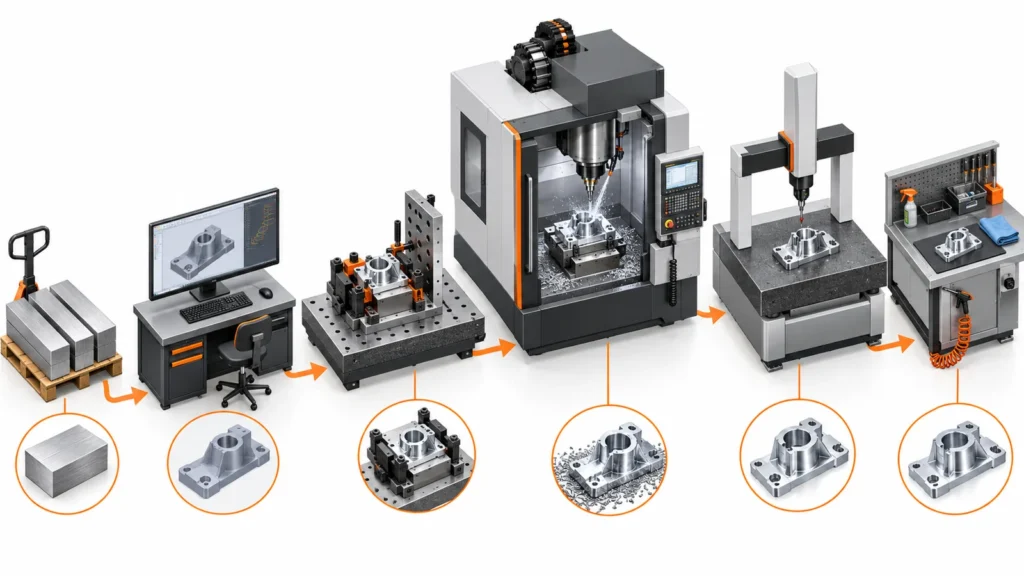 Um orçamento de CNC é o preço de uma rota de fabricação proposta. Ele reflete a seleção de estoque, programação, fixação da peça, configuração, corte, trocas de ferramenta, inspeção, acabamento, manuseio, documentação e risco. Antes de alterar o modelo CAD, pergunte qual operação ou requisito controla a estimativa.
O guia principal para custo da usinagem CNC explica como essas categorias compõem um orçamento. Uma revisão de redução de custos vai um passo além: ela vincula cada requisito caro a uma alternativa controlada e verifica se a alternativa ainda atende à função da peça.
Um orçamento de CNC é o preço de uma rota de fabricação proposta. Ele reflete a seleção de estoque, programação, fixação da peça, configuração, corte, trocas de ferramenta, inspeção, acabamento, manuseio, documentação e risco. Antes de alterar o modelo CAD, pergunte qual operação ou requisito controla a estimativa.
O guia principal para custo da usinagem CNC explica como essas categorias compõem um orçamento. Uma revisão de redução de custos vai um passo além: ela vincula cada requisito caro a uma alternativa controlada e verifica se a alternativa ainda atende à função da peça.
| Sinal de orçamento | Provável carga de processo | Primeira pergunta de engenharia |
|---|---|---|
| Alto custo de setup ou dispositivo | Múltiplas orientações, fixação instável ou fixação personalizada | As características podem compartilhar um datum e ser alcançadas a partir de menos direções? |
| Tempo de ciclo longo | Grande remoção de material, ferramentas pequenas, características profundas ou passes de acabamento fino | Qual característica consome mais tempo de fuso? |
| Inspeção cara | Tolerâncias apertadas amplas, datums difíceis ou relatório completo | Quais características realmente controlam a função ou a conformidade? |
| Alta margem para refugo | Distorção, geometria frágil, requisitos incertos ou risco de processamento em estágio avançado | O processo pode ser estabilizado antes da operação crítica final? |
| Prazo de entrega longo | Estoque incomum, ferramental especial, acabamento terceirizado ou esclarecimentos repetidos | A especificação pode usar as entradas disponíveis sem alterar o desempenho? |
Esse diagnóstico evita o redesenho aleatório. Aumentar todos os raios, mudar o material ou excluir notas do desenho pode criar novos problemas enquanto deixa o verdadeiro fator de custo intocado.
A Escada de Redução de Custos: Elimine Setups Antes de Perseguir Segundos
 Nem todas as economias têm a mesma alavancagem. Uma pequena melhoria na taxa de avanço pode economizar segundos, enquanto eliminar um setup inteiro pode remover manuseio, apalpação, transferência de datum, preparação de dispositivo e um ponto de inspeção. Revise o processo em ordem decrescente de impacto estrutural.
Esta sequência também esclarece se uma taxa horária de máquina mais elevada é realmente mais cara. Uma rota multi-eixo pode custar mais por hora de máquina, mas menos por peça aceite, se substituir fixações e transferências de datum. O custo deve ser comparado ao nível da peça concluída, e não apenas pela taxa horária.
Edições de Geometria que Dão à Ferramenta um Trabalho Melhor
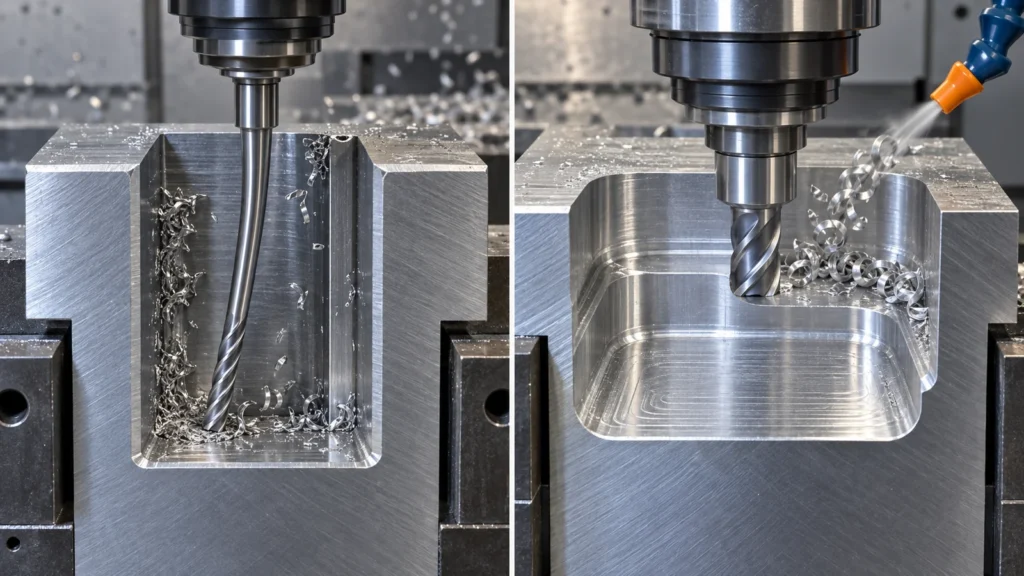 As alterações de geometria de maior valor melhoram o acesso da ferramenta e a rigidez. Permitem ao processo usar um cortador maior, uma ferramenta mais curta, menos passagens ou uma fixação mais segura. O limite exato depende do material, do tamanho da característica, da profundidade, da tolerância e do equipamento disponível, por isso trate as proporções fixas como pontos de partida para discussão e não como regras universais.
Do not simplify geometry in isolation. A two-piece design may machine faster but add alignment, fasteners, sealing, assembly labor, and failure modes. The correct comparison is total delivered cost and functional risk.
Tolerance and Inspection: Spend Precision Where It Protects Function
 A tight tolerance can change the process route. It may require a finish pass, controlled clamping, temperature awareness, staged measurement, a different machine, or a larger scrap allowance. The cost increases again when the drawing does not provide a usable datum scheme or acceptance method.
Use the CNC machining tolerance guide to separate general dimensions from fit, seal, motion, alignment, and load-bearing characteristics. Then review each controlled feature through four questions:
A tight tolerance can change the process route. It may require a finish pass, controlled clamping, temperature awareness, staged measurement, a different machine, or a larger scrap allowance. The cost increases again when the drawing does not provide a usable datum scheme or acceptance method.
Use the CNC machining tolerance guide to separate general dimensions from fit, seal, motion, alignment, and load-bearing characteristics. Then review each controlled feature through four questions:
- What failure occurs if this feature reaches either limit?
- Does size alone control function, or is form, orientation, position, or surface condition more relevant?
- Can the supplier measure it repeatably from the stated datums?
- Must every part receive a full report, or can the inspection plan reflect risk and production stage?
Cost reduction does not mean deleting inspection. It means making acceptance evidence proportional to risk. A clear critical-characteristics list is usually more useful than applying the same tolerance and reporting burden to the entire drawing. JUCHENG’s quality control workflow can be referenced when defining dimensional reports, traceability, and inspection expectations.
Material, Stock, and Finish Can Cost More Than the CAD Suggests
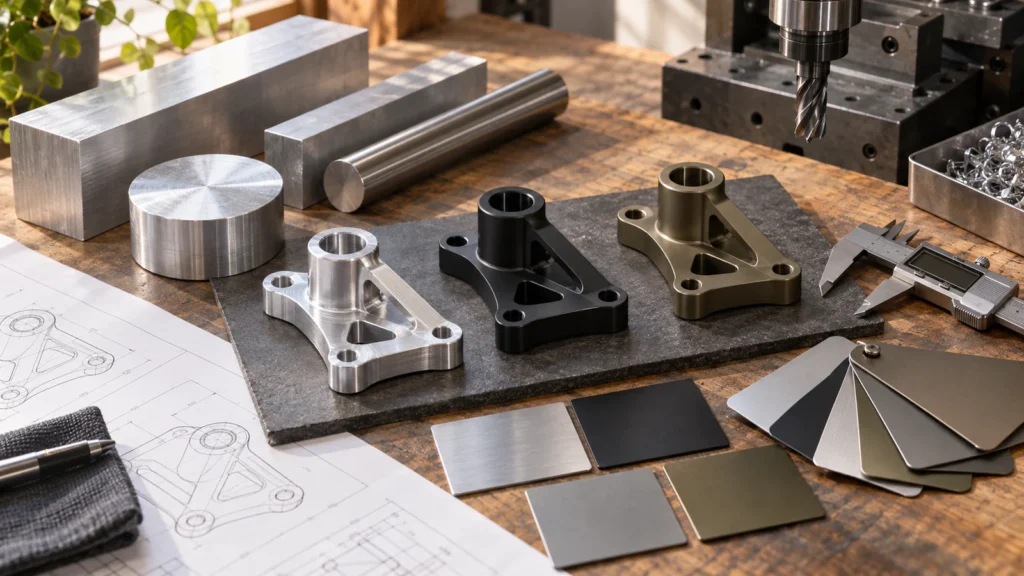 The model shows finished geometry, but the shop buys starting stock. Cost depends on grade, condition, stock size, minimum purchase quantity, certification, yield, and how much material becomes chips. A small finished part can still be expensive when it must be cut from an oversized or difficult-to-source blank.
Review the Biblioteca de materiais CNC to compare viable material families, but do not substitute solely on purchase price. A cheaper alloy can increase tool wear, distortion, finishing difficulty, or rejection risk. Confirm strength, corrosion, temperature, wear, electrical, chemical, and compliance requirements before changing grade or condition.
The model shows finished geometry, but the shop buys starting stock. Cost depends on grade, condition, stock size, minimum purchase quantity, certification, yield, and how much material becomes chips. A small finished part can still be expensive when it must be cut from an oversized or difficult-to-source blank.
Review the Biblioteca de materiais CNC to compare viable material families, but do not substitute solely on purchase price. A cheaper alloy can increase tool wear, distortion, finishing difficulty, or rejection risk. Confirm strength, corrosion, temperature, wear, electrical, chemical, and compliance requirements before changing grade or condition.
Surface requirements deserve the same discipline. A blanket fine-roughness callout can add finishing passes to faces that never seal, slide, locate, or appear to the user. Multiple cosmetic treatments, selective masking, polishing before coating, or a finish that changes critical dimensions can add handling and inspection. Define the purpose of each treatment, then use the site’s surface finishing options to discuss suitable routes.
Illustrative DFM Review: An Expensive Housing Without a “Bad” Feature
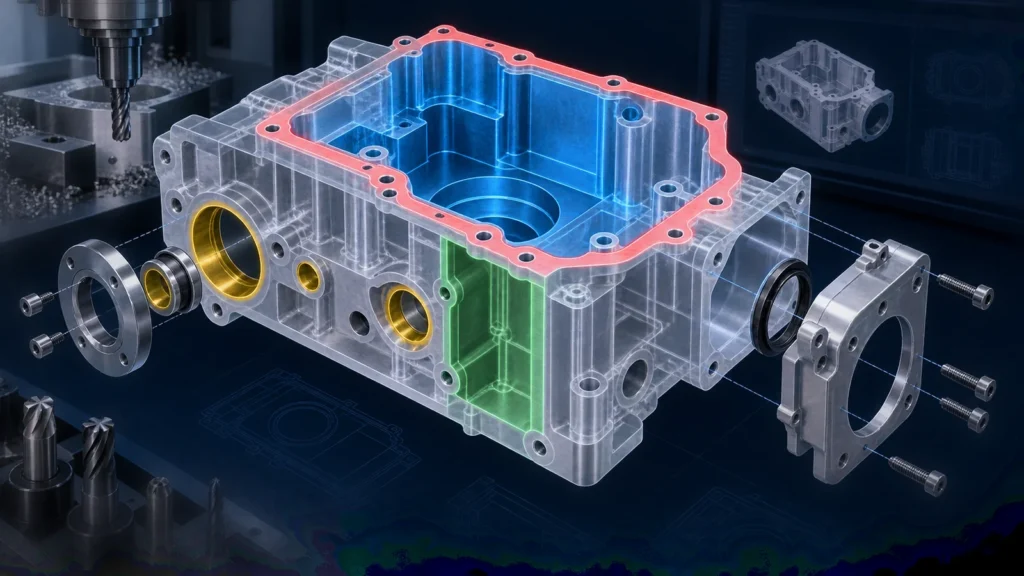 Consider an aluminum electronics housing that receives a higher-than-expected quote. No single feature is impossible. The cost comes from the interaction of several ordinary decisions: a deep pocket with small internal radii, cosmetic treatment on all faces, tightly controlled non-mating dimensions, side holes in multiple orientations, and a full dimensional report.
A disciplined review would not begin by changing the alloy or removing quality checks. It would trace the route:
Consider an aluminum electronics housing that receives a higher-than-expected quote. No single feature is impossible. The cost comes from the interaction of several ordinary decisions: a deep pocket with small internal radii, cosmetic treatment on all faces, tightly controlled non-mating dimensions, side holes in multiple orientations, and a full dimensional report.
A disciplined review would not begin by changing the alloy or removing quality checks. It would trace the route:
The redesign might enlarge nonfunctional corner radii, relocate selected holes to a common orientation, identify only the connector and sealing interfaces as critical, and limit cosmetic requirements to visible surfaces. The housing still performs the same job, but the manufacturing route becomes easier to fixture, cut, finish, and verify.
This example is illustrative rather than a claimed customer result. Actual savings cannot be predicted from geometry alone; they depend on material, size, quantity, equipment, inspection scope, supplier process, and the accepted design changes.
Do Not “Save” Cost by Removing the Evidence or Function You Need
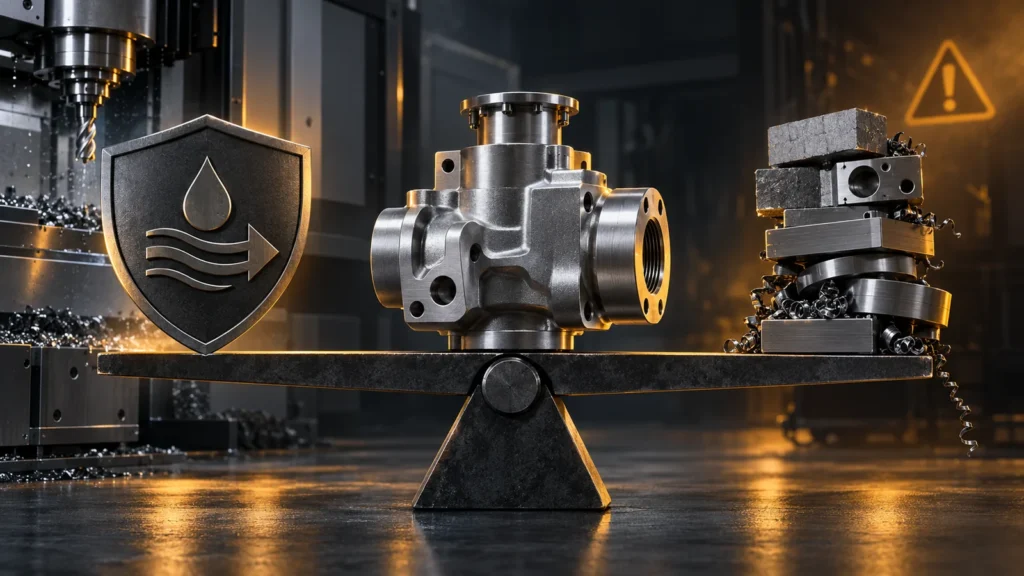 Some quote reductions are false economies. They lower the initial price while increasing assembly problems, field failures, rework, or supplier disputes. Preserve requirements that control safety, fit, sealing, fatigue, sterilization, traceability, regulatory compliance, or validated appearance.
A Quote-Ready Package Makes Cost Drivers Visible
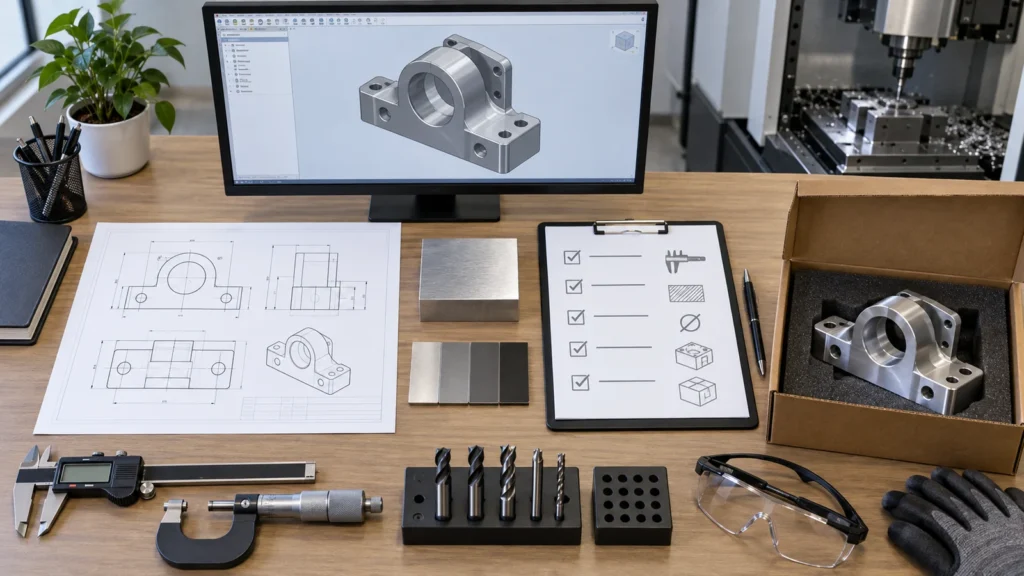 Incomplete RFQs create uncertainty, and uncertainty is often priced as risk. A useful package lets the supplier distinguish fixed requirements from negotiable preferences and propose alternatives without guessing.
Ask suppliers to identify the top two or three cost drivers and price meaningful alternatives separately. A controlled option—such as a revised radius, a different stock condition, or a reduced reporting scope—creates a decision you can review. A blanket discount request does not explain what changed.
CNC Machining Cost Reduction FAQs

What usually produces the largest CNC cost reduction?
Removing a setup, shortening tool reach, reducing heavy stock removal, or limiting demanding tolerances to functional features often has more leverage than small cycle-time adjustments. The largest opportunity varies by part, so the supplier should identify the operation or requirement driving the quote.
Does using a three-axis machine always cost less?
No. A three-axis machine may have a lower hourly rate, but multiple setups and fixtures can increase total cost and datum-transfer risk. A multi-axis route can be more economical when it completes more features in one controlled setup.
Should I loosen every tolerance to reduce price?
No. Loosen only requirements that do not protect function, assembly, safety, or compliance. Keep critical features clearly controlled and measurable. A functional tolerance strategy is safer than applying either extremely tight or extremely loose limits across the entire drawing.
Can ordering more parts lower the unit cost?
Often, because programming, setup, fixturing, and first-part work can be distributed across more units. However, material, cycle time, finishing, inspection, inventory, and revision risk remain. Compare realistic quantity breaks rather than ordering excess parts solely for a lower unit price.
What information should I send for a cost-reduction review?
Send the current CAD model and drawing, quantities, material and finish, critical interfaces, inspection requirements, delivery needs, and a note identifying what can or cannot change. That context helps engineering teams reduce process burden without weakening the part’s intended function.