
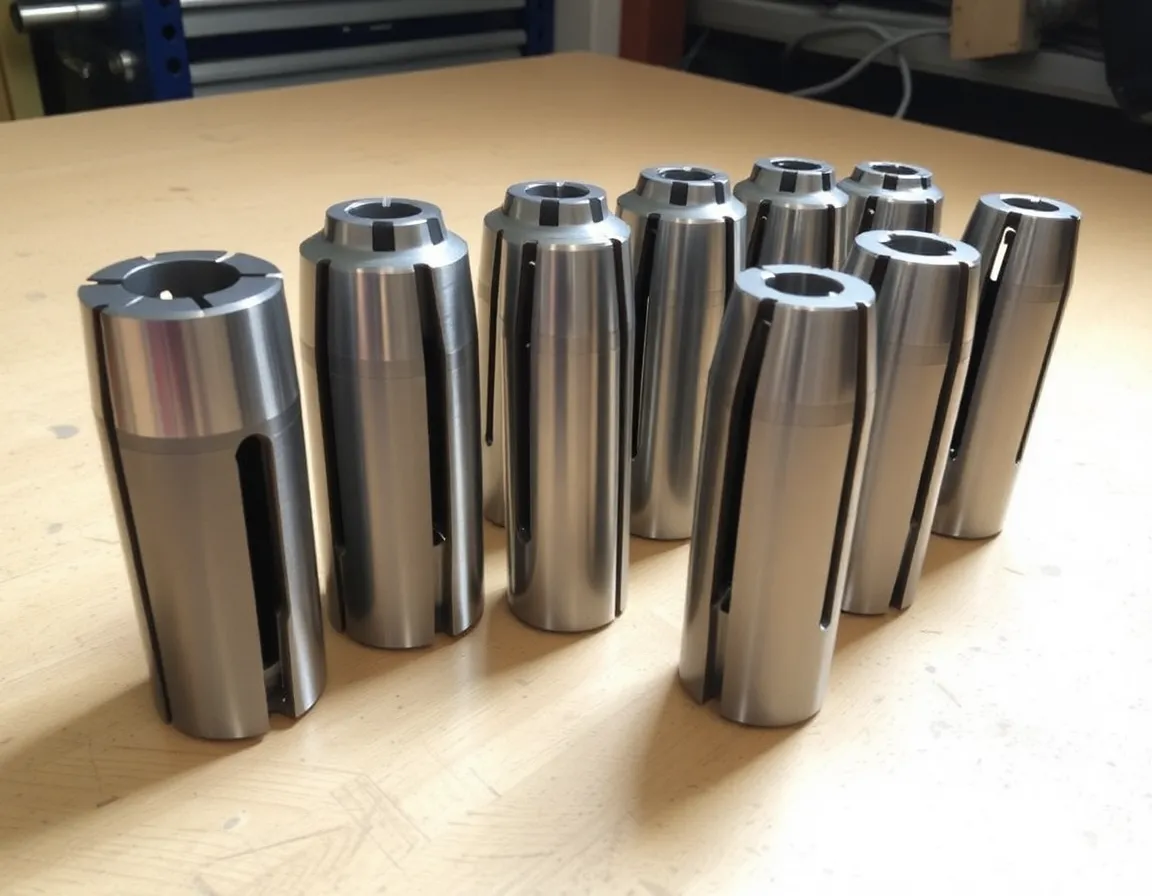
Every machinist knows the sinking feeling: a high-value workpiece is clamped in the vise, the program is proven, and yet the part just won't sit right. It's too thin, too irregular, too delicate, or too oddly shaped for standard workholding. The setup takes hours, the part shifts under cutting forces, and scrap rates climb. In precision manufacturing, these "tricky parts" are not the exception—they are the daily reality. Custom workholding collets offer a targeted, repeatable, and often surprisingly cost-effective answer to these problems. This article explores what custom collets are, how they work, where they excel, and how to specify and maintain them for maximum return.
What Are Custom Workholding Collets?
Workholding collets are precision sleeves—typically slotted or segmented—that grip a workpiece by contracting or expanding around it when actuated by a chuck, fixture, or drawbar. Standard collets, such as 5C, 16C, 3J, ER, and TG styles, cover a wide range of round, hexagonal, and square stock sizes. They are fast, accurate, and repeatable within their size range.
Custom workholding collets are purpose-built versions of these devices, designed and manufactured to grip a specific part geometry that no off-the-shelf collet can handle. Instead of gripping a nominal diameter, a custom collet may be bored with the exact profile of a cast or forged blank, slotted to clear a flange, segmented to grip multiple bosses simultaneously, or shaped to contact only designated clamping surfaces on a finished part.
Custom collets are produced in several forms:
- Bored-to-profile collets: Standard collet bodies (e.g., 5C or 16C blanks) machined with a custom internal form that matches the workpiece.
- Segmented or "finger" collets: Collets with machined slots that create flexible jaws, allowing controlled collapse onto irregular or thin-walled parts.
- Expanding collets: Mandrels that expand outward to grip a bore from the inside—ideal for parts where the outside diameter must remain accessible for machining.
- Multi-part and dedicated fixtures: Custom collet systems integrated into a fixture plate to hold one or several identical parts in a single load.
Because they are made for one part family, custom collets eliminate the compromises of soft jaws, shims, and improvised clamping—delivering the concentricity and rigidity of a collet with the geometric freedom of a dedicated fixture.
How Custom Collets Solve Tricky Machining Problems
The value of a custom collet becomes clear when you examine the failure modes of conventional workholding. Vises and standard jaws contact parts at a few points, inviting distortion and vibration. Standard collets demand a clean, round, nominal-diameter gripping surface. Three-jaw chucks struggle with non-round parts and thin walls. Custom collets address each of these weaknesses directly.
Gripping Irregular and Non-Round Geometries
Casting, forging, and additive-manufactured blanks rarely present a perfect cylinder. A custom collet bored to the blank's actual profile—including draft angles, parting-line flash relief, and asymmetric features—distributes clamping force across the intended surfaces. The result is secure holding without point-loading that can crack or deform the part.
Controlling Distortion in Thin-Walled Parts
Thin-walled rings, bushings, and housings are notorious for collapsing or springing out of tolerance when clamped. A segmented custom collet with full-perimeter contact and carefully tuned wall thickness applies uniform radial force, minimizing ovalization. Many shops pair these collets with controlled clamping pressure—pneumatic or hydraulic actuators with regulators—to hold delicate parts without crushing them.
Improving Access and Reducing Setups
When a collet grips a part by a hub, bore, or dedicated clamping land, the surfaces to be machined remain exposed. This enables single-setup machining—turning, facing, and milling features that would otherwise require re-fixturing. Fewer setups mean less stacked error, shorter cycle times, and fewer opportunities for human error.
Delivering Repeatability at Production Scale
Custom collets are hardened and ground to tight tolerances, so part-to-part concentricity is typically measured in microns, not thousandths of an inch. For high-mix, high-volume shops, that repeatability translates directly into stable process capability (Cpk) and fewer inspection rejections.
Key Benefits of Custom Workholding Collets
Shops that invest in custom collets consistently report improvements across several dimensions:
- Accuracy and concentricity: Typical total indicated runout (TIR) of 0.0002–0.0005 in. (5–13 µm) is achievable with properly made collets, far better than most jaw systems.
- Repetibilidad: Once set, a collet locates the part identically every cycle, eliminating operator-dependent variation.
- Reduced scrap and rework: Uniform clamping and secure holding prevent slip marks, distortion, and chatter-induced defects.
- Faster setups: Drop-in loading replaces time-consuming indicating and shimming; changeover between parts becomes a matter of seconds.
- Longer tool life: Rigid holding reduces vibration, which is a leading cause of premature tool wear and poor surface finish.
- Operator safety and ergonomics: Consistent, mechanical clamping removes judgment calls and improvised setups that can fail under load.
- Cost efficiency at volume: While a custom collet costs more than a standard one, its per-part cost often falls below soft jaws or dedicated fixtures once production volume is considered.
It is worth noting the trade-off: custom collets are part-specific. Their economics depend on the number of parts to be run, the value of the parts, and the cost of the problems they solve. For a family of similar parts, a single collet design can sometimes be adapted with interchangeable inserts, spreading the investment.
Aplicaciones en diversas industrias
Custom collets appear wherever precision meets awkward geometry:
- Aeroespacial: Thin-walled bushings, hydraulic fittings, turbine components, and fastener blanks where concentricity and surface integrity are critical.
- Dispositivos médicos: Small, delicate instrument components and implant blanks that cannot tolerate clamp marks or distortion.
- Automoción: Valve bodies, sensor housings, and powertrain components with cast or forged gripping surfaces.
- Job shops and contract machining: High-mix production where quick changeover and first-part accuracy drive profitability.
- Watchmaking and precision instruments: Tiny, irregular components requiring micron-level holding accuracy.
Best Practices for Specifying and Using Custom Collets
Getting the most from a custom collet starts long before the first chip is cut. Follow these guidelines to ensure the investment pays off.
Define the Gripping Strategy First
Identify which surfaces on the part are acceptable for clamping—ideally surfaces that are already finished, will remain unmachined, or have generous tolerance. Determine whether the collet should contract on an outside diameter or expand into a bore. Consider how clamping force will interact with part stiffness and where distortion is least harmful.
Provide Complete, Accurate Part Data
Supply the collet maker with a current 3D model, a detailed 2D drawing with tolerances, and the material specification. Note any draft angles, flash, or surface finish on as-received blanks. If blanks vary from lot to lot, specify the range the collet must accommodate—or plan for a collet matched to each blank condition.
Match the Actuation Method to the Application
Mechanical drawbars, pneumatic actuators, and hydraulic systems each offer different clamping force and control. For delicate parts, specify a pressure-regulated actuator so clamping force can be dialed in and locked. For heavy roughing, prioritize rigidity and force capacity over speed of actuation.
Build in Adjustment and Wear Allowance
Collets wear at the gripping surface. Design the interface so the collet can be re-ground or re-bored a limited number of times, and specify hardness and coating (e.g., nitriding or hard chrome) appropriate to the part material and cycle count. Keep a spare on the shelf—custom lead times can be weeks.
Maintain Cleanliness and Torque Discipline
Chips and coolant residue between collet and part are the leading cause of runout error. Establish a cleaning routine at every load, and use torque or pressure settings verified against the collet maker's recommendations. Log clamping cycles so wear can be predicted rather than discovered through scrap.
Validate with a First-Article Run
Before committing to production, run a first-article inspection that includes concentricity, roundness, and dimensional stability after clamping. Check for clamp marks on the part. Adjust clamping pressure or contact geometry if distortion appears. A modest validation effort prevents expensive surprises at full volume.
Conclusión
Tricky parts are not going away. As designs grow lighter, more complex, and more tightly toleranced, the limitations of vise jaws and standard collets become increasingly costly. Custom workholding collets close that gap by combining the accuracy and speed of collet holding with geometry-specific engineering. They reduce setups, protect delicate parts, and deliver the repeatability that modern production demands. For shops facing parts that "just won't sit right," a custom collet is often the most direct route from setup frustration to stable, profitable machining.