
When your engineering team specifies machining nylon 66 for a new gear train, bearing housing, or structural automotive component, you are making a deliberate choice about performance, durability, and long-term reliability. But here is the question that keeps design engineers and procurement specialists up at night: How do you select the right CNC machining partner for nylon 66 parts when every shop claims to be an expert?
This guide approaches CNC machining nylon 66 from a buyer’s perspective. Rather than simply listing facts, we will walk through the critical decisions you face—material grade selection, tolerance specification, moisture management, and vendor qualification—so you can make an informed choice that balances performance, cost, and risk. By the end, you will understand not only what makes nylon 66 unique but also how to evaluate whether a machining partner like Jucheng Precision has the technical infrastructure to deliver parts that stay within specification from the factory floor to final assembly.
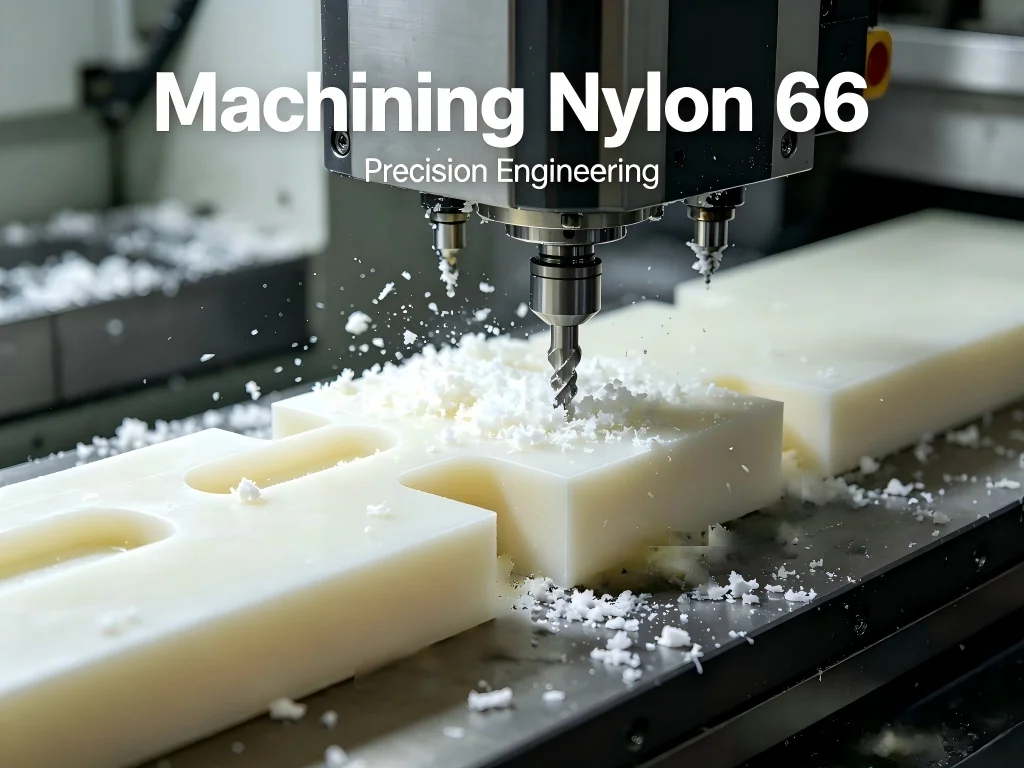
Understanding Nylon 66: What Makes It Different?
Before diving into vendor selection, you need a clear picture of what nylon 66 actually is and why it behaves differently from other engineering plastics. Polyamide 66—commonly referred to as PA66—is a semi-crystalline thermoplastic synthesized from two monomers, each containing six carbon atoms. This molecular symmetry allows the polymer chains to pack tightly, creating a higher degree of crystallinity than its cousin, PA6.
What does this mean for your parts? The crystalline structure gives nylon 66 superior mechanical properties: it is naturally harder, stiffer, and more resistant to deformation under prolonged stress—a trait known as creep resistance. Parts machined from PA66 hold their shape better under continuous pressure, which is why engineers frequently specify it for manifold spacers, heavy-duty bearing housings, and high-torque gear applications.
However, the same crystallinity that delivers these benefits also creates machining challenges. Because the material is more rigid than PA6, it does not deflect as much during cutting, allowing a skilled machinist to hold tighter geometric tolerances. But that rigidity also means the material is more prone to internal stresses if cutting parameters are not optimized.
Nylon 66 vs. Nylon 6: The Critical Comparison
One of the most frequent debates in engineering circles is nylon 46 vs nylon 66—or more accurately, PA6 versus PA66. While both materials share the polyamide family name, their performance profiles differ significantly.
| Property | Nylon 6 (PA6) | Nylon 66 (PA66) |
|---|---|---|
| Melting Point | ~220°C | ~260°C |
| Tensile Strength | Moderate | Higher |
| Stiffness | Lower | Higher |
| Impact Resistance | Excellent at low temperatures | Moderate |
| Abrasion Resistance | Moderate | Higher |
| Moisture Absorption | Higher | Lower |
| Heat Deflection Temperature | Lower | Higher |
| Chemical Resistance | Good | Excellent |
| Typical Cost | ~30% less expensive | Premium |
As the table illustrates, PA66 offers distinct advantages when your application demands higher temperature resistance, greater strength, and improved dimensional stability under load. PA6, by contrast, is the more flexible, impact-resistant option that processes at lower temperatures and typically costs less.
One nuance that frequently catches engineers off guard: while PA66 absorbs slightly less moisture overall than PA6, it tends to absorb moisture slightly faster. This means that even though the equilibrium moisture content is lower, the rate of uptake can be more rapid—a factor that demands careful attention during machining and post-processing.
For applications requiring maximum toughness and impact resistance, PA6 may be the better choice. But for structural parts that must withstand elevated temperatures and maintain dimensional stability under load, nylon 66 is the clear winner. The automotive industry, for instance, increasingly favors PA66 for engine components and interior applications, with the segment projected to grow at a CAGR of 5.8% to 7.8% driven by lightweighting trends.
The Hidden Challenge: Moisture and Dimensional Stability
If there is one concept that separates successful nylon 66 machining projects from costly failures, it is moisture management. Nylon is hygroscopic—it absorbs moisture from the surrounding air like a sponge. This is not a surface effect; water molecules penetrate the polymer structure itself.
The consequences are twofold. First, the part swells. A nylon component can change dimensions by 1% to 2% or more depending on humidity. A hole that measures 10.00mm in a dry workshop might become 10.15mm on a humid day—a catastrophic deviation for precision assemblies. Second, absorbed moisture acts as a plasticizer, making the nylon softer, weaker, and less stiff. The part you chose for its strength can become flimsy in a wet environment.
This is the paradox of nylon: you select it for its mechanical properties, but those properties depend heavily on environmental conditions. The secret is not to fight nylon’s nature but to understand and manage it.
For CNC machining, this means several things. Raw material should be stored in humidity-controlled environments. Tolerances should be designed with environmental expansion in mind—Jucheng Precision, for example, recommends designing tolerances no tighter than +/- 0.1mm for large parts to account for this behavior. Pre-drying of nylon sheets before machining is often recommended, and post-machining stabilization or annealing may be necessary for high-precision applications.
When evaluating a machining partner, ask specifically about their moisture management protocols. Do they store raw material in climate-controlled facilities? Do they pre-condition material before machining? Do they have documented procedures for measuring and controlling moisture content? These questions separate serious manufacturers from those who treat nylon like any other plastic.
What to Look for in a CNC Machining Partner for Nylon 66
Selecting a service provider for CNC machining nylon 66 requires evaluating capabilities across several dimensions. Here is what the most discerning buyers examine:
1. Thermal Management Capability
Nylon 66 has a melting point of approximately 260°C—higher than PA6 but still significantly lower than most metals. Heat generated during cutting can cause localized melting, surface smearing, and dimensional instability. A competent machining partner will demonstrate:
- Sharp, high-positive-rake carbide tooling to reduce friction and heat buildup
- Optimized speeds and feeds—moderate spindle speeds combined with higher feed rates to minimize thermal deformation
- Appropriate cooling methods—compressed air or minimal mist cooling to prevent thermal damage without introducing excessive moisture
- Flood coolant strategies where appropriate to flush away long, stringy chips that can wrap around the cutter
If a shop treats nylon 66 like aluminum or steel, run the other way. The thermal dynamics are fundamentally different.
2. Toolpath Strategy and Fixturing
Nylon 66’s flexibility—relative to metals—demands careful fixturing to maintain dimensional stability. Stable clamping and reduced vibration are essential to hold tolerances. Additionally, toolpath strategy must consider entry points, chip evacuation, and reduced depth per pass to ensure optimal surface integrity and tool life.
Ask potential vendors: How do you fixture nylon parts? What toolpath strategies do you employ for deep pockets or thin walls? The answers will reveal whether they truly understand the material’s behavior.
3. Burr Management
Machining nylon 66 often leaves tenacious burrs that are difficult to remove. These burrs can interfere with assembly, damage mating components, or compromise the function of gear teeth and bearing surfaces. Specialized deburring techniques—cryogenic treatment or manual trimming—are often required.
A shop that does not mention burr management in their process documentation may not be equipped to deliver production-ready parts.
4. Quality Systems and Certifications
Quality certifications provide objective evidence of a manufacturer’s commitment to process control. Jucheng Precision, for instance, operates under IATF 16949—the highest global standard for automotive quality—and ISO 13485 for medical applications. These certifications require documented processes, rigorous risk mitigation, and complete traceability.
For automotive applications, IATF 16949 certification indicates a “zero-defect” mindset and a system designed to produce a 99.8% qualification rate. For medical devices, ISO 13485 validates excellence in the healthcare supply chain.
While not every project requires these certifications, they serve as strong indicators of overall quality culture. If a vendor holds these credentials, it suggests they have the discipline to handle demanding nylon 66 machining projects reliably.
5. Material Selection and Sourcing
Not all nylon 66 is created equal. Reputable machining partners maintain relationships with established material suppliers and offer documented material certifications. They should be able to provide:
- Material certification and traceability
- Full dimensional CMM reports
- Hardware certifications where applicable
Jucheng Precision, for example, stocks and machines multiple nylon grades including PA6, PA66, glass-filled nylon, and oil-filled nylon, each suited to specific engineering applications.
Common Applications: Where Nylon 66 Excels
Understanding what is nylon 6 and nylon 66 used for helps clarify why the material commands a premium. Nylon 66 use spans numerous demanding industries:
Automotive
Nylon 66 is extensively used in engine components, powertrain systems, airbag containers, radiator tanks, cylinder head covers, and oil pans. Its heat resistance and strength make it essential for under-the-hood applications where temperatures can exceed 150°C. With the growth of electric vehicles, PA66 use in battery modules and wiring systems is expanding.
Mechanical Engineering
Gears, sprockets, pulleys, bearings, bushings, and wear strips all benefit from nylon 66’s self-lubricating properties and wear resistance. The material’s low coefficient of friction makes it ideal for moving parts that must operate without external lubrication.
Electrical and Electronics
Nylon 66 offers good insulating properties combined with heat resistance, making it suitable for electrical components, connectors, and cable management systems. The electrical and electronic segment is projected to grow at 5.5% to 7.5%, driven by demand for high-performance connectors and insulators.
Industrial Equipment
Heavy-duty housings, pump bodies, and structural components frequently specify glass-filled nylon 66 for maximum rigidity and dimensional stability.
What is particularly noteworthy is the versatility across these applications. The same base material—nylon 66—can be machined into a gear that must withstand millions of cycles, a bearing that operates without lubrication, or a structural mount that supports significant loads. This breadth of application is what makes nylon 66 machining such a valuable capability for manufacturers across industries.
Reddit and Community Perspectives: What Engineers Are Saying
Online engineering communities frequently discuss the practical realities of CNC machining nylon 66. A recurring theme across forums like r/Machinists and r/AskEngineers is the importance of moisture management—a topic we have already covered in depth. Engineers consistently warn newcomers about the dimensional changes that occur when nylon parts absorb moisture, emphasizing that tolerances must account for this behavior.
Another common discussion point is tool selection. Experienced machinists recommend sharp carbide tooling with positive rake angles to reduce heat generation and prevent melting. Several community members have shared stories of ruined parts caused by dull tools or improper feeds, reinforcing the importance of optimized cutting parameters.
Coolant strategy also generates significant discussion. While some machinists advocate for compressed air cooling to avoid introducing moisture, others prefer flood coolant to manage chip evacuation. The consensus appears to be that the approach depends on the specific operation and part geometry—there is no one-size-fits-all solution.
One insight that consistently emerges from these discussions is the value of working with a machining partner who specializes in engineering plastics rather than a generalist shop that primarily processes metals. The thermal dynamics, fixturing requirements, and moisture considerations are sufficiently different that specialized expertise makes a measurable difference in part quality.
Why Jucheng Precision Stands Out for Nylon 66 Machining
Based on the evaluation criteria outlined above, Jucheng Precision (Jucheng Precision Technology) demonstrates several distinctive strengths for machining nylon 66:
Technical Expertise in Engineering Plastics
Jucheng Precision has invested in high-speed, high-torque CNC centers specifically suited for the demands of nylon 66 machining. This is not a metal shop dabbling in plastics—it is a facility equipped and staffed to handle the unique challenges of engineering polymers. The company regularly performs nylon CNC machining for precision gear sets, milling sharp, accurate tooth profiles that can handle significant torque loads.
Comprehensive Material Capabilities
Jucheng handles a wide array of nylon grades including PA6, PA66, and glass-filled nylon, utilizing advanced CNC technology to deliver functional prototypes and production parts. This breadth of capability means the same partner can support you across different projects and material requirements.
Quality Certifications
Jucheng Precision operates under IATF 16949 and ISO 13485 quality management systems. These certifications require documented processes, rigorous risk mitigation, and complete traceability—exactly what demanding nylon 66 applications require. The IATF 16949 standard, in particular, represents a commitment to a “zero-defect” mindset and a system designed to produce a 99.8% qualification rate.
Moisture Management Protocols
Jucheng stores raw material in humidity-controlled environments and recommends designing tolerances no tighter than +/- 0.1mm for large parts to account for environmental expansion. This pragmatic approach acknowledges the material’s inherent behavior rather than pretending it doesn’t exist.
Vertically Integrated, Certified Partnership
Jucheng Precision Technology offers the security of a vertically integrated, certified partner committed to the lowest risk and highest quality output. For buyers who cannot afford quality-related disruptions, this integration matters.
Frequently Asked Questions About CNC Machining Nylon 66
1. What is the difference between nylon 6 and nylon 66 for CNC machining?
The primary difference lies in molecular structure. Nylon 66 has a more crystalline arrangement, making it stiffer, stronger, and more heat-resistant than nylon 6. However, nylon 6 offers better impact resistance and is typically less expensive. For nylon 66 machining, the increased rigidity allows tighter tolerances but requires more careful thermal management.
2. What are the main challenges in CNC machining nylon 66?
The three primary challenges are thermal management (avoiding melting during cutting), moisture control (preventing dimensional changes from humidity), and burr removal. Successful nylon 66 machining requires sharp tooling, optimized cutting parameters, and appropriate cooling strategies.
3. What tolerances can be achieved when machining nylon 66?
With proper fixturing and optimized parameters, tolerances as tight as +/- 0.01mm can be achieved. However, because nylon absorbs moisture and expands, it is generally advisable to design tolerances no tighter than +/- 0.1mm for large parts to account for environmental variation.
4. What industries use CNC-machined nylon 66 parts?
Nylon 66 is widely used in automotive (engine components, powertrain, interiors), mechanical engineering (gears, bearings, bushings), electrical and electronics (connectors, insulators), and industrial equipment (housings, structural components).
5. How does moisture affect machined nylon 66 parts?
Moisture causes two problems: dimensional swelling (1% to 2% or more) and reduced mechanical properties (the material becomes softer and weaker). This is why moisture management—from raw material storage to final packaging—is critical for precision nylon 66 machining.
6. Is nylon 66 more expensive to machine than nylon 6?
The base material cost for nylon 66 is typically higher—roughly 30% more than nylon 6. Machining costs may also be slightly higher due to the need for sharper tooling, optimized parameters, and more careful thermal management. However, the performance advantages often justify the premium for demanding applications.
7. What cooling method is best for CNC machining nylon 66?
Compressed air or minimal mist cooling is generally preferred to prevent thermal damage without introducing excessive moisture. For operations with significant chip generation, flood coolant may be used to flush away chips, but moisture absorption must be carefully managed.
8. How do I choose a CNC machining partner for nylon 66 parts?
Evaluate potential partners on thermal management capability, toolpath and fixturing expertise, burr management protocols, quality certifications (IATF 16949, ISO 13485), and moisture control procedures. Look for specialists in engineering plastics rather than generalist shops.
Making the Decision: A Practical Framework
When you are ready to select a partner for CNC machining nylon 66, consider this practical framework:
Step 1: Define your requirements clearly. What are the critical dimensions? What tolerances must be maintained? What environmental conditions will the part face in service? The answers will inform both material grade selection and vendor qualification.
Step 2: Evaluate material grade. Is PA66 truly the right choice, or would PA6 or glass-filled nylon better serve your application? Refer to the comparison table earlier in this guide.
Step 3: Qualify potential vendors. Ask about thermal management protocols, fixturing strategies, burr removal processes, and moisture control procedures. Request references from similar projects.
Step 4: Verify quality systems. Look for IATF 16949 or ISO 13485 certification as indicators of process discipline.
Step 5: Discuss tolerance and inspection. Confirm that the vendor can achieve your required tolerances and provide full dimensional inspection reports.
Step 6: Review material sourcing. Ensure the vendor can provide material certifications and traceability.
By following this framework, you can move beyond generic claims of expertise and make a data-driven decision about who will machine your nylon 66 parts.
The global nylon 66 market was valued at USD 5.8-9.6 billion in 2024 and is projected to grow at a CAGR of 5.5% to 7.5% through 2030. This growth reflects the material’s exceptional combination of strength, thermal stability, and wear resistance. For buyers who understand the nuances of nylon 66 machining—and who select partners with the technical infrastructure to manage its unique challenges—the material delivers exceptional value across automotive, industrial, and electrical applications.
Whether your project involves a high-speed gear set, a thermally stable bushing, or a structural automotive component, the principles outlined in this guide will help you navigate the selection process with confidence. The key is to look beyond surface-level capabilities and examine the underlying technical disciplines—thermal management, moisture control, toolpath strategy, and quality systems—that separate exceptional machining partners from the rest.
Ready to Start Your Nylon 66 Machining Project?
Jucheng Precision brings together the technical expertise, quality certifications, and material capabilities required for reliable nylon 66 machining. With IATF 16949 and ISO 13485 certification, advanced CNC equipment, and documented moisture management protocols, Jucheng delivers parts that stay within tolerance from the factory floor to final assembly.
Contact Jucheng Precision today to discuss your nylon 66 machining requirements, request a quote, or learn more about their comprehensive engineering plastics capabilities.