
نافذة فحص شفافة، ودليل انزلاقي، وحلقة تباعد كهربائية ساخنة لا تحتاج جميعها إلى البلاستيك نفسه. البدء كل رسم بـ “يُفضَّل PEEK” قد يضيف تكلفة دون حل المشكلة المتحكمة؛ والبدء بأرخص مخزون قد يُفوِّت متطلباً لا يظهر إلا بعد التجميع.
اختر بلاستيك CNC عبر استبعاد المرشحين غير المناسبين، ثم تحقق من صحة الدرجات المتبقية في ظل الظروف المقصودة. PEEK وUltem (PEI) وDelrin (أسيتال) والنايلون وPTFE وPMMA والبولي كربونات تشغل أدواراً مختلفة. لا يوجد ترتيب واحد يلتقط الحمل المستمر وامتصاص الماء والتعرض الكيميائي والاحتكاك والأداء البصري في آن واحد.
هذا دليل فرز وظيفي، وليس كتالوجاً لخدمات التشغيل الآلي ولا بديلاً عن بيانات التصميم الخاصة بكل درجة. الإطار الأوسع إطار مواد التشغيل الآلي CNC يغطي الاختيار السابق بين عائلات المواد.
اكتب ملف الوظيفة بحدود النجاح/الفشل
 استبدل الصفات العامة بشروط يمكن للمهندس تقييمها. “مقاوم للحرارة” لا يوضح ما إذا كان الجزء يتعرض لدورة تنظيف قصيرة أو يحمل حملًا بشكل مستمر بالقرب من مصدر حرارة. “مقاوم للمواد الكيميائية” يحذف السائل والتركيز ودرجة الحرارة ومدة التلامس.
حدد عوامل الاستبعاد الحقيقية قبل تقييم السعر. إذا كان يجب على نافذة أن تنقل طولاً موجياً محدداً بتشوه متحكم فيه، فإن درجة عالية الأداء غير شفافة ليست خياراً بديلاً: إنها تفشل في تلبية هذا المتطلب. وإذا كان لا يمكن لفاصل أن يفقد التحميل المسبق خلال عمر خدمته، فإن مقاومة الشد قصيرة المدى مقياس فرز غير كامل.
لا تستبدل درجة حرارة الانحراف الحراري أو نقطة الانصهار أو الحد الأقصى لدرجة حرارة الخدمة في الكتالوج بدرجة حرارة التشغيل المسموح بها تحت الحمل. فهي تصف اختبارات أو حدوداً مختلفة، وليس نفس حالة التصميم.
سبعة مرشحين، لأسباب مختلفة للبقاء في القائمة
 يحدد الجدول أدناه المرشحين المبدئيين والسؤال الذي يمكن أن يبطل كل اختيار. وهو يصف عائلات المواد غير المحشوة الشائعة ما لم يُذكر خلاف ذلك؛ ويجب مقارنة الدرجات الدقيقة وأشكال المخزون بشكل منفصل.
For a hot, loaded component, PEEK machining is a route to investigate, not an automatic specification. Ensinger’s unfilled PEEK stock-shape data distinguish short-term mechanical properties, thermal limits and low water uptake. Those advantages still need to be tested against the part’s load and exposure.
For a precision guide operating in a moderate environment, Delrin CNC machining may be a more relevant starting point than a high-temperature polymer. However, “acetal” includes homopolymer and copolymer products; they should not be substituted without reviewing the intended conditions.
اختبر المتطلبات معًا
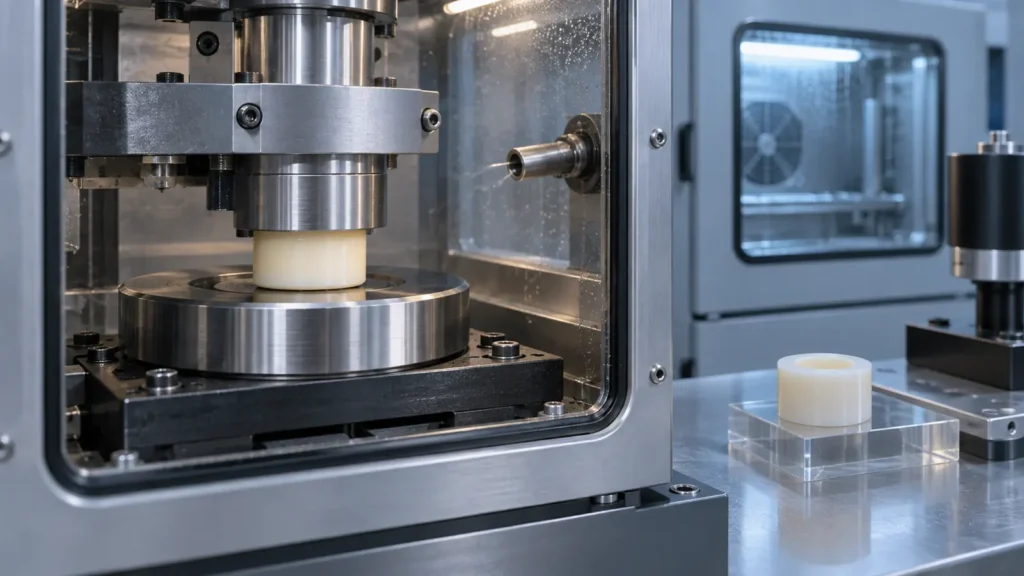
Load plus time plus temperature
A component can pass a short proof load and still move gradually during service. Creep is time-dependent deformation under load. Evaluate the relevant grade’s data at the intended stress and temperature, and define how much movement the assembly permits.
PTFE illustrates why thermal capability and structural rigidity must remain separate questions. Carrara’s PTFE guidance discusses loss of sealing force through creep. A material may tolerate the environment chemically yet need a different support or sealing arrangement to maintain its function. A low coefficient of friction alone does not qualify it as a bearing material.
Moisture plus fit
For nylon, define the moisture state in which dimensions are accepted and the conditions the assembly will later experience. Ensinger’s machinable-plastics guidance notes that moisture uptake and release can alter dimensions. “Dry at inspection” is therefore not equivalent to “stable in a humid installation.”
Consider a hypothetical close-running roller. A small clearance established in a dry room may not represent the running clearance after environmental exposure. The design decision may involve a different grade, conditioning, revised clearance or another polymer—not simply tighter machining.
Transparency plus impact plus cleaning
PMMA and PC should be compared using the finished optical requirement, not photographs of raw transparent stock. Curbell distinguishes acrylic’s optical appeal from polycarbonate’s toughness. Machining marks, polishing, thickness, scratches and the chosen stock grade affect the final viewing surface.
For machined polycarbonate parts, include the cleaning agents and fastening arrangement in the review. A clear part that looks acceptable before cleaning may not represent its condition after repeated use. Do not claim a protective or safety function from the polymer name alone; the complete design and applicable tests govern that use.
Sliding contact plus the mating surface
Friction and wear belong to a contact pair. Counterface material and finish, pressure, speed, lubrication, contaminants and temperature can change the result. Compare candidates in a representative contact test instead of selecting the smallest friction number from unrelated datasheets.
اسم البوليمر ليس تعريفًا كاملًا للمادة
 State the manufacturer or approved equivalent, product grade, filler content, colour where relevant, and required stock form. Delrin is a trade name associated with acetal homopolymer; Ultem identifies a PEI product family. Neither is a substitute for a complete procurement specification.
For Ultem machining, an unfilled grade and a reinforced grade are not interchangeable. Fillers can alter stiffness, dimensional response, electrical behaviour, wear and the machined edge. A stronger filled grade may also be unsuitable for a required insulating or clean-contact function.
State the manufacturer or approved equivalent, product grade, filler content, colour where relevant, and required stock form. Delrin is a trade name associated with acetal homopolymer; Ultem identifies a PEI product family. Neither is a substitute for a complete procurement specification.
For Ultem machining, an unfilled grade and a reinforced grade are not interchangeable. Fillers can alter stiffness, dimensional response, electrical behaviour, wear and the machined edge. A stronger filled grade may also be unsuitable for a required insulating or clean-contact function.
Keep stock-shape data separate from injection-moulding resin or 3D-printing data. Manufacturing route, reinforcement orientation and material condition can matter. An attractive number measured on a moulded test bar is not automatically a guaranteed property of the supplied machined component.
Compliance is also grade- and application-specific. Avoid generic callouts such as “FDA plastic” or “medical PEEK” without identifying the intended contact, relevant declarations and validation requirements. A material declaration and approval of the finished assembly answer different questions.
حوّل القائمة المختصرة إلى قرار يمكن الدفاع عنه
 Retain two plausible candidates when important data are missing. Ask for comparable stock and machining proposals using the same geometry, quantities, inspection state and acceptance requirements. Compare the finished component—not just price per kilogram.
A short decision record should explain why one candidate remains and another was rejected. That record is more useful at the next drawing revision than a generic label such as “premium engineering plastic.”
Does choosing PEEK remove the need for prototype testing?
No. It does not establish the behaviour of a thin wall, a sliding pair, a stressed chemical interface or a long-term loaded assembly. Test the features and environments that control the design.
Can an inexpensive plastic prototype validate a more expensive production grade?
It may validate selected aspects of geometry or assembly access. It cannot automatically validate friction, creep, thermal movement, chemical resistance or electrical performance in the production material. Record what the prototype test does—and does not—demonstrate.