
Você tem um lote de tarugos de aço 1018 na bancada e precisa transformá-los em componentes de precisão. Parece simples o suficiente — o 1018 deveria ser um dos aços de baixo carbono mais usináveis disponíveis. No entanto, de alguma forma, seu acabamento superficial parece mais um campo arado do que uma superfície usinada. Suas fresas de topo estão lascando prematuramente, e você não consegue descobrir se deveria estar operando a 500 SFM ou chegando mais perto de 1000 SFM. Se este cenário parece familiar, você não está sozinho. A usinagem do aço 1018 apresenta um conjunto único de desafios que enganam até operadores de CNC experientes. A boa notícia? Esses problemas têm soluções — e elas começam com a compreensão exata do que faz o 1018 funcionar.
O Que Exatamente É o Aço 1018?
Antes de podermos resolver os quebra-cabeças de usinagem que este material apresenta, precisamos entender com o que estamos trabalhando. Aço 1018 é um aço doce de baixo carbono que pertence à série AISI 10xx, contendo aproximadamente 0,15% a 0,20% de carbono em peso. O “18” em sua designação refere-se a este teor de carbono — cerca de 0,18%. Esta porcentagem de carbono relativamente baixa é o que dá ao 1018 sua combinação distintiva de propriedades: boa usinabilidade, excelente soldabilidade e resistência moderada.
A composição química se decompõe da seguinte forma: carbono (0,15–0,20%), manganês (0,60–0,90%), fósforo (≤0,04%), enxofre (≤0,05%), com o restante sendo ferro. O teor de manganês é notavelmente maior do que em alguns outros aços de baixo carbono como o AISI 1020, o que proporciona maior temperabilidade e melhores características de usinagem.
Em termos de propriedades mecânicas, o trefilado a frio Aço 1018 normalmente exibe uma resistência à tração de cerca de 440 MPa (64.000 psi), um limite de escoamento de aproximadamente 370 MPa (53.700 psi) e uma dureza Brinell de cerca de 126 HB. Esses números o colocam firmemente na categoria de “resistência moderada” — forte o suficiente para a maioria das aplicações gerais, mas não tão duro a ponto de destruir ferramentas de corte.
O índice de usinabilidade do aço 1018 é geralmente citado em cerca de 70% a 78% do AISI B-1112 (ou 62% do AISI 1112, dependendo do padrão de referência). Isso o coloca na categoria de usinabilidade “boa” — não tão fácil de cortar quanto aços com chumbo como o 12L14, mas significativamente mais usinável do que aços de alto carbono ou liga.
O Problema do Mundo Real: Por Que a Usinagem do Aço 1018 Pode Ser Frustrante
Aqui é onde as coisas ficam interessantes. Apesar de seu favorável índice de usinabilidade, o aço 1018 tem a reputação de ser enganosamente difícil de usinar bem. Passe algum tempo em fóruns de usinagem e você encontrará inúmeras discussões de maquinistas frustrados. Um maquinista amador lamentou: “O 1018 é difícil de deixar um bom acabamento sem retificação. Pastilhas de alumínio são muito afiadas e têm ângulos de saída elevados”. Outro usuário no Practical Machinist observou que “1018 — muito soldável, mas pegajoso e mais difícil de produzir peças com bom acabamento superficial”.
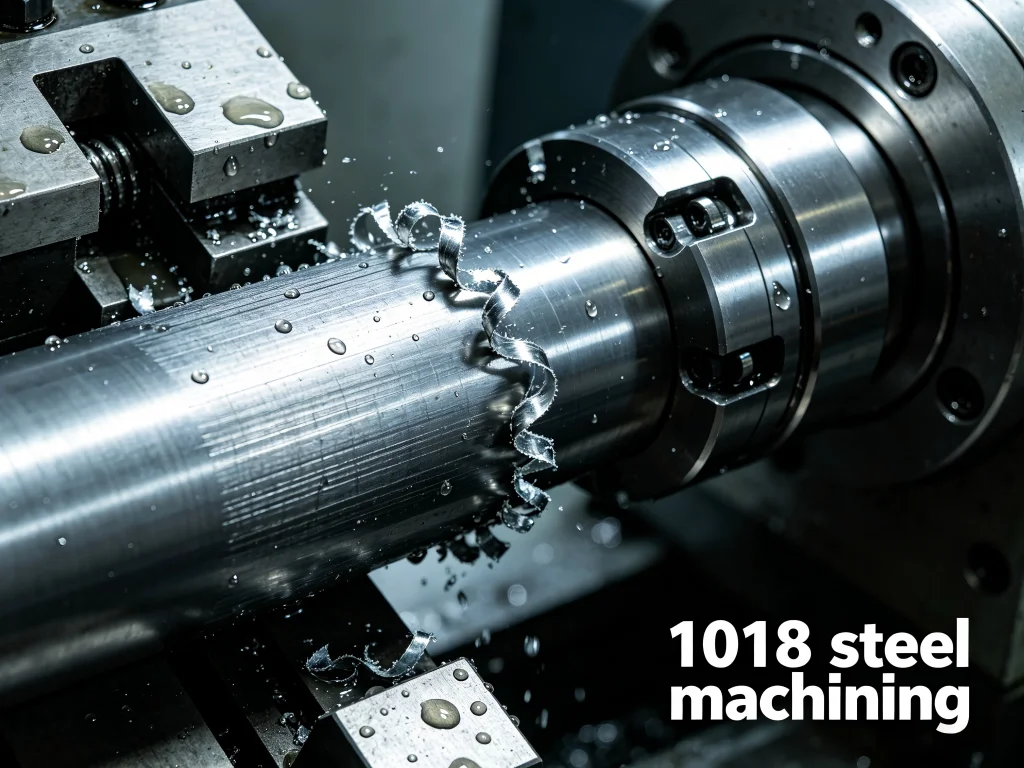
A questão central é esta: Aço 1018 não é um aço verdadeiramente de corte fácil. Falta-lhe as adições de enxofre ou chumbo que fazem com que graus como 12L14 ou 1215 cortem como manteiga. Em vez disso, o 1018 produz cavacos contínuos e fibrosos que podem enrolar-se nas ferramentas e causar problemas. O material tem tendência a encruar se os parâmetros de corte não forem otimizados, e alcançar aquele acabamento superficial espelhado exige frequentemente mais atenção à geometria da ferramenta e às condições de corte do que muitos operadores esperam.
Como observou um especialista do setor da Sandvik Coromant, “Tradicionalmente, os aços de baixo carbono ISO P1, como o 1010 ou o 1018, eram considerados fáceis de usinar. Hoje, porém, esses materiais podem ser alguns dos mais desafiadores no que diz respeito ao controle de cavacos”. O problema não é que o 1018 não possa ser bem usinado — é que os parâmetros que funcionaram no seu último trabalho podem não funcionar neste.
A Solução: Acertar as Velocidades e Avanços de Corte do Seu Aço 1018
O fator mais importante para o sucesso da usinagem do aço 1018 é ajustar corretamente as velocidades e os avanços. É aqui que muitos operadores erram, e é também onde as maiores melhorias podem ser feitas.
Compreender a Ciência por Trás dos Parâmetros de Corte
A investigação demonstrou que a velocidade de corte tem um efeito dramático tanto na taxa de remoção de material (MRR) como na rugosidade superficial ao usinar aço AISI 1018. Um estudo que utilizou um delineamento experimental Taguchi L9 concluiu que aumentar a velocidade de corte de 56 para 76 m/min aumentou a MRR em 22,83%, enquanto aumentar ainda mais para 96 m/min acrescentou outros 15,43%. Talvez mais importante, o mesmo estudo demonstrou que aumentar a velocidade de corte de 56 para 76 m/min reduziu a rugosidade superficial (Ra) em 31,92%, e de 76 para 96 m/min reduziu-a em mais 40,71%.
Isto significa que velocidades de corte mais elevadas geralmente melhoram tanto a produtividade como o acabamento superficial ao usinar aço 1018 — até certo ponto. No entanto, o avanço conta uma história diferente. Aumentar o avanço de 0,1 para 0,14 mm/rot aumentou a MRR em 20,64%, mas também aumentou a rugosidade superficial em 16,95%. Existe um compromisso entre a remoção de material e a qualidade superficial que precisa de ser gerido.
Tool overhang also plays a significant role. Increasing tool overhang from 40 to 50 mm decreased MRR by 7.34% and increased surface roughness by 11.11%. Keeping tool overhang as short as possible is essential for both productivity and finish quality.
Recommended 1018 Steel Cutting Speeds and Feeds
Based on industry data and research findings, here are practical starting points for machining 1018 steel:
| Operation | Cutting Speed (SFM) | Cutting Speed (m/min) | Feed Rate (IPR) | Feed Rate (mm/rev) | Depth of Cut |
|---|---|---|---|---|---|
| Turning (Roughing) | 400–600 | 122–183 | 0.008–0.015 | 0.20–0.38 | 0.060–0.120 in |
| Turning (Finishing) | 600–1000 | 183–305 | 0.004–0.008 | 0.10–0.20 | 0.010–0.030 in |
| Milling (Roughing) | 350–500 | 107–152 | 0.002–0.005 per tooth | 0.05–0.13 per tooth | 0.060–0.150 in |
| Milling (Finishing) | 500–700 | 152–213 | 0.001–0.003 per tooth | 0.025–0.076 per tooth | 0.010–0.030 in |
| Perfuração | 80–130 | 24–40 | 0.004–0.008 per rev | 0.10–0.20 per rev | N/A |
Note: These are starting parameters. Actual optimal values may vary based on machine rigidity, tooling, coolant, and specific part geometry.
One machinist on Practical Machinist shared their experience: “I finish 1018 around 1000 SFM. Since you are limited to 5000 RPM I’d run at a constant RPM of around 4500 for the whole part (for finishing)”. Another user noted: “It will take some serious SFM to get a nice finish out of 1018, I would probably start at 500 SFM and expect to go up”. The consensus across the machining community is that higher speeds—particularly for finishing passes—are essential for achieving good surface quality.
Tool Selection and Geometry
Tool selection is another critical factor in successful usinagem do aço 1018. Carbide tools are generally preferred for their hardness and wear resistance. However, the geometry of the insert matters enormously.
For roughing operations, a stronger edge geometry with a larger nose radius (0.031″ or 0.047″) helps withstand the cutting forces and provides better tool life. For finishing, a sharper edge with a smaller nose radius (0.015″ or 0.031″) produces better surface finishes. Coated carbide grades—particularly those with TiN, TiCN, or AlTiN coatings—offer improved wear resistance and longer tool life when machining 1018 steel.
One forum participant noted that “1018 is not tough on the machine”, meaning it does not place excessive stress on the machine tool itself. However, the material’s tendency to produce continuous chips means that chip breaking and chip evacuation deserve special attention.
Coolant and Lubrication Strategies
Heat management is crucial when machining 1018 steel. Research has explored various cooling approaches, including compressed air-assisted machining, minimum quantity lubrication (MQL), and conventional flood coolant. One study found that palm kernel oil used in MQL applications performed better than standard mineral oil lubricants.
For most shop-floor applications, flood coolant with a water-soluble oil emulsion works well for 1018 steel. The coolant helps control thermal expansion, improves chip evacuation, and extends tool life. If you are experiencing built-up edge (BUE) issues, increasing coolant pressure or switching to a more effective lubricant may help.
What Type of Steel Is 1018? Understanding Its Place in the Material World
For those wondering what kind of steel is 1018, the answer lies in its classification. 1018 is a low-carbon, mild steel in the AISI 10xx series. It is produced through either basic oxygen furnace (BOF) or electric arc furnace (EAF) processes, and it is available in both hot-rolled and cold-drawn conditions.
Cold-drawn 1018 is preferred for precision machining applications because the cold drawing process enhances dimensional accuracy, surface finish, and mechanical properties. When you see references to “cold finished” or “cold rolled” 1018 steel, this is the material most commonly used in CNC machining operations.
One common question is how hard is 1018 steel. The Brinell hardness typically ranges from 126 to 131 HB, with a Rockwell B hardness of approximately 71. This places it in the “soft but not too soft” category—hard enough to hold its shape during machining but not so hard that it destroys cutting tools.
The material is sometimes referred to as UNS G10180 and carries various equivalent designations including AMS 5069, ASTM A108, and SAE J403. It is available in rounds, squares, flats, and hexagons, making it one of the most versatile steel grades on the market.
Common Applications: Where 1018 Steel Shines
Aço 1018 is used across a remarkably wide range of industries and applications. Its combination of good machinability, excellent weldability, and moderate strength makes it a go-to material for many manufacturing scenarios.
In the automotive industry, 1018 steel is used for various components including shafts, pins, gears, and structural parts. Its ability to be case-hardened makes it particularly suitable for carburized parts that require a hard surface and a tough core.
In construction and infrastructure, 1018 steel works well in bending, crimping, and swaging processes for fixtures, mounting plates, and spacers. Its moderate strength and excellent formability make it ideal for structural applications where high strength is not the primary requirement.
In general manufacturing, 1018 steel is commonly used for high-volume screw machine parts, precision components, fasteners, bolts, and machinery parts. The material’s uniform composition allows for tight tolerances and smooth surface finishes, making it a favorite for CNC machining operations.
For those searching for 1018 steel Malaysia-based sourcing, the material is widely available throughout the region. Malaysian suppliers typically offer 1018 with a machinability rating of 78% of AISI B-1112 and an average surface cutting speed of 130 feet per minute.
Key Considerations for Choosing a 1018 Steel Machining Partner
If you are outsourcing your usinagem do aço 1018 rather than doing it in-house, several factors should guide your decision. The quality of the finished parts depends not just on the material itself, but on the expertise of the machine shop performing the work.
Precision and Tolerances: Not all CNC shops are created equal when it comes to holding tight tolerances on 1018 steel. Look for a partner with experience in precision machining of low-carbon steels and a track record of meeting demanding specifications.
Equipment and Capabilities: The best shops invest in modern CNC equipment with rigid construction, high spindle speeds, and advanced coolant systems. These capabilities directly translate to better surface finishes and more consistent part quality.
Process Optimization: Experienced machinists understand that 1018 steel cutting speed and feed parameters need to be optimized for each specific job. A shop that takes a one-size-fits-all approach to speeds and feeds will likely produce inconsistent results.
Quality Assurance: Look for shops with robust quality management systems, including inspection equipment and documented quality procedures. ISO certifications and other quality credentials provide additional assurance.
Material Sourcing: The quality of the raw 1018 steel matters. Reputable shops source material from established mills and can provide material test reports (MTRs) documenting chemical composition and mechanical properties.
Why Jucheng Precision Stands Out for 1018 Steel Machining
At Jucheng Precision, we have spent over a decade refining the art of machining 1018 steel. Our approach is built on a deep understanding of the material’s behavior and a commitment to precision that goes beyond industry standards.
When we perform CNC steel machining on 1018, we almost exclusively start with cold-drawn bar stock to ensure the highest dimensional stability. This material choice, combined with our optimized cutting parameters, allows us to achieve surface finishes and tolerances that many shops struggle to match.
Our CNC capabilities are designed to leverage the precision of cold-rolled steel. We utilize advanced tooling strategies, including coated carbide inserts with optimized geometries for both roughing and finishing operations. Our machining centers feature high spindle speeds and rigid construction, allowing us to run the higher cutting speeds that produce superior surface finishes on 1018 steel.
Quality is not an afterthought at Jucheng—it is built into every step of our process. From raw material inspection to final part verification, we maintain rigorous quality controls that ensure consistency across every batch. Whether you need high-volume production runs or low-volume precision prototypes, we have the expertise and capacity to deliver.
Our team understands the nuances of usinagem do aço 1018—from chip control strategies to coolant selection to the specific speeds and feeds that produce the best results. We do not just machine parts; we engineer solutions that optimize both quality and cost-effectiveness.
Frequently Asked Questions About 1018 Steel Machining
1. What is the machinability rating of 1018 steel?
O 1018 steel machinability rating is generally cited at approximately 70% to 78% of AISI B-1112 (or about 62% of AISI 1112). This places it in the “good” machinability category, though it is not as free-cutting as leaded grades like 12L14.
2. What are the recommended cutting speeds for 1018 steel?
For turning operations, starting cutting speeds range from 400–600 SFM for roughing and 600–1000 SFM for finishing. For milling, start at 350–500 SFM for roughing and 500–700 SFM for finishing. These are starting points—actual optimal speeds may vary based on your specific setup.
3. What type of steel is 1018?
What type of steel is 1018? It is a low-carbon mild steel in the AISI 10xx series, containing approximately 0.15–0.20% carbon. It is classified as a plain carbon steel and is available in both hot-rolled and cold-drawn conditions.
4. How hard is 1018 steel?
How hard is 1018 steel? In the cold-drawn condition, 1018 steel has a Brinell hardness of approximately 126–131 HB and a Rockwell B hardness of about 71. It can be case-hardened to achieve higher surface hardness while maintaining a tough core.
5. Is 1018 steel easy to machine?
Yes, 1018 steel is considered to have good machinability, though it requires optimized speeds and feeds to achieve the best results. Unlike true free-machining steels, 1018 can be challenging for chip control and surface finish if parameters are not properly set.
6. What are common applications for 1018 steel?
Common applications include shafts, pins, gears, fasteners, bolts, precision machined parts, structural components, and automotive parts. It is also widely used for carburized parts requiring case hardening.
7. Can 1018 steel be welded?
Yes, 1018 steel has excellent weldability and can be welded using most conventional methods including gas, resistance, oxyacetylene, and submerged arc welding. Its low carbon content means it typically does not require pre-heating or post-weld heat treatment for most applications.
8. What is the difference between 1018 and 12L14 steel?
12L14 contains lead for improved machinability, making it easier to machine than 1018. However, 1018 has superior mechanical properties and better weldability. Choose 1018 when you need strength and weldability; choose 12L14 when machining ease is the top priority.
9. Does 1018 steel rust?
Yes, like most carbon steels, 1018 steel will rust when exposed to moisture. Protective coatings, oiling, or other corrosion prevention methods are recommended for applications where rust could be an issue.
10. What is the average surface cutting speed for 1018 steel?
The average surface cutting speed for 1018 steel is typically cited at approximately 130 feet per minute, though optimal speeds vary significantly based on the specific operation and tooling being used.
Getting Started With Your 1018 Steel Project
Whether you are machining 1018 steel in-house or seeking a trusted partner to handle your precision components, success comes down to understanding the material and applying the right techniques. The challenges of chip control, surface finish, and tool life are all solvable with the right approach to speeds, feeds, tooling, and coolant.
At Jucheng Precision, we combine deep material expertise with state-of-the-art CNC capabilities to deliver exceptional results on every project. Our team is ready to help you navigate the complexities of usinagem do aço 1018 and achieve the quality and consistency your applications demand.
Contact Jucheng Precision today to discuss your next 1018 steel machining project. Let us show you what precision machining looks like when it is backed by decades of experience and a commitment to excellence.