Introduction: The Precision Challenge of Complex Splines
In the world of advanced manufacturing, the creation of complex, high-precision splines—whether involute gear teeth, serrations, cam profiles, or custom kinematic forms—presents a formidable challenge. Traditional machining methods often struggle with the intricate geometries, tight tolerances, and superior surface finishes required for these critical components. This is where Wire Electrical Discharge Machining (Wire EDM) emerges not just as an alternative, but as the definitive solution. Mastering Wire EDM for spline cutting unlocks the ability to produce incredibly accurate, burr-free, and stress-free splined features in even the hardest, most exotic materials, revolutionizing design possibilities for engineers across aerospace, medical, automotive, and tooling industries.
Understanding the Wire EDM Process for Spline Generation
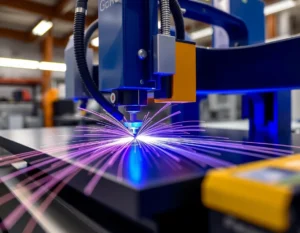
At its core, Wire EDM is a non-contact, thermoelectric machining process that uses a continuously traveling thin brass or coated wire (typically 0.02mm to 0.33mm in diameter) as an electrode. This wire, guided by computer-controlled upper and lower guides, cuts through electrically conductive material by generating a rapid series of controlled electrical sparks between the wire and the workpiece, submerged in deionized water. Each spark erodes a microscopic amount of material, and the path of the wire is precisely dictated by a CNC program, allowing for the creation of complex 2D and 2.5D shapes.
How It Specifically Applies to Splines
When cutting splines, the Wire EDM machine's CNC system follows a digital contour that defines the exact spline profile. Unlike a milling cutter that has a fixed diameter and can be limited by tool deflection and access, the wire's path is compensated for its own radius (a process called "wire offset"), allowing for the generation of sharp corners, true involute curves, and fine root details that are impossible with chip-cutting tools. The process is typically performed in multiple passes: a roughing pass to remove the bulk of material, followed by one or more finishing passes. These finishing passes use lower power settings to skim the surface, dramatically improving dimensional accuracy and surface finish, which is critical for spline functionality and fatigue life.
The Unmatched Benefits of Wire EDM for Spline Cutting
Choosing Wire EDM for spline manufacturing offers a suite of advantages that directly address the limitations of conventional machining.
Geometric Freedom and Extreme Precision
Wire EDM is not constrained by tool geometry or rigidity. It can produce internal and external splines with equal ease, including non-standard, custom, or modified profiles. Tolerances within ±0.0005" (0.0127mm) or better are routinely achievable, with exceptional repeatability across multiple parts. This is paramount for ensuring proper fit, function, and load distribution in splined couplings.
Material Versatility and Zero Mechanical Stress
Since material removal is achieved through electrical erosion, the hardness of the workpiece is virtually irrelevant. Wire EDM excels at machining hardened tool steels (D2, A2, M2), carbides, Inconel, titanium, and other exotic alloys after they have been fully heat-treated. This eliminates the risk of post-heat-treatment distortion that can plague conventionally machined splines. Furthermore, the process induces no mechanical stress, burrs, or tool marks, resulting in a ready-to-use component that often requires no secondary finishing.
Superior Surface Integrity
The multi-pass cutting strategy produces a uniform, high-quality surface finish, often better than 0.4 µm Ra (16 µin Ra) in finishing passes. This smooth surface profile reduces friction and wear in dynamic spline applications and improves fatigue resistance by minimizing micro-stress concentrators.
Key Applications Across Industries
The unique capabilities of Wire EDM spline cutting make it indispensable in several high-tech sectors.
- 航空宇宙・防衛: Manufacturing of lightweight, high-strength splined shafts for actuators, gearbox components in turbines, and precision couplings in flight control systems from materials like titanium and high-temperature alloys.
- 医療機器製造: Creating miniature, complex splines on surgical instrument drives, bone reamers, and implantable device components, where absolute precision and cleanliness are non-negotiable.
- Automotive & Motorsports: Producing prototype and production splines for transmission components, limited-slip differentials, and high-performance drive systems, often in hardened states for immediate durability testing or use.
- Mold & Die Tooling: Cutting precise ejection or alignment splines directly into hardened mold inserts and die blocks, ensuring perfect alignment over millions of cycles.
- Precision Engineering & Robotics: Fabricating custom splined couplings for servo motors, robotic joints, and optical positioning systems that demand zero backlash and high positional accuracy.
Best Practices for Mastering Wire EDM Spline Cutting
To consistently achieve optimal results, a systematic approach from design to machine operation is essential.
Design for Manufacturability (DFM)
Collaborate early with your EDM supplier. Consider the wire diameter when determining minimum internal corner radii (a rule of thumb is radius ≥ wire radius + overburn). Ensure adequate clearance for the wire to thread through start holes. Specify critical dimensions and tolerances clearly, understanding that tighter tolerances increase machining time due to additional finishing passes.
Strategic Setup and Programming
The location of the start hole is critical. It should be placed in a non-critical area of the slug (the piece of material that falls out) to avoid damaging the finished spline profile when the cut is completed. Advanced CAM software is used to generate the CNC path with correct wire offsets, skim pass sequences, and technology parameters (power, voltage, flush pressure). For complex splines, using a tapered cut (where the upper and lower guides move independently) may be necessary to create draft or undercuts, though this adds significant programming complexity.
Optimizing Cutting Parameters and Wire Selection
- Wire Type: Standard brass wires are cost-effective for most steels. Coated wires (e.g., zinc-coated or diffused) allow for higher cutting speeds and improved surface finish on challenging materials like carbides.
- Flushing: Excellent dielectric flush is paramount to evacuate eroded particles from the narrow kerf, especially in deep cuts or fine details. Adjustable flush nozzles must be positioned as close as possible to the workpiece.
- Power Settings: Use aggressive settings for roughing to maximize speed, but employ fine-tuning for finishing passes. Modern machines with adaptive control can automatically adjust parameters in real-time for consistent results.
Post-Process Considerations
While Wire EDM leaves a superior finish, the process does create a thin, hard recast layer or "white layer" on the surface. For ultra-high-cycle fatigue applications, this layer may need to be removed via a light abrasive polishing or chemical etching. Always verify critical spline dimensions with appropriate metrology, such as coordinate measuring machines (CMM) or optical comparators with spline analysis software.
Conclusion: Embracing the Capability
Mastering Wire EDM for complex spline cutting is about more than just operating a machine; it's about embracing a fundamental shift in design and manufacturing philosophy. It liberates engineers from the constraints of traditional tooling, enabling the creation of stronger, more precise, and more reliable splined components in the materials best suited for the end application. By understanding the process principles, leveraging its unique benefits, and adhering to proven best practices, manufacturers can turn the most daunting spline design into a repeatable, high-quality reality, pushing the boundaries of innovation in precision engineering.