Gradi di acciaio disponibili
| Grado |
Nome comune |
Caratteristiche principali |
Applicazioni tipiche |
| 1018 |
Acciaio dolce / Basso tenore di carbonio |
Eccellente saldabilità e formabilità. Basso costo. Non temprabile per alta durezza. |
Piastre di montaggio, staffe, perni, attrezzature, parti strutturali generiche. |
| 1045 |
Acciaio al carbonio medio |
Resistenza superiore al 1018. Può essere trattato termicamente per una durezza moderata. Buona lavorabilità. |
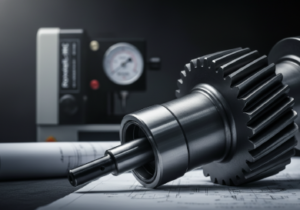
Bulloni, prigionieri, alberi idraulici, ingranaggi. |
| 4140 |
Acciaio cromoly |
Tenacità eccellente, resistenza agli urti e alla fatica. Ampiamente utilizzato in parti ad alto stress. |
Assali, alberi a gomito, ingranaggi, mandrini di fresatrici. |
| 4340 |
Acciaio legato Ni-Cr-Mo |
Resistenza e tenacità superiori, anche in sezioni spesse. Mantiene la resistenza ad alte temperature. |
Carrelli di atterraggio aerospaziali, parti di camion pesanti, ingranaggi di trasmissione di potenza. |
| 12L14 |
Acciaio a lavorabilità libera |
Contiene piombo/zolfo per velocità di lavorazione estremamente elevate. Bassa resistenza, non saldabile. |
Boccole, inserti, accoppiatori, parti per macchine a vite ad alto volume. |
| A2 / D2 |
Acciaio per utensili |
Extremely hard and wear-resistant. Used for cutting tools and dies. |
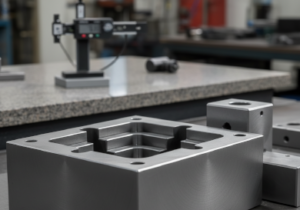
Punch dies, mold inserts, cutting blades, gauges. |
Steel Machining Capabilities
| Capacità |
Descrizione tecnica |
Vantaggio Jucheng |
| Heavy-Duty Turning |
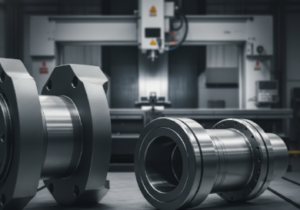
High-torque CNC turning for machining tough alloy steels into shafts, axles, and cylindrical housings. |
Capable of handling large diameter billets with rapid material removal rates for cost efficiency. |
| Hard Part Machining |
Machining steel after heat treatment (up to ~60 HRC) using PCBN or specialized carbide tools. |
Allows for final sizing after distortion from heat treatment, ensuring high precision. |
| Rettifica di precisione |
Surface and cylindrical grinding to achieve tight tolerances (+/- 0.005mm) and superior surface finishes. |
Essential for bearing surfaces and mating parts in automotive and machinery applications. |
| Elettroerosione e taglio a filo |
Using electrical discharge to cut hardened tool steels for mold making and complex internal features. |
Enables the creation of sharp corners and deep cavities that traditional milling cannot access. |
Fabrication Guidelines for Steel
Strategia di Trattamento Termico:
Steel is often machined in an annealed (soft) state, then heat-treated for hardness, and finally ground or hard-turned to finish size. This workflow balances machining speed with part durability.
Chip Control:
Low carbon steels (like 1018) can be “gummy” and produce long, stringy chips. We use chip-breaking tool geometries and high-pressure coolant to break chips into manageable sizes, preventing bird-nesting.
Surface Protection:
Unlike Aluminum or Stainless, standard steel rusts easily. Parts must be oiled immediately after machining or plated (Zinc, Nickel, Black Oxide) to prevent corrosion during shipping and storage.
Tool Coatings:
We utilize TiCN or AlTiN coated tools to withstand the high heat generated when machining alloy steels, allowing for faster speeds and longer tool life.
Principali settori di applicazione
Automotive (IATF 16949 Certified)
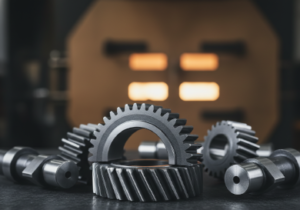
Componenti chiave: Transmission gears, crankshafts, axle shafts, engine brackets.
Why Steel: Alloy steels (like 4140/4340) provide the immense fatigue strength and toughness needed for drivetrain components.
Industrial Machinery
Componenti chiave: Hydraulic cylinders, machine base plates, heavy-duty fasteners.
Why Steel: 1018 and 1045 steels offer a cost-effective solution for structural parts requiring high rigidity.
Robotics & Automation
Componenti chiave: Motor mounts, precision guide rails, structural arms.
Why Steel: Provides the mass and stiffness required to dampen vibrations in high-speed robotic systems.
Oil & Gas
Componenti chiave: Drill bit bodies, valves, high-pressure fittings.
Why Steel: High-strength alloys withstand the extreme pressures and abrasive environments of downhole drilling.