
Si está buscando componentes de precisión para interiores aeroespaciales, bandejas de esterilización médica o carcasas electrónicas de alta frecuencia, probablemente se haya encontrado con el mecanizado de Ultem como un requisito de capacidad crítico. Este termoplástico amorfo, desarrollado por SABIC bajo el nombre de marca ULTEM™, ofrece una combinación de estabilidad térmica, resistencia mecánica y aislamiento eléctrico que pocos plásticos de ingeniería pueden igualar. Pero el mecanizado de Ultem no es como cortar acetal o aluminio. La baja conductividad térmica del material, su alta rigidez y su susceptibilidad al agrietamiento por tensión exigen un control disciplinado del proceso, herramientas especializadas y una comprensión profunda de cómo se comportan los diferentes grados bajo las fuerzas de corte. Esta guía recorre todo lo que necesita saber: qué es el plástico Ultem es, cómo mecanizar Ultem 1000 frente a Ultem 2300, los parámetros críticos que separan el éxito de la chatarra, y por qué asociarse con un taller de CNC experimentado como Jucheng Precision marca la diferencia entre una pieza que rinde y una que falla.
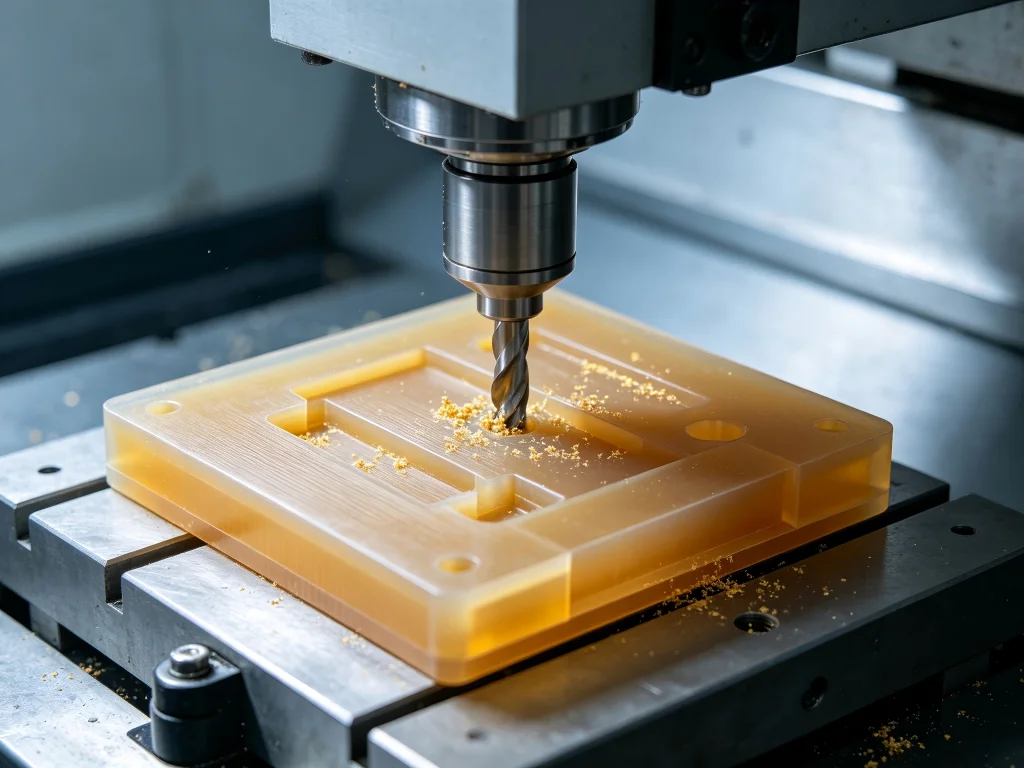
¿Qué es el plástico Ultem? Comprender el material detrás del nombre
es el plástico Ultem es el nombre de marca del polieterimida (PEI), un termoplástico de ingeniería amorfo de alto rendimiento. A diferencia de los polímeros semicristalinos que tienen puntos de fusión definidos, el Ultem se ablanda gradualmente a medida que aumenta la temperatura, creando una ventana de procesamiento estrecha donde la eliminación de material ocurre de manera eficiente sin degradación térmica. Este comportamiento único, combinado con una temperatura de transición vítrea (Tg) de 217 °C y una clasificación de temperatura de servicio continuo de 170 °C a 180 °C, lo hace adecuado para aplicaciones donde plásticos convencionales como el nailon, el acetal o el policarbonato fallarían.
La estructura molecular del material —un enlace éter para flexibilidad y procesabilidad combinado con un grupo imida para resistencia térmica y mecánica— ofrece lo que los ingenieros suelen describir como un rendimiento similar al del metal en un paquete ligero y eléctricamente aislante. Es inherentemente ignífugo, alcanzando una clasificación UL94 V-0 sin aditivos químicos, y genera un mínimo de humo, razón por la cual aparece en interiores de cabinas de aeronaves y otros entornos críticos para la seguridad contra incendios.
Propiedades clave que definen el rendimiento del Ultem
To understand why Mecanizado CNC de Ultem requiere una atención tan cuidadosa que ayuda observar las características de referencia del material:
- Rendimiento térmico: Temperatura de transición vítrea de 217 °C, servicio continuo hasta 170–180 °C. Mantiene la rigidez a temperaturas en las que la mayoría de los plásticos de ingeniería se reblandecen.
- Resistencia mecánica: Resistencia a la tracción de aproximadamente 105 MPa para el Ultem 1000, rivalizando con algunos metales fundidos. Su excelente resistencia a la fluencia hace que los componentes mecanizados mantengan tolerancias estrictas bajo esfuerzo continuo.
- Aislamiento eléctrico: Rigidez dieléctrica de aproximadamente 33 kV/mm, lo que lo hace prácticamente transparente a la radiación de microondas e ideal para componentes de RF de alta frecuencia.
- Estabilidad química e hidrolítica: Resiste fluidos automotrices, alcoholes y ácidos acuosos. Su excepcional estabilidad hidrolítica permite ciclos repetidos de esterilización en autoclave sin degradación molecular.
- Estabilidad dimensional: El bajo coeficiente de expansión térmica y la mínima absorción de humedad garantizan que las piezas conserven su geometría ante cambios de temperatura y humedad.
Estas propiedades explican por qué el mecanizado de Ultem PEI se ha vuelto esencial en múltiples industrias. Pero también explican por qué el material no da tregua en el taller: su alta rigidez y baja conductividad térmica crean desafíos que exigen respeto.
El desafío del mecanizado: por qué el Ultem es diferente
Los maquinistas experimentados suelen describir el trabajo con Ultem como más cercano al mecanizado de una cerámica frágil que al de un metal dúctil. El material produce virutas cortas y frágiles que se fracturan limpiamente cuando los parámetros son correctos, pero cuando se desvían fuera de los rangos óptimos, se observará formación de polvo pulverulento o, peor aún, vitrificación y fusión de la superficie.
Thermal Management: The Primary Enemy
Ultem’s thermal conductivity is remarkably low—approximately 0.22 W/m·K. This means heat generated during cutting concentrates at the cutting edge rather than dissipating into the bulk material or the chip. The consequences can be severe:
- Surface glazing and melting that compromises dimensional accuracy
- Tool edge buildup that degrades surface finish
- Thermal stress cracking in thin-walled sections
- Discoloration indicating thermal degradation of the polymer matrix
- Dimensional distortion as residual stresses relax post-machining
The key to successful el mecanizado de Ultem lies in removing material before heat accumulation reaches critical levels. This requires aggressive chip evacuation, appropriate cutting speeds, and often supplemental cooling strategies that go beyond standard flood coolant application.
Tool Wear and Selection
While unfilled Ultem 1000 is not as abrasive as glass-filled composites, it will still accelerate tool wear when machined incorrectly. Solid carbide tools are mandatory—high-speed steel (HSS) tools blunt too quickly. For machining Ultem 2300, the 30% glass fiber reinforcement makes the material significantly more abrasive, and many shops recommend polycrystalline diamond (PCD)-coated tools to combat rapid tool ablation.
Tool geometry matters as much as tool material. Two- or three-flute end mills provide larger gullets for efficient chip evacuation, preventing chip re-cutting and heat buildup. A higher helix angle—around 45° or more—is preferred because it provides a shearing action that reduces cutting forces.
Ultem 1000 vs. Ultem 2300: Choosing the Right Grade
One of the most common decisions in Mecanizado CNC de Ultem projects is whether to specify Ultem 1000 o Ultem 2300. The choice has significant implications for machining strategy, tooling costs, and final part performance.
| Propiedad | Ultem 1000 (Unfilled) | Ultem 2300 (30% Glass-Filled) |
|---|---|---|
| Densidad | 1.27 g/cm³ | 1,51 g/cm³ |
| Resistencia a la tracción | ~105 MPa | 17,000–20,000 psi (~117–138 MPa) |
| Flexural Modulus | ~3,200 MPa | 850,000–950,000 psi (~5,860–6,550 MPa) |
| Maquinabilidad | Easier; less tool wear; cleaner surface finish | More abrasive; requires specialized tooling; lower speeds |
| Acabado superficial | Typically smoother, more pristine | May be less smooth due to glass fibers |
| Aplicaciones típicas | Insulators, housings, brackets,精密几何形状 | High-strength structural components, reusable medical devices |
Ultem 1000 is the unfilled base grade that offers the best balance of machinability and mechanical properties. It produces chips that are easier to control and generally delivers a cleaner surface finish. For parts that require tight dimensional tolerances, complex geometries, or optical-quality surfaces, Ultem 1000 is often the preferred choice.
Ultem 2300, by contrast, offers greater rigidity and improved dimensional stability at elevated temperatures, thanks to its 30% glass fiber reinforcement. However, the glass fibers make the material more abrasive and the chips more challenging to control. Tooling costs are higher, and surface finish may not reach the same level as unfilled grades.
The decision between these grades ultimately comes down to application requirements: if stiffness and strength at temperature are paramount, Ultem 2300 may be the better choice. If machinability, surface finish, and tool life are the primary concerns, Ultem 1000 is hard to beat.
Core Applications: Where Ultem Machining Delivers Value
es el plástico Ultem finds its way into some of the most demanding engineering applications across multiple industries. Understanding these use cases helps clarify why el mecanizado de Ultem has become such a critical capability.
Aeroespacial y Aviación
The aerospace industry is perhaps the largest consumer of machined Ultem components. The material’s inherent flame retardance (UL94 V-0), low smoke emissions, and high strength-to-weight ratio make it ideal for aircraft interior components. Specific applications include:
- Cabin interior components that must meet FAR 25.853 flame requirements
- Instrument housings and bracketry that require dimensional stability across temperature extremes
- Electrical connectors and insulators where dielectric performance is critical
- Radome assemblies that must be transparent to microwave radiation
Medical Devices and Healthcare
Ultem’s biocompatibility and ability to withstand repeated autoclave sterilization cycles make it a material of choice for medical applications. The material maintains its properties through harsh sterilization methods that would destroy lesser plastics. Common medical applications include:
- Reusable surgical instruments and handles
- Medical device housings and probe enclosures
- Sterilization trays and containers
- Analytical instrument components
Electronics and Semiconductor
The electrical insulation properties of Ultem—high dielectric strength and stable dielectric loss factor across a broad frequency range—make it a standard material for high-frequency electronic applications. Semiconductor process components, electrical insulators, and connector bodies are typical applications.
Automoción
Under-hood automotive applications benefit from Ultem’s heat resistance and dimensional stability. The material performs reliably in the high-temperature environments found in engine compartments and transmission systems.
Critical Selection Factors: What to Look For in an Ultem Machining Partner
Not every CNC shop is equipped to handle el mecanizado de Ultem PEI successfully. The material’s sensitivity to heat, stress, and tool wear means that capability, experience, and process control matter enormously. Here are the key factors to evaluate when selecting a machining partner for your Ultem components.
Tooling Expertise and Inventory
el mecanizado de Ultem requires specialized tooling—solid carbide end mills with specific geometries, and for glass-filled grades, PCD-coated tools. A shop that understands the difference between machining Ultem 1000 and Ultem 2300, and stocks the appropriate tooling for each, is already ahead of the curve. Ask potential partners about their tool selection protocols for high-performance plastics.
Thermal Management Capabilities
Because heat is the primary enemy in Mecanizado CNC de Ultem, a shop’s approach to thermal management is critical. This includes everything from cutting speed and feed rate selection to coolant strategy and chip evacuation. Shops that have experience with high-performance polymers will have established protocols for managing heat—aggressive chip evacuation, appropriate cutting speeds, and cooling strategies that go beyond standard flood coolant.
Stress Relief and Annealing Protocols
Ultem is susceptible to environmental stress cracking (ESC) when exposed to certain polar organic solvents, and internal stresses from machining can lead to warping or cracking over time. Experienced shops perform stress-relief annealing—heat treatment cycles both before and after machining—to relieve internal stresses and ensure long-term dimensional stability. For high-precision or large Ultem 1000 parts, stress relief before and after CNC machining may be necessary to reduce warping, cracking, or dimensional changes caused by internal stresses.
Quality Control and Metrology
Aerospace, medical, and semiconductor applications typically require tight tolerances—often in the ±0.01–0.02 mm range. A shop’s quality control capabilities, including CMM (coordinate measuring machine) inspection, optical comparators, and surface profilometers, directly impact whether your parts meet specifications.
Material Sourcing and Traceability
Ultem is available in sheet, rod, plate, block, and resin forms. The quality of the raw material matters, and shops that source from reputable suppliers and maintain full traceability provide an additional layer of assurance.
Best Practices for Successful Ultem CNC Machining
Whether you are machining Ultem in-house or outsourcing to a specialized shop, understanding the best practices helps you ask the right questions and set appropriate expectations.
Cutting Parameters: Starting Points
Para machining Ultem 1000, recommended roughing parameters with carbide tooling are 500–900 SFM with a chip load of 0.004–0.007 inches per tooth for a 1/2-inch end mill. For finishing, 700–1200 SFM with a chip load of 0.002–0.003 inches per tooth. For Ultem 2300, reduce speeds to 350–700 SFM with a chip load of 0.003–0.005 inches per tooth.
These are first-pass starting points. Actual parameters depend on machine rigidity, tool geometry, coolant application, and part geometry. The goal is to remove material efficiently while preventing heat accumulation at the cutting edge.
Tool Geometry and Coatings
End mills with 2 or 3 flutes provide larger chip clearance than 4-flute designs. A helix angle of 45° or more produces a shearing action that reduces cutting forces and heat generation. For glass-filled grades, diamond coatings or PCD tools extend tool life significantly.
Workholding Considerations
Ultem’s relatively low modulus of elasticity compared to metal makes it more susceptible to deformation under clamping pressure. Excessive or poorly distributed clamping force can cause the material to bow or flex, resulting in out-of-tolerance dimensions once the clamps are released. For thin-walled or complex geometries, machining-induced stresses can cause the part to warp after it is cut free from the stock material.
Coolant and Chip Evacuation
Proper chip evacuation is essential to prevent chip re-welding onto the machined surface. While flood coolant is common, some shops use air blast or mist systems to avoid thermal shock that can occur when cold coolant hits a hot cutting zone. The right approach depends on the specific operation, tooling, and part geometry.
Avoiding Sharp Corners
Applying radii to internal corners relieves stress concentrations and reduces tool wear. Sharp internal corners can cause the brittle material to chip or break out, especially when exiting a cut.
Why Jucheng Precision for Ultem Machining
With over a decade of experience in precision manufacturing, Jucheng Precision has built a reputation for handling demanding engineering thermoplastics, including Ultem (PEI). Founded in Shenzhen in 2012, the company operates from an 8,000-square-meter facility with over 190 employees, including 30 highly skilled technical personnel.
The facility houses more than 150 CNC machines, including 25+ Haas and Mazak units covering 3-axis, 4-axis, turning, grinding, wire EDM, and sinker EDM. This extensive equipment base allows Jucheng to handle everything from prototyping through low-volume and high-volume production runs.
Para Mecanizado CNC de Ultem specifically, Jucheng has developed specialized protocols that address the material’s unique challenges:
- Specialized tooling: Razor-sharp carbide tools with specific ramp-in strategies for Ultem to ensure pristine surface finish
- Stress-relief annealing: Precise heat treatment cycles both before and after machining to relieve internal stresses and ensure long-term dimensional stability
- Quality certifications: ISO 9001:2015, ISO 14001, ISO 13485 (medical devices), and IATF 16949 (automotive)
- Advanced metrology: CMM, optical comparator, surface profilometer, and hardness tester supporting typical tolerances of ±0.005mm
- Rapid turnaround: Quotes within hours, parts as fast as 4 days
Jucheng’s testing has shown that for load-bearing brackets that do not see friction, Ultem is often the technically superior choice over alternatives like PEEK. The company’s experience across aerospace, medical, semiconductor, and automotive industries means they understand the specific requirements of each sector—from FAA flame ratings to USP Class VI biocompatibility.
Frequently Asked Questions About Ultem Machining
What is the difference between Ultem 1000 and Ultem 2300?
Ultem 1000 is the unfilled base grade offering the best balance of machinability and mechanical properties. Ultem 2300 contains 30% glass fiber reinforcement, providing greater stiffness and dimensional stability at elevated temperatures but with more abrasive machining characteristics and higher tooling costs.
Can Ultem be machined to tight tolerances?
Yes. With proper setup, tooling, and process control, Mecanizado CNC de Ultem can achieve tolerances of ±0.01–0.02 mm. Jucheng Precision routinely holds tolerances of ±0.005mm with appropriate part geometry and process controls.
What tooling is recommended for machining Ultem?
Solid carbide tools are mandatory—HSS tools blunt too quickly. For Ultem 1000, sharp carbide end mills with 2 or 3 flutes and a 45°+ helix angle work well. For Ultem 2300, PCD-coated or diamond tools are recommended to combat the abrasive effects of glass fibers.
Why does Ultem require annealing?
Ultem is susceptible to stress cracking and warping from internal stresses generated during machining. Stress-relief annealing—heat treatment cycles before and after machining—relieves these internal stresses and ensures long-term dimensional stability. This is particularly important for high-precision or large parts.
What industries use machined Ultem components?
Aerospace (cabin interiors, instrument housings), medical devices (surgical instruments, sterilization trays), electronics and semiconductor (insulators, connectors), and automotive (under-hood components) are the primary industries.
Is Ultem difficult to machine?
Ultem is more challenging than standard engineering plastics like acetal or nylon. Its low thermal conductivity traps heat at the cutting edge, and its high rigidity makes it prone to brittle fracture if parameters are incorrect. However, with appropriate tooling, cooling, and process control, el mecanizado de Ultem PEI can be performed reliably and repeatably.
What surface finish can be achieved with machined Ultem?
Typical machined finishes range from Ra 3.2 μm (125 μin) to finer values depending on machining requirements. Ultem 1000 generally produces a cleaner surface than Ultem 2300 due to the absence of glass fibers.
How does Ultem compare to PEEK for CNC machining?
Both are high-performance thermoplastics, but they have different strengths. PEEK offers higher continuous service temperature (260°C vs. 170–180°C for Ultem). However, Ultem is often the technically superior choice for load-bearing brackets that do not see friction, and it is generally easier to machine than PEEK. The choice depends on the specific application requirements.
Whether you are specifying Ultem 1000 for a精密 electronic housing or Ultem 2300 for a high-strength aerospace bracket, understanding the material’s properties, machining challenges, and best practices is essential for success. Partnering with an experienced shop like Jucheng Precision—with the right tooling, process controls, and quality systems in place—ensures your components meet specification the first time, every time.
Ready to discuss your next Ultem machining project? Contact Jucheng Precision for a quick quote and engineering consultation.