
In the intricate world of precision engineering, threaded parts machining represents a fundamental intersection of geometry, material science, and mechanical utility. Whether it is a tiny fastener in a medical device or a massive lead screw in industrial equipment, the ability to create accurate, repeatable threads is what allows complex systems to be assembled, adjusted, and maintained. For engineers and procurement specialists looking for threaded machine parts, understanding the nuances of how these components are manufactured is essential for ensuring the structural integrity of their final products.
The manufacturing landscape has shifted significantly with the advent of advanced CNC technology. Today, a threading machine parts shop must leverage multi-axis lathes and milling centers to meet the tightening tolerances required by the aerospace, automotive, and electronics sectors. This guide provides an encyclopedic look at the processes, standards, and strategic considerations involved in producing high-quality machined threads, while highlighting why jucheng remains a leader in this specialized field.
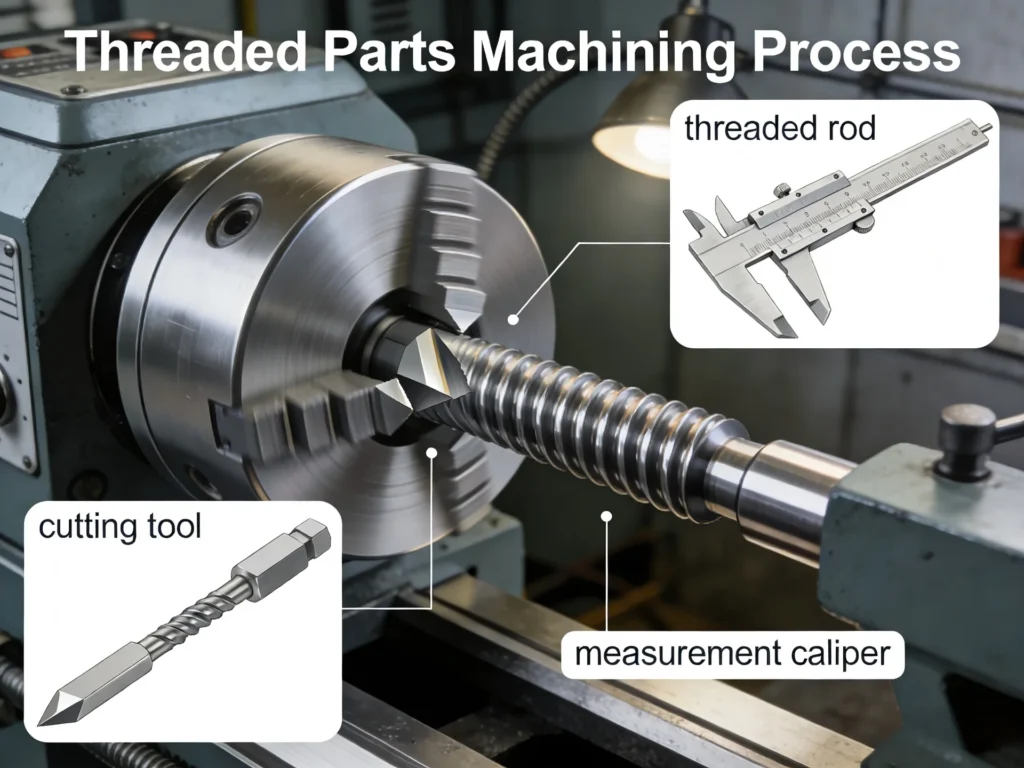
Understanding the Fundamentals: What Are Machined Parts with Threads?
To answer the question of what are machined parts, one must look at the subtractive manufacturing process. These are components created by removing material from a raw workpiece—typically a metal bar or plastic block—to achieve a specific shape. Within this category, threaded components are unique because they feature a continuous helical ridge. This ridge, or thread, allows for the conversion between rotational and linear motion or the secure fastening of two components.
When discussing threaded machine parts, we often categorize them by their physical location: external threads (found on bolts and screws) and internal threads (found in nuts or tapped holes). The threading machining process must account for several critical dimensions, including the major diameter, the minor diameter, and the pitch. The pitch is the distance from one thread crest to the next, and its accuracy determines how well the parts will mate during assembly. On platforms like Reddit, many hobbyists and junior engineers often discuss the “feel” of a thread, but in a professional setting, this is replaced by rigorous metrology and Go/No-Go gauge testing to ensure every part adheres to global standards like ISO or Unified Thread Standard (UTS).
The Technical Breakdown of the Threading Machining Process
The threading machining process is not a one-size-fits-all operation. Depending on the volume, material, and required precision, several different methods could be employed. Modern facilities like jucheng utilize a combination of these techniques to optimize both cost and quality.
1. Single-Point Threading on a Lathe
This is perhaps the most versatile method. In this process, a cutting tool with a specific profile moves longitudinally along the rotating workpiece. Each pass removes a small amount of material until the full thread depth is reached. Engineers may choose this for large diameters or custom pitches that standard taps cannot accommodate.
2. Thread Milling
Unlike turning, thread milling uses a rotating tool on a 3-axis or 5-axis CNC mill. This is particularly useful for large internal threads or when the part is too bulky to rotate on a lathe. It offers excellent chip control and reduces the risk of a broken tool becoming stuck in a high-value workpiece—a common “horror story” shared in Facebook machining groups.
3. Tapping and Die Cutting
For standard threading machine parts name conventions like M6 or 1/4-20, tapping is the go-to solution for internal threads. Modern CNC machines use “rigid tapping,” where the spindle rotation and feed rate are perfectly synchronized to create flawless threads at high speeds.
Common Types of Machine Parts and Their Threading Requirements
In any industrial catalog, you will find a vast array of types of machine parts that rely on threads. These are often categorized by their function within a machine. Understanding the types of threading in lathe machine operations allows designers to select the right geometry for the job.
- Fastening Parts: These include bolts, screws, and studs designed to hold assemblies together. They usually require high tensile strength and consistent pitch.
- Transmission Parts: Lead screws and power screws that convert rotary motion to linear motion. These require high precision and smooth surface finishes to reduce friction.
- Adjustment Parts: Found in optical instruments or measuring tools where fine threads allow for microscopic movements.
- Fluid Power Components: NPT or BSPT threaded fittings used in hydraulic systems to create leak-proof seals.
The following table illustrates the comparison between common thread standards often requested at a professional threading machine parts shop:
| Thread Standard | Measurement Unit | Typical Application | Key Characteristic |
|---|---|---|---|
| Metric (ISO) | Millimeters | Global Automotive & Electronics | 60° thread angle, universal compatibility. |
| UNC/UNF (UTS) | Inches | North American Aerospace & Machinery | Coarse (UNC) for strength; Fine (UNF) for vibration resistance. |
| NPT | Inches (Tapered) | Plumbing & Hydraulic Systems | Tapered design creates a pressure-tight seal. |
| Acme | Inches/Metric | Vises, Jacks, CNC Lead Screws | Trapezoidal shape for high load transmission. |
Core Application Scenarios for Threaded Parts
The demand for high-quality threaded parts machining spans across almost every high-tech industry. At jucheng, we see these components integrated into various critical environments:
Automotive and Transportation
In the automotive sector, threaded machine parts are found in engine blocks, suspension systems, and transmission housings. These parts must withstand extreme thermal cycling and constant vibration. Using threading machine parts name identifiers like “grade 8 bolts” is common here to denote high-strength requirements.
Aerospace and Defense
Weight reduction is the primary goal in aerospace. Consequently, many threaded machine parts are made from titanium or high-strength aluminum alloys. The threading machining process for these materials is complex because titanium tends to “gall” or stick to the cutting tool, requiring specialized coatings and cooling techniques.
Medical Device Manufacturing
Small-scale threaded parts machining is vital for orthopedic implants and surgical instruments. These parts must be bio-compatible and feature burr-free threads to prevent contamination or tissue irritation. jucheng employs high-precision Swiss-type lathes to handle these delicate types of machine parts.
Critical Factors When Selecting a Threading Machine Parts Shop
Choosing the right partner for threaded parts machining is a decision that impacts the entire lifecycle of your product. If you are browsing a threading machine parts shop, consider the following technical and business factors:
- Precision and Tolerances: Can the shop hold a “Class 3” fit? For critical assemblies, the tolerance on the pitch diameter is incredibly tight. Ask for their inspection reports.
- Material Expertise: Machining threads in 316 Stainless Steel is vastly different from machining them in Brass or PEEK plastic. Ensure the shop has experience with your specific alloy.
- Quality Certification: Look for ISO 9001 or AS9100 certifications. These guarantee that the shop follows standardized procedures for every threading machining process.
- Lead Times and Scalability: A shop like jucheng offers both rapid prototyping and high-volume production, which is essential for taking a product from concept to market.
- Surface Finishing: Threads often require post-processing, such as anodizing, plating, or heat treatment, to improve wear resistance or prevent corrosion.
Installation and Maintenance of Threaded Components
Even the most perfectly executed threaded parts machining can fail if not installed or maintained correctly. In the field, technicians may encounter “cross-threading,” which occurs when the threads are misaligned during initial engagement, leading to permanent damage.
To prevent this, always start threads by hand before using power tools. Lubrication is also vital; applying a small amount of anti-seize compound may prevent galvanic corrosion in environments where different metals are in contact. For maintenance, using a thread pitch gauge can help identify threaded machine parts that have become deformed due to over-torquing. If a thread is stripped, options like Helicoil inserts can often restore the functionality of the part without requiring a full replacement.
Why Jucheng is the Leader in Threaded Parts Machining
In a competitive global market, jucheng (https://www.jccncmachining.com/) distinguishes itself through a relentless focus on engineering excellence and customer-centric service. We understand that threaded parts machining is more than just cutting metal; it is about providing a reliable foundation for our clients’ innovations.
Our facility is equipped with state-of-the-art CNC turning and milling centers capable of handling the most complex types of threading in lathe machine operations. Whether you require a single custom component or a production run of ten thousand threaded machine parts, our team applies the same level of rigorous quality control. We utilize advanced optical comparators and thread gauges to verify every dimension, ensuring that when our parts arrive at your facility, they fit perfectly every time.
Furthermore, jucheng offers extensive material options, ranging from standard aerospace-grade aluminum to exotic inconel alloys. Our engineers are available to consult on the best threading machining process for your specific application, potentially saving you costs by optimizing the design for manufacturability (DFM). By choosing jucheng, you are not just hiring a threading machine parts shop; you are gaining a strategic partner dedicated to your success.
Frequently Asked Questions (FAQ)
1. What is the difference between cut threads and rolled threads?
Cut threads are made by removing material via the threading machining process, while rolled threads are formed by pressing the material into shape. Cut threads are generally more versatile for low-volume or high-precision custom threaded machine parts, whereas rolled threads are often stronger and better for mass-produced fasteners.
2. How do I choose the right thread pitch for my application?
Generally, coarse threads (like UNC) are better for brittle materials or when fast assembly is required. Fine threads (like UNF) provide higher tension and are less likely to loosen under vibration. Consulting with an expert at jucheng can help you determine the optimal pitch for your specific types of machine parts.
3. Can you machine internal threads in very hard materials?
Yes, but it requires specialized carbide tooling and often a slower threading machining process. In some cases, electrical discharge machining (EDM) may be used if the material is too hard for traditional cutting tools.
4. What is “galling” and how can it be prevented in threaded parts?
Galling is a form of wear caused by adhesion between sliding surfaces. It is common in stainless steel and titanium threaded machine parts. It may be prevented by using dissimilar metals, applying specialized coatings, or using high-quality lubricants during assembly.
5. What are the most common threading machine parts name conventions I should know?
You should be familiar with terms like “Major Diameter,” “Pitch,” “Lead,” and “Flank Angle.” Additionally, understanding the difference between “Tapered” (like NPT) and “Straight” threads is crucial for fluid-handling applications.
6. How does Jucheng ensure the quality of internal threads?
We use a combination of precision Go/No-Go plug gauges, coordinate measuring machines (CMM), and visual inspection. For critical internal threaded parts machining, we can also perform cross-sectional analysis during the first-article inspection phase.
7. Is it possible to machine custom thread profiles?
Absolutely. Using CNC types of threading in lathe machine setups, we can program virtually any helical profile, including square threads, buttress threads, or custom variable-pitch designs for specialized industrial applications.
8. What information do I need to provide for a quote?
Ideally, a 2D technical drawing specifying the thread standard, tolerance class, material, and surface finish. If you only have a 3D model, our team at jucheng can help extract the necessary threading specifications to begin the threading machining process.
For more information on how we can assist with your next project, please visit our website or contact our engineering team directly. We are committed to providing the highest quality threaded parts machining solutions in the industry.
Ready to elevate your project with precision? Contact jucheng today for a detailed quote on your custom threaded machine parts. Our experts are standing by to ensure your components meet the highest global standards of accuracy and durability.