
The Problem — When “Anodizing Services for Machined Parts” Becomes a Procurement Nightmare
You have just received a batch of precision-machined aluminum components back from the anodizer. The samples looked flawless — a clean, uniform clear finish with just the right amount of luster. But now, looking at the actual production run, you feel your stomach tighten. The finish is inconsistent. Some parts have turned a dark, splotchy gray. Others show bright streaks running down one side. Several pieces have what looks like shadow marks where the coating barely seems to have taken at all. A few have already started developing small white specks — early signs of corrosion. Your customer is expecting delivery next week, and you are now looking at thousands of dollars worth of parts that may be destined for the scrap bin.
This scenario may sound uncomfortably familiar if you have ever sourced anodizing services for machined parts without a thorough understanding of what the process actually entails — and without a clear set of criteria for evaluating potential finishing partners. Online forums and discussion groups frequently surface similar horror stories. One machinist on Practical Machinist described sending 500 parts to an ISO-registered anodizer after receiving promising samples, only to receive back a batch that was “an absolute disaster” — dark gray finishes on parts that were supposed to be clear, splattered discoloration, and bright streaks that rendered the entire lot scrap, representing over $6,000 in lost value[reference:0]. A motorcycle parts manufacturer on Webike reported that their black anodized components faded to an uneven bronze color within just three months of exposure to sunlight — a clear indication of poor sealing or inadequate UV stability in the dye[reference:1].
The frustration expressed across these communities is palpable. On Reddit and Facebook machining groups, engineers frequently ask for recommendations for reliable anodizing services for machined parts near me, but the responses are often mixed — some users rave about a particular shop, while others warn of poor quality control, missed deadlines, or finishes that do not match the promised color. One Facebook group member noted that “there’s a lot of mixed reviews about quality of work,” adding that while some anodizers take a rigid “this way or no way” approach, others are more flexible but inconsistent in their results. The problem, as many experienced procurement professionals have discovered, is not that quality anodizing is impossible to find. Rather, the challenge lies in knowing what to look for, what questions to ask, and how to distinguish a truly capable finishing partner from one that simply talks a good game.
This guide walks you through exactly what makes anodizing services for machined parts succeed or fail. By the end, you will understand the process well enough to ask the right questions, evaluate potential suppliers with confidence, and avoid the expensive mistakes that have frustrated so many engineers and procurement professionals before you. And if you are currently searching for anodizing services for machined parts in USA, Canada, the UK, or other global markets, you will have a practical framework for making the right choice — whether that partner ends up being Jucheng or another provider that meets your specific requirements.
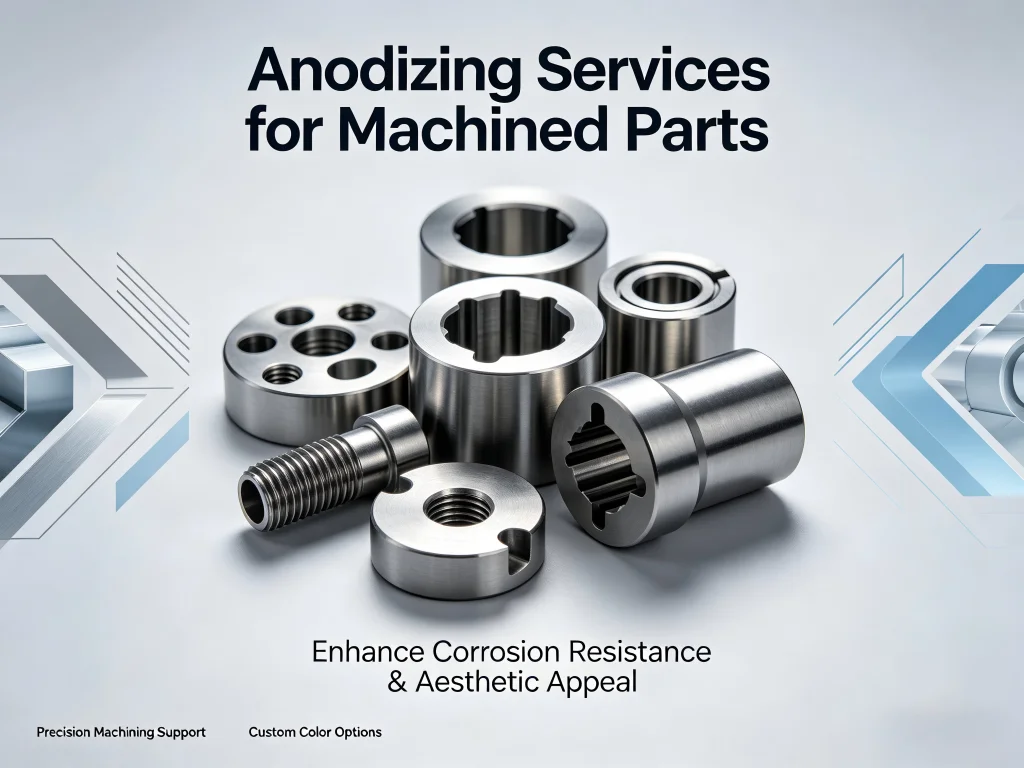
Before you can effectively evaluate potential suppliers of anodizing services for machined parts, you need a solid grasp of what the process actually does to your components. Many engineers mistakenly think of anodizing as simply a type of paint or coating that gets applied to the surface. This misconception leads to poor specifications, unrealistic expectations, and ultimately, disappointing results.
Anodizing is fundamentally different from painting, powder coating, or plating. It is an electrochemical passivation process that transforms the outer layer of the aluminum itself into a durable, corrosion-resistant aluminum oxide ceramic. When a CNC-machined part is submerged in an acidic electrolyte bath — typically sulfuric acid — and an electrical current is applied, the aluminum surface acts as the anode. Oxygen ions from the electrolyte react with the aluminum atoms on the surface, building up a porous crystalline oxide layer that grows both outward from the surface and inward into the substrate[reference:2].
Because this oxide layer is actually part of the metal rather than something stuck on top, it cannot chip, flake, or peel away from the substrate the way a paint layer could. Anodized aluminum develops a surface that is approximately three times tougher than untreated aluminum, and the finish remains intact even after being colored or subjected to significant mechanical stress[reference:3]. The porous nature of the freshly anodized surface also makes it highly receptive to dyes, which is how you achieve those vibrant red, blue, gold, black, and other colored finishes.
After the anodizing and dyeing steps, the parts must be sealed — typically in hot deionized water or a nickel acetate solution — to close the pores, lock in the color, and maximize corrosion resistance. This sealing step is critical. Poor sealing is one of the most common reasons why anodized parts fail prematurely, yet it receives far less attention in specifications than anodizing thickness or type. One industry source notes that properly sealed Type II anodic coatings per MIL-A-8625 must withstand 336 hours of salt spray testing — a standard that many low-quality finishing shops fail to meet[reference:4].
Types of Anodizing You Need to Know About
When you evaluate anodizing services for machined parts, you will encounter three main process types, each suited to different applications:
- Type I (Chromic Acid Anodizing): Produces a relatively thin coating, typically 0.5 to 5 micrometers thick. This type may be specified for aerospace or defense components where minimal dimensional change and fatigue reduction are critical concerns[reference:5]. However, environmental restrictions on chromium have made this process less common in recent years, with many shops moving toward non-chromate alternatives.
- Type II (Sulfuric Acid Anodizing): The most widely used process for general-purpose anodizing services for machined parts. It produces a coating thickness of 5 to 30 micrometers and provides excellent corrosion resistance while remaining compatible with a wide range of dye colors[reference:6]. This type is appropriate for consumer products, electronic enclosures, automotive trim, and many industrial components that require both protection and aesthetic appeal.
- Type III (Hard Anodizing): Also known as hardcoat anodizing, this process produces a much thicker and harder coating — typically 25 to 100 micrometers, with hardness values reaching 500 to 700 HV. The process is run at near-freezing temperatures (0 to 5 degrees Celsius) and higher voltages (25 to 100 volts) to achieve this dense, wear-resistant layer[reference:7]. Type III is specified for components subjected to harsh environments, high abrasion, or severe wear — think hydraulic valve bodies, precision sliding bearings, and aerospace structural brackets. Salt spray resistance for Type III coatings may exceed 336 hours when properly sealed[reference:8].
A quick comparison of these types, based on published industry data, may help you decide which specification fits your application:
| Characteristic | Type I (Chromic Acid) | Type II (Sulfuric Acid) | Type III (Hard Anodizing) |
|---|---|---|---|
| Coating Thickness | 0.5–5 µm | 5–30 µm | 25–100 µm |
| Surface Hardness (HV) | 150–200 | 200–300 | 500–700 |
| Corrosion Resistance (Salt Spray) | ~336 hrs sealed | 336+ hrs sealed | 336+ hrs, up to 1000+ |
| Color Options | Limited | 12+ standard colors | Primarily black/bronze |
| Wear Resistance | Low | Medium | High (60-70 Rc equivalent) |
| Typical Applications | Aerospace, fatigue-sensitive | Casing, enclosures, trim | Hydraulics, bearings, tools |
Specification Matters — Not All Anodizing Services for Machined Parts Deliver the Same Results
One of the most common mistakes engineers make when sourcing anodizing services for machined parts is assuming that any anodizer can handle any aluminum alloy. This assumption has led to countless disappointing results, as different alloy families respond very differently to the anodizing process.
The table below summarizes how common aluminum alloys typically perform when sent for anodizing services for machined parts, based on industry-standard compatibility data:
| Aluminum Alloy | Anodizing Compatibility | Key Considerations | Suitable For |
|---|---|---|---|
| 6061 | Excellent | Performs well for both decorative (Type II) and hardcoat (Type III) anodizing. Minimal pitting tendency. Clear, bright finishes achievable. | General machining, structural components, automotive frames, bicycle parts, electronics enclosures |
| 6063 | Excellent | Often used in architectural applications. Produces consistent, uniform finishes. Excellent for clear and colored Type II anodizing. | Architectural extrusions, trim, tubing, consumer products |
| 7075 | Good (hardcoat); Fair (decorative) | Hard anodizes exceptionally well due to zinc content. Decorative anodizing may produce darker, less uniform finishes. Not ideal for bright colors. | Aerospace, high-stress structures, hardcoat applications, molds |
| 2024 | Fair | Copper content creates challenges (pitting, darkening). Best suited for Type I (chromic) or specifically optimized Type II processes. Decorative anodizing not recommended. | Aerospace (with proper process controls), fatigue-sensitive applications |
| 5052 | Good | Magnesium content affects dye uptake. Corrosion resistance is naturally good. Clear or light colors work best. May show slight color variations. | Marine components, sheet metal parts, fuel tanks |
| 6082 | Excellent | Very similar to 6061 in anodizing behavior. Good for both Type II and Type III. Consistent, uniform finishes typical. | Structural, mechanical, transportation, general engineering |
The underlying issue is that alloying elements like copper, silicon, and magnesium affect how the oxide layer forms. High-copper alloys such as 2024 may produce an uneven or darkened finish unless the anodizer adjusts the process parameters specifically for that material. Many providers of anodizing services for machined parts do not take the time to optimize their process for each alloy — they run everything through the same bath and hope for acceptable results. A skilled anodizer, by contrast, will adjust bath chemistry, temperature, voltage ramp rates, processing time, and even use specialty additives to achieve a uniform finish on challenging alloys[reference:9].
Forum discussions consistently highlight this as a critical distinction between quality shops and those that consistently produce disappointing results. One anodizing professional on Reddit explained that “surface prep is very important” and that “since anodize is not an additive coating, imperfections in the base metal will show through in the end.” Another user in a Facebook machining group noted that getting good results on used or previously finished parts is much harder than working with brand new, clean machined components — emphasizing that surface preparation and material condition matter as much as the anodizing process itself.
What to Look For When You Search for Anodizing Services for Machined Parts Near Me
When you begin searching for anodizing services for machined parts near me or exploring options across regions like anodizing services for machined parts in canada or anodizing services for machined parts uk, you may find dozens of potential suppliers. Here is a structured way to evaluate them and avoid the costly mistakes described at the beginning of this guide.
Certifications and Quality Management Systems
Do not simply accept a supplier’s word that they provide quality anodizing services for machined parts. Look for verifiable certifications. An ISO 9001:2015 certification indicates a basic level of quality management, but more specialized certifications signal higher capability. For aerospace or medical components, look for NADCAP accreditation — a credential held by only the most rigorous finishing shops. One UK-based finishing service notes that their “extensive network of NADCAP, CAA and ISO-approved suppliers” is what allows them to serve demanding industries like aerospace, automotive, and defense[reference:10]. For automotive applications, IATF 16949 certification may be relevant, while AS9100 indicates aerospace-grade quality systems.
Jucheng, for example, operates under ISO 9001:2015 and ISO 13485:2016 certifications — the latter being particularly significant for medical device components where traceability and process validation are non-negotiable[reference:11].
Process Control and Consistency Capabilities
The difference between an acceptable and an exceptional provider of anodizing services for machined parts often comes down to process control. Ask potential suppliers about their monitoring systems. Do they continuously monitor bath chemistry, temperature, voltage, and current density throughout the run? Do they document these parameters for traceability? Do they perform regular salt spray testing on process panels to validate corrosion resistance?
Reputable shops will typically run Type II and Type III processes in accordance with MIL-A-8625 and may also meet AMS, ASTM B580, or ISO 7599 standards[reference:12]. They will understand the specific requirements for process control testing, including the monthly salt spray validation required by the MIL spec for sealed Type II coatings — a detail that less capable shops may overlook or simply ignore.
One anodizing engineer in an online technical forum explained that achieving consistent results on complex geometries — such as parts with deep bores, sharp internal corners, or threaded features — requires careful racking design, solution agitation, and potentially auxiliary anodes. If a supplier cannot explain how they handle these challenges, you may want to keep looking.
Turnaround Time and Logistics for Global Supply Chains
If your supply chain spans multiple continents, you may need anodizing services for machined parts in usa for one product line and similar services in Asia or Europe for another. Look for suppliers with a global footprint that can deliver consistent quality across locations. Some finishing companies operate facilities in North America, Europe, and Asia, allowing customers to maintain a single specification and process standard while reducing transportation costs and lead times[reference:13].
For urgent requirements, some shops offer expedited turnaround. Jucheng, for instance, can deliver finished parts — from machining through to anodizing — in as quickly as 2 days for certain orders, with global delivery in 3 to 5 days[reference:14]. This capability, while not always necessary for every project, can be invaluable for prototype validation or emergency production runs.
Where Anodizing Services for Machined Parts Make the Biggest Difference
Anodizing services for machined parts support a remarkably wide range of industries, each with distinct priorities and performance requirements. Understanding how your specific application aligns with these industry norms can help you communicate more effectively with potential finishing partners.
- Aerospace: The aerospace industry was among the earliest adopters of anodizing, dating back to the 1920s when seaplane parts made of Duralumin were anodized for saltwater corrosion protection[reference:15]. Today, the industry relies on anodizing for components such as helicopter rotor blades, avionic cases, instrument panels, airframe skins, and satellite components[reference:16]. The emphasis here is on strict adherence to MIL-A-8625 specifications, fatigue resistance, and coating uniformity.
- Automotive: Modern vehicles use anodized aluminum for frames, wheels, pistons, bumpers, and various trim components. Motorcycle suspension components often receive Type II or Type III anodizing for both corrosion protection and aesthetic appeal[reference:17]. The challenge in automotive applications is achieving consistent color matching across high-volume production runs while maintaining competitive per-part costs.
- Medical: Surgical instruments, medical device housings, and implantable device components may all benefit from anodizing. The ISO 13485:2016 certification held by Jucheng signals the level of quality management and traceability required in this highly regulated sector[reference:18].
- Marine and Defense: Components exposed to saltwater environments — from boat fittings to defense electronics housings — demand exceptional corrosion resistance. Type III hard anodizing with enhanced sealing is often specified for these applications to survive prolonged exposure to harsh conditions.
- Consumer Electronics: Smartphone casings, laptop enclosures, wearable device housings, and high-end audio equipment frequently feature anodized aluminum finishes. In this sector, aesthetics matter as much as function — color consistency, scratch resistance, and tactile feel are all critical quality attributes.
One forum participant summarized the value proposition clearly when discussing anodized engine castings: the finish was applied “for corrosion protection” and resulted in a “pale grey matt finish” that served its protective function without adding significant cost or complexity to the manufacturing process. This pragmatic approach — applying the minimum necessary finish to achieve the required performance — is often the most cost-effective strategy for industrial components.
Conversely, when aesthetics are paramount — such as on visible automotive trim or premium consumer goods — more rigorous process controls and potentially multiple finishing steps may be justified.
Frequently Asked Questions About Anodizing Services for Machined Parts
Drawing from common questions raised on Reddit, Facebook machining groups, and engineering forums, here are answers to the most frequently asked questions about anodizing services for machined parts.
Can any aluminum alloy be anodized successfully?
Not all alloys anodize equally well. 6061, 6063, and 6082 produce excellent results for both decorative and hardcoat anodizing. 7075 anodizes well for Type III applications but may produce darker, less uniform decorative finishes. 2024 is challenging due to its copper content and may require specialized process parameters to avoid pitting or darkening. The table in Part 3 provides more detailed alloy-specific guidance.
What is the difference between Type II and Type III anodizing?
Type II (sulfuric acid anodizing) produces a coating thickness of 5 to 30 micrometers with hardness around 200–300 HV. It supports a wide range of dye colors and is appropriate for general corrosion protection and decorative applications. Type III (hard anodizing) produces a thicker, denser coating — 25 to 100 micrometers thick with hardness reaching 500–700 HV — suitable for wear-resistant components exposed to harsh environments. Type III typically costs more and is limited in color options, generally available only in black, gray, or bronze tones.
How long does anodized finish typically last?
Properly anodized and sealed parts can last for decades, even in outdoor environments. The key variables are coating thickness, seal quality, and environmental exposure conditions. Sealed Type II coatings per MIL-A-8625 must withstand 336 hours of salt spray testing, which correlates with many years of real-world corrosion resistance in most environments[reference:19]. However, poor-quality anodizing — particularly inadequate sealing — may show signs of degradation in as little as a few months, as seen in the motorcycle parts example earlier[reference:20].
Can anodized parts be stripped and re-anodized if the finish is unacceptable?
Yes, but with caveats. Stripping removes material, which changes the dimensions of the part — typically reducing outside dimensions by the thickness of the removed oxide layer. Forum discussions indicate that stripping and re-anodizing multiple times can cause fit issues, especially on close-tolerance components. One experienced user noted that they have seen parts re-anodized five times before acceptable results were achieved, but each cycle altered the part dimensions[reference:21]. If a batch of parts fails anodizing, the more economical solution is often to work with a more capable supplier rather than attempting to salvage poor-quality work.
How do I evaluate anodizing quality without expensive laboratory testing?
Several simple checks can reveal basic quality issues. Look for uniform appearance — no dark streaks, splotches, or inconsistent coloration. Run a fingernail across the surface — properly anodized Type III coatings feel hard and ceramic-like, not waxy or coated. Perform a simple dye stain test to check seal quality: apply a drop of dye solution to the surface; if the dye absorbs into the coating rather than beading up, the seal may be inadequate. For critical applications, request salt spray test reports and coating thickness measurements from the supplier.
What questions should I ask before committing to a large production run?
Before scaling up production, ask your potential supplier: Which aluminum alloys do you anodize most frequently, and what results can I expect from my specific alloy? Do you perform in-process quality checks, including coating thickness and salt spray validation? Can you provide references from customers with similar applications? Do you seal your Type II coatings per MIL specs? What is your typical defect rate and rework allowance? And crucially — can you process pilot quantities first to validate the finish before full production begins? The forum horror stories almost always involve suppliers who promised one result based on samples but delivered something entirely different when the full production order arrived.
What is the typical cost range for anodizing services?
Costs vary widely depending on part geometry, quantity, anodizing type, and geographic region. As a general guideline, Type II anodizing is moderately priced — typically less expensive than powder coating or high-quality electroplating. Type III costs more due to the longer processing times, tighter temperature control requirements, and higher energy consumption. For an accurate estimate, you will need to submit your part specifications and quantity requirements to potential suppliers. Most reputable shops provide free quotes with reasonable turnaround.
Why Jucheng Stands Out Among Providers of Anodizing Services for Machined Parts
You now have a clear framework for evaluating potential partners. If you are currently comparing options — whether anodizing services for machined parts in usa, Canada, the UK, or elsewhere — Jucheng offers several specific advantages worth considering.
Integration from machining to finishing. Jucheng does not simply receive parts from customers and send them to an anodizer. The company operates 55+ CNC turning and milling machines, including five 5-axis units, and performs surface finishing in-house — including polishing, anodizing, and powder coating[reference:22]. This integrated approach means no handoffs between separate vendors, no finger-pointing when quality issues arise, and one accountable partner from raw material to finished, anodized part.
Certifications that matter. Jucheng holds ISO 9001:2015 (quality management) and ISO 13485:2016 (medical devices) certifications[reference:23]. For customers in highly regulated industries — medical, aerospace, defense — these certifications are not optional. They provide documented evidence that quality systems, process controls, and traceability meet international standards.
Material and alloy expertise. The company works with a broad range of materials: aluminum, stainless steel, mild steel, alloy steel, tool steel, various plastics, titanium, and other metals. Within aluminum alloys, Jucheng has experience with 6061, 7075, 6082, and other common grades — meaning your specific alloy does not present an unexpected challenge.
Speed without sacrificing quality. When prototypes or emergency production runs demand rapid turnaround, Jucheng can deliver fully machined and anodized parts in as little as 2 days, with global shipping taking 3 to 5 days[reference:24]. This capability may be the difference between meeting a critical deadline and missing it entirely.
Global supply chain efficiency. Whether you need anodizing services for machined parts in canada, anodizing services for machined parts uk, or parts delivered anywhere in the world, Jucheng’s logistics network can accommodate your requirements. One partner handling both machining and finishing, with global delivery capabilities, simplifies your supply chain remarkably.
To evaluate whether Jucheng is the right fit for your specific project, visit the company website at jccncmachining.com, review the full range of capabilities, and request a quote with your part specifications. The team can advise on alloy selection, anodizing type, sealing requirements, and expected lead times for your particular application.
Ready to Upgrade Your Anodizing Strategy?
Do not let another batch of parts become a costly lesson. Contact Jucheng today to discuss your project requirements and receive a detailed quote for anodizing services for machined parts. Share your design files, specify your alloy and finish requirements, and let the team demonstrate what integrated CNC machining and anodizing can do for your next production run.
→ Get Your Instant Quote at www.jccncmachining.com ←