
In the realm of high-precision manufacturing, few technologies offer the versatility and exacting standards of 4 axis wire edm. As industries push the boundaries of design, from aerospace components to intricate medical devices, the need for non-contact machining that can handle complex geometries has never been higher. At Jucheng, we understand that selecting the right machining process is not just about the equipment; it is about achieving a level of accuracy that traditional milling simply cannot reach. This comprehensive guide explores the mechanics, applications, and strategic advantages of utilizing 4 axis wire edm machine technology for your next project.
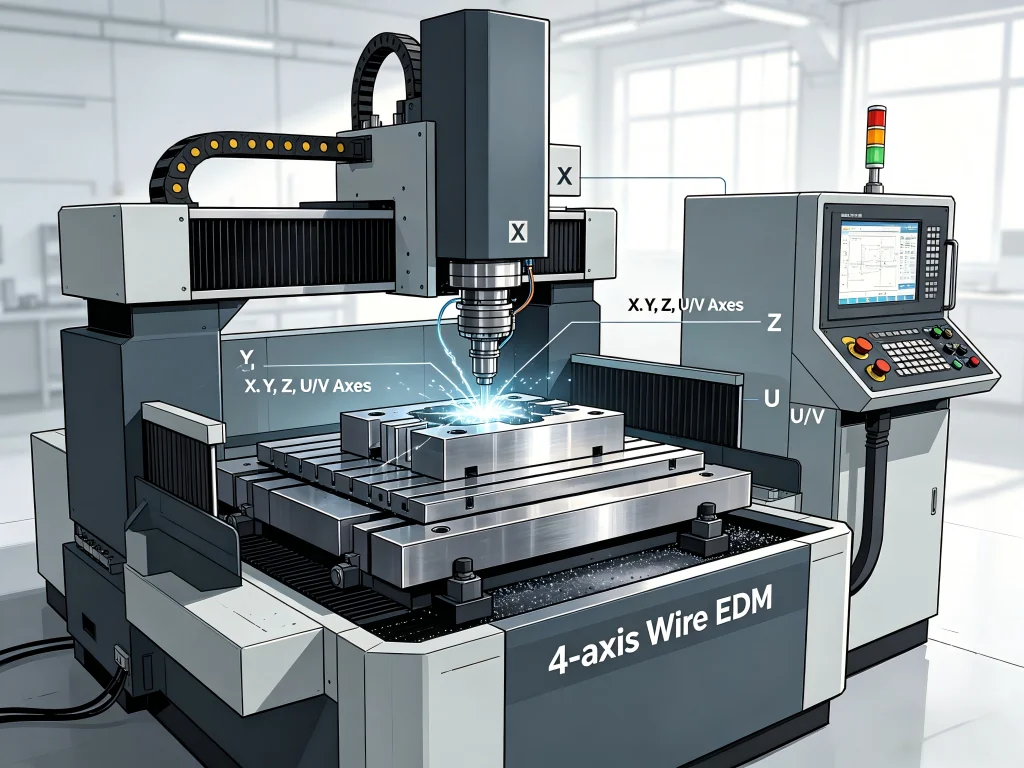
Understanding the Basics: What is 4 axis wire edm?
To appreciate the power of this technology, one must first understand what is edm wire cutting. Electrical Discharge Machining (EDM) is a subtractive manufacturing process that uses thermal energy to remove material from a workpiece. Instead of a physical cutting tool, a thin, electrically charged wire acts as the electrode. By creating a series of rapid electrical sparks between the wire and the workpiece, the material is eroded in a controlled environment, typically submerged in a dielectric fluid.
The “4-axis” designation refers to the movement capabilities of the machine. While a standard 2-axis machine moves in the X and Y planes to create 2D shapes, a 4th axis wire edm system adds independent movement to the upper and lower wire guides. These are usually referred to as the U and V axes. By allowing the top of the wire to move independently of the bottom, the machine can create tapered angles, transition shapes (such as a square at the top and a circle at the bottom), and highly complex 3D profiles that are impossible to achieve with 2-axis systems.
How the edm wire cutting process Works
The edm wire cutting process is a masterpiece of electrical engineering. It begins with the workpiece being secured in a tank filled with deionized water. This fluid serves two purposes: it acts as an insulator until a specific voltage is reached, and it flushes away the microscopic debris (chips) created by the erosion. A continuous spool of edm wire is fed through the machine, ensuring that the tool is always fresh and not prone to wear that would compromise precision. This non-contact nature means there is no mechanical force exerted on the part, allowing for the machining of extremely fragile or thin-walled components without distortion.
The Critical Role of 4 axis wire edm programming
One cannot discuss the hardware without addressing the software. 4 axis wire edm programming is significantly more complex than standard CNC milling. The programmer must define two separate paths—one for the lower guide (XY) and one for the upper guide (UV). Sophisticated CAD/CAM software is required to synchronize these movements so that the wire remains at the correct angle at every micro-second of the cut.
On platforms like Reddit and various CNC machining forums, professionals often discuss the challenges of “taper compensation.” When the wire is tilted, its effective diameter changes relative to the vertical plane. Expert programmers at Jucheng utilize advanced algorithms to compensate for these variations, ensuring that the final part meets tolerances as tight as +/- 0.002mm. Effective 4 axis wire edm programming also optimizes the “lead-in” and “lead-out” points to prevent witness marks on the finished surface, a common concern for high-aesthetic or high-performance parts.
Materials Matter: edm wire types and edm wire sizes
Selecting the right consumables is vital for a successful cut. The choice of edm wire types directly affects cutting speed, surface finish, and precision.
- Brass Wire: The most common and cost-effective option. It provides a good balance of conductivity and tensile strength, suitable for general-purpose applications.
- Zinc-Coated Wire: These wires feature a brass or copper core with a zinc coating. The zinc vaporizes at a lower temperature, which helps cool the wire and allows for faster cutting speeds.
- Molybdenum Wire: Known for its incredibly high melting point and tensile strength, this is often used in specialized machines where wire reuse is a factor, though it is less common in high-speed 4-axis production.
Furthermore, edm wire sizes must be carefully matched to the geometry of the part. Standard diameters range from 0.10mm to 0.30mm. A thinner wire allows for tighter internal radii (the “corner” of a cut), but it is also more prone to breakage if the tension and power settings are not perfectly calibrated. Jucheng specialists evaluate the specific requirements of your design to choose the optimal wire diameter, balancing speed with the necessity of fine detail.
Core Application Scenarios for 4 axis wire edm
What is edm wire used for in the real world? Its applications are vast, particularly where material hardness or geometric complexity prevents the use of traditional tools. Because EDM erodes material regardless of its hardness, it is the preferred method for cutting hardened tool steel, tungsten carbide, and titanium.
Aerospace and Defense
In aerospace, 4 axis wire edm is used to create turbine blades with intricate cooling holes and complex fir-tree roots. The ability to cut tapered shapes ensures that these critical components fit perfectly within their housings, where even a micron of error could lead to catastrophic failure.
Medical Device Manufacturing
The medical industry requires biocompatible materials that are often difficult to machine. 4 axis wire edm machine setups are used to produce surgical instruments, orthopedic implants, and tiny components for robotic surgery. The burr-free finish produced by the edm wire cutting process reduces the need for secondary polishing, which is crucial for maintaining the integrity of medical-grade surfaces.
Tool and Die Industry
This is perhaps the most traditional home for EDM. Creating extrusion dies, where a shape must transition or taper through the thickness of a metal block, is a task perfectly suited for a 4th axis wire edm. This ensures that the extruded plastic or metal flows correctly and maintains its shape during the production process.
| Feature | Traditional CNC Milling | 4 axis wire edm |
|---|---|---|
| Material Hardness | Limited by tool hardness. | Can cut any conductive material (Hardened Steel, Carbide). |
| Mechanical Stress | High (physical contact). | Zero (non-contact erosion). |
| Complex Tapers | Difficult/Requires 5-axis. | Native capability via U/V axes. |
| Internal Radii | Limited by tool diameter. | As small as 0.05mm (half of wire diameter). |
| Surface Finish | Varies by tool path. | Extremely smooth, mirror-like finishes possible. |
Key Factors to Consider When Choosing a 4 axis wire edm Partner
If you are looking to outsource your machining needs, not all service providers are equal. When evaluating a partner like Jucheng, consider the following factors to ensure project success:
1. Precision and Tolerances
The primary reason to use 4 axis wire edm is precision. Ask for documented proof of their ability to hold tolerances. At Jucheng, we maintain our machines in climate-controlled environments to prevent thermal expansion from affecting the accuracy of the 4 axis wire edm machine.
2. Programming Expertise
As mentioned, 4 axis wire edm programming is a specialized skill. Does the team have experience with complex 3D lofting and variable tapers? A mistake in the UV path can ruin an expensive piece of aerospace-grade titanium instantly.
3. Material Handling and Knowledge
Does the provider understand the nuances of different edm wire types? For example, using a high-speed zinc-coated wire might be better for thick blocks, while a fine brass wire is better for intricate electronics. Their knowledge of what is edm wire used for in different contexts can save you time and money.
4. Quality Certifications
Look for ISO 9001:2015 certifications. These ensure that the company follows rigorous quality management protocols, from material intake to final inspection. Jucheng’s commitment to these standards is a cornerstone of our service model.
Installation and Maintenance: Ensuring Longevity
For those looking to bring 4 axis wire edm capabilities in-house, maintenance is non-negotiable. Unlike a lathe that might survive some neglect, an EDM machine is a high-precision instrument that requires clean surroundings. The deionized water system must be constantly monitored for conductivity. If the water becomes too conductive, the sparks will become uncontrolled, ruining the edm wire cutting process.
Filters must be replaced regularly to remove the eroded particles. Furthermore, the power feed contacts—the parts that transfer electricity to the wire—must be rotated or replaced to prevent grooving, which can cause the wire to vibrate and decrease accuracy. Regular calibration of the U and V axes is also essential to maintain the integrity of the 4th axis wire edm movements.
Why Choose Jucheng for Your 4 axis wire edm Needs?
At Jucheng (https://www.jccncmachining.com/), we have spent years refining our approach to 4 axis wire edm. We don’t just see ourselves as a machine shop; we are research partners for our clients. Our facility is equipped with state-of-the-art 4 axis wire edm machine technology capable of handling projects ranging from micro-machined medical components to large-scale industrial dies.
Our competitive advantage lies in our vertical integration. We combine expert 4 axis wire edm programming with a deep understanding of metallurgy. Whether you are struggling with a difficult material or a geometry that seems impossible to cut, our engineering team could provide a solution that balances cost-efficiency with uncompromising quality. We offer a wide range of edm wire sizes and edm wire types to tailor the process specifically to your part’s requirements. With Jucheng, you gain access to a legacy of technical excellence and a commitment to delivery timelines that keep your supply chain moving.
Frequently Asked Questions (FAQ)
1. What is the main benefit of 4-axis over 2-axis wire EDM?
The main benefit is the ability to create complex 3D shapes and tapers. While 2-axis machines only move vertically, a 4th axis wire edm allows the top and bottom of the wire to follow different paths, enabling the creation of conical shapes, transition geometries, and varied angles along a single cut.
2. Can 4 axis wire edm cut non-conductive materials?
Generally, no. The edm wire cutting process relies on electrical sparks. Therefore, the material must be conductive. This includes all metals and some conductive ceramics. If you need to cut non-conductive plastics or glass, other methods like waterjet or laser cutting may be required.
3. How does 4 axis wire edm programming differ from 3-axis milling?
In milling, you control a tool tip in 3D space. In 4 axis wire edm programming, you are essentially controlling two separate 2D paths (XY and UV) simultaneously. The software must calculate how these two paths interact to form the final 3D shape of the wire’s flank.
4. What are the most common edm wire sizes?
Most industrial applications use wire diameters between 0.20mm and 0.25mm. However, for ultra-fine detail, sizes as small as 0.05mm can be used, though these require specialized machines and slower cutting speeds to prevent breakage.
5. Is the edm wire cutting process slow?
Compared to traditional milling, EDM is slower in terms of material removal rate. However, when you consider that it can cut hardened materials in a single pass and produces a finished surface that requires no deburring, the overall production cycle for complex parts is often faster and more reliable.
6. What determines the choice of edm wire types?
The choice depends on the priority of the job. If speed is the goal, zinc-coated wires are often preferred. If precision and fine finish on a budget are needed, standard brass wire is the go-to. For very specific aerospace alloys, specialized high-tensile wires may be used.
7. Does 4 axis wire edm create heat-affected zones (HAZ)?
Because it is a thermal process, there is a very thin recast layer and a microscopic heat-affected zone. However, because the part is submerged in dielectric fluid, this zone is significantly smaller than what you would find with laser or plasma cutting, and it can often be removed with a “skim cut” (a second, low-power pass).
8. How accurate is a 4 axis wire edm machine?
Modern machines are incredibly accurate, often achieving tolerances of +/- 0.002mm to 0.005mm. The actual accuracy depends on the machine’s condition, the ambient temperature, the quality of the wire, and the skill of the operator.
Ready to Elevate Your Manufacturing?
Choosing the right machining process can be the difference between a project’s success and failure. If your designs require the extreme precision and geometric flexibility that only 4 axis wire edm can provide, Jucheng is here to help. Our team of experts is ready to discuss your specifications, from 4 axis wire edm programming challenges to material selection and beyond.
Contact Jucheng today for a detailed consultation and quote. Let us show you how our advanced 4-axis capabilities can bring your most complex visions to life with unmatched accuracy and efficiency. Visit our website at https://www.jccncmachining.com/ to learn more about our services and company certifications.