
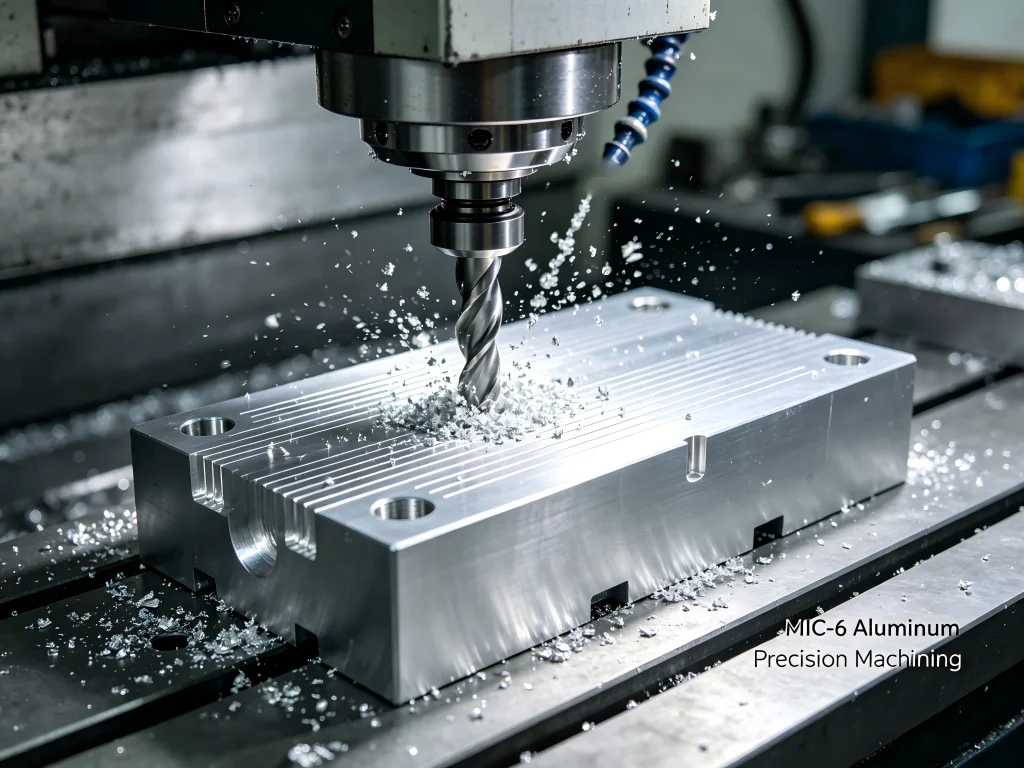
What Exactly Is MIC 6 Aluminum? Understanding the Cast Tooling Plate That Won’t Move
If you have spent any time browsing McMaster-Carr or Alro’s inventory, you have likely encountered MIC 6 aluminum plate listed under “cast tool and jig plate.” But what makes it fundamentally different from the 6061 sheet sitting elsewhere in the warehouse?
MIC 6 aluminum is a precision-cast, stress-relieved aluminum alloy specifically engineered for applications where dimensional stability takes priority over raw strength. Unlike rolled or extruded aluminum plates—which contain internal stresses locked in during the forming process—MIC 6 is produced through continuous casting. Each thickness is individually cast, with the molten metal continuously fed to eliminate defects from lapses and seams. This manufacturing approach yields a fine-grain structure that is remarkably free from internal stresses.
What does that mean when you start machining? Simply put: when you remove material from a standard 6061-T6 plate, the release of those locked-in stresses can cause the part to warp, twist, or bow unpredictably. With MIC 6 aluminum, that risk drops dramatically. The material arrives at the shop floor already stress-relieved, which is why machinists on CNCZone consistently describe it as “stable”—it stays where you put it.
The Chemical Composition That Drives Performance
For those who want to dig into the metallurgy, MIC 6 aluminum falls into the 7000-series alloy family, which means its primary hardening agent is zinc. The typical chemical composition includes:
- Aluminum (Al): 91.4% – 95.7% (base element)
- Zinc (Zn): 5.1% – 6.1% (primary hardening agent)
- Magnesium (Mg): 2.1% – 2.9%
- Copper (Cu): 1.2% – 2.0%
- Silicon (Si): 0.40% – 0.80%
- Iron (Fe): 0.10% – 0.50%
- Manganese (Mn): up to 0.30%
- Chromium (Cr): 0.18% – 0.28%
- Titanium (Ti): up to 0.20%
This differs notably from 6061 aluminum, which relies on magnesium and silicon as its primary hardening agents. The zinc-rich chemistry of MIC 6 contributes to its characteristic cast structure and stability, though it does mean the material is less weldable than 5000-series alternatives like ATP-5 or Alca 5.
Mechanical Properties at a Glance
The numbers tell an important story about where MIC 6 shines and where its limitations lie. According to manufacturer datasheets and supplier specifications, the key mechanical properties are:
- Tensile Strength: 23,900 psi (166 MPa)
- Yield Strength: 15,200 psi (105 MPa)
- Percent Elongation: 3%
- Brinell Hardness: 65 BHN
- Elastic Modulus: 71.0 MPa
In practical terms, MIC 6 is not the strongest aluminum you can buy—7075 and even 6061-T6 both surpass it in ultimate strength. However, strength is rarely the primary concern for tooling plates, jigs, and fixtures. What matters far more is whether the plate stays flat after you machine pockets into it. On that front, MIC 6 excels decisively.
The Flatness Advantage: Why MIC 6 Aluminum Machining Transforms Precision Work
Let’s talk about numbers that actually matter on the shop floor. A standard 6061 aluminum plate might come with a flatness tolerance of 0.030 inches across a 24-inch span—or worse, no guaranteed flatness at all. MIC 6 is different. The datasheet specifications show:
- Flatness tolerance: Within 0.015 inches on plates 1/4-inch to 5/8-inch thick, and 0.005 inches on plates 3/4-inch to 4-inch thick
- Thickness tolerance: +/- 0.005 inches from nominal for thicknesses from 1/4 inch to 4 inches
- Surface finish: Finished to 20 microinches typical on both sides
One CNCZone user put it plainly: “The advantages of MIC 6 over regular 6061 plate are that it is flatter, has a closer thickness tolerance and is stable which means when it is machined it will not warp due to the relief of internal stresses.” That single observation encapsulates why so many precision shops have made the switch.
Another machinist on IndustryArena noted that typical MIC 6 flatness runs under 0.009 inches for standard sheets, with some coming in as flat as 0.005 inches across large dimensions. When you are building a CNC router base or a precision inspection fixture, that level of flatness eliminates hours of manual surfacing and scraping.
What the Forums Say About Real-World Use
Across hobbyist and professional forums, MIC 6 has developed a loyal following. A member on Festool Owners Group described using MIC 6 for a drill press table, noting that “It’s nice to work with”. Another builder on CNC Cookbook chose 1/4-inch MIC 6 for bearing blocks specifically because “the faces of it already have a nice ground finish”.
However, the forums also reveal the honest challenges. One machinist commented that “MIC-6 is particularly gummy when machining. I always use coolant and I still get a little bit of chip weld if things aren’t just right.” This aligns with the material’s characteristic tendency to form built-up edge if cutting parameters are not optimized. The solution? Sharp carbide tooling, appropriate coolant application, and feeds and speeds tailored to the material’s unique behavior.
On the positive side, many users report that MIC 6 produces cleaner chips than 6061. “You will also have a much easier time cutting it dry cause the chips break up easier than 6061 and is less gummy,” one forum contributor noted. That property translates directly to reduced cycle times and less downtime spent clearing stringy, problematic chips from the machine enclosure.
MIC 6 vs 6061: A Head-to-Head Comparison for CNC Machining Decisions
This is the question that appears repeatedly on engineering forums and in procurement meetings: should you use MIC 6 or 6061? The honest answer depends entirely on your application. Both materials have legitimate places in a well-stocked machine shop.
A comparison across key attributes helps clarify the decision:
AttributeMIC 6 Aluminum6061-T6 AluminumProduction methodContinuous cast, stress-relievedRolled/extruded, heat treated (T6)Flatness (as-supplied)0.005″ – 0.015″ typicalNot guaranteed without additional millingSurface finish20 microinches typical both sidesMill finish, varies significantlyTensile strength23,900 psi45,000 psi (approx.)Yield strength15,200 psi40,000 psi (approx.)Machining stabilityExcellent – minimal warping after material removalModerate – internal stresses may cause distortionWeldabilityPoorExcellentAnodizing suitabilityGoodExcellentTypical cost per pound$4.50 – $6.50$2.50 – $3.50The cost differential is substantial—according to 2025 market research, MIC 6 typically costs $4.50 to $6.50 per pound compared to $2.50 to $3.50 for 6061 aluminum. That price premium reflects the additional manufacturing complexity of continuous casting and the value of guaranteed flatness. Whether the premium makes sense depends on how much you value machining stability versus raw material cost.
Beyond 6061: Exploring MIC 6 Aluminum Equivalent Options
When engineers search for mic-6 aluminum equivalent materials, several alternatives deserve consideration. ATP-5 and Alca 5, both based on 5083 aluminum-magnesium alloy, offer interesting trade-offs. Forum discussions highlight that ATP-5 has a Brinell hardness of 70 (versus MIC 6’s 65), better corrosion resistance, and superior weldability. However, MIC 6 is noted to be stiffer and slightly more thermally conductive.
For applications requiring higher strength, 7075 aluminum represents a viable alternative, though its machinability rating is generally considered inferior to MIC 6. According to comparative analyses, MIC 6 earns an A-grade machinability rating compared to 7075’s B-grade, meaning shorter machining times and lower tool wear costs.
Some shops have successfully substituted precision-milled and stress-relieved 6061 plates that have been blanchard ground on both sides. These products can approach MIC 6’s flatness while retaining 6061’s higher strength and weldability, though they typically cost more than standard 6061 plate.
Critical Application Scenarios Where MIC 6 Aluminum Machining Excels
Understanding where MIC 6 aluminum machining delivers maximum value requires looking beyond the spec sheet at real-world applications. The material’s unique combination of flatness, stability, and machinability makes it particularly suitable for certain categories of work.
CNC Machine Bases and Components
A properly flat machine base is the foundation of precision machining. When builders on CNCZone and DIY CNC forums discuss gantry plates, router beds, and milling machine tables, MIC 6 consistently appears as the material of choice. One member described building a table for a drill press using MIC 6, while another used 1/4-inch MIC 6 for bearing blocks on a custom CNC project. The material’s stability ensures that bolt holes, counterbores, and mounting surfaces remain aligned even after extensive machining operations.
Inspection Fixtures and Metrology Tooling
Quality assurance departments rely on fixtures that do not introduce measurement error. When you are inspecting parts to +/- 0.001 inches, the fixture itself must be flat and stable. MIC 6 aluminum is commonly specified for CMM fixtures, inspection jigs, and gauge bases precisely because its dimensional stability allows repeatable, reliable measurements over thousands of inspection cycles.
One industrial supplier notes that MIC 6 is “used for base plates, tools, marine fittings, and hydraulic and aerospace equipment,” highlighting its versatility across demanding environments.
3D Printing Build Platforms
The 3D printing community has enthusiastically adopted MIC 6 as the premium material for heated build plates. A user on the Duet3D forum described switching to a MIC 6 plate and achieving “much improved bed flatness,” noting that the material eliminated the warping issues that plagued their previous setup. For large-format printers where bed flatness directly impacts first-layer adhesion and print quality, MIC 6 has become the gold standard.
Electronics Assembly and Semiconductor Tooling
In electronics manufacturing, fixtures must maintain precise positioning while dissipating static charge and providing stable support. MIC 6’s combination of flatness and machinability makes it suitable for wave solder pallets, SMT assembly fixtures, and inspection tooling for printed circuit board fabrication.
Medical Device Manufacturing
The medical device industry demands exceptional precision and repeatability. Surgical instrument assembly fixtures, implant inspection tooling, and testing apparatus frequently employ MIC 6 as the base material. Jucheng Precision, for instance, has experience producing medical-grade components using advanced 5-axis CNC machining, with the material stability of MIC 6 supporting the tight tolerances required for ISO 13485 compliance.
Optimizing the MIC 6 Aluminum Machining Process: Feeds, Speeds, and Tooling
Successful MIC 6 aluminum machining requires understanding how the material behaves differently from conventional wrought alloys. While it machines beautifully when approached correctly, the cast structure demands specific attention to cutting parameters.
Recommended Cutting Parameters
For carbide cutting tools—which are strongly preferred for MIC 6 work—the recommended starting surface speeds range from 600 to 1200 surface feet per minute (SFM). High-speed steel tools should run between 150 and 600 SFM. These parameters achieve the balance between material removal rate and tool life while minimizing the risk of built-up edge.
Feed rates typically range from 100 to 200 mm/min for finishing passes, though roughing operations can run significantly faster with proper cutter engagement. The key is maintaining consistent chip load to prevent the gummy behavior that some machinists report.
Tool Selection Strategies
Sharp, polished carbide end mills with appropriate coating (ZrN or AlTiN) tend to perform best on MIC 6. The material’s fine grain structure allows excellent surface finishes—often achieving 25 Ra or better—but it also makes the material prone to smearing if tools become dull.
Many professional shops use high-helix, three-flute end mills designed specifically for aluminum. These tools provide the chip clearance necessary to prevent recutting and the shear geometry that produces clean, manageable chips rather than stringy, problematic ones.
Coolant and Lubrication
While some machinists successfully cut MIC 6 dry, particularly for roughing operations, coolant application generally improves results. A mist system or flood coolant helps prevent chip welding on the tool, reduces thermal expansion of the workpiece, and extends tool life. The forum user who reported chip weld issues noted that consistent coolant application largely resolved the problem.
For finishing operations, some shops prefer a light lubricant rather than full flood coolant, as this allows better observation of surface finish development and chip formation.
Achieving Superior Surface Finish
One of MIC 6’s standout advantages is its ability to achieve exceptional surface finishes directly off the machine. According to machining comparison data, MIC 6 typically achieves 20-30% better surface finish than 6061 due to its uniform cast structure, which eliminates fiber tearing during cutting operations. The material’s fine grain structure and lack of internal stress mean that finishing passes can be lighter and faster while still meeting demanding surface roughness specifications.
For applications requiring the best possible surface finish, a light climb milling pass with a sharp, polished tool can achieve results that rival grinding or lapping. The 20-microinch finish on as-supplied MIC 6 plate serves as an excellent starting point for further refinement when needed.
Why Jucheng Precision Delivers Superior Results in MIC 6 Aluminum Machining
Selecting the right manufacturing partner for MIC 6 aluminum machining matters almost as much as selecting the right material. Jucheng Precision brings over 20 years of CNC machining experience to every project, with specialized expertise in aluminum parts manufacturing. The company’s facility houses advanced 3-axis, 4-axis, and 5-axis CNC machining centers capable of producing components that meet the most demanding dimensional requirements.
What sets Jucheng apart in the MIC 6 aluminum space is the combination of technical knowledge and practical experience. The team understands that MIC 6 behaves differently from other aluminum alloys—from chip formation to thermal expansion to fixturing requirements. That understanding translates directly into better outcomes for clients.
Engineering Support and DFM Reviews
Before any cutting begins, Jucheng offers a complimentary Design for Manufacturing (DFM) review. This process identifies potential issues with the part design that could affect machinability, cost, or quality. “Relying on brokers who simply accept your drawings without question is highly dangerous,” the company notes—which is why Jucheng takes the time to provide detailed feedback on how to optimize parts for MIC 6 aluminum machining before production starts.
The DFM review covers critical aspects like feature accessibility, tolerance allocation, surface finish requirements, and material utilization. For complex parts that require multiple setups or specialized fixturing, the engineering team recommends strategies to minimize handling while maintaining accuracy.
Quality Assurance and Certification
Jucheng maintains rigorous quality control processes throughout the manufacturing workflow. From incoming material verification to in-process inspection to final CMM validation, every MIC 6 aluminum component receives appropriate attention. The company’s ISO-compliant quality system ensures traceability and consistency across production runs of any size.
For clients requiring material certification, Jucheng provides full documentation including material certificates with lot numbers for all MIC 6 aluminum plate used in production. This traceability is essential for aerospace, medical, and defense applications where material provenance cannot be compromised.
Scalable Production Capabilities
Whether a project requires one prototype or ten thousand production parts, Jucheng’s manufacturing infrastructure adapts to the need. The company’s expertise extends from low-volume rapid prototyping through full-scale production runs, with consistent quality maintained across all volumes. This flexibility means clients can develop and refine designs in MIC 6 without switching suppliers when moving to production.
The combination of technical expertise, quality focus, and scalable production makes Jucheng a natural partner for any organization considering MIC 6 aluminum for precision applications. With advanced equipment including 5-axis machining centers, Jucheng delivers the accuracy that high-stakes projects demand.
Making the Right Choice: A Practical Decision Framework for MIC 6 Aluminum
After reviewing the properties, applications, and machining considerations for MIC 6 aluminum, the natural question becomes: how should you evaluate whether it suits your specific project?
Ask These Questions Before Selecting MIC 6
Is dimensional stability the primary requirement? If your part must maintain its geometry after machining, MIC 6’s stress-relieved cast structure offers significant advantages over rolled or extruded alternatives. The material’s predictable behavior reduces the need for secondary operations like re-flattening or stress-relieving after roughing.
What flatness does the design actually require? For tolerance calls tighter than 0.005 inches across significant dimensions, MIC 6 provides a head start that standard plates cannot match. However, if the design can tolerate more variation, a precision-milled 6061 plate might suffice at lower cost.
Will welding be required? MIC 6 does not weld well. If the assembly requires welded aluminum components, consider ATP-5, Alca 5, or stress-relieved 6061 instead. This limitation appears repeatedly in forum discussions and should factor into material selection early in the design process.
What is the structural loading? For parts carrying significant mechanical loads or subjected to fatigue cycling, MIC 6’s lower strength compared to 6061 or 7075 may eliminate it from consideration. Tooling plates and fixtures rarely see structural loads, which is why the lower strength matters little in practice.
What is the cost versus benefit trade-off? The price premium for MIC 6—typically 50% to 100% higher than standard 6061 plate—must be justified by reduced machining time, better quality outcomes, or eliminated secondary operations. For high-value parts where flatness failures would be catastrophic, the premium often pays for itself many times over.
When to Choose Alternatives
Projects requiring high strength-to-weight ratio should lean toward 7075 or 6061-T6. Applications involving welding or anodizing might benefit from ATP-5 or Alca 5, which offer better corrosion resistance and weldability while maintaining comparable flatness. For purely structural components where flatness is not critical, standard 6061 plate remains the most economical choice.
Some shops have found that precision-milled, stress-relieved 6061 tooling plate offers a middle ground—better flatness than standard plate, better strength than MIC 6, and acceptable weldability. These products cost more than standard 6061 but less than MIC 6, making them worth considering for hybrid applications.
Installation, Handling, and Storage Best Practices for MIC 6 Aluminum Plate
Proper handling of MIC 6 aluminum from receipt through final installation preserves the material’s critical properties. While the material is remarkably stable compared to rolled alternatives, certain practices maximize its performance in the finished assembly.
Receiving and Inspection
Upon delivery of MIC 6 aluminum plate, verify thickness and flatness before releasing the material to production. The typical +/-0.005 inch thickness tolerance provides a useful acceptance criterion. For critical applications, a surface plate and dial indicator can confirm flatness meets specifications before any machining begins.
Document any surface damage or irregularities—although MIC 6 arrives with a 20-microinch finish on both sides, scratches or dings during shipping may require additional surfacing passes.
Storage Recommendations
Store MIC 6 plates flat on a clean, rigid surface to prevent warping from uneven support. For long-term storage, vertical racking with proper edge protection works well for thinner plates, while thicker plates should remain flat-stacked with protective paper between layers.
Temperature fluctuations affect all aluminum, but MIC 6’s cast structure responds predictably to thermal cycles. Avoid storing plates near heat sources or in direct sunlight if dimensional stability is critical for upcoming machining.
Workholding for Machining
The same stability that makes MIC 6 attractive for finished parts also simplifies workholding during machining. The material does not spring or relax significantly when unclamped, so conventional vises, clamps, and vacuum chucks perform reliably. For thin plates requiring both sides machined, consider double-disc grinding or vacuum fixturing to maintain flatness through the process.
One forum contributor advised that for parts being bolted directly to a machine table, facing only the top surface may suffice—the as-supplied flatness may meet requirements without machining both sides.
Finishing and Post-Processing
MIC 6 accepts anodizing, though results vary compared to 6061. The cast structure can produce slightly different color outcomes, particularly with clear anodizing. For decorative or functional anodized finishes, test samples should be processed before committing production parts.
For applications requiring painted or powder-coated surfaces, standard aluminum preparation methods work well. The fine-grain surface accepts primers and topcoats without special treatment beyond proper cleaning and etching.
Frequently Asked Questions About MIC 6 Aluminum Machining
What is the typical flatness tolerance for MIC 6 aluminum plate?
According to manufacturer datasheets, flatness tolerance is maintained within 0.015 inches for plates 1/4-inch to 5/8-inch thick, and within 0.005 inches for plates 3/4-inch to 4-inch thick. In practice, many plates measure flatter than the published tolerance.
Can MIC 6 aluminum be welded?
MIC 6 is not considered weldable. The cast structure and zinc content make reliable welding difficult. For applications requiring welded aluminum components, ATP-5, Alca 5, or 6061 are more appropriate choices.
How does MIC 6 compare to 6061 for CNC machining?
MIC 6 offers superior flatness, closer thickness tolerances, and better machining stability due to its stress-relieved cast structure. However, 6061 provides higher strength (approximately twice the yield strength), better weldability, and lower cost. The choice depends on whether stability or strength matters more for the specific application.
What surface finish does MIC 6 ship with?
MIC 6 aluminum is finished to 20 microinches typical on both sides. This fine machined finish often eliminates the need for initial surfacing passes, reducing setup time and material waste.
Is MIC 6 aluminum suitable for anodizing?
Yes, MIC 6 can be anodized. However, the cast structure may produce slightly different color results compared to wrought alloys. Testing samples before full production is recommended for color-critical applications.
What is the maximum thickness available for MIC 6 plate?
MIC 6 aluminum plate is available in thicknesses from 1/4 inch up to 4 inches and beyond from some suppliers. Thicker plates are typically custom cast rather than stocked items.
Why does MIC 6 cost more than standard aluminum plate?
The continuous casting process requires specialized equipment and generates lower yields than rolling. Additionally, each thickness is individually cast, and the stress-relieving process adds manufacturing steps. The cost premium reflects these factors and the guaranteed flatness that rolled plates cannot match.
Does MIC 6 aluminum require special cutting tools?
Standard carbide end mills work well, though sharp, polished tools with aluminum-specific geometry produce the best results. High-helix, three-flute end mills are particularly effective at managing chip formation and preventing built-up edge.
Moving Forward with MIC 6 Aluminum Machining Projects
MIC 6 aluminum occupies a unique position in the machinist’s material palette—not the strongest, not the cheapest, but arguably the most stable and predictable option for precision tooling and fixturing. The material’s guaranteed flatness, tight thickness tolerances, and excellent machinability have made it the default choice for applications ranging from CNC machine bases to 3D printer build platforms to aerospace inspection fixtures.
When evaluating whether MIC 6 suits a particular project, the key metric is not strength but stability. If a part must remain flat and true after material removal, the premium for MIC 6 usually justifies itself through reduced scrap, eliminated secondary operations, and faster cycle times. If structural strength or weldability drives the design, other alloys may serve better.
For organizations ready to explore MIC 6 aluminum for their next project, partnering with an experienced CNC machining provider like Jucheng ensures that the material’s advantages are fully realized. From DFM review through final inspection, Jucheng’s technical expertise and advanced multi-axis CNC capabilities deliver the quality outcomes that precision applications demand.
Ready to discuss your MIC 6 aluminum machining requirements? Contact Jucheng Precision to schedule a complimentary DFM review and receive a detailed quote for your project.