
If you have ever searched online for laser engraving services only to feel overwhelmed by endless quotes, conflicting advice about materials, and doubts about whether the final result will match your expectations, you are far from alone. Across Reddit’s r/lasercuttingbusiness and Facebook groups dedicated to custom manufacturing, one question surfaces again and again: “How do I consistently get high-quality, durable engravings at a fair price without endless back-and-forth?” This guide approaches that problem from the perspective of someone who has been in your shoes—whether you are a product designer, a small business owner, or a creative professional—and walks you through every practical step toward a solution.
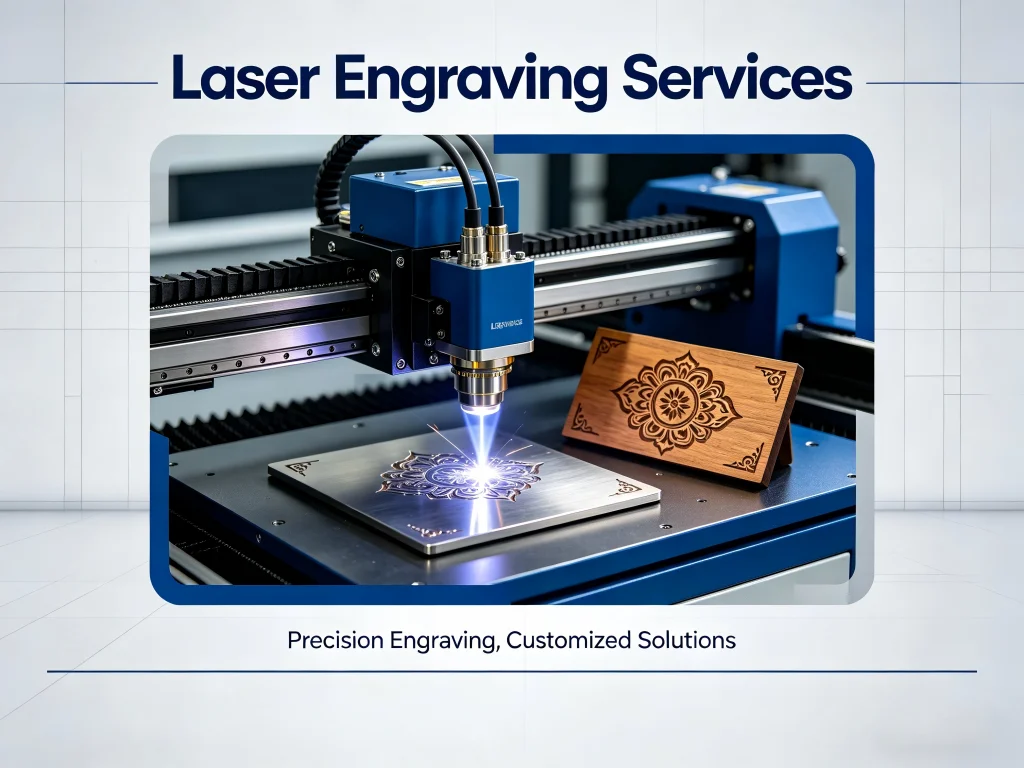
What Exactly Are Laser Engraving Services And How Do They Work?
Before diving into solutions, it helps to understand the underlying technology. Laser engraving services refer to professional offerings where a high-powered laser beam is used to mark, etch, or carve designs onto a wide range of materials. Unlike printing, which adds a layer on top of a surface, laser engraving physically alters the material itself, producing marks that are permanent and highly resistant to wear, moisture, and UV exposure.
Jucheng Precision describes the process as a subtractive manufacturing technique: the laser beam focuses intense thermal energy onto a microscopic area, causing localized melting, vaporization, or color change depending on the material and settings[reference:0]. For aluminum parts, for instance, deep engraving might reach depths of 0.01–0.5 millimeters, while shallow etching stays below 0.01 millimeters but produces high-contrast markings ideal for barcodes and logos[reference:1].
Three primary laser technologies dominate the service industry today:
- Fiber lasers (≈1064 nm wavelength): These couple extremely efficiently to bare metals. They are the go-to choice for serial numbers on stainless steel, deep engraving on aluminum, and permanent part identification in aerospace and automotive applications.
- CO₂ lasers (≈10,600 nm wavelength): These are absorbed efficiently by organic materials. They excel on wood, acrylic, leather, glass, fabric, and plastics, making them the workhorse for signage, gifts, and decorative items.
- UV lasers (355 nm wavelength): These operate with a “cold processing” effect that minimizes heat-affected zones. They are ideal for delicate materials like certain medical-grade plastics, thin films, and high-precision electronics components.
What makes professional laser engraving services distinct from DIY approaches is not just the machine quality but the expertise in matching laser type, power settings, and speed to each specific material and design requirement. As one Redditor in r/lasercuttingbusiness noted, “Getting crisp results on reflective metals or layered acrylics requires understanding pulse frequencies and multiple passes—things you only learn by ruining a few test pieces first.” A professional service provider has already done that learning for you.
The Real Problem: Inconsistent Quality, Hidden Costs, And Material Confusion
Let us walk through a scenario that echoes what countless customers describe in online forums. Sarah runs a small electronics startup. She needs to engrave serial numbers and regulatory markings onto 500 aluminum enclosures. She contacts three local engraving shops. The first says, “We can do it,” but delivers marks that look faded after two weeks of handling. The second quotes a price that seems reasonable, but there is a $200 setup fee and a $50 “design adjustment” charge that was never mentioned upfront. The third shop has excellent online photos but cannot handle the required 0.2 mm depth tolerance for her certification standard.
This is not an isolated experience. Searching for laser engraving services near me often returns businesses with wildly different capabilities, pricing models, and quality standards. A Google Maps review for a UK-based service warns: “DO NOT ORDER FROM THIS PLACE. Horrible experience. The letters for the engraving are poorly made. When we call the owner to see if we can get a refund/replacement he says there’s nothing he can do”[reference:2]. Conversely, a highly-rated service in Leeds earns a perfect 5/5 rating for precision and attention to detail[reference:3].
The inconsistency is real. Without a structured way to evaluate providers, customers frequently waste time and money on subpar results. The core of the problem can be broken down into four recurring pain points:
- Material compatibility guesswork: Many providers cannot clearly state which materials they can engrave reliably, leading to adhesion failures, burned edges, or unreadable marks.
- Unpredictable pricing structures: Some charge by the hour, others by the item, and many add hidden fees for design work, file preparation, or rush orders.
- Lack of precision control: Achieving consistent depth, edge quality, and contrast across a production run requires calibrated equipment and documented process controls. Only established service providers invest in that infrastructure.
- No quality guarantee: When a batch of engraved parts fails inspection, who bears the cost of rework? Smaller operators often lack the capacity to offer meaningful warranties.
The following sections present a structured solution to each of these pain points, helping you not only find a reliable provider but also understand what to ask, what to expect, and how to budget accurately.
Selecting The Right Laser Technology: Fiber, CO₂, Or UV?
The first major decision in any laser engraving project is choosing the correct laser type. There is no single “best” technology; the right choice depends entirely on your materials and desired outcome. The table below summarizes the key differences:
| Technology | Wavelength | Best For | Relative Speed | Typical Applications |
|---|---|---|---|---|
| Fiber Laser | 1064 nm | Bare metals, anodized aluminum, engineered plastics, deep engraving on steel | Very high | Serial numbers, QR codes, logos on tools, automotive parts, medical devices |
| CO₂ Laser | 10,600 nm | Wood, acrylic, glass, leather, fabric, paper, coated metals, stone | Moderate to high | Signage, awards, personalized gifts, packaging prototypes, fabric cutting |
| UV Laser | 355 nm | Heat-sensitive plastics, glass, thin films, certain ceramics, electronics | Moderate | Delicate medical components, circuit board marking, transparent material engraving |
Industry experts emphasize that fiber lasers are not “better” than CO₂ lasers—they are simply different tools for different material families. In a detailed comparison, one provider notes: “Many small shops benefit from owning both: CO₂ for everyday engraving and cutting, and fiber for specialized metal and stone projects”[reference:4]. For customers, this means that the ideal service provider may operate multiple machine types to handle diverse material requirements. Jucheng Precision, for example, offers a fleet of precision manufacturing equipment that includes fiber and CO₂ capabilities, allowing seamless transitions between material types without outsourcing to third parties[reference:5].
When evaluating a potential service provider, ask specifically: “Which laser type will you use for my material, and why?” A confident answer will reference wavelength absorption characteristics and provide examples of past work on similar substrates.
Material Compatibility: What Can (And Cannot) Be Laser Engraved?
One of the most common frustrations expressed in laser engraving forums involves damaged materials or unsatisfactory results due to poor compatibility matching. According to a comprehensive material guide, CO₂ lasers work best for organic and non-metal materials, while fiber lasers are superior for metals and high-reflective surfaces[reference:6]. But the real-world compatibility list is more nuanced.
Pro Tip from Manufacturers: Always request a material test before committing to a full production run. A professional service provider should offer sample engraving on your actual material or an equivalent substrate. This single step eliminates 90 percent of compatibility surprises.
Here is a quick reference based on material categories:
- Woods (hardwoods, softwoods, plywood, MDF): CO₂ lasers produce clean, dark engravings and can cut through up to approximately 20 mm厚度 depending on power. Fiber lasers engrave wood but are generally less efficient for this material.
- Metals (steel, aluminum, brass, copper, titanium): Fiber lasers are unmatched for speed and contrast on bare metals. Anodized aluminum can also be marked beautifully with CO₂ lasers, but the mark is shallower. For deep, tactile engraving on stainless steel, fiber is the clear winner[reference:7].
- Acrylic and Plastics: Cast acrylic lasers exceptionally well with CO₂ machines, producing frosted white engravings on clear sheets or revealing contrasting layers on two-color acrylic. ABS, polycarbonate, and other engineering plastics may require specific wavelength selection (often UV) to avoid melting or discoloration.
- Glass and Stone: These materials can be engraved with CO₂ lasers, but the effect is often a frosted or etched surface rather than a deep cut. Coated glass products (such as wine glasses with a thin paint layer) laser very well when the coating is removed to expose clear glass beneath[reference:8].
- Leather and Fabric: CO₂ lasers cut and engrave leather cleanly, with sealed edges that do not fray. Natural fabrics like cotton and linen mark well, while synthetic materials must be tested for melting risk.
A forum participant on mybroadband.co.za shared: “I need to engrave a basic logo onto some hard plastics. It is for prototyping of a product, so will be relatively low volume. Laser etching and engraving usually have better results on lighter colours and harder materials”[reference:9]. This observation points to an important principle: material color and surface finish directly affect contrast. Dark anodized aluminum yields a bright white mark when engraved, while raw aluminum may produce a subtle silver-gray contrast that requires careful angle viewing.
Jucheng Precision has published detailed guides on specialized applications, such as laser engraving two-color acrylic sheets. These materials consist of a thin contrasting top layer fused onto a rigid colored base. When the laser vaporizes the top layer, the base color is revealed, producing exceptionally crisp, professional signage and display elements[reference:10]. Understanding these subtleties is what separates commodity engraving services from true manufacturing partners.
Decoding Laser Engraving Pricing: Where Does Your Money Go?
Price confusion ranks as the second most frequent complaint after quality inconsistency. A search for laser engraving services price reveals ranges from $10 for a small keychain to $300+ for complex industrial projects[reference:11]. Understanding the cost structure helps you evaluate quotes fairly and avoid unpleasant surprises.
A detailed 2026 pricing analysis from the laser industry explains that there is no single fixed price that works for every job. Prices vary because engraving jobs differ in material, time, complexity, and customer expectations. The goal is not to be the cheapest; the goal is to be profitable and consistent[reference:12]. Most professional engraving services price jobs using one or more of these methods:
- Per-item pricing: Common for standardized products like engraved cutting boards, tumblers, or keychains. The price includes engraving time, basic setup, and material handling.
- Per-minute or per-hour billing: Preferred for custom or variable jobs. Hourly rates in 2026 range from lower rates for simpler work to higher rates for professional shops with significant overhead. Multiply the estimated engraving time by the rate to get the cost.
- Per-square-inch pricing: Often used for signage, plaques, or flat items. The cost scales with the engraved area.
- Per-project quotes: Common for branding projects, bulk orders, or corporate work. The provider gives one fixed price based on the full scope.
Realistic price examples from 2026 data include: wooden cutting boards ranging from $40 to $80 each (with material cost around $10), engraved tumblers priced between $25 and $45 per item, photo engravings on wood or slate costing $40 to $100+, and custom industrial metal engravings falling in the $75 to $300+ range depending on complexity and depth[reference:13]. These are starting points; actual quotes may vary by region and provider capability.
When requesting quotes from laser engraving services, always ask for a breakdown that includes:
- Material cost (raw materials plus any test pieces or marking sprays)
- Machine time (including setup and engraving duration)
- Design and file preparation (vector file creation or adjustment)
- Any minimum order quantity or volume discounts
- Shipping and handling fees
Transparency in these factors is a strong signal of a professional operation. As one pricing expert notes: “Customers often think engraving is instant. It is not. Design time includes vector file creation, material testing, and multiple adjustments”[reference:14]. A reputable provider explains these steps upfront.
Quality Assurance And Process Control: How To Guarantee Consistent Results
For customers who need production-volume engraving (hundreds or thousands of parts), consistency matters as much as initial quality. Laser engraving, at its core, is a CNC process: the laser head moves under computer control with micron-level repeatability. However, environmental factors—room temperature, lens cleanliness, material batch variation—can introduce drift over time. Professional services implement quality assurance protocols to control these variables.
Jucheng Precision, for instance, applies ISO-level process documentation to its laser marking operations. This includes maintaining calibrated power output logs, scheduled lens cleaning and beam alignment, and documented parameter tables for each material type. For customers, this means that part number 500 will match part number 1 within specified tolerances. Do not hesitate to ask potential providers: “What is your quality control process for medium-to-large production runs?” A vague answer (“We just watch the machine run”) is a red flag. A confident answer will reference documented parameters, sample retention, and periodic verification marks.
Online discussion forums often highlight the importance of technician expertise. One thread on Signs101 describes a customer who received signs with visible pink staining because the engraving was not deep enough to remove the colored layer cleanly. The solution involved running a second pass with adjusted settings[reference:15]. An experienced operator would have recognized the material’s behavior during initial tests and adjusted the process before running the full batch. This is the value of hiring a service with demonstrated material-specific knowledge.
Additionally, consider certification requirements. Industries such as medical devices, aerospace, and automotive often require that permanent markings withstand specific environmental tests (salt spray, abrasion, temperature cycling). A service provider familiar with these standards can advise on engraving depth thresholds and verification methods. Without this expertise, you might receive parts that appear correct upon delivery but degrade under real-world conditions.
Regional Considerations: Local, National, Or International Service Providers?
Depending on your location and project scale, you may search for laser engraving services manila, laser engraving services singapore, laser engraving services london, or laser engraving services toronto. Each region has its own ecosystem of providers with varying capabilities, labor costs, and shipping logistics. A search for laser engraving services philippines might reveal competitive hourly rates, but shipping time and customs handling must be factored in. Similarly, laser engraving services uk providers may offer faster turnaround for local customers but at higher per-item rates.
International customers sometimes look for laser engraving services philippines price list to benchmark costs before approaching local suppliers. This is a smart strategy: understanding global price floors helps you negotiate reasonably. However, consider that shipping delicate engraved items across borders introduces risk of damage or delay. For prototype quantities, local providers often make more sense despite slightly higher per-unit costs. For production runs of hundreds or thousands of pieces, international sourcing can unlock significant savings if the provider demonstrates proven export packaging and quality consistency.
Modern manufacturing platforms bridge this gap by offering centralized quoting and order management. Jucheng Precision operates as a full-service manufacturing partner, handling both domestic and international clients through robust logistics and communication channels. Their facility is equipped with multiple laser systems and CNC machining capabilities, allowing customers to combine engraving with other finishing processes like anodizing, powder coating, or silk-screening under one roof[reference:16].
How Jucheng Precision Approaches Laser Engraving As A Manufacturing Solution
Jucheng Precision differentiates itself by treating laser engraving not as an isolated service but as one layer of a broader precision manufacturing ecosystem. The company operates over 150 CNC machines plus dedicated laser systems, enabling seamless integration of engraving with upstream and downstream processes[reference:17]. For customers, this means that a single part can be machined, anodized, and laser-marked without transferring between multiple vendors, reducing lead times and quality variation.
From a technical standpoint, Jucheng Precision focuses on three key pillars: wavelength selection based on material physics, process parameter optimization for depth and contrast, and quality verification via measurable criteria. Their published guide on aluminum laser engraving notes that fiber lasers at 1064 nm are ideal for metal absorption, with engraving depths adjustable from 0.01 mm for fine text to 0.5 mm for tactile identification marks that survive aggressive environments[reference:18]. For anodized aluminum, the same fiber laser can produce bright, high-contrast markings with excellent readability.
In the domain of acrylic signage, Jucheng Precision has explored two-color cast acrylic sheets, where the top layer is vaporized to reveal a contrasting base color[reference:19]. This technique produces professional-grade results for corporate lobbies, trade show exhibits, and high-end retail displays. The company notes that cast acrylic offers superior optical clarity and consistent engraving quality compared to extruded alternatives, which may yield inconsistent results under laser operations[reference:20]. Sharing this level of material-specific knowledge exemplifies an expertise-driven service provider.
For customers seeking a quote, Jucheng Precision provides a structured process: submit design files (DXF, AI, or other common vector formats), specify material type and thickness, and indicate volume requirements. The company then recommends the optimal laser technology (fiber, CO₂, or UV) and provides a transparent breakdown of setup fees, per-unit costs, and estimated lead times. This systematic approach addresses the pricing and quality consistency problems described earlier.
Frequently Asked Questions About Laser Engraving Services
Prices vary widely based on material, size, and complexity. Small items like keychains with a simple logo may cost $10 to $20 per piece in low volumes. Medium-sized custom projects (engraved cutting boards, tumblers) typically range from $25 to $75. Complex industrial engravings requiring deep marks on metal can exceed $100 per piece, with volume discounts applying for orders of 100 pieces or more. For accurate estimates, always request a quote with a breakdown of material, machine time, and design fees.
No. While professional services can engrave a wide range of materials (wood, acrylic, anodized aluminum, stainless steel, glass, leather, and many plastics), some materials are unsuitable. PVC and vinyl release toxic chlorine gas when lasered. Highly reflective materials like mirrored surfaces may damage certain laser types without special equipment. Fiber lasers handle bare metals effectively, while CO₂ lasers are better for organic materials. Always request a material test from your provider before committing to a production run.
Most professional services accept vector file formats such as DXF (Drawing Exchange Format), AI (Adobe Illustrator), CDR (CorelDRAW), or SVG. Vector files define lines and curves mathematically, allowing precise control over the laser path. Raster images (JPG, PNG) can be converted but may lose sharpness. Simple text effects are often applied directly by the service provider. Ensure your design uses black-and-white contrast where white areas represent no engraving and black areas represent engraved zones.
Laser engravings are significantly more durable than printed marks. Because the laser physically alters the material (removing or discoloring a thin layer), the mark is embedded within the substrate. Printed marks sit on the surface and can wear off with friction, solvent exposure, or UV degradation. A properly executed laser engraving on metal or hard plastic will outlast the product itself in most applications. This durability makes laser engraving the standard for medical device labeling, automotive part identification, and aerospace component marking.
Start by searching for providers in your area and reading their online reviews, paying attention to comments about consistency, communication, and handling of mistakes. Ask potential providers for samples on your material type. Look for businesses that clearly explain their laser technology (fiber vs. CO₂ vs. UV) and can provide material compatibility documentation. Established manufacturing companies that offer laser engraving alongside other services (CNC machining, finishing) often have better quality control than small dedicated engraving shops.
Turnaround times range from 24 hours for small, rush orders at local providers to 5 to 10 business days for high-volume production runs. Setup and file preparation may take one to two days. Always confirm lead times in writing, especially for time-sensitive projects. Some international providers offer expedited shipping but require additional charges.
Yes. Many customers combine laser engraving with processes like anodizing, powder coating, silk-screening, or sandblasting. The order of operations matters: for example, if you need colored anodized parts with engraved text, you typically anodize first, then laser engrave to reveal bare aluminum beneath. Work with a service provider who understands sequence dependencies to avoid rework or damaged finishes.
This depends on the provider. Many local sign and gift engraving shops accept single-item orders, often charging a modest setup fee. Industrial-focused providers may have minimum order quantities of 50 or 100 pieces to justify machine setup and programming time. Always ask about minimum quantities and whether sample pieces are available for testing before approval.
On metals like aluminum and steel, fiber lasers can achieve engraving depths between 0.01 mm (for fine marking) and 0.5 mm (for tactile deep engraving) by adjusting power and making multiple passes. Deeper engraving requires more time and may affect the surrounding material finish. For most identification purposes (serial numbers, logos), depths around 0.05 mm provide excellent durability without excessive processing time.
Line thickness, font selection, and contrast all influence final quality. Sans-serif fonts generally engrave cleaner than fine serif fonts. Minimum recommended line thickness is typically 0.3 mm to 0.5 mm. For reverse-text applications (where the background is removed, leaving raised text), ensure adequate spacing between letters to prevent bridges or unintended connections. Your service provider should review your design and suggest adjustments before production.
Bringing It All Together: Your Laser Engraving Action Plan
After working through the technology understanding, material compatibility, pricing structures, and quality considerations discussed above, you can approach your next laser engraving project with confidence. Here is a concise action plan:
- Define your requirements clearly: Material type, desired mark depth, contrast expectations, and volume (prototype, small batch, or full production).
- Request material tests from 2 to 3 providers: Compare not just the visual result but also edge quality, readability, and durability simulation if possible.
- Ask for transparent pricing: Seek line-item breakdowns including material costs, machine time, design fees, and any minimum order quantities.
- Verify process control: For production runs, ensure the provider can document repeatability via logs, retained samples, or quality certifications.
- Consider integration with other manufacturing steps: If your parts require machining, finishing, and engraving, evaluate a full-service manufacturing partner like Jucheng Precision to streamline the supply chain.
The difference between frustration and satisfaction in laser engraving services almost always comes down to informed decision-making at the selection stage. By understanding the interplay between laser type, material physics, and process economics, you avoid the painful cycle of hoping for good results and instead demand predictable, verifiable outcomes.
Need A Reliable Laser Engraving Partner?
Jucheng Precision combines advanced fiber, CO₂, and UV laser systems with decades of precision manufacturing experience. Whether you need serial numbers on 500 aluminum housings or intricate acrylic signage for a corporate lobby, their team provides transparent pricing, material testing, and ISO-level quality control. Visit Jucheng’s website to submit your design files and receive a detailed quote within one business day.