
The modern landscape of manufacturing frequently presents engineers with a difficult paradox. As product designs become increasingly intricate, the materials required to bring them to life become harder and more resilient. Traditional CNC milling and turning centers often struggle to process these advanced alloys without experiencing severe tool deflection, excessive heat generation, or catastrophic tool failure. If you are a machinist who has spent hours trying to mill a complex profile in hardened tool steel only to have the cutting tool snap, you are certainly not alone. Discussions across various online communities, such as specialized manufacturing groups on Reddit and Facebook, frequently highlight the immense frustration associated with machining tight tolerances in hard metals. Fortunately, a highly effective solution exists to address these specific manufacturing bottlenecks. Utilizing precision-engineered wire edm inserts has revolutionized the way we approach complex geometries and hardened materials.
In this comprehensive exploration, we will examine how adopting advanced electrical discharge machining strategies can resolve your most pressing manufacturing dilemmas. Whether you are battling with rapid tool wear or trying to justify the initial capital investment of high-end machinery, this guide will provide actionable insights to elevate your production capabilities.
The Core Problem: Why Traditional Machining Fails in High-Precision Scenarios
To understand the immense value of specialized electrode components, we must first analyze the fundamental limitations of mechanical cutting processes. Traditional machining relies on physical contact between a cutting tool and the workpiece. This physical interaction inherently generates friction, heat, and mechanical stress.
The Nightmare of Tool Deflection and Breakage
When dealing with hardened materials such as D2 tool steel, tungsten carbide, or aerospace-grade titanium, traditional carbide end mills face a grueling environment. The resistance offered by these materials causes the cutting tool to push away from the desired path. This phenomenon, known as tool deflection, destroys dimensional accuracy. To compensate, operators might reduce feed rates, but this drastically increases cycle times and production costs. On forums like Reddit, many CNC operators recount stories of breaking dozens of micro-end mills while trying to cut small, intricate slots in hardened molds, leading to massive delays.
The Limitation of Geometrical Complexity
Have you ever tried to machine a perfectly square internal corner with a round rotating tool? It is geometrically impossible without leaving a radius equivalent to the radius of the cutter. For many aerospace and medical applications, sharp internal corners and complex, thin-walled structures are mandatory. Mechanical cutting forces may easily deform or destroy these delicate features during the manufacturing process.
The Solution: Enter the World of Wire EDM
To bypass these physical limitations, forward-thinking manufacturers transition to non-traditional machining methods. Electrical Discharge Machining (EDM) does not use mechanical force to remove material. Instead, it utilizes controlled electrical sparks to erode the metal. This brings us to our core solution: utilizing highly accurate electrode systems and wire edm inserts to achieve geometries that were previously deemed impossible.
By utilizing a thin, electrically charged wire guided by precision CNC controls, we could slice through conductive materials regardless of their hardness. This process eliminates cutting forces, prevents thermal distortion, and allows for the creation of incredibly sharp internal radii.
Module 1: Product Definition and Core Principles of EDM
To effectively implement this solution, we must understand the underlying science behind the technology. What exactly are these specialized components, and how does the system operate?
What is Wire EDM?
Wire Electrical Discharge Machining is a electro-thermal production process where a thin single-strand metal wire, usually made of brass or stratified copper, is fed through the workpiece. The workpiece is submerged in a tank of dielectric fluid, typically deionized water. The system does not cut the material; rather, it melts or vaporizes it using thousands of sparks per second.
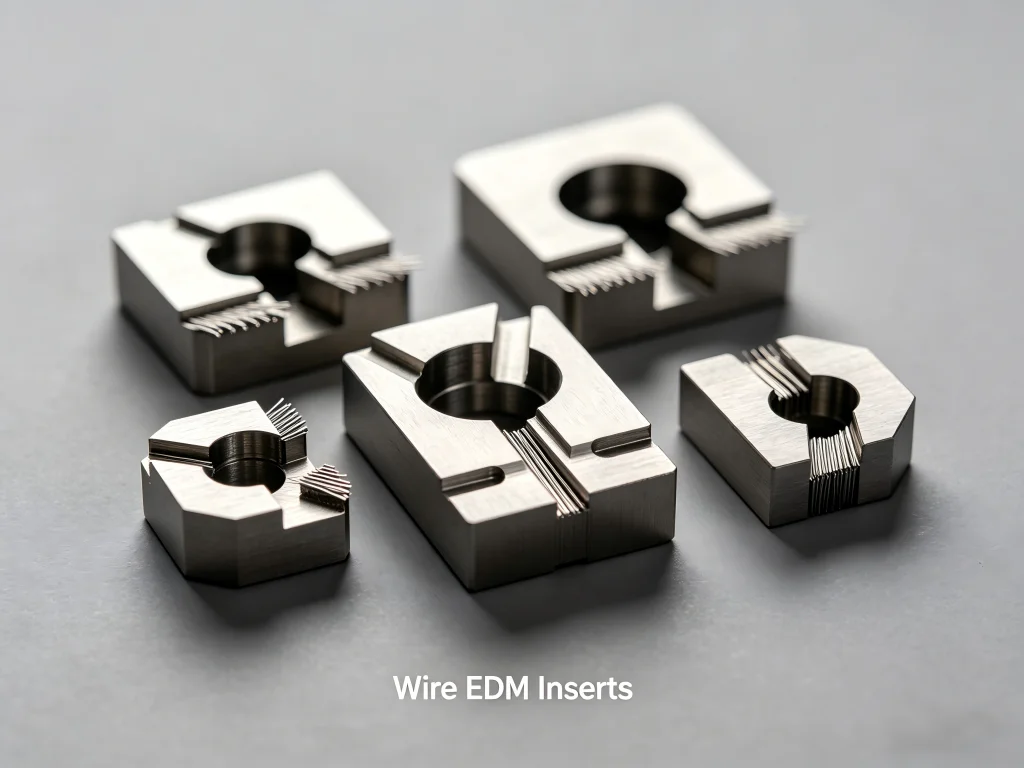
When discussing wire edm inserts, we are usually referring to highly precise, replaceable components used within the machine’s guide system, or custom-machined carbide and ceramic inserts produced via the EDM process to be used in other heavy-duty clamping tools. In the context of tooling, these inserts serve as the high-wear contact points that require perfect dimensional repeatability.
The Working Principle: How the Sparks Fly
The process may be broken down into a series of highly controlled steps that occur in micro-seconds:
- Voltage Application: The wire edm machine applies a voltage potential between the wire electrode and the conductive workpiece.
- Dielectric Breakdown: As the wire approaches the workpiece, the electric field overcomes the insulating properties of the deionized water. A channel of plasma forms between the electrode and the metal.
- The Spark and Erosion: A spark jumps across the gap, generating localized temperatures ranging from 8,000 to 12,000 degrees Celsius. This intense heat instantly melts and vaporizes a microscopic amount of material.
- Flushing: The dielectric fluid acts as a coolant and flushes the microscopic eroded particles (swarf) away from the gap, preventing short circuits.
- Continuous Feeding: To prevent the wire from breaking due to erosion, fresh wire is continuously fed from a supply spool to the take-up spool.
Comparing Wire EDM to Sinker EDM
It is important not to confuse this process with another common variant. While a continuous wire acts like a bandsaw in the wire process, a sinker edm uses a machined graphite or copper electrode shaped like the desired cavity. The electrode is slowly lowered or “sunk” into the workpiece to create blind cavities.
Both methods are incredibly precise, but wire machining is superior for through-features, complex extrusions, and tight slits, whereas the sinker method is indispensable for blind molds and complex 3D cavities.
Module 2: Core Application Scenarios Across Diverse Industries
Because this technology removes the barrier of material hardness, it has become a staple in several high-tech industries. Let us examine where these components and machines solve the most critical production challenges.
1. High-Precision Mold and Die Manufacturing
The tool and die industry was the earliest adopter of this technology and remains its biggest user. Stamping dies and injection molds must be made from hardened tool steels to withstand millions of production cycles. Machining these blocks after heat treatment is a massive challenge for traditional CNC mills.
By utilizing advanced wire machining, manufacturers could cut complex die profiles directly into hardened blocks with tolerances as tight as ±0.002 mm. This eliminates the need for post-machining heat treatment, which often causes part distortion. Wire edm inserts are heavily utilized in multi-cavity molds where identical, highly wear-resistant components must be swapped out quickly to maintain production uptime.
2. The Aerospace Industry: Conquering Superalloys
Aerospace components are subjected to extreme environments, requiring materials like Inconel, Hastelloy, and titanium. These materials are notorious for their poor machinability, rapidly dulling traditional cutting tools.
In jet engine manufacturing, this technology is used to cut the fir-tree slots in turbine disks that hold the turbine blades. The stress-free nature of the spark erosion process ensures that no micro-fractures are introduced into these critical components, vastly improving fatigue life.
3. Medical Device Fabrication
The medical sector demands extreme miniaturization and absolute biocompatibility. Surgical instruments and implantable devices often feature tiny, complex geometries made from surgical-grade stainless steel or titanium.
Traditional machining could leave burrs that are difficult to remove in micro-scale parts. Because electrical discharge machining is a non-contact process, it leaves a burr-free finish. Micro-machined wire edm inserts are used to create the clamping jaws of endoscopic surgical tools and the intricate channels in bone-growth matrices.
4. Custom Automotive and Racing Components
In high-performance automotive applications, weight reduction and strength are paramount. Custom gears, splines, and drive shafts are often made from ultra-hard alloys. Wire erosion allows custom race teams to prototype and produce low-volume, high-strength transmission components with perfect tooth profiles that would be cost-prohibitive to produce using traditional gear hobbing.
Module 3: Key Purchasing Factors for Wire EDM Consumables and Machinery
If you have determined that this process is the correct solution for your application, making the correct purchasing decision is critical. Whether you are sourcing a brand-new wire edm machine or looking for reliable wire edm inserts, several key factors must guide your procurement process.
1. Understanding the True Cost: Wire EDM Machine Price
One of the biggest hurdles for shops looking to adopt this technology is the initial capital expenditure. When researching the market, you will find that a brand-new wire edm machine price might range from $50,000 for a basic entry-level model to over $300,000 for a high-end, submersible, linear-motor-driven machine with auto-threading capabilities.
However, smart buyers must look beyond the sticker price and calculate the total cost of ownership (TCO) and return on investment (ROI). You should consider the following cost factors:
- Power Consumption: EDM machines run for hours, sometimes days, unattended. Energy-efficient generators can save thousands annually.
- Consumable Costs: High-quality brass wire, resin filters, and dielectric fluid can add up. Ensure your machine can use generic consumables if you want to lower running costs, or stick to premium OEM consumables for maximum accuracy.
- Maintenance and Downtime: A cheaper machine that breaks down frequently will cost more in the long run than a premium machine with 99% uptime.
2. Material Compatibility and Thickness
Before finalizing a purchase, audit the typical wire edm materials your shop processes. While any conductive material can be processed, different metals react differently to spark erosion.
- Carbide: Requires specialized anti-electrolysis power supplies to prevent cobalt leaching, which weakens the carbide structure.
- Titanium: Cuts beautifully but requires specific flushing pressures to prevent the buildup of recast layers.
- Aluminum: Highly conductive and cuts fast, but can foul up the dielectric fluid quickly.
Ensure the machine generator you select has pre-programmed tech files for the specific materials you intend to cut.
3. Positional Accuracy and Surface Finish Requirements
Not all machines are built the same. If your shop produces parts for the aerospace or semiconductor industries, you may need sub-micron accuracy. Look for machines utilizing linear shaft motors rather than traditional ball screws, as they offer frictionless movement and do not wear over time. Furthermore, multi-pass skim cutting capabilities are required if you need to achieve mirror-like surface finishes (Ra < 0.2 µm).
4. Machine Guides and Inserts Quality
The wire guide system is the heart of the machine’s accuracy. Sourcing high-quality diamond or ceramic wire edm inserts for your guide system ensures that the wire stays perfectly perpendicular to the worktable. Poorly made guides will allow the wire to vibrate, resulting in wavy surface finishes and poor dimensional control.
To help you visualize the decision-making process, we have compiled a comparison table evaluating traditional methods versus EDM variations:
| Feature/Capability | Traditional CNC Milling | Sinker EDM Process | Wire EDM Process |
|---|---|---|---|
| Material Hardness Limit | Limited by tool hardness (difficult above 50 HRC) | No limit, as long as it is electrically conductive | No limit, as long as it is electrically conductive |
| Cutting Forces | High (causes tool deflection and part deformation) | None (non-contact process) | None (non-contact process) |
| Geometrical Strengths | Excellent for bulk material removal and 3D surfacing | Unmatched for blind cavities and complex mold pockets | Perfect for through-cuts, tight slits, and conical tapers |
| Minimum Internal Radius | Determined by the radius of the smallest end mill | Determined by the machined electrode corner radius | Determined by the wire radius (as small as 0.02 mm) |
| Surface Finish Quality | Good, but may require manual polishing or grinding | Excellent, capable of achieving textured or polished finishes | Excellent, capable of achieving mirror-like finishes with skim passes |
| Setup and Cycle Times | Fast setup, fast cycle times for softer metals | Long setup (electrode fabrication required), slow cycle times | Moderate setup (no custom tooling needed), slow but automated cutting |
Module 4: Practical Guide to Installation, Operation, and Maintenance
Once your machine is on the floor and you have your premium consumables ready, maintaining peak operational efficiency requires strict adherence to best practices. Many manufacturing horror stories on social media stem from neglecting basic maintenance protocols.
The Importance of Machine Leveling and Environmental Control
Precision machining requires a stable environment. When installing your machine:
- Foundation: Ensure the concrete floor is thick enough to support the machine without flexing. Vibrations from nearby punch presses can ruin EDM surface finishes.
- Temperature Control: For ultra-high precision, the ambient temperature of the room should be controlled within ±1 degree Celsius. A change in room temperature will cause the machine casting and the workpiece to expand or contract, destroying micron-level tolerances.
Step-by-Step Guide to Daily Maintenance
To maximize the lifespan of your machine and your wire edm inserts, your operators should follow this daily checklist:
- Clean the Work Area: Remove all metal sludge and debris from the worktable and the tank seals.
- Check Deionized Water Conductivity: If the water conductivity is too high, the sparks will become uncontrolled, leading to poor surface finish or frequent wire breakage. Monitor the deionizing resin bottle and replace it when conductivity spikes.
- Inspect the Wire Guides: Inspect the upper and lower diamond guides for wear. If a groove has worn into the guide, the wire will not be held securely, resulting in poor accuracy.
- Check the Energizing Plates (Power Feeds): These plates transfer the electrical current to the wire. Over time, the wire wears a groove into these carbide or silver plates. Index or rotate the plates regularly to ensure a fresh, flat contact surface.
- Monitor Filter Pressure: The dielectric fluid must be perfectly clean. If the filter pressure gauges are in the red zone, replace the paper cartridge filters immediately to ensure proper flushing.
Troubleshooting Common Issues: Preventing Wire Breakage
One of the most common complaints among new operators on Facebook machining groups is constant wire breakage. If your wire is breaking frequently, check the following parameters:
- Flushing Pressure: If the upper or lower flushing nozzles are damaged or placed too far from the part, the eroded particles will not be cleared from the gap, causing a short circuit and snapping the wire.
- Wire Tension: If the tension is too high, mechanical stress will snap the wire. If it is too low, the wire will bow, destroying accuracy.
- Generator Settings: If you are trying to cut too fast, the peak current might be too high for the wire diameter you are using. Reduce the “on-time” or increase the “off-time” in the generator settings.
Module 6: Why Sourcing from jucheng Makes the Ultimate Difference
When navigating the complex world of CNC procurement, choosing the right partner is just as important as choosing the right technology. jucheng stands at the forefront of the precision manufacturing industry, offering unparalleled expertise and resources.
Here is why global manufacturers rely on the capabilities found at jccncmachining.com:
1. Absolute Mastery Over Difficult Materials
At jucheng, processing difficult metals is not a specialty; it is a daily standard. The engineers have developed proprietary tech files for optimized spark erosion in aerospace superalloys and advanced ceramics. This deep understanding of material science ensures that your parts are manufactured with the least amount of thermal stress and the highest structural integrity.
2. State-of-the-Art Machinery Fleet
A manufacturing facility is only as good as its equipment. The facility is equipped with the latest generation of submersible CNC units utilizing linear drive technology. This massive investment guarantees that every part produced meets the most stringent aerospace and medical tolerances reliably.
3. Vertically Integrated Manufacturing Solutions
One of the greatest advantages of partnering with this team is their comprehensive service offering. They do not just specialize in wire erosion. The facility boasts a complete lineup of 5-axis CNC machining centers, high-speed turning centers, and traditional sinker edm stations. This allows them to take a raw block of metal and perform bulk material removal via high-speed milling before performing the final, ultra-precise feature cuts via wire erosion. This single-source accountability saves customers massive amounts of time and logistical headaches.
4. Rigorous Quality Assurance and Traceability
In high-stakes industries, precision must be verified. The quality control department utilizes high-end coordinate measuring machines (CMM) and optical comparators to verify dimensions down to the micron. Full material traceability and inspection reports can be provided with every order, ensuring compliance with international aerospace and medical standards.
5. Unmatched Prototyping Speed and Scalability
Whether you need a single custom tool insert for a research project or a production run of ten thousand precision components, the team possesses the agility to handle both extremes. Their vast inventory of standard wire edm materials ensures that production can begin almost immediately upon drawing approval, drastically reducing your time-to-market.
Module 5: Frequently Asked Questions About Wire EDM Technology
To provide you with a comprehensive understanding, we have compiled and answered the most common questions from buyers and engineers.
Q1: Can wire EDM machine non-conductive materials like glass or ceramics?
Generally speaking, no. The entire principle relies on electrical current passing between the electrode and the workpiece. Therefore, the material must be electrically conductive. However, some advanced engineering ceramics can be doped with conductive elements to make them machinable via spark erosion. For purely non-conductive materials, ultrasonic machining or laser cutting are better alternatives.
Q2: How does the wire EDM machine price compare to high-speed 5-axis milling centers?
The pricing is quite comparable. A top-tier Japanese or Swiss 5-axis machining center may easily cost between $200,000 and $450,000. Premium wire erosion machines fall into a similar price bracket. While high-speed mills excel at rapid bulk material removal in softer metals, wire erosion machines provide unmatched precision and the ability to cut hardened alloys that would destroy milling cutters.
Q3: What is the typical surface finish achievable with this process?
The achievable surface finish depends heavily on the number of skim passes performed. A single roughing pass might yield a rough, matte finish around 2.5 to 3.0 µm Ra. However, by performing multiple, low-power skim passes with a high-end machine, operators could achieve highly polished finishes of less than 0.2 µm Ra, often eliminating the need for subsequent manual grinding or polishing.
Q4: Are there any hazardous byproducts associated with wire spark erosion?
The process is generally very clean and safe compared to traditional grinding, which creates hazardous airborne dust. However, the eroded metal particles (swarf) are suspended in the dielectric fluid. When cutting materials like cobalt-bound carbide or nickel alloys, proper disposal of the used paper filters and the concentrated sludge is mandatory according to local environmental regulations. Ensuring good ventilation around the machine is always a recommended best practice.
Q5: How thin can the wire be, and how does it affect the part geometry?
The standard wire diameter used in most industrial applications is 0.25 mm (0.010 inches). However, for micro-machining extreme details, machines may utilize wires as thin as 0.02 mm (0.0008 inches). Using a thinner wire allows for incredibly small internal corner radii but reduces cutting speed significantly and increases the risk of wire breakage. Engineers must carefully balance the need for ultra-fine radii with production economics.
Q6: Does the thermal nature of the spark create a heat-affected zone (HAZ)?
Yes, because the material is vaporized by intense heat, a microscopic recast layer or “white layer” forms on the surface of the cut. This layer is highly stressed and can be brittle. To mitigate this issue in critical aerospace components, modern machines utilize specialized AC power supplies and multi-pass skim cutting strategies to minimize the thickness of this recast layer to negligible, sub-micron levels.
Conclusion: Empowering Your Production Line Today
The challenges of modern manufacturing demand innovative solutions. You do not have to struggle with rapid tool wear, impossible geometries, and delayed delivery times when working with hardened alloys. By embracing the stress-free, sub-micron precision of electrical discharge machining, you could unlock design possibilities that will set your products apart in a highly competitive market.
Whether you need bulk production or highly specific custom components, settling for mediocre tooling is not an option. Do not let difficult materials dictate your design limits. Visit the official website of the experts at Jucheng CNC Machining to explore how their advanced manufacturing capabilities can solve your most complex engineering challenges. Reach out to their dedicated engineering team today to upload your CAD files and receive a detailed, comprehensive quote within 24 hours. Let us help you turn your most complex concepts into flawless, tangible realities.