
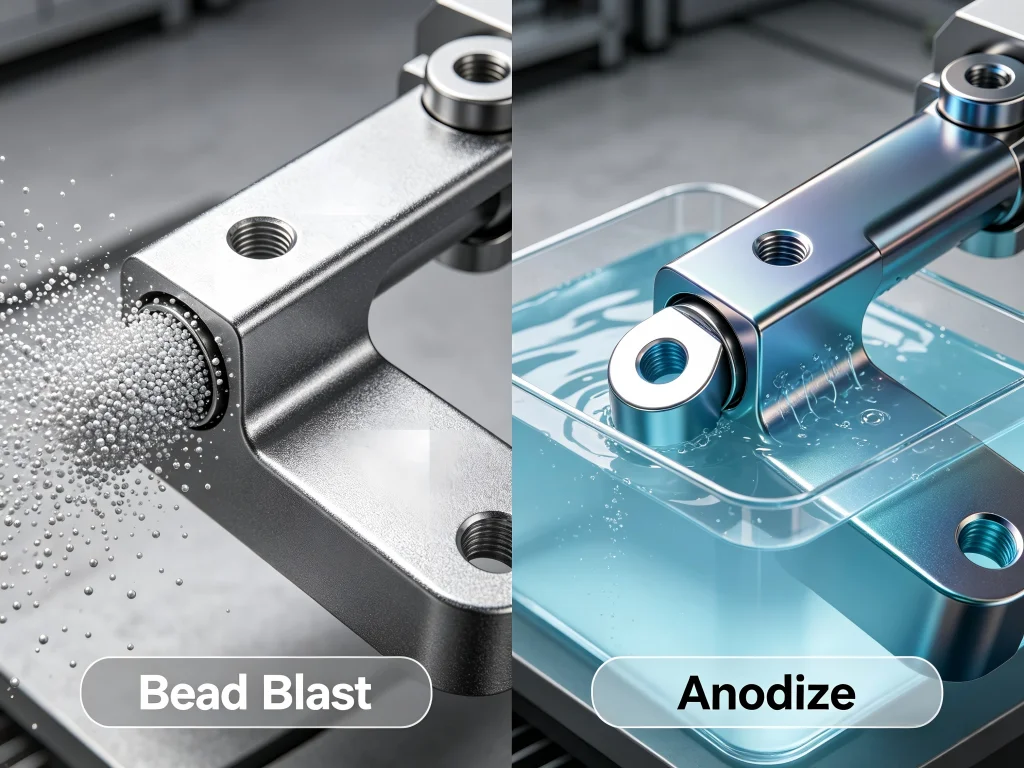
What Is a Clear Anodize Finish? — The Electrochemical Transparency
A clear anodize finish is an electrochemical conversion of aluminum’s surface into a transparent, porous oxide layer, typically 5 to 25 microns thick, that fully integrates with the base metal instead of sitting on top like paint. Unlike dyed or colored anodizing, no pigments are introduced into the pores after the anodizing bath. The resulting film appears silver or slightly gray, reflecting the natural hue of the aluminum alloy itself. The process occurs in a sulfuric acid electrolyte at controlled temperature (usually 18–22 °C), where the aluminum part acts as the anode, and direct current flows through it. Oxygen ions migrate to the surface, reacting with aluminum atoms to build a hexagonal-cell aluminum oxide (Al₂O₃) structure. Because the layer grows both inward and outward from the original surface, dimensional change is predictable — roughly half the total thickness adds to each side — a crucial point for precision CNC components.
A common point of confusion, noted repeatedly on r/manufacturing and practical machinist forums, is that “clear” does not mean “invisible.” The oxide itself is transparent, but the underlying metal’s microstructure and alloying elements influence the visual tone. Alloys high in copper (like 2024) produce a yellowish-brown tint, while pure aluminum or 6063 extrusions stay bright silver. This nuance trips up engineers who expect optical clarity but receive a slightly warm gray part. The seal step — immersion in hot deionized water or nickel acetate solution — closes the porous cells, preventing staining and corrosion entry, locking the clear appearance permanently. Without sealing, a clear anodized surface may soak up contaminants over time, gradually shifting tone or losing its dielectric properties.
Electrochemical Principle in Simple Steps
Breaking the mechanism into digestible stages helps when discussing quality control with suppliers:
- Pre-treatment: Degreasing, alkaline etching (for a matte, satin finish), and desmutting remove the natural oxide and surface impurities. At this stage, the final texture is determined — bright dip for a mirror-like clear anodized look, or mechanical brushing for a clear satin anodized finish.
- Anodizing: The racked part is submerged in sulfuric acid, current density typically between 1.0 and 1.5 A/dm², and time controls thickness. For a #17 clear anodized finish (17 microns), dwell might be 30–45 minutes depending on current efficiency.
- Rinsing: Critical to avoid acid carryover that could later leach out and stain the surface.
- Sealing: Hydration of the aluminum oxide in boiling water or mid-temperature sealant closes pores, ensuring the clear finish does not absorb fingerprints or humidity.
How Clear Anodize Codes Define Your Specification — #14, #17 and Beyond
When a print calls out “clear anodized finish code #17” or “#14 clear anodized finish,” the number refers to the coating thickness in microns under common proprietary labeling systems used by major aluminum extrusion and architectural hardware manufacturers. The codes are not formal ISO or MIL standards but have become widely adopted shorthand across North American supply chains. A #14 clear anodized finish denotes roughly 14 microns of oxide, suitable for interior architectural parts with low abrasion exposure. A #17 clear anodized finish offers 17 microns, typical for exterior window frames, curtain wall profiles, and components requiring a 10-year coastal durability guarantee. Heavier coatings like 25 microns (sometimes labeled Class I per MIL-A-8625 Type II) serve heavy industrial or marine settings, but may cause slight chalking or loss of surface detail on sharp CNC edges.
On a Reddit thread titled “Clear anodize spec #17 vs. MIL-A-8625 Type II Class 2,” a finishing engineer explained that many OEMs simply write “clear anodize per Kawneer standard” because the Kawneer clear anodized finish system has become a de facto reference for architectural aluminum. The Kawneer clear anodized finish uses a tightly controlled 17-micron layer with a mid-temperature nickel seal, yielding the uniform silver-white look expected on high-rise mullions. Satin variations — a clear satin anodized finish — are achieved through upstream mechanical etching or bead blasting, not coating chemistry changes. If your application involves consumer-facing surfaces, code choice directly impacts fingerprint resistance, color consistency across batches, and even the cyclic fog corrosion test results.
| Code / Standard | Typical Thickness (microns) | Best Suited Environment | Seal Type | Visual Result on 6063-T5 |
|---|---|---|---|---|
| #14 Clear Anodized Finish | 12–15 | Interior architectural, electronics enclosures | Hot water or nickel acetate | Bright silver with fine grain |
| #17 Clear Anodized Finish (Kawneer-type) | 17–20 | Exterior windows, curtain walls, automotive trim | Mid-temperature nickel seal | Uniform satin silver, low iridescence |
| MIL-A-8625 Type II Class 1 (Clear) | 5–25 (user-specified) | Military, aerospace, optoelectronics | Dichromate or nickel acetate | Varies with alloy; often slight yellow on 2024 |
| Class I (25 microns / 1 mil) | 23–28 | Marine, heavy industrial, offshore | Nickel acetate mandatory | Matte, may show slight texture |
When transitioning from prototype CNC runs to production, always lock the anodizing code in the purchase order, not just the term “clear.” A Facebook group poll among product designers revealed that nearly 40% of finish rejections stemmed from mismatched expectations on anodize thickness and resulting color shift on aluminum clear anodized finish parts made of 6061 versus 6063. Consistent specification eliminates that risk.
Where Clear Anodized Finish Aluminum Delivers Value — Core Applications
Clear anodized finish aluminum spans industries where metallic aesthetics, corrosion resistance, and electrical isolation must coexist. The coating’s hardness (around 150–400 HV depending on alloy and thickness, often surpassing raw aluminum by an order of magnitude) makes it a go-to for high-touch, high-visibility components. Its dielectric breakdown voltage, typically 30–50 V/µm, protects electronics from short circuits. Here are the domains where specifying aluminum clear anodized finish makes both engineering and economic sense.
Architectural Fenestration and Curtain Walls
The Kawneer clear anodized finish remains the benchmark for extruded aluminum windows, storefronts, and structural glazing. In coastal cities like Miami or Vancouver, architects demand #17 clear anodized finish with a nickel acetate seal to withstand salt spray without turning chalky white. The uniform silver appearance maintains brand identity across large façade surfaces. A case study from a Houston commercial tower documented that properly specified clear anodized mullions showed less than 0.1 mm cosmetic corrosion after 12 years of hurricane-season exposure, whereas polyester powder coat on adjacent panels had micro-cracks at edges. The key is specifying the right alloy — 6063-T5 or 6063-T6 — to ensure a bright, non-streaky clear finish free from “tiger stripes” caused by uneven extrusion quenching.
Medical Device Housings and Surgical Instruments
Surgical trays, scanner housings, and dental handpiece bodies often rely on clear anodized finish aluminum code specified to MIL-A-8625 Type II Class 1 because the coating provides repeated autoclave sterilization resistance without peeling. A biomedical engineer on r/MedicalDevices shared that switching from electroless nickel plating to clear anodizing eliminated nickel ion leaching risks for a hand-held diagnostic device, while maintaining the required matte silver look. Because the oxide is chemically inert and does not off-gas, it suits cleanroom environments. Here, the clear anodised finish must be free from cobalt or heavy metal sealants if ISO 10993 biocompatibility is on the table; hot water sealing suffices for tissue contact.
Consumer Electronics and Precision Housings
Laptop unibody shells, audio amplifier faceplates, and camera gimbals often sport a clear satin anodized finish to hide fingerprints while retaining a high-end metal feel. Apple’s familiar silver MacBook chassis is a clear anodized 6000-series aluminum with micron-level process controls to avoid “galaxy” speckling. CNC-machined aluminum parts from boutique audio brands then go directly to clear anodizing after vibratory deburr to achieve a consistent matte grain. Discussions on the Facebook group “CNC Machining & Finishing” highlighted that even a 0.5°C temperature drift in the anodizing tank can shift the final tone from cool silver to warm champagne on 6061 parts, enough to fail a visual match audit.
Automotive Exterior Trim and EV Battery Components
Roof rails, window surrounds, and Tesla’s early Model S brightwork all used clear anodized extrusions for weight savings over stainless steel. In electric vehicle battery enclosures, clear anodized cooling plates and bus bar separators exploit the oxide’s electrical insulation (withstanding 500–1000 V DC with appropriate thickness) while radiating heat. An engineer on a Facebook EV conversion group reported 18% better thermal emissivity on a clear anodized aluminum heat sink compared to bare 6061, a valuable gain in passive-cooled power electronics.
Choosing the Right Clear Anodized Finish — Critical Purchasing Factors
Procurement and engineering teams who treat clear anodizing as a generic “one-spec-fits-all” finish often end up with color mismatch, chipping at sharp edges, or premature pitting in outdoor service. Selecting a supplier and process requires evaluating five interlinked criteria — each backed by data rather than guesswork.
1. Alloy Chemistry and Temper
Not all aluminum clears equally. Wrought 6061-T6, the darling of CNC machining, yields a warm gray-tinted clear anodized finish because its magnesium and silicon content reacts slightly during anodizing. 6063, formulated for extrusion and anodizing, remains bright and cool-toned. 5052, with its higher magnesium, anodizes with a soft silvery matte look but may develop a yellowish hue if improperly desmutted. 7075, rich in zinc and copper, often results in an olive-brown clear anodised finish that only looks acceptable when a dark industrial tone is desired. Before ordering, always request a sample plaque anodized on the specific alloy lot to confirm the visual target. Real-world Reddit advice: “If you want a true silver clear anodize on CNC parts, stick to 6063 or 6463 and avoid copper-bearing alloys.”
2. Surface Preparation and Texture
The same clear anodizing chemistry can produce a mirror-bright finish or a matte satin one, entirely dictated by the pre-treatment. Alkaline etching (15–30 g/L sodium hydroxide at 50–60°C, 5–15 minutes) imparts a uniform frosted base, creating the clear satin anodized finish popular in architectural hardware. Acid bright dip (phosphoric-nitric mixture) yields a high-luster clear finish used on decorative automotive trim. Mechanical brushing or glass bead blasting before anodizing adds a directional grain beloved by luxury consumer goods. As a buyer, you must specify not just “clear anodize” but “clear anodized finish aluminum — etched matte” or “#17 clear anodized finish over polished surface” to lock the aesthetic. Skipping this step may lead to glossy parts when a satin was wanted, a mismatch often noted in Facebook finish spec discussions.
3. Thickness and Sealing Quality
Exterior parts demand minimum 15 microns, ideally 17–20 microns, with an accelerated seal quality test per ASTM B680 (dye stain test) or ISO 3210. A proper nickel acetate seal should yield no dye adsorption after 5 minutes. For electronics, you might accept thinner 5–10 micron films to maintain heat dissipation, but then the wear resistance drops. Procurement officers at medical OEMs often impose a 1000-hour neutral salt spray requirement (ASTM B117) for clear anodized aluminum parts; only heavy sealed coatings (20+ microns) pass this without pitting. Always ask your supplier for their seal quality certification — hot water sealing is cheap but less robust than mid-temperature nickel seal, which provides a harder, smut-free surface on aluminum clear anodized finish.
4. Dimensional Control for CNC Components
Anodizing adds material outward and consumes a few microns of base metal. For tight-tolerance bores (H7 fit), the growth of a 17-micron coating (roughly 8–10 microns per side) could either interfere with mating parts or be completely masked. Skilled CNC shops apply maskant or oversize machining allowance to accommodate the anodize buildup. When sourcing complex parts, your supplier must have a track record of integrating machining and anodizing under one quality system; otherwise, the finger-pointing between the machine shop and the anodizer leaves you holding a pile of out-of-spec parts. Jucheng, for instance, manages both stages in-house, applying controlled growth compensation on precision medical and aerospace components.
5. Lead Time and Batch Consistency
A common pain point aired in online manufacturing forums is the unpredictable lead time of outsourced anodizing — racks get delayed, color drifts between batches, and rework eats weeks. Batch consistency demands calibrated anodizing lines running the same current density, tank chemistry, and temperature profile every single shift. One large architectural fabricator gave a talk at Aluminum USA emphasizing that even different racking positions within the tank can cause 2–3 micron thickness variation, altering the visual sheen on a clear anodized finish code. Vetting a supplier’s racking strategy and whether they dedicate tanks to clear anodizing (no dye cross-contamination) is a practical step that saves grief.
Installation and Maintenance of Clear Anodized Surfaces
Once the aluminum clear anodized finish arrives on site, preserving its integrity requires material-handling discipline and correct cleaning chemistry. Unlike paint, you cannot simply buff out scratches; the oxide is integral with the metal.
Handling and Assembly Precautions
Unpack clear anodized extrusions with clean, dry gloves to prevent sweat-induced etching. When driving screws, use nylon-tipped contact points or protective film; bare steel tools may gall the coating. For field-cut ends on architectural profiles, apply a clear cold anodizing touch-up pen (often organic-inorganic hybrid sealers) to protect raw aluminum at cut edges — a practice required by Kawneer’s installation manual for warranty compliance.
Cleaning Do’s and Don’ts
The #1 maintenance error, often mentioned on r/HomeImprovement, is using alkaline masonry cleaner or strong detergents on anodized window frames. High pH dissolves aluminum oxide, turning a clear finish cloudy white. The recommended regimen:
- Use pH-neutral (6–8) mild soap and water, applied with a soft microfiber cloth.
- For urban grime, a diluted isopropyl alcohol (max 30%) solution may help lift hydrocarbon deposits without attacking the seal.
- Never use steel wool, abrasive pads, or acid-based wheel cleaners — they scratch and etch the coating.
- Rinse thoroughly with clean water to avoid spotting from evaporated dissolved salts.
Long-Term Outdoor Performance
A sealed clear anodized finish will naturally develop a slight “patina” over decades, a subtle shift from bright silver to a softer grey, without losing protective properties. A 25-year study on Florida exposure of #17 clear anodized 6063 coupons showed less than 0.5-micron erosion of the coating, with only minimal chalking. Minor surface stains from mineral deposits can be cleaned with a mild white vinegar dilution (1:4 with water), but always test a hidden area first. Routine inspection of sealants and gaskets at joints prevents moisture trapped behind the profile, which could cause filiform corrosion snaking under the anodized layer.
Frequently Asked Questions About Clear Anodize Finish
- What is the difference between clear anodize and silver powder coating?
- Clear anodize is a transparent oxide grown from the aluminum itself, retaining metallic depth and heat dissipation. Silver powder coat is a pigmented plastic film applied electrostatically. Anodizing won’t peel or chip like paint, but offers fewer color options. For heat sinks, clear anodize is preferred; for UV stability at lower cost, powder coating may be suitable.
- Does clear anodized aluminum turn yellow over time?
- On certain alloys, yes. 6061 often develops a warm champagne tone due to magnesium-silicon intermetallics, while 7075 turns brownish-yellow. 6063 stays silver. A high-quality nickel seal minimizes UV-driven yellowing, but cannot entirely eliminate it on copper-rich alloys. Specifying 6063 or 1100 alloy is the only way to guarantee long-term silver-white appearance.
- Can I re-anodize a part that already has a clear anodized finish?
- Yes, but stripping the old oxide in a chromic-phosphoric acid solution or alkaline etch will remove some base aluminum, altering dimensions. Re-anodizing multiple times can degrade sharp edges and thread fit. Usually, a single rework is acceptable for cosmetic reasons, but critical tolerances should be verified post-strip.
- What does the Kawneer clear anodized finish specification actually mean?
- It refers to Kawneer’s architectural aluminum extrusion anodizing standard, typically 17 microns (AA-M12C22A31). This standard also mandates specific cleaning and sealing practices to ensure consistent color and corrosion resistance across projects. When designers note “Kawneer clear anodized finish” on drawings, they’re invoking that standard’s quality benchmarks.
- Is clear anodized finish conductive?
- No, aluminum oxide is an electrical insulator. Dielectric strength ranges from 30–50 V/µm, so a 17-micron coating can withstand roughly 500–850 V before breakdown. For electronics enclosures requiring grounding, masking or threaded inserts to pierce the anodizing are necessary to establish electrical bonding.
- How do I specify a clear satin anodized finish instead of glossy?
- State “clear satin anodized finish” and detail the pre-treatment method: typically alkaline etch dip before anodizing. Alternatively, specify a blast profile (e.g., 100-grit glass bead at 40 psi) before anodizing. This avoids the bright dip process that yields a high-gloss surface. Including a reference sample or digital image in the contract encourages first-pass yield.
- What is a clear anodized finish code I should use for marine environments?
- Use a 25-micron coating (Class I or equivalent) with a nickel acetate seal per MIL-A-8625. For architectural marine applications, the #17 Kawneer-type finish with a mid-temperature nickel seal has proven effective for decades, but some clients upgrade to 25 microns if salt spray exposure is direct. Avoid hot water seals alone, as they may be less durable in aggressive chloride environments.
Why Leading Engineers Trust Jucheng for Precision Clear Anodized Parts
When complex CNC-machined components must carry a flawless clear anodize finish, the difference between an average supplier and Jucheng becomes visible in first-article inspection reports. Jucheng’s integrated model — multi-axis milling, turning, wire EDM, and anodizing under one roof — removes the logistical gaps that cause mismatched specs and delays. By controlling the entire chain from incoming 6061/6063 bar stock through ultrapure rinses, the team ensures each part’s anodize thickness matches engineering claims, not just a nominal code.
Technical competence tracked in data: Jucheng operates calibrated rectifiers with <0.5% ripple, chilled tank circulation maintaining ±1°C, and automatic time-current controllers that guarantee ±2-micron thickness uniformity across complex geometries. This precision explains why a medical robotics client witnessed a 60% reduction in color-match rejects after switching from a fragmented supply chain to Jucheng’s all-in-one service. For a drone manufacturer needing a clear satin anodized finish on 7075 gimbal housings, Jucheng’s process engineers developed a tailored desmut step and dual-etch pretreatment that yielded a consistent, non-staining matte silver tone the previous supplier couldn’t replicate.
Certifications and capacity that de-risk orders: Jucheng’s anodizing line adheres to ISO 9001:2015 certified quality management, with full traceability from material certs to final seal quality testing. Fast-turn 5-axis CNC prototypes with a #14 clear anodized finish can ship in as few as 7 business days, while production volumes scale to thousands of units without color drift. In-house CMM inspection verifies that post-anodize dimensions still hold the ±0.01 mm tolerances expected in aerospace fittings.
Real-world partnership, not transaction: Customers consistently mention on LinkedIn and supplier review platforms that Jucheng’s application engineers proactively suggest alloy alternatives (e.g., 6463 for an ultra-bright clear look) or adjustment of etching time to match a legacy part’s appearance. This preemptive communication, combined with transparent packaging and shipping documentation, reduces inbound QC rejections to near zero — a tangible improvement for any OEM.
Whether your product demands a Kawneer clear anodized finish equivalent for architectural extrusions, a military-spec clear anodized aluminum finish code on avionics brackets, or a fine satin finish on consumer drone parts, Jucheng’s depth of CNC expertise and finishing science turns your specification into a reliable, repeatable outcome. View detailed case studies and material capability charts at Jucheng CNC Machining Services and explore the surface finishing portfolio here.
Take the Next Step in Your Aluminum Finish Specification
Selecting a clear anodize finish need not be a gamble. With a firm grasp of alloy effects, specification codes, and supplier qualifications, you can lock in a production-ready finish that endures years of service. Share your part drawing at Jucheng’s contact page to receive a technical proposal including anodizing recommendations, thickness mapping, and lead time projections tailored to your volume. For further independent insights, explore the Aluminum Anodizers Council’s technical library here and the MIL-DTL-5541 standard overview here.