
When you source CNC machined components, the final touch matters. It is not just about making the part look better; it is about ensuring it performs under real-world conditions. Whether browsing forums like r/CNC or r/Machinists on Reddit, one question comes up repeatedly: “How do I pick the right surface treatment for metal parts without blowing my budget or missing tolerances?” This guide exists to answer that.
The engineering behind a surface finish could determine whether your assembly resists rust in a marine environment or fails during a salt spray test. With so many options available, confusion is common. This article will explore the most reliable methods—such as anodizing, powder coating, plating, and passivation—and help you evaluate suppliers like Jucheng against industry standards. We aim to provide a transparent, decision-focused framework.
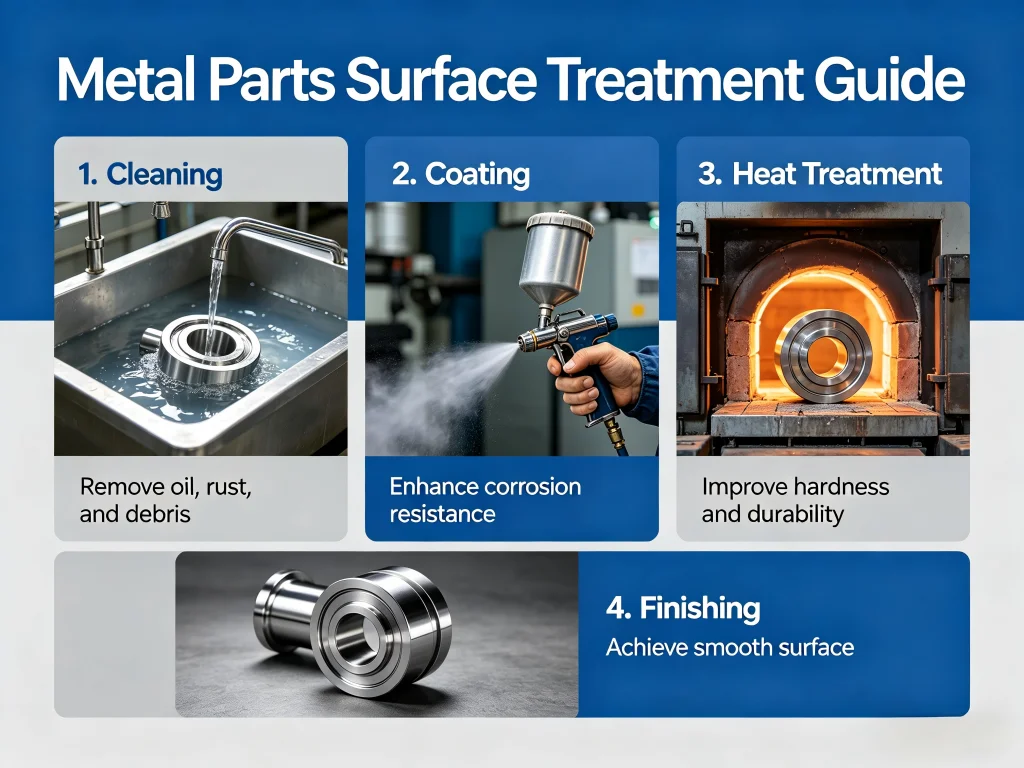
1. Why a Simple “As-Machined” Surface Often Isn’t Enough
A freshly machined metal part might have microscopic peaks and valleys left by the cutting tool. This rough texture, often measured in Ra (average roughness) values, can be a starting point for corrosion or fatigue. Many engineers discover too late that a legacy steel component requires a surface treatment process for steel to survive outdoor conditions. On platforms like Facebook groups dedicated to metalworking, professionals share stories of products that failed because the finish did not match the environment.
The core value of a coating or conversion layer is to modify the outermost surface of the substrate. You could enhance corrosion resistance, increase surface hardness, improve electrical conductivity, or meet strict FDA hygiene rules. However, every process has trade-offs in thickness, cost, and lead time. Understanding these trade-offs upfront separates a successful project from a costly reorder.
2. Comparing the Most Common Surface Treatment Options
To help you make a clear decision, we have put together a comparison table based on actual material compatibility and performance data. This table highlights factors that might influence your choice: mechanical durability, aesthetic finish, and tolerance impact. A frequent point of confusion is whether to use anodizing or powder coating for an aluminum housing. The table below clarifies the distinction.
Data sources include supplier capability sheets and discussions on r/manufacturing.
| Treatment Type | Typical Substrates | Key Benefit | Dimensional Change | Salt Spray Resistance (ASTM B117) | Relative Cost |
| :— | :— | :— | :— | :— | :— |
| Anodizing (Type II/III) | Aluminum, Titanium | Hardens surface, dyeable | Low (5–25 µm) | Excellent (500+ hrs) | Medium |
| Powder Coating | Steel, Aluminum | Thick protection, color options | High (50–150 µm) | Good (300–500 hrs) | Medium |
| Electroless Nickel Plating | Steel, Copper, Brass | Uniform thickness, wear resistance | Moderate (10–50 µm) | Very Good (200–400 hrs) | Medium-High |
| Passivation | Stainless Steel | Removes iron, prevents rust | Negligible | N/A (prevents oxidation) | Low |
| Zinc Plating (with trivalent chrome) | Carbon Steel | Sacrificial corrosion protection | Moderate (5–15 µm) | Good (120–200 hrs) | Low |
| Black Oxide | Steel | Anti-glare, oil retention | Negligible | Low (requires oil) | Low |
Let’s examine these processes in greater detail. Anodizing turns the aluminum surface into a hard, porous oxide layer that can be sealed or colored; in contrast, powder coating applies a polymer-based paint layer that cures under heat. When you need to treat a stainless steel medical tool, passivation chemically removes free iron particles. Meanwhile, for a steel bracket that lives near saltwater, a multi-layer paint or zinc plating with a clear topcoat might be the safest bet.
2.1 Anodizing vs. Powder Coating: The Eternal Debate
On Reddit, users often ask which finish holds up better on outdoor gear. Anodizing (especially hard coat) bonds with the metal itself and does not chip like paint. However, powder coating provides a thicker barrier against physical abrasion and is much easier to match to a specific brand color. If your part requires tight tolerances (like a valve body), anodizing might be the better fit because it adds minimal thickness. For heavy machinery panels, powder coating could offer better impact resistance.
2.2 Plating Options for Steel and Copper
The surface treatment for copper often involves electroless nickel plating because it prevents tarnishing and provides a hard, even layer without a heavy build-up on complex geometry. For steel components, zinc plating is a cost-effective way to resist red rust, but it might not look as premium as nickel-chrome plating. Black oxide works well for firearms and automotive fasteners where a low-profile, glare-free finish is needed, but it offers minimal corrosion resistance unless sealed with oil or wax.
3. Critical Factors for Selecting a Surface Finish Provider
Before sending your RFQ, you should assess potential vendors on five key parameters. Even if a supplier lists many surface treatment options, you need to dig deeper. Most quality issues arise not from a lack of equipment, but from poor quality control and inconsistent masking.
- Material Compatibility: Not every finish adheres to every alloy. High-silicon aluminum, for instance, might yield a dark discoloration under anodizing. Always verify the provider’s compatibility matrix. Jucheng’s online guide explicitly maps which materials work with anodizing, passivation, or plating, which eliminates guesswork.
- Quality Assurance Protocols: What instruments does the shop use? Professional facilities employ X-ray fluorescence for thickness, cross-cut tape tests (ASTM D3359) for adhesion, and salt spray chambers to confirm corrosion resistance. Without these verification steps, a coating that looks good today could delaminate next month.
- Geometric Constraints: Small holes, deep cavities, or sharp corners may trap chemical residues or fail to receive full coverage. Electroless nickel plating is known for its uniform deposition in bores, whereas electroplating might leave thinner layers in recesses.
- Cosmetic Grading: Discuss the required surface grade upfront. Jucheng grades surfaces into Class A (display-quality visual), Class B, and Class C (functional only). A price quote based on Class C standards will be vastly different from a quote for a flawless cosmetic finish.
- Environmental and Trade Compliance: For exporting to the EU or US, finishes must be RoHS and REACH compliant. Some legacy chromate conversion coatings (hexavalent chromium) are heavily restricted. Reliable vendors will provide certificates of conformance.
4. How to Interpret Surface Roughness Requirements (Ra Values)
In CNC machining, surface roughness is commonly defined by Ra (average roughness). The international standards ISO 1302 and ASME Y14.36 define how to denote these symbols on engineering drawings. According to industry benchmarks, standard machined parts usually fall between Ra 3.2 µm (visible tool marks) and Ra 1.6 µm (smooth). For sealing surfaces or bearings, Ra 0.8 µm or lower might be required.
However, be cautious: certain treatments like sandblasting or powder coating will round up the peaks and could change the functional roughness. If your print calls for a precise Ra 0.4 µm, a thick powder coat will likely bury that finish. In that scenario, you might choose anodizing or electropolishing, which preserves the underlying smoothness. This nuance is often debated in technical forums, where engineers share tips on specifying “critical” surfaces that must be masked prior to coating.
5. Industry-Specific Guidelines for Steel and Aluminum
Different industries have established best practices. Understanding these could save you from over-engineering or under-protecting a part.
- Aerospace: Hard anodizing per MIL-A-8625 and chemical conversion coating (Alodine) are common for flight-grade aluminum. Salt spray resistance exceeding 336 hours is typical.
- Medical Devices: Passivated stainless steel is the gold standard. Electropolishing may follow to achieve a mirror finish that is easy to sterilize and resists bacterial adhesion.
- Automotive: You will find zinc-flake coatings on chassis bolts and black oxide on interior mechanisms. Chrome plating remains popular for exterior trim, though hexavalent chrome is increasingly phased out.
- Consumer Electronics: Thin, decorative finishes like bead-blasted and anodized aluminum bodies. Surface treatment for plastics is also common here, including painting and EMI/RFI shielding metallization.
When working with steel, decide if you need surface treatment process for steel that adds a conductive layer (plating) or a non-conductive one (paint). For structural elements, a conversion coating like manganese phosphate might offer both oil retention and friction reduction.
6. Why Choose Jucheng for Your Surface Finishing Needs
Jucheng operates as a one-stop manufacturing hub, integrating CNC machining with in-house and certified partner finishing services. Their advantage is rooted in controlling the entire workflow, from raw material to final inspection, which minimizes handling damage and reduces logistical delays. Here is what sets them apart:
- Transparent Material-Finish Matching: Jucheng provides a clear compatibility chart indicating recommended finishes for aluminum, stainless steel, carbon steel, brass, copper, titanium, and plastics. This eliminates the risk of selecting a non-adherent process.
- Strict Quality Assurance (QA) Protocols: The company employs X-Rite spectrophotometers for color consistency, eddy-current gauges for coating thickness (ensuring 25 µm for hard anodize), cross-cut adhesion tests per ASTM D3359, and salt spray validation per ASTM B117.
- Complex Masking Capabilities: Some parts require dual finishes (e.g., anodized outer surface with a conductive masked grounding pad). Jucheng specializes in precise masking to isolate specific features.
- Global Compliance: All finishing processes are RoHS and REACH compliant, ensuring no legal obstacles when exporting to Europe or North America.
- Cosmetic Grading: Instead of a vague “good finish,” Jucheng categorizes surfaces into Class A (Visual), Class B, and Class C, applying inspection criteria appropriate to your project’s needs.
Community feedback on manufacturing forums highlights that consistent communication and clear DFM (Design for Manufacturing) notes reduce the risk of finish-related delays. Jucheng provides a detailed DFM review within 24 hours, which aligns with the needs of fast-paced prototyping and full-scale production.
7. Common Questions About Surface Treatments (FAQ)
The following questions are derived from recurring topics on LinkedIn groups, Reddit discussions, and query logs for terms like surface treatment examples and what is surface treatment of metals.
1. What is surface treatment of metals, exactly?
Surface treatment refers to any process that alters the top layer of a metal part to improve corrosion resistance, wear properties, aesthetics, or adhesion. This includes applying a coating (paint, plating), chemically converting the surface (anodizing, black oxide), or removing contaminants (passivation).
2. Which surface treatment provides the best corrosion resistance?
For aluminum, hard anodizing or powder coating (with proper pretreatment) offers excellent protection. For steel, electroless nickel plating and zinc plating with trivalent passivation rank highly. Stainless steel relies on passivation to restore its native chromium oxide layer. The best choice depends on the environment (marine, industrial, indoor).
3. Can I apply a surface treatment to plastic parts?
Yes. Surface treatment for plastics includes spray painting, vapor smoothing, dyeing, and metallization (EMI shielding). However, traditional electroplating does not work on plastic without an electroless deposition strike layer.
4. How does passivation improve stainless steel?
Passivation uses a chemical bath (nitric or citric acid) to dissolve free iron and surface contaminants from stainless steel. This allows a uniform chromium oxide layer to form, which prevents red rust and improves the material’s inherent corrosion resistance.
5. What are the typical surface treatment examples for high-wear applications?
Hard chrome plating, electroless nickel (heat-treated), and hard anodizing (Type III) are common examples for hydraulic rods, gears, and valve spools. Chemi-thermal treatments like nitriding or carburizing are also effective but change the metallurgy, not just the surface coating.
6. How do I specify a surface treatment on a technical drawing?
Use ISO 1302 or ASME Y14.36 symbols to indicate the required finish. Note the roughness (Ra), treatment type (e.g., Anodize per MIL-A-8625 Type II), and any “mask” areas. It is also wise to include a general note like “Matte black powder coating, 50–80 µm thickness, ASTM B117 500 hr minimum.”
7. Can I combine multiple surface finishes on a single part?
Yes, often through masking. For example, an aluminum block could be fully anodized, but certain grounding pads are masked off to remain conductive. Alternatively, a steel bracket could be zinc plated over most surfaces, with a selected rail masked for welding later.
8. Making the Final Decision: A Step-by-Step Checklist
Choosing the optimal finish does not have to be guesswork. Follow this decision framework to narrow down the options.
- Define the operating environment: Indoor/outdoor, salt water, chemical exposure, UV stability.
- Identify functional needs: Corrosion resistance, wear hardness, electrical properties, or FDA certification.
- Analyze substrate material: Aluminum, steel, stainless steel, copper, or plastic. Refer to supplier compatibility charts.
- Check tolerance requirements: Will a 0.002-inch coating cause fit issues? Choose anodizing or thin-film coatings if tolerances are tight.
- Set cosmetic standards: Is this a Class A visible surface or a hidden functional surface? Communicate this to your vendor.
- Request test certifications: Ask for salt spray reports, adhesion test videos, and thickness measurements from past batches.
A partner like Jucheng simplifies this process by offering DFM feedback that flags potential masking issues or material compatibility problems before production begins. This approach reduces costly engineering changes later.
Ready to Finalize Your Surface Treatment Specification?
Stop guessing which finish will hold up in the field. Upload your CAD file or share your technical requirements, and the engineering team will provide a detailed finishing proposal and DFM analysis—including masking strategies, recommended finish layers, and certified test reports.
Get a Quote From Jucheng Within 24 Hours.
Just attach your 2D or 3D file, and receive a compliance check plus finishing recommendations.